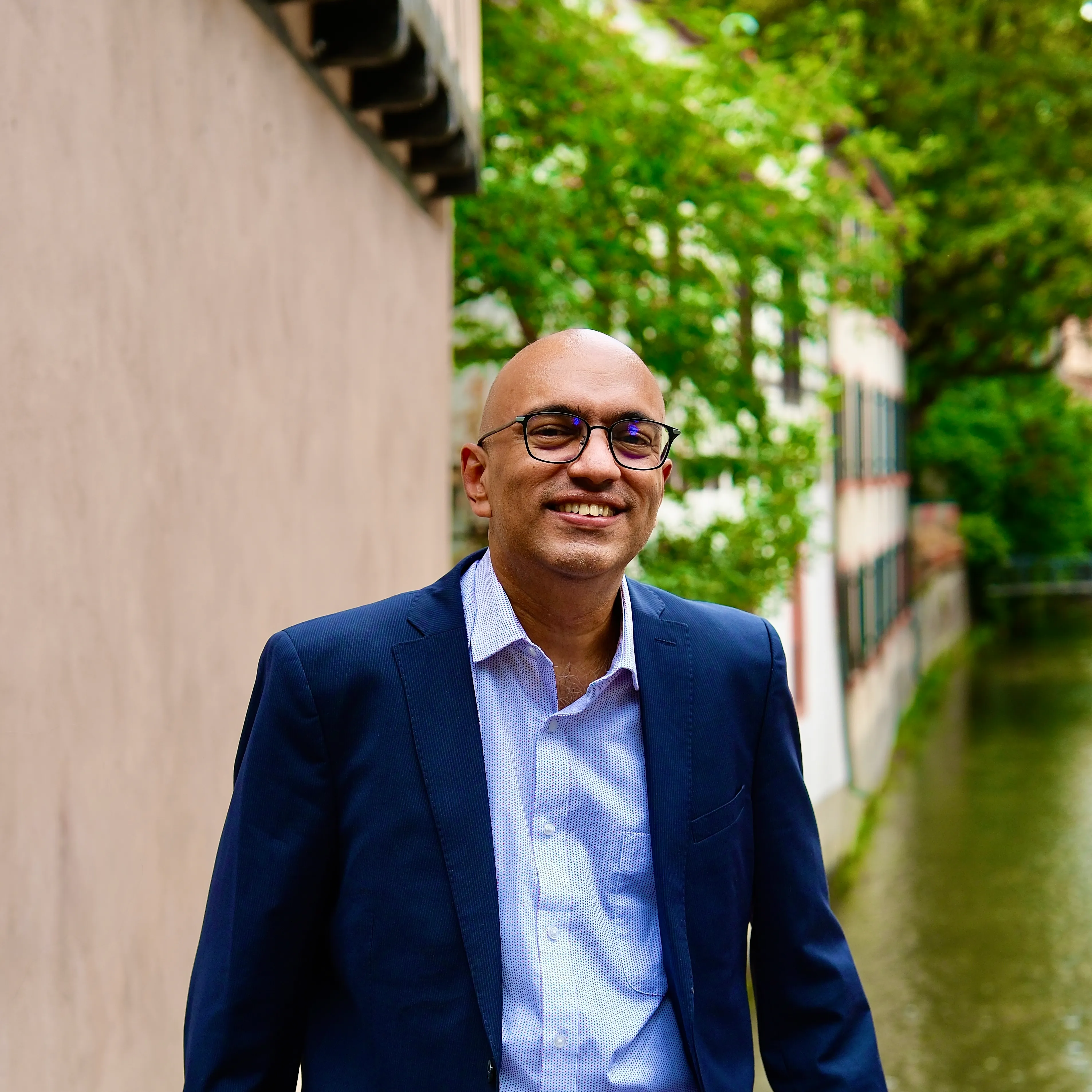
 Photo by Tani Photto
 Pramod Prasanth
I spent 25 years learning why enterprise decisions fail. Now I am building the infrastructure to fix them.
I chose my own name at age four. Took my father's first name as a surname to avoid caste markers.
I grew up moving across India. Kerala, Orissa, Punjab. You learn early that systems have rules, and that context changes how people follow them.
After twenty-five years across supply chains, health systems, and enterprise operations, I am building ChainAlign: infrastructure for organisational judgment.
The problem
Every enterprise has infrastructure for data, analytics, and execution. Nobody has infrastructure for the judgment that connects them. The missing layer is not another copilot or dashboard. It is a system that instruments the decision itself. This is what I am building.
A pattern, not a career
I have been building at the frontier of what is possible in my context since 1995, when I wrote a Windows application in a country still running DOS.
In 2007, I designed and implemented one of the world's earliest serialisation-based supply chain systems at Syngenta: a full track-and-trace architecture creating a digital twin of the product from manufacturing line to farmer, deployed across Germany, Vietnam, India, and Brazil. The same backend powered an anticounterfeiting programme that detected where products were being counterfeited in near-real time rather than months later, and a customer loyalty programme that mapped purchasing patterns across regions. I later created variants of this architecture at other firms for automated batch declarations, warehouse automation, and regulatory compliance.
I designed the Tatmeen system for the UAE Ministry of Health: responding to the RFP, designing the solution architecture, identifying the technical vendor to build it. National-scale health infrastructure from a blank page.
I co-founded Cloudfeet AG to give mom-and-pop retailers in developing markets the same decision capability as Amazon or Tesco, connecting them directly with manufacturers. I bootstrapped it and ran out of cash. The problem has not gone away.
That is the pattern. I see what is needed before the tools or the market exist for it. I design it, I get it built, and then I move on to the next problem. With ChainAlign, I am breaking the last part of that pattern. This time, I am building it and staying.
From PowerPoint to production
For 15 years, I was the person who designed systems and wrote the specifications that other teams built. Solution architecture, functional specs, technical specs, orchestrating the build, verifying through multi-angle testing. At companies where decisions move real money: Pfizer, AstraZeneca, BASF, Gilead, Syngenta, Novo Nordisk, UAE Ministry of Health. Compliance infrastructure supporting pharmaceutical sales across 15+ markets. Serialisation architectures tracing products from manufacturing line to patient.
That was never two roles. It was one role that most organisations split across five people and a consulting firm. Not advising from a distance. In the room, accountable for the outcome.
Then AI-enabled development changed the equation. I can now build what I architect. ChainAlign is 55,000+ lines of production code that I wrote and that a team will build on.
ChainAlign
In 2025, I founded ChainAlign: a decision intelligence platform for enterprises.
The thesis is simple. Enterprises have data. They still cannot decide. The problem is not analytics. It is the last mile from analysis to aligned action. Decisions collapse back to Excel not because Excel is good, but because nothing has properly replaced it for the messy, political, multi-stakeholder work of getting a leadership team to commit.
ChainAlign instruments that process. It makes the structure of decisions visible, traceable, and improvable over time. Not a recommendation engine. A system that builds organisational judgment as a compounding asset.
My writing explores this territory: why AI copilots produce articulate mediocrity, how planning becomes theatre when deviation has no consequences, and what decision infrastructure actually requires.
I co-founded a charity that builds and runs schools for underprivileged children in India. My niece was eating ice cream outside a restaurant. A man was begging with his daughter the same age. That was 1997. The image stayed. In 2002, I started the charity with friends. It operates on systemic design principles, not one-off donations.
Based in Basel, Switzerland. Five languages across three language families. 15+ countries, not as a tourist but as someone who stays long enough to understand how decisions are actually made in each one. Writing about why at pramod.ch/essays.