# Pramod Prasanth
> Technical architect and enterprise domain expert. I design and build enterprise decision systems. My background is enterprise supply chain architecture across pharma and chemicals.
## Essays
- [Where Did AI Come From?](https://pramod.ch/essays/where-did-ai-come-from/): People were giving form to imagined beings forty thousand years ago. Intelligence became something to build only when named people made dated choices about what it is.
The figure is about thirty centimetres tall and carved from a mammoth's tusk. It stands upright on two legs, with a mostly human body and a lion's head. It was made about forty thousand years ago. It is in the Museum Ulm in southern Germany, which describes it as the oldest known depiction of a mythical creature. The museum is closed for rebuilding, and the figure goes on show again in early 2027.[^1][^3]

The Lion Man of the Hohlenstein-Stadel cave. Mammoth ivory, about 40,000 years old. Museum Ulm. Photo: Dagmar Hollmann, [CC BY-SA 4.0](https://creativecommons.org/licenses/by-sa/4.0/).
It came out of the ground in pieces. On 25 August 1939, the last day of a dig at the Stadel cave in the Swabian Jura, the excavators lifted out fragments of worked ivory.[^2][^3] A week later Germany invaded Poland, and the fragments went into storage. For thirty years nobody saw a figure in them. In December 1969 the archaeologist Joachim Hahn, taking an inventory of the pieces in the museum's store, noticed carving on them and fitted more than two hundred together.[^2][^3] Fragments added in 1982 showed that the head was a cat's.[^2] New excavations at the cave between 2009 and 2013 found more, and the figure is now assembled from over three hundred pieces.[^3]
We know what it is made of, how old it is and where it lay. We do not know what it meant. Its maker may have thought of it as a god, an ancestor, a character in a story, or a person dressed in a lion's skin. Even its sex cannot be settled. As the magazine *Archaeology* put it, "neither the gender of the animal nor of its human parts is discernible."[^2]
About forty thousand years later, around 1250, late in the Chola period, an unnamed caster in South India made a bronze of Narasimha, Vishnu in his man-lion form. Narasimha is one of the ten main avatars of Vishnu, and for devotees his form recalls the defeat of a demon who seemed impossible to beat.[^4] This bronze leaves the fight out. Narasimha sits with his legs crossed, held in place by a yoga band, his four arms spread in balance. His upper right hand holds a flaming discus. The face above the mane is set in concentration. Two posts rise on either side of him, and they once held a halo. The Cleveland Museum of Art, which owns the figure, reads it as royal power joined to yogic discipline.[^4]
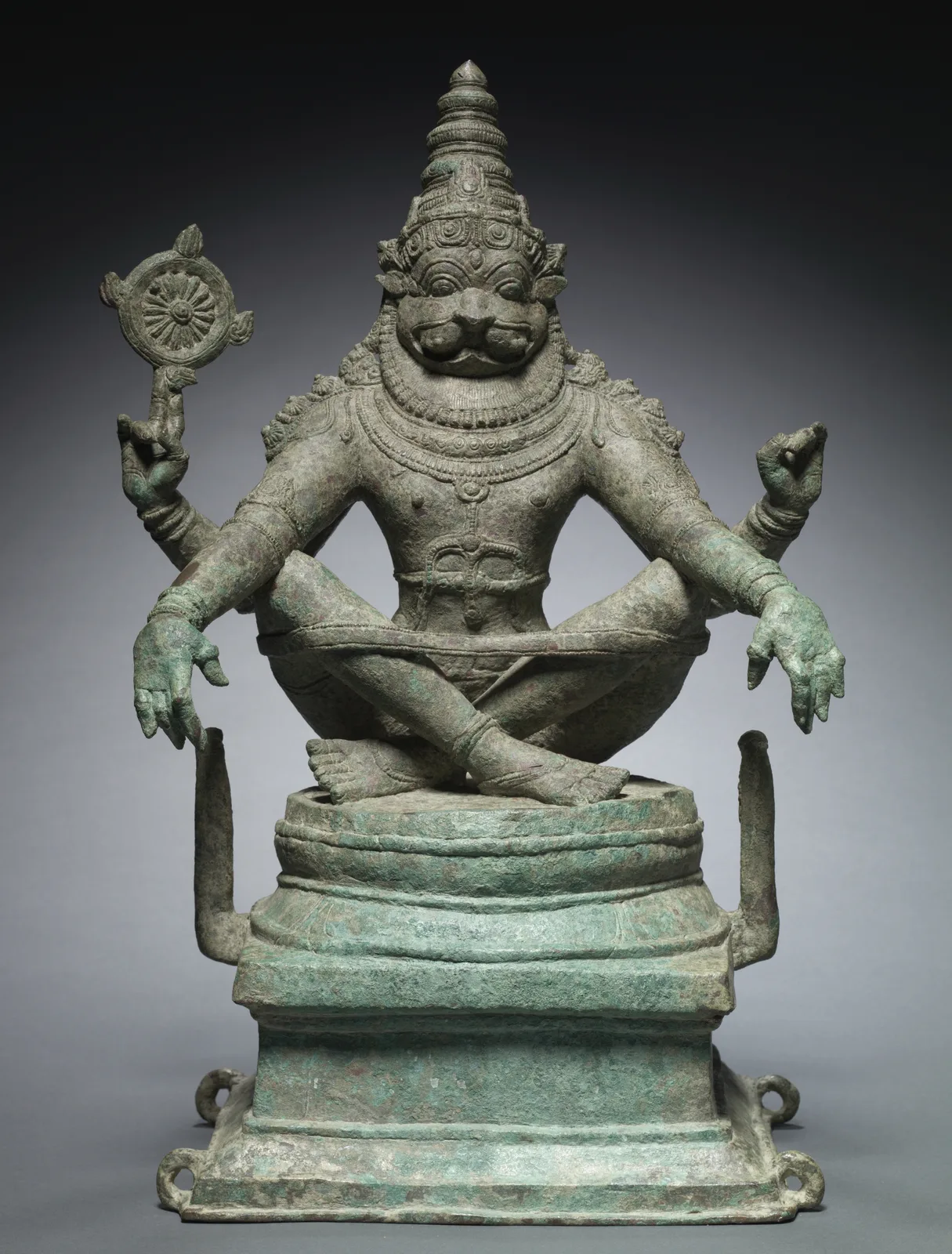
Yoga Narasimha, Vishnu in his man-lion avatar. South India, late Chola period, c. 1250. Bronze, 57 cm high. Cleveland Museum of Art, CC0.
Neither figure is an early form of artificial intelligence, and nothing connects either one to a computer by descent. What they share with artificial intelligence is older. For at least forty thousand years, people have given shape to minds that are not simply human. The Lion Man's maker left no account of what that mind was. Narasimha's makers left a full one: his name, his story, his posture and the way he is read are written down and still practised.[^4][^5][^6] Both were made to be looked at, not to act. The wish that a made thing might answer back came much later, and for a long time it stayed a story. When it became a programme of work, the steps were taken by named people at known dates, and each carried a decision about what intelligence is.
## The made thing that answers
In the tenth book of Ovid's *Metamorphoses*, a poem he was still revising when he was banished to the Black Sea coast in 8 CE, the sculptor Pygmalion carves a woman "out of snow-white ivory" and falls in love with what he has made.[^7] At the festival of Venus he prays, shyly, for a wife like his ivory girl. When he gets home and touches the statue, the ivory softens under his fingers and grows warm. She is alive, and she looks back at him.
Ovid does not give her a name. She was called Galatea much later, and the name was first given wide circulation by Rousseau's *Pygmalion*, probably written in 1762.[^8] The story records, in Ovid's Rome, the wish for a made thing that answers back. A goddess grants it, and the statue comes to life as what her maker prayed for.
Nineteen centuries later the story was still being carved. Rodin made a model of the scene in 1889, and it was carved in marble, not ivory, about twenty years later. In the version now in New York, the sculptor sits against the stone with his head at the woman's waist, while she leans away from him with her lower legs still part of the rough block.[^9]

Auguste Rodin, *Pygmalion and Galatea*, modelled 1889, carved c. 1908–9. Marble. The Metropolitan Museum of Art, CC0.
The made things that did answer were engineered. Around 1206, an engineer from upper Mesopotamia, Ibn al-Razzaz al-Jazari, finished a book of mechanical devices for the ruler Nasir al-Din. It covers clocks, trick vessels for drinking parties, fountains, machines for raising water and devices for washing.[^10] One of them is a basin for washing the hands. Water pours from the beak of a peacock, and a small figure comes out of a door to offer soap.
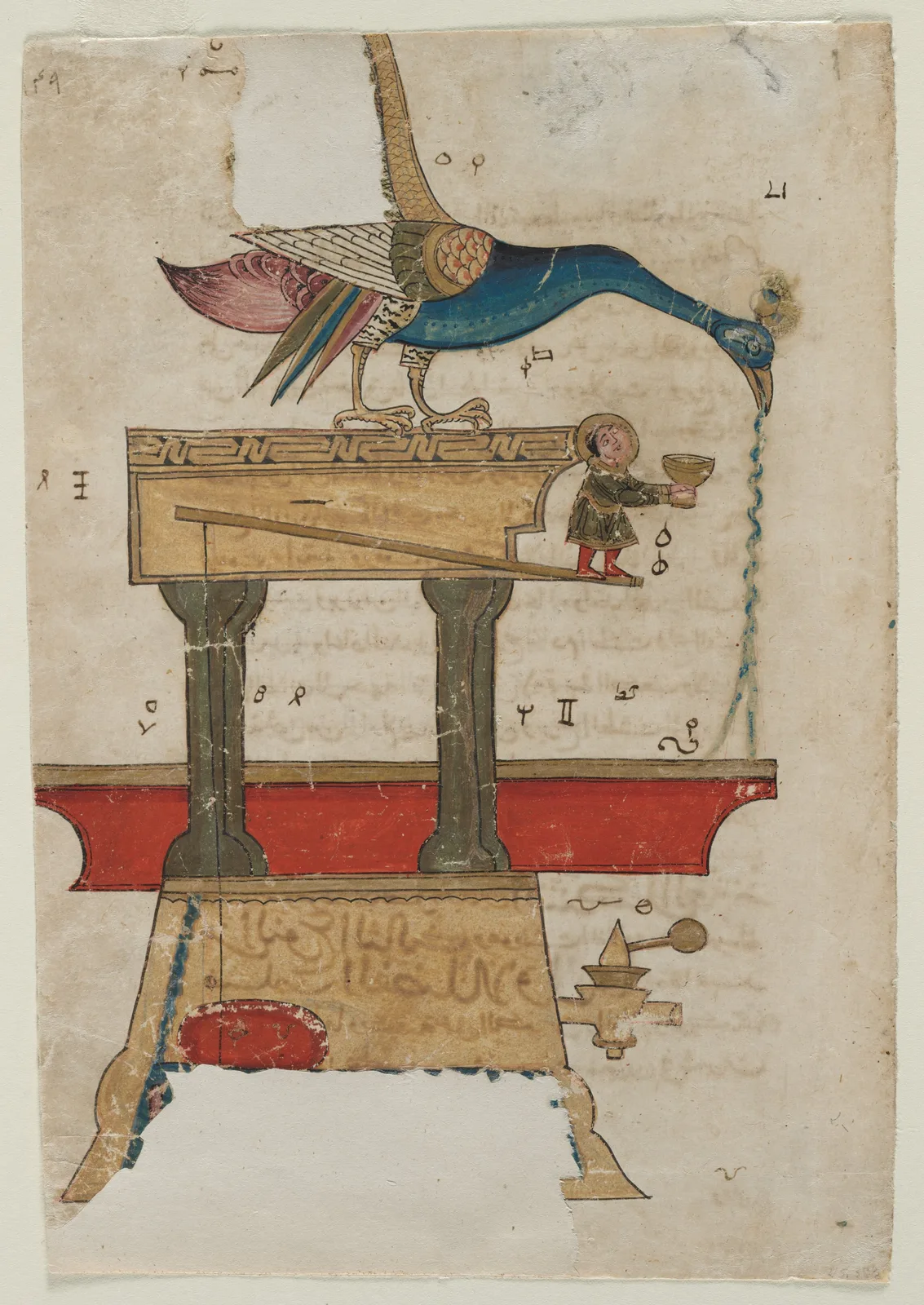
Peacock-shaped hand-washing device, from a copy of al-Jazari's *Book of Knowledge of Ingenious Mechanical Devices* (written 1206). Damascus, 1315, Mamluk period. Opaque watercolour and gold on paper. Cleveland Museum of Art, CC0.
The painted leaf is not from 1206. It comes from a copy made in Damascus in 1315, one of fifteen copies of the book that survive.[^10] The museum that owns it is careful on a further point: nobody knows for certain that the peacock basin was ever built.[^10] Al-Jazari worked in a tradition of automata that was already old, known in the ancient, Byzantine and Islamic worlds.
Everything the peacock was designed to do was fixed by its maker. Its mechanism would decide when the figure appeared, and it would appear the same way every time. It was meant to respond when someone used it, but nothing in it would change through use. To make a thing that changed through use, someone first had to ask whether a machine could think at all.
## Intelligence becomes a research programme
In October 1950 the mathematician Alan Turing published a paper in the philosophy journal *Mind*. Its first sentence is: “I propose to consider the question, ‘Can machines think?’”[^11] Turing then set the question aside. If "machine" and "think" were defined by how the words are commonly used, he argued, the answer would have to come from an opinion poll, which was absurd. So "I shall replace the question by another." The replacement was a game. An interrogator puts written questions to two hidden players, one a person and one a machine, and tries to tell which is which. Turing's choice was to judge a machine by its conduct, by what it said, and to leave aside what went on inside it.
Near the end of the paper Turing made a second suggestion: "Instead of trying to produce a programme to simulate the adult mind, why not rather try to produce one which simulates the child's?"[^11] Build something like a child's mind, and then educate it.
Five years later four researchers made a different bet. On 31 August 1955, John McCarthy, Marvin Minsky, Nathaniel Rochester and Claude Shannon dated a proposal for "a 2 month, 10 man study of artificial intelligence" at Dartmouth College in the summer of 1956.[^12] The proposal rested on one conjecture: that "every aspect of learning or any other feature of intelligence can in principle be so precisely described that a machine can be made to simulate it." Like Turing's game, it was a decision about what intelligence is.
For the next thirty years, much of the field wrote descriptions by hand. Allen Newell and Herbert Simon built the Logic Theorist, a program that proved theorems in logic, which they date to 1955. Two decades later they stated the idea behind it as a hypothesis: "A physical symbol system has the necessary and sufficient means for general intelligent action."[^13]
From 1965, Edward Feigenbaum and his colleagues at Stanford built DENDRAL, a program that worked out the structure of chemical compounds from the readings of laboratory instruments such as a mass spectrometer. Feigenbaum described how they were made. A "knowledge engineer" worked intensively with a human expert, drew out what the expert knew, and wrote it into the program as rules.[^14]
Each of these choices met its limit. In 1972 the mathematician James Lighthill wrote a survey of the field for Britain's Science Research Council, published the following year. Lighthill concluded that no part of the field had yet delivered the major impact it had promised.[^15] He singled out one general cause: the field had not reckoned with the combinatorial explosion. A method that worked on a small problem failed on a large one, because the number of possibilities to check grew much faster than the problem did.
The expert systems had their turn in the 1980s. By one standard textbook's account, the AI industry grew from a few million dollars in 1980 to billions of dollars in 1988.[^16] A review written in 1988 found that the business "has been through a terrible period in 1987–88". The once-leading American start-ups had run into losses and cut staff. Symbolics, the biggest single company in the field on the strength of its expensive Lisp workstations, had suffered "an equally dramatic reversal of fortunes."[^17] The years that followed came to be called the AI winter.[^16]
The people inside the field had warned of it. In 1984, at AAAI-84, the main American conference in the field, a panel met to discuss "The Dark Ages of AI". It started from a "deep unease among AI researchers" that expectations of the field were too high, and that this would "eventually result in disaster."[^18]
Some had been trying another road all along. In 1958 the psychologist Frank Rosenblatt published the perceptron, a network of simple units whose connections were adjusted by experience rather than written by hand.[^19] The work was sponsored by the US Navy's Office of Naval Research, and in 1960 the Navy released a photograph of the machine built on the idea, the Mark I Perceptron. The caption explains how it learned. Test patterns, such as printed letters, were placed in front of its photocell "eye". "When the machine incorrectly identifies a pattern or letter, the trainer forces it to respond correctly by means of an electrical control."[^20]
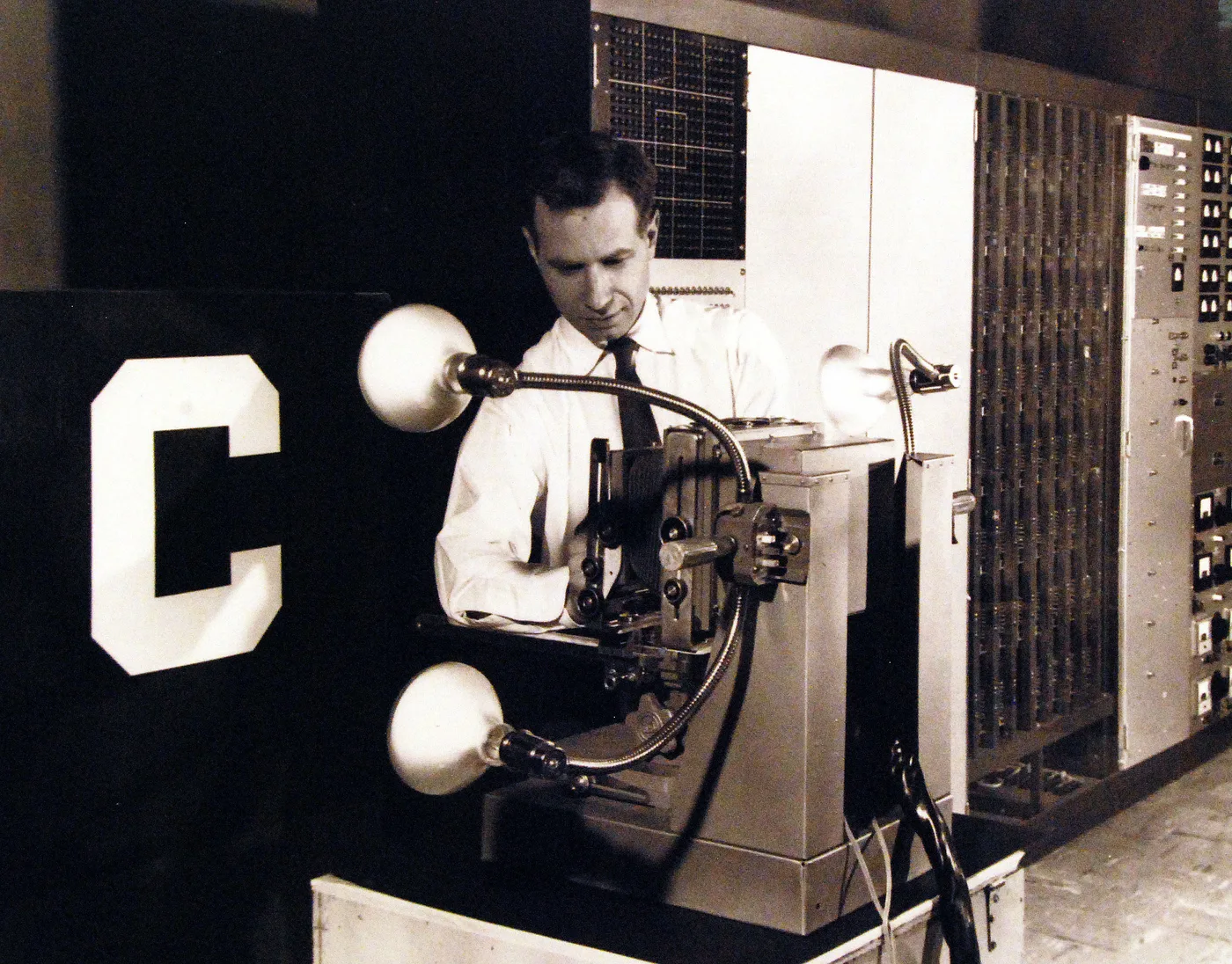
The Mark I Perceptron, in a US Navy photograph released in 1960. A printed letter faces the machine's photocell "eye". National Museum of the U.S. Navy, public domain.
The adjustment was the machine's. The letters, the right answers and the judgement of when it was wrong all came from the person standing beside it. It was close to what Turing had proposed in 1950: a child machine, taught like a pupil, partly by punishments and rewards.[^11]
Rules and learning ran side by side for decades, and each fell in and out of favour. In 1969 Minsky and Seymour Papert published *Perceptrons*, which proved that simple networks of this kind could represent very little. A two-input perceptron could not be trained to tell whether its two inputs were different. The proofs did not cover networks with more layers. Soon afterwards, money for research on neural networks dwindled almost to nothing.[^21][^16] In 1986 David Rumelhart, Geoffrey Hinton and Ronald Williams showed how a network with extra layers between input and output could be trained by passing its errors backwards through it. The units in those middle layers, they wrote, "come to represent important features of the task domain", features that nobody had described to the machine.[^22]
Networks with many layers took off only in 2011, first in speech recognition and then in recognising objects in images.[^16] In 2012 a network built by Alex Krizhevsky, Ilya Sutskever and Hinton was entered in an annual competition to sort photographs into a thousand categories. Its top-five error rate was 15.3 per cent. The next-best entry's was 26.2 per cent.[^23] The systems it beat were built largely on features designed by hand, and similar gains were reported in speech recognition and machine translation.[^16]
In 2017 eight researchers, most of them at Google, published a design they called the transformer. It was built to translate between languages. Most earlier translation networks read a sentence one word after another, and the transformer dropped that step, "dispensing with recurrence and convolutions entirely", and relied instead on a mechanism called attention.[^24] The paper also wrote down what attention costs. It weighs every part of a passage against every other part, so a passage twice as long needs about four times as many comparisons.[^24] Its authors judged attention faster than reading word by word for sentences of the length used in translation, and suggested that, for very long inputs, each part could be limited to its neighbours.[^24]
The next bet was on size. A language model works on text broken into small units called tokens, and in training it learns to predict the next one. In January 2020 Jared Kaplan, Sam McCandlish and eight colleagues at OpenAI reported that such a model's prediction loss fell in a smooth, predictable way as three things grew: the model, its training text and the computing spent on it. As the computing budget increased, they wrote, it "should be spent primarily on larger models".[^25] In May 2020 Tom Brown and thirty colleagues at OpenAI described GPT-3, a model trained to predict the next token, with 175 billion parameters (the values adjusted in training). That was ten times as many as any earlier language model built the same way. Three-fifths of its training mix came from a filtered copy of Common Crawl, an archive of pages from the web.[^26] In March 2023 OpenAI described GPT-4 the same way, as a model "pre-trained to predict the next token in a document".[^27]
Each step was a bet: judge the machine by its conduct, describe intelligence precisely, write the expert's knowledge into rules, let the machine adjust itself from examples, translate with attention, train ever larger models to predict the next token over ever more text.
## Back to the ivory
The Lion Man is still in Ulm, and no account of it survives.
Neither figure carries its maker's name. The makers of artificial intelligence left theirs, on dated decisions about what intelligence is. Turing's paper is in *Mind*. The Dartmouth proposal is a dated typescript with four names on it. Lighthill's survey and the 1988 trade review each carry a date and their authors' names, and the Navy's photograph of the Mark I carries the date of its release.
For the systems in use today the record is thinner. As with the Mark I, people still supply the answers and the judgement. Most of the text a language model learns from was written by people. In March 2022 Long Ouyang and nineteen colleagues at OpenAI described hiring about forty contractors to write examples of good answers and to rank the model's outputs. The rankings trained a second model to score answers, and the language model was tuned against it.[^28] A year later, OpenAI's report on GPT-4 gave "no further details about the architecture (including model size), hardware, training compute, dataset construction, training method, or similar."[^27] For GPT-4, the details of which text went in, how the model was built and how it was tuned were not published, and silence about the data is common. In December 2025 a Stanford-led index scored thirteen major developers on what they disclose and found them most secretive about training data.[^29]
In October 2026 Nick Cammarata of Goodfire, an interpretability research lab, published a study of the neurons in Qwen3-32B.[^30] Its makers had released the model's weights for anyone to download.[^31] Goodfire's preliminary audits found that most of the model's neurons seem to have one main job. Cammarata calls this a working hypothesis.[^30]
Two days later the researcher Leo Gao agreed that neurons had been too quickly written off as a jumble of unrelated jobs. But Gao said this was "nowhere near a sufficient argument that we understand most of what neurons are doing".[^32] Researchers outside the company that built the model have started to read what its neurons do, and because the weights are public, anyone with the skill can check their reading.
## Sources
[^1]: Museum Ulm, Archaeology collection, museumulm.de/en/collections/archaeology/. About 40,000 years old; carved from mammoth ivory; described by the museum as the oldest known depiction of a mythical creature (the museum's framing). The caves of the Swabian Jura became a UNESCO World Heritage Site in 2017. The page (read 24 October 2026) states that the museum "is currently closed due to rebuilding measures" and that the Lion Man is "on display again at the Ulm Museum starting January 16, 2027".
[^2]: Jarrett A. Lobell, "New Life for the Lion Man," *Archaeology*, March/April 2012, archaeology.org/issues/march-april-2012/features/new-life-for-the-lion-man/. Fragments found on 25 August 1939, a week before the war began and before the fieldwork could be completed; three decades in storage until Joachim Hahn began an inventory and pieced together more than 200 fragments; fragments added in 1982 showed a cat's head; "neither the gender of the animal nor of its human parts is discernible." *Archaeology* gives the later excavations as 2008–2011; this essay follows the Museum Ulm folder [3] for those dates.
[^3]: Museum Ulm, *Der Löwenmensch im Museum Ulm / The Lion Man at the Museum Ulm*, bilingual visitor folder, undated (it refers to the 2017 UNESCO listing as past). Fragments recovered in August 1939, on the last day of the excavations at the Stadel cave; carving noticed in December 1969 and the splinters fitted into a figure of about 30 cm; first professional restoration in 1988; known to the public as the "Löwenmensch" (Lion Man) since 1994; further ivory pieces found in the State Office for Cultural Heritage Baden-Württemberg excavations from 2009 to 2013; the figure now assembled from more than 300 pieces; described as "the oldest effigy of a mythical creature". The folder says the carving "attracted the attention of an archeologist" in December 1969 and does not name him.
[^4]: Cleveland Museum of Art, *Yoga Narashimha, Vishnu in his Man-Lion Avatar*, 1973.187, clevelandart.org/art/1973.187. South India, late Chola period, c. 1250; bronze, 57 × 31 × 23 cm. Description: one of the ten main avatars of Vishnu; "for devotees, the man-lion form recalls a myth that describes his superhuman defeat of a seemingly invincible demonic foe"; the form "embodies royal power and yogic discipline"; the posts on either side held a halo.
[^5]: T. A. Gopinatha Rao, *Elements of Hindu Iconography*, vol. 1, part 1 (Madras: Law Printing House, 1914), pp. 149–150, read from the Internet Archive scan. Summarising the image-making texts, Rao gives the single seated image of Narasimha (Girija- or Kevala-Narasimha) as "seated on a padmasana in the utkutika posture, the forelegs being maintained in the required position by the yoga-patta belt going round them and the back of the body", with two or four arms; if four, the upper right holding the chakra; "This form of the image of Narasimha is often designated as the Yoga-Narasimha." He gives the story from the *Padma Purana*, "substantially in agreement with what is found in the *Vishnu Purana*". That the form is still worshipped: see [6].
[^6]: Arulmigu Lakshmi Narasimmaswamy Temple, Sholinghur, Ranipet district, Tamil Nadu (temple code TM001502), official site maintained by the Hindu Religious and Charitable Endowments Department, Government of Tamil Nadu, sholinghurnarasimmar.hrce.tn.gov.in, read 25 October 2026. "Narasimha sits in a Yogic posture in a shrine facing East and is called Yoga Narasimha Swamy"; the temple is "praised by the Thirumangai Alwar, Pei Alwar, Nam Alwars in their pasuram"; "The Friday Thirumanjanam of the Periyamalai weekly is at 7.00 am".
[^7]: Ovid, *Metamorphoses* X.243–297, translated by A. S. Kline, poetryintranslation.com. Pygmalion carves "snow-white ivory"; the festival of Venus; the ivory softens at his touch. Ovid does not name the statue. Date: Kline's Ovid page (poetryintranslation.com/PITBR/Latin/Ovhome.php) gives the banishment as 8 AD, to Tomis on the Black Sea coast; in *Tristia* I.VII (tr. A. S. Kline, 2003) Ovid calls the *Metamorphoses* "the work cut short by [its] author's sad flight", "rough and still unfinished".
[^8]: Cited at second hand. Meyer Reinhold, "The Naming of Pygmalion's Animated Statue," *The Classical Journal* 66, no. 4 (1971): 316–319, as reported in Wikipedia, "Galatea (mythological statue)" (read 24 October 2026): no surviving ancient text names the statue, and the name "Galatea" was first given wide circulation by Rousseau's *Pygmalion*. The article is behind a paywall (JSTOR) and was not read; no open copy was found. Rousseau probably wrote the text in 1762; it was first performed in Lyon in 1770 (Wikipedia, "Pygmalion (Rousseau)", read 25 October 2026).
[^9]: The Metropolitan Museum of Art, Auguste Rodin, *Pygmalion and Galatea*, 10.31, metmuseum.org/art/collection/search/191292. Marble; modelled 1889, carved c. 1908–9; 97.2 × 88.9 × 76.2 cm. Open Access, CC0.
[^10]: Cleveland Museum of Art, *Peacock-shaped Hand Washing Device: Illustration from The Book of Knowledge of Ingenious Mechanical Devices (Automata) of Ibn al-Razza al-Jazari*, 1945.383.a, clevelandart.org/art/1945.383.a. A leaf "from a 1315 Syrian copy" of the book, "written in 1206"; Damascus, Mamluk period; 15 surviving manuscript copies; al-Jazari, "an engineer from upper Mesopotamia", was "in the service of King Nasrī al-Dīn"; the book's devices include "clocks, trick vessels for drinking sessions, devices for washing, fountains, water-raising machines, and measuring instruments"; the automata tradition was "known in the ancient, Islamic, and Byzantine worlds"; the peacock's mouth "acts as a spigot" and the figure "emerged from a small door and offers soap"; "We do not know with certainty that al-Jazarī's device was ever actually constructed." The museum does not name the ruler's dynasty or city, and neither is given here.
[^11]: A. M. Turing, "Computing Machinery and Intelligence," *Mind* 59, no. 236 (October 1950): 433–460. §1: "I propose to consider the question, 'Can machines think?'" and "Instead of attempting such a definition I shall replace the question by another." §7: "Instead of trying to produce a programme to simulate the adult mind, why not rather try to produce one which simulates the child's?"
[^12]: J. McCarthy, M. L. Minsky, N. Rochester and C. E. Shannon, "A Proposal for the Dartmouth Summer Research Project on Artificial Intelligence," typescript dated 31 August 1955; reprinted in *AI Magazine* 27, no. 4 (2006), doi:10.1609/aimag.v27i4.1904. Read from the typescript scan. "August 31, 1955"; "a 2 month, 10 man study of artificial intelligence be carried out during the summer of 1956 at Dartmouth College".
[^13]: Allen Newell and Herbert A. Simon, "Computer Science as Empirical Inquiry: Symbols and Search," *Communications of the ACM* 19, no. 3 (1976): 113–126. The Logic Theorist dated by the authors to 1955; the physical symbol system hypothesis as quoted.
[^14]: Edward A. Feigenbaum, "The Art of Artificial Intelligence: Themes and Case Studies of Knowledge Engineering," *Proceedings of IJCAI-77* (1977): 1014–1029. DENDRAL "begun in 1965", a project with the Stanford Mass Spectrometry Laboratory, working from instrument data that included "data from a mass spectrometer"; the knowledge engineer "works intensively with an expert to acquire domain-specific knowledge and organize it for use by a program", with the expert's rules represented "in the situation => action form".
[^15]: James Lighthill, "Artificial Intelligence: A General Survey," in *Artificial Intelligence: A Paper Symposium* (Science Research Council, 1973); written July 1972. The conclusion is paraphrased from "In no part of the field have the discoveries made so far produced the major impact that was then promised." Lighthill singles out "one rather general cause for the disappointments that have been experienced: failure to recognise the implications of the combinatorial explosion," the explosive growth in possible combinations as a knowledge base grows.
[^16]: Stuart Russell and Peter Norvig, *Artificial Intelligence: A Modern Approach*, 4th ed. (Pearson, 2020), chapter 1, read from the publisher's sample chapter (aima.cs.berkeley.edu/newchap01.pdf). Secondary. §1.3.3, p. 22: *Perceptrons* "proved that, although perceptrons (a simple form of neural network) could be shown to learn anything they were capable of representing, they could represent very little"; "a two-input perceptron could not be trained to recognize when its two inputs were different"; "their results did not apply to more complex, multilayer networks", yet "research funding for neural-net research soon dwindled to almost nothing"; back-propagation brought "an enormous resurgence in neural-net research in the late 1980s". §1.3.4, p. 24: the industry "boomed from a few million dollars in 1980 to billions of dollars in 1988"; "soon after that came a period called the 'AI winter.'" §1.3.8, p. 26: "It was not until 2011, however, that deep learning methods really took off. This occurred first in speech recognition and then in visual object recognition"; the 2012 ImageNet system "demonstrated a dramatic improvement over previous systems, which were based largely on handcrafted features"; "Similar gains have been reported in speech recognition, machine translation, medical diagnosis, and game playing."
[^17]: T. Johnson, J. Hewett, C. Guilfoyle and J. Jeffcoate, "Expert systems: the second wave," *The Knowledge Engineering Review* 3, no. 3 (1988): 177–181, doi:10.1017/S0269888900004446. Abstract: "The expert systems business has been through a terrible period in 1987–88"; in the USA, the leading start-ups "have all run into losses and cut back staff"; Symbolics, "whose high priced Lisp workstations have made it the biggest single company in artificial intelligence," "has hit an equally dramatic reversal of fortunes."
[^18]: Drew McDermott, M. Mitchell Waldrop, B. Chandrasekaran, John McDermott and Roger Schank, "The Dark Ages of AI: A Panel Discussion at AAAI-84," *AI Magazine* 6, no. 3 (1985): 122–134. Abstract: the panel discussed the "deep unease among AI researchers who have been around more than the last four years or so ... that perhaps expectations about AI are too high, and that this will eventually result in disaster." A forecast made in 1984, not evidence of what followed.
[^19]: F. Rosenblatt, "The Perceptron: A Probabilistic Model for Information Storage and Organization in the Brain," *Psychological Review* 65, no. 6 (1958): 386–408. "The theory has been developed for a hypothetical nervous system, or machine, called a perceptron"; for such a system to learn, "it must be possible to modify the A-units or their connections". A footnote records the work's sponsorship by the Office of Naval Research.
[^20]: US Navy photograph 330-PSA-80-60 (USN 710739), "Experimental Machine Able To Identify Letters of Alphabet Announced By Navy," released 24 June 1960; the caption gives the work as "sponsored by the Office of Naval Research with the assistance from Rome Air Development Center"; National Museum of the U.S. Navy, via Wikimedia Commons, public domain. Caption quoted as above.
[^21]: Marvin Minsky and Seymour Papert, *Perceptrons: An Introduction to Computational Geometry* (MIT Press, 1969). Cited as the book; its results are described here as in [16].
[^22]: David E. Rumelhart, Geoffrey E. Hinton and Ronald J. Williams, "Learning representations by back-propagating errors," *Nature* 323 (9 October 1986): 533–536. Hidden units "come to represent important features of the task domain."
[^23]: Alex Krizhevsky, Ilya Sutskever and Geoffrey E. Hinton, "ImageNet Classification with Deep Convolutional Neural Networks," *Advances in Neural Information Processing Systems* 25 (2012). ILSVRC-2012: winning top-5 test error of 15.3%, against 26.2% for the second-best entry.
[^24]: Ashish Vaswani et al., "Attention Is All You Need," *Advances in Neural Information Processing Systems* 30 (2017), arXiv:1706.03762. Built for machine translation, "dispensing with recurrence and convolutions entirely". Table 1 gives the per-layer complexity of self-attention as O(n²·d), where n is the sequence length and d the representation dimension. Section 4: self-attention layers are faster than recurrent layers "when the sequence length n is smaller than the representation dimensionality d, which is most often the case with sentence representations" in machine translation; "for tasks involving very long sequences, self-attention could be restricted to considering only a neighborhood of size r".
[^25]: Jared Kaplan, Sam McCandlish, Tom Henighan, Tom B. Brown, Benjamin Chess, Rewon Child, Scott Gray, Alec Radford, Jeffrey Wu and Dario Amodei, "Scaling Laws for Neural Language Models," arXiv:2001.08361, 23 January 2020 (OpenAI; Kaplan also Johns Hopkins). Abstract: "The loss scales as a power-law with model size, dataset size, and the amount of compute used for training." Section 1: "As the computational budget C increases, it should be spent primarily on larger models, without dramatic increases in training time or dataset size."
[^26]: Tom B. Brown and 30 co-authors (OpenAI), "Language Models are Few-Shot Learners," arXiv:2005.14165, first posted 28 May 2020; *Advances in Neural Information Processing Systems* 33 (2020). Abstract: GPT-3 is "an autoregressive language model with 175 billion parameters, 10x more than any previous non-sparse language model." Table 2.2: filtered Common Crawl, 410 billion tokens, 60% of the training mix.
[^27]: OpenAI, "GPT-4 Technical Report," arXiv:2303.08774, 15 March 2023. Section 2: GPT-4 is "a Transformer-style model pre-trained to predict the next token in a document, using both publicly available data (such as internet data) and data licensed from third-party providers", then fine-tuned with reinforcement learning from human feedback; "Given both the competitive landscape and the safety implications of large-scale models like GPT-4, this report contains no further details about the architecture (including model size), hardware, training compute, dataset construction, training method, or similar." OpenAI says it plans to make further details "available to additional third parties".
[^28]: Long Ouyang and 19 co-authors (OpenAI), "Training language models to follow instructions with human feedback," arXiv:2203.02155, 4 March 2022. Section 1: "We first hire a team of 40 contractors to label our data"; "a dataset of human-written demonstrations of the desired output behavior"; "a dataset of human-labeled comparisons between outputs from our models", used to train a reward model "to predict which model output our labelers would prefer". Section 3.4: "a team of about 40 contractors on Upwork and through ScaleAI."
[^29]: Alexander Wan, Kevin Klyman, Sayash Kapoor, Nestor Maslej, Shayne Longpre, Betty Xiong, Percy Liang and Rishi Bommasani, "The 2025 Foundation Model Transparency Index," arXiv:2512.10169, 11 December 2025 (Stanford, with Berkeley, Princeton and MIT). Thirteen companies scored, OpenAI among them; "the average score out of 100 fell from 58 in 2024 to 40 in 2025. Companies are most opaque about their training data and training compute …"; §5.1: "Data properties is the lowest scoring subdomain, with companies scoring just 15% on average. Eight companies score none of the 5 indicators in this subdomain, failing to disclose the data size, language composition, or domain composition, or to provide external access to the data or instructions for replicating the data."
[^30]: Nick Cammarata (Goodfire), with contributions from Curt Tigges and Tarun Gogineni, "Neural Networks Are Already Clean," already-clean.goodfire.com, 15 October 2026, read 25 October 2026. Described on the page as "An informal research essay and working hypothesis about neural networks." Summary: "We can now understand most neurons in models up to trillions of parameters, and think the outlook for mechanistic interpretability may be far better than we thought." Section 1: "In preliminary audits of Qwen3-32B, we estimate that roughly 90% of neuron poles have one main job, often with small related offshoots; another ~7% have two related jobs; and only ~2-4% are not yet understood"; on his earlier work at OpenAI (Bills, Cammarata, Mossing et al., 2023): "about 1.7% of neurons interpretable by our most generous measure." followed by "With better tools and modern models, the situation looks quite different." A neuron's poles are its positive and negative sides; the page notes the share varies with the threshold set for weak activations. On its gallery of 1,000 randomly chosen neuron studies (Qwen3-32B and Qwen3.6-35B-A3B): "What we see is about 90% of neurons having basically one job." The 1.7% figure is from an older model and a different method. Goodfire, Company page, goodfire.com/company, read 25 October 2026: "Goodfire is an AI interpretability research lab"; "We are headquartered in San Francisco".
[^31]: Qwen team (Alibaba), Qwen3-32B model card, huggingface.co/Qwen/Qwen3-32B, read 25 October 2026. "License: apache-2.0"; the weights are published for download. Qwen3 Technical Report published 14 May 2025. Qwen organisation card, huggingface.co/Qwen, read 25 October 2026: "the large language model family built by Alibaba Cloud".
[^32]: Leo Gao, "Neural networks are not already clean," LessWrong, 17 October 2026, lesswrong.com/posts/Dkh7pXKjoNWkkxQDz/neural-networks-are-not-already-clean, read 25 October 2026. Agrees that "people have been too quick to write off neurons as polysemantic" and that "we should update on it. But it's nowhere near a sufficient argument that we understand most of what neurons are doing, and these results do not show that interpretability is solved, or even that it is vastly easier than previously anticipated." Closing section: "I'm hopeful that it's possible to disentangle everything, figure out how computation-in-superposition works, and ultimately find clean, understandable circuits in networks."
**Image credits.** Lion Man: Dagmar Hollmann, Wikimedia Commons (https://commons.wikimedia.org/wiki/File:Loewenmensch1.jpg), licensed CC BY-SA 4.0 (https://creativecommons.org/licenses/by-sa/4.0/), resized and unaltered otherwise. Narasimha and the al-Jazari leaf: Cleveland Museum of Art, CC0. Rodin: The Metropolitan Museum of Art, CC0. Mark I Perceptron: National Museum of the U.S. Navy, public domain.
The artworks in this essay were found through Open Museum (except the photograph of the Lion Man).
### Companion artwork
Shawabty of Pinudjem I, High Priest of Amen and King, by Unknown Egyptian workshop, c. 990–969 BCE, Bright blue faience with purple details. Shawabty of Pinudjem I, High Priest of Amen and King. Egypt, Third Intermediate Period, Dynasty 21, c. 990–969 BCE. Bright blue faience with purple details. Cleveland Museum of Art, CC0.
- What: Shawabty of Pinudjem I, High Priest of Amen and King. Egypt, Dynasty 21, c. 990–969 BCE. Bright blue faience with purple details, 11 cm high. Cleveland Museum of Art.
- Why: A shawabty stood in for its owner and did the owner's menial work in the afterlife. This one was pressed from a mould and painted, and it carries a king's name in a cartouche. Three thousand years ago, people made a figure to do someone's labour and wrote on it whose it was.
- Look at: The column of dark painted signs down the front of the body, and the oval cartouche inside it that holds the king's name. The blue came out in the firing, from copper added to the faience paste.
Source: https://clevelandart.org/art/1914.582 (CC0)
---
- [Tool Equality Is Not Enough](https://pramod.ch/essays/tool-equality-is-not-enough/): Why equal access to AI tools does not mean equal power in the market
There is a town in Cheshire called Macclesfield, about half an hour south of Manchester. I spent time there in 2013 and 2014, and its centre was hollowing out. Over those two years, the shops that were left kept closing, one after another, and pawnshops opened in their place.
The town had argued about its supermarket before I got there. In 2012, when Tesco planned to replace its Hibel Road store with a Tesco Extra twice the size at Barracks Mill, the town's own MP warned in public that the new store's high share of non-food "may suck the lifeblood out of the town centre." At a public meeting in St Michael's Church, 157 of the more than 210 people there recorded their opposition, and no one raised a hand in support.[^1] People who had lived alongside the first store knew what one twice its size would mean.
For years afterwards I kept asking why the centre had emptied, and the standard explanation did not satisfy me. It holds that the supermarket was cheaper and more convenient, and the shops that could not compete deserved to lose. That is true as far as it goes. It does not explain why the loss felt like more than a set of businesses closing.
The same kind of promise is now made about artificial intelligence. Give everyone the tools the giants have, and the field levels itself. I believed that once, and built a company on it. What I learned is that a market stays open only if small players can enter, reach customers, switch suppliers, and retain enough value to survive. That is what I mean by contestability. Powerful tools guarantee none of it, and it is what the high street lost.
## What actually left
A family greengrocer, I eventually realised, is not only a shop. The people who run it are proprietors. They keep their own margin and set their own hours. That income is enough to make them participants in the place they live. They sponsor the junior football side. They are on the committee for the New Year event. The shop is a node in a web of small obligations.
When the superstore replaces the shop, the proprietor's place goes to shift workers, not to another proprietor. A shift worker is not going to sponsor the football side. They cannot. The commercial transaction still happens. Groceries are still sold. But the surplus that used to flow from the shop into the community stops flowing, because the superstore moves it off the shopfloor and into a corporate margin accounted for somewhere else.
The community surplus was never priced. Nobody ever put a number on the greengrocer's sponsorship of the football side, so when the shop closed, the loss went unrecorded. Every welfare calculation that says the town is better off is telling the truth about what it measures: cheaper groceries, more choice, more jobs. It is silent about the community surplus.
The scale of the churn was real, whatever you make of its causes. The New Economics Foundation, an advocacy think tank, estimated that Britain lost more than thirty thousand local outlets, from food shops and pubs to bank branches and post offices, in the five years to 2000. Over the same years, by NEF's account, independent fresh-food specialists saw their sales fall by about forty per cent.[^2] NEF's 2005 survey found that more than four in ten of the towns surveyed had become "clone towns," their high streets taken over by the same national chains.[^3]
There is an obvious objection. Nobody forced anyone into the superstore. Shoppers chose it, freely, because it served them better. If the town centre died, the town killed it with its own footfall.
That is true, and at the time it was a good choice. The superstore was cheaper and had everything under one roof, and a chain fighting to establish itself will set its prices for the local market it is trying to take. Britain's competition regulator documented how. Its 2000 inquiry found the major chains, Tesco among them, persistently selling some frequently purchased products below cost and "price flexing," which it defined as varying prices in different places "in the light of local competitive conditions," in ways not related to costs.[^4]
But the choices added up, and together they changed the market the next shopper would find. Once the independent shops have gone, they are not coming back, because the footfall that would sustain them now goes to the superstore's car park. What was a choice among many becomes a choice between the superstore and a longer drive.
The bargain also looks different depending on where you can shop. The large store offers one price; the smaller neighbourhood format offers another. When the consumer group Which? priced a basket of seventy-five groceries, in a comparison published in February 2023, the same shop cost about ten per cent more at a Tesco Express, the small format the chain brought onto high streets, than at a large Tesco: about eight hundred pounds a year more for someone buying that basket every week.[^5] Cheap groceries remain available, but not necessarily on the terms, or in the places, people need them.
The regulator looked twice and acted on neither practice. In 2000 it judged both remedies it considered for below-cost selling disproportionate, and every remedy it considered for price flexing undesirable, disproportionate or impractical. In 2008 it found that below-cost selling did not harm competition, so no remedy arose for it. It did act on weak local competition, ordering the largest chains to give up land and restrictive covenants that kept rivals out, and it recommended a competition test for new large stores.[^6]
So "the shoppers chose it" is true, and it leaves out what the town could still choose afterwards. A shopper who can walk to three greengrocers can walk away from any one of them. A shopper whose alternative is a longer drive has a weaker hand, even when the price on the shelf looks fine.
## The remedy I built
I did not just watch this. I tried to fix it.
The company was called Cloudfeet, and the theory behind it was simple enough to fit on one line. The reason the greengrocer and the small manufacturer lost was that the giants had tools they could not match. A Tesco or a Walmart runs on planning, forecasting and order-management systems that let it see demand across thousands of stores and move stock against it. The greengrocer has nothing comparable. It orders on what sold last week and on the owner's judgement. The small manufacturer is in the same position. Selling into a fragmented market, it has no such nervous system either, and its ordinary ERP cannot even model the problem, because it was built to serve a handful of large accounts, not to reach millions of small customers directly. So I built a cloud platform to close that gap. It was a horizontally scalable back end, designed to give the small player the same planning capability the incumbent had and to let a manufacturer coordinate all the way out to a mass of end customers its own systems could never have handled.
Give the small players the incumbents' tools, the thinking went, and you restore the contest.
It never reached the market. The immediate reason is unglamorous: I could not get investors over the line, and without capital the platform could not reach the scale the model needed. But that reason hides a deeper one that took me years to admit. Even if the funding had come, I am no longer sure it would have restored the contest, because the tools were never what decided whether a small manufacturer could enter a market, reach its customers, or keep its margin.
## What the tools did not touch
Four things decided whether a small player could enter a market and reach its customers. The first was capital: the small manufacturer needed working capital to hold stock and absorb late payment before it could enter a new market at all, and no planning system supplies that. The second was logistics: reaching customers meant physical movement of goods, trucks and warehouses and last-mile delivery, none of which a forecast performs. The third was habit: the customer had already been trained, over years of convenience, to reach for the incumbent by reflex, and no back end changes that. And the fourth was distribution: the layer that decides what reaches the shelf, and on whose terms.
I could build the tools. I had no way around the conditions on which they would have to compete.
## The bazaar and what sits behind it
Contestability is easiest to see where it is still physical. Walk through Chandni Chowk in Delhi, or Chatuchak in Bangkok. There are thousands of sellers, stall after stall, and the defining feature of the place is that you can walk away. If one trader will not meet your price, the next one will, or the one after that. Here competition is something you experience with your feet. The seller knows you can leave, and that knowledge is the whole discipline.
Now follow the goods backward, off the market floor to the suppliers beneath it. A market can have thousands of sellers and still depend on a much smaller number of suppliers, distributors, or landlords. The visible competition does not tell you how much freedom those sellers have. The shopper on the floor can always take three more steps. The trader behind the counter, looking for a different supplier, a better wholesale price or a cheaper pitch, may find far fewer places to walk to.
In 2005 the European Commission made a set of commitments from Coca-Cola legally binding in the countries of the EU, Iceland and Norway where it had a particularly strong market position. Coca-Cola undertook to stop signing shops and pubs to exclusive deals, to stop paying rebates that rewarded them for buying as much Coke as before, or more, and to stop making a shop that wanted Coke take its less popular brands as well. Where a shop had no other chilled space, it was to be free to use at least a fifth of the Coca-Cola cooler for any drink it chose.[^7] Every one of those commitments concerns the shelf, the fridge and the terms on which a rival reaches the customer.
So the number of stalls tells you little on its own. The question the bazaar puts is whether, somewhere beneath the stalls, the sellers themselves can still walk away.
## The same remedy, offered again
The case for open-weight AI is the case I made for Cloudfeet. It offers the same remedy, resting on the same assumption: that better tools are enough. Open models, the argument goes, hand the small player the same capability the giants have. Anyone can download a near-frontier model, run it, build on it, and compete. The equipment has been levelled, so the field will level itself.
And the capability has arrived. Epoch AI's 2024 benchmark analysis put the lag between the best open-weight models and the best closed ones at about a year; on its newer capability index, a different measure, it has averaged three to four months since 2023.[^8] That is a real gain in what a small firm can make. The app layer that sits on top of these models looks like a bazaar: thousands of startups, stall after stall, apparent competition everywhere you look. You can walk away from any one of them.
But follow the goods backward, the way you would in Chandni Chowk, and the walking gets harder the further down you go. The thousands of app-layer companies sit on a small number of foundation-model providers. By the estimate of Menlo Ventures, an investor in Anthropic, three of them take close to nine-tenths of what US enterprises spend on large language model APIs.[^9]
Those providers in turn sit on compute. The chips come mostly from one vendor, Nvidia, with about seven-tenths of the AI chip market by one analyst's estimate, a more concentrated position than any model provider holds. Beneath that sit three clouds, Amazon, Microsoft and Google, with 28, 20 and 15 per cent of cloud infrastructure spending.[^10] Open weights hand you the model file. They do not hand you the compute to train or serve it at scale, and a builder buys that compute from one of a few sellers, on their terms.
Above the builders sits another scarce resource: access to customers. Sometimes a purchasing office decides who gets it; sometimes reputation does, or a platform's ranking. More capacity to produce does not automatically buy more access. When anyone can build, everyone builds, and the enterprise buyer still looks only at the short list it already has. The app store still ranks what it shows. Whoever controls those allocations holds what the shelf and the cooler held in the Coca-Cola case: the terms on which the goods reach anyone.
Trust is a separate problem from distribution. Distribution decides whether a buyer sees you at all. Trust is whether, having seen you, they will rely on you, and AI has left it roughly where it was. Making things, the writing and coding and designing, has sped up dramatically. Selling them has not, because a sale needs a buyer to decide whether to depend on you, and people still make up their minds at human speed. A relationship still matures over quarters. A procurement cycle still runs its months. So every open-weight builder now produces at machine speed into a market that absorbs at human speed. The constraints I came to see at Cloudfeet, capital, logistics, habit and distribution, have not moved. Open weights loosen the constraint on what a small firm can build, while leaving the constraints on market access intact.
Anthropic's API tokens do not look as if they are being sold below cost: SemiAnalysis estimates that the company raised its gross margin on inference from 38 per cent to over 70 per cent in the first months of 2026.[^11] If there is a subsidy, it more likely sits in the flat-rate consumer subscription, where a heavy user can consume far more compute than the fixed fee covers.
Behind that sits the scale of the capital being spent to build the position, with the five largest hyperscalers, Microsoft, Amazon, Alphabet, Meta and Oracle, putting more than four hundred billion dollars into capital investment in 2025.[^12] That is spending on acquisition. What the terms look like once the habit is set is not yet known, and it will depend on whether users and builders can still walk away. For the case where they cannot, Lina Khan, then chair of the US Federal Trade Commission, described the "too big to care" posture of monopolies, and Cory Doctorow took the phrase up for tech: big enough to face no consequence for degrading what they sell, because their customers have nowhere else to go.[^13]
The disanalogy is real. There are a few such providers, not one, and they compete, sometimes fiercely. So the claim is narrower than monopoly: a handful of providers with high switching costs, at the layer everything else depends on, can leave the plurality above them with much less freedom than it appears to have.
There is also a serious argument that concentration at this layer is a feature, because a small number of well-resourced labs can be held responsible for safety in a way that a free-for-all cannot. But it is an argument about who should hold the power, not about whether the power is concentrated. However the safety question is answered, the builders above that layer still need to be able to enter, reach customers and switch suppliers. A responsible steward does not by itself give them any of that.
## The test
When someone tells you a market is competitive, whether it is a high street, a bazaar, or the AI stack, do not count the sellers. The number of sellers is the part you are meant to look at, the stalls and the storefronts and the thousands of startups. Ask instead whether the participants can credibly walk away: whether a seller can change supplier, whether a builder can change provider, whether a small firm can reach a customer without someone else's permission. Find the layer where alternatives cease to be credible. Look in both directions: below the sellers, at the layer that supplies them, and above them, at the layer that allocates access to customers.
I built Cloudfeet because I thought the small player needed the giant's tools. The question I would now put to anyone building with AI is whose permission they still need to make a living from it.
## Sources
[^1]: Macclesfield Express, "New Tesco store is 'no done deal', says Macclesfield MP David Rutley" (7 March 2012), now at macclesfield-live.co.uk/news/local-news/new-tesco-store-no-done-2526622. Rutley: "the high percentage of non-food may suck the lifeblood out of the town centre." The 2012 plan was to "replace the Hibel Road store with a Tesco Extra twice the size at Barracks Mill." St Michael's Church meeting: more than 210 attended; in a survey of guests by church members, 157 opposed the plans and no one raised a hand in support.
[^2]: New Economics Foundation, *Ghost Town Britain* (December 2002). "Over 30,000 local economic outlets" lost in the five years to 2000 (counting food retailers, general stores, pubs, bank branches and post offices); independent fresh-food specialists' sales down 40% between 1995 and 2000 (NEF citing a Thames Valley University study). NEF is an advocacy think tank.
[^3]: New Economics Foundation, *Clone Town Britain: The survey results on the bland state of the nation* (2005). "Of the towns surveyed 41 per cent are clone towns": 42 of 103 surveys returned by the public, for towns of 5,000 to 150,000 people (plus 27 London returns). Clone town: a high street that has become "a monochrome strip of global and national chains." Volunteer survey. Not the 2004 report of the same main title.
[^4]: Competition Commission, *Supermarkets: A report on the supply of groceries from multiple stores in the United Kingdom*, Cm 4842 (2000), para 1.6. "Persistently selling some frequently purchased products below cost" by the major chains, Tesco among them, found to operate against the public interest; price flexing defined as "varying prices in different geographical locations in the light of local competitive conditions, such variation not being related to costs."
[^5]: Which?, policy and insight article on the cost of convenience-store shopping (9 February 2023), which.co.uk/policy-and-insight/article/the-cost-of-convenience-thatll-be-800-please-which-reveals-the-extra-cost-of-shopping-local-aSbR28c4fejd. The same 75 groceries, at 2022 prices, were 10% dearer at Tesco Express than at larger Tesco stores: an extra £15.73 a week, or £817.91 more over a year, for the basket bought weekly.
[^6]: Competition Commission (2000), para 1.7: both remedies considered for below-cost selling "would require monitoring and intervention that would be disproportionate" (and prohibitions abroad had not proved effective); the price-flexing remedies considered "are either undesirable, disproportionate or present practical difficulties." Competition Commission, *The supply of groceries in the UK market investigation*, final report (30 April 2008), summary para 19: below-cost selling not found to be predatory or to produce an adverse effect on competition. The 2008 report did find an adverse effect from weak local competition. The remedies it imposed were the release of restrictive covenants and measures on landsites in highly concentrated local markets (para 42); the competition test in the planning process was a recommendation to government and the devolved administrations, which the Commission could not itself impose (summary para 4, paras 43 and 11.13).
[^7]: European Commission press release IP/05/775 (22 June 2005). Commitment decision covering the EU, Iceland and Norway, with the commitments "applicable in those countries where Coca-Cola has a particularly strong market position," until 31 December 2010: no exclusivity, no target or growth rebates ("rebates that reward its customers purely for purchasing the same amount or more of Coca-Cola's products than in the past"), no forcing outlets to take less popular products with its stronger brands, and, where no other suitable chilled capacity exists, the outlet is "free to use at least 20% of the cooler provided by Coca-Cola for any product of its choosing." A commitment decision, not an infringement finding.
[^8]: Epoch AI, data insight on the open-weight to closed-model gap (29 May 2026), epoch.ai/data-insights/open-closed-eci-gap: "Since January 2026, the most capable open-weight models have lagged frontier closed models by an average of four months," measured on the Epoch Capabilities Index, and "slightly larger than" the average of three months between January 2023 and October 2025 in Epoch's October 2025 data insight (epoch.ai/data-insights/open-weights-vs-closed-weights-models). Epoch's 4 November 2024 open-models report (epoch.ai/blog/open-models-report), benchmark-based, put the lag at about one year (90% range 5 to 22 months). That is a benchmark-based measure, not comparable with the ECI figures; the two together do not show the gap narrowing.
[^9]: Menlo Ventures, "2025: The State of Generative AI in the Enterprise" (9 December 2025). Estimated share of enterprise LLM API spend: Anthropic 40%, OpenAI 27%, Google 21%; "these three companies account for 88% of enterprise LLM API usage." Survey of 495 US enterprise decision-makers; shares estimated from API usage. Menlo Ventures is an investor in Anthropic.
[^10]: TrendForce press release, "Strong Demand from CSPs and Sovereign Cloud to Drive Over 20% Growth in AI Server Shipments by 2026" (30 October 2025): "TrendForce estimates that NVIDIA will maintain approximately 70% of the AI chip market share in 2025" (basis not stated). Synergy Research Group, "Q2 Cloud Market Passes $143 Billion; Highest Growth Rate in Eight Years" (30 July 2026): Q2 2026 worldwide shares of cloud infrastructure service revenues (IaaS, PaaS and hosted private cloud) of 28% Amazon, 20% Microsoft, 15% Google.
[^11]: SemiAnalysis, "AI Value Capture: The Shift To Model Labs" (1 May 2026), public portion: Anthropic's "gross margins on their inference infrastructure have increased from 38% to over 70%" over "this year", to 1 May 2026. Analyst estimate; labs' economics are not disclosed. That API tokens are not sold below cost is an inference from this margin, not a statement in the source. The flat-rate subscription point in the same paragraph is qualitative and unpinned.
[^12]: Epoch AI, data insight on hyperscaler capex and operating cash flow (16 June 2026), epoch.ai/data-insights/hyperscaler-capex-vs-cash-flow, covering Microsoft, Amazon, Alphabet, Meta and Oracle: aggregate cash capex "on track to overtake operating cash flow in Q3 2026." Epoch's quarterly figures sum to roughly $412 billion for 2025 (our sum; Epoch states no annual total).
[^13]: Cory Doctorow, "Too big to care," *Pluralistic* (4 April 2024), pluralistic.net/2024/04/04/teach-me-how-to-shruggie/. Doctorow: "Khan described tech monopolists as 'too big to care.'" Khan's own words, on *The Daily Show* (YouTube oaDTiWaYfcM, at about 2:15), were about monopoly power in general: "that type of too-big-to-care-type approach is really what ends up signaling that a company has monopoly power because they can start mistreating you, but they know you're stuck." Doctorow applies it to tech in his "enshittification" argument.
### Companion artwork
Cloth Merchant's Shop, by Basarat (son of Dutta), ca. 1850, Opaque watercolour and gold on paper. Basarat (son of Dutta), Cloth Merchant's Shop, ca. 1850. Opaque watercolour and gold on paper. Brooklyn Museum, New York, via Wikimedia Commons. Public Domain.
- What: Cloth Merchant's Shop, Basarat (son of Dutta), ca. 1850. Opaque watercolour and gold on paper. Brooklyn Museum.
- Why: A seller needs more than the goods and the tools to sell them, and Basarat's merchant has much more. Cloth is stacked high on both sides of the doorway: capital held as stock. An older man beside him writes on a long, narrow sheet, most likely the shop's accounts. A guard sits beside the merchant with a long gun and a sword, and a boy brings another bolt in from the back. All of it sits on a raised stone platform, above the street where a porter passes and two men share a hookah.
- Look at: The edge of the platform. A white plinth with a scalloped border runs the width of the picture and divides it in two. Above it, under the red-and-white striped awning, is everything the shop runs on. Below it, on bare ground, are the porter with his load, the two men with the hookah, and a child with a black dog. Basarat signed in red in the blue border beneath them: "ba qalam Basarat walad Dutta musawwir", by the pen of Basarat, son of Dutta, painter.
Source: https://commons.wikimedia.org/wiki/File:Brooklyn_Museum_-_Cloth_Merchant%27s_Shop_-_Basarat.jpg (PD)
---
- [Built for What Comes Next](https://pramod.ch/essays/built-for-what-comes-next/): Every company ages into an organisation built for its current advantage. Designing for what comes next means placing bets before their value is certain, keeping options that are cheap to preserve and expensive to recreate, and changing how capital, talent, data and authority move through the company. Agents make the last of these urgent.
In September 2016, Mercedes-Benz launched a new sub-brand for its electric cars, EQ.[^1] In July 2021 it said it was getting ready to go all-electric by the end of the decade, and committed more than €40 billion to battery-electric cars between 2022 and 2030.[^2] In February 2024 the target became up to half of sales electrified by the second half of the decade, counting plug-in hybrids, with combustion engines "until well into the 2030s".[^3] By October 2024 the EQ name itself was being phased out, and the all-electric pledge had always carried the qualifier "where market conditions allow". The electric G-Class is called the G 580, not the EQG.[^4]
The sales followed the same line. Mercedes sold 222,600 battery-electric cars in 2023, 185,100 in 2024 and 168,800 in 2025, when they were 9.4% of its cars.[^5] Net profit for 2025 was €5.3 billion, down from €10.4 billion the year before. Mercedes put the fall down to tariffs, exchange rates and competition in China,[^6] and all three are real.
My last two cars were Mercedes. From 2020 to 2023 I drove a Mercedes-AMG GLC 63 S, with its V8, and from 2023 to 2025 a Mercedes-AMG EQS 53. The EQS interior was what I expect from a Mercedes, and it delivered. The car was great too. But if I were to go back, I would go back to the V8.
I think the deeper problem was not that Mercedes failed to invest in electric cars. It was that it treated electrification as a project alongside the organisation, rather than as a reason to redesign the organisation itself. You can see it in how the electric cars were built. A separate brand[^1] and a dedicated electric-only platform, EVA2,[^7] were a serious bet on the product, and they also ring-fenced it. The organisation that had spent generations perfecting the combustion Mercedes stayed intact and kept running the core business, and the electric car ran beside it rather than through it. In 2024 Mercedes reportedly put work on its next large electric platform on hold,[^7] and the separate brand was already being folded back in. That is my interpretation, not Mercedes' own account. Its chief executive, Ola Källenius, has defended the choice: if the market is not fully electric, "the only solution that we think is viable in that scenario is that you have two platforms."[^4]
There is a fair reading in which Mercedes was right. Demand for expensive electric cars grew more slowly than it had planned for, and by Mercedes' own account in 2024, cheap electric cars were selling faster than luxury ones.[^3] Building a second large electric platform into that market might have cost more than it saved. That is a question about timing. The organisational question is separate: whether Mercedes was built so that an electric car could become the core of the company, or only so that it could sit beside it.
The BMW Group, including MINI, sold into the same market and took the other route. It designed its main architecture so that combustion, plug-in hybrid and electric versions of a model could come off the same production line. TechCrunch described that as BMW hedging its bets, said the compromises in cars like the i4 were obvious, and noted that the next generation, the Neue Klasse, runs on a dedicated electric platform.[^7] In 2025 the group still sold 442,072 electric cars, 3.6% more than the year before and about 18% of its sales, while Mercedes' fell to 168,800. BMW credits what it calls its technology-neutral approach.[^5] In this market, the company that put the electric car through its core organisation, compromises and all, sold more of them and kept growing.
The distinction matters far beyond cars. Every company ages into a structure built for its current advantage. The question is whether it can rebuild before that structure makes the next advantage invisible.
Designing for the next stage means three things: placing selective bets before their value is certain; retaining options that are cheap to preserve but expensive to recreate; and changing the rules by which capital, talent, data and authority move through the company.
## Where advantage lives
I spent ten years at Syngenta and three more consulting for it, so I will use the company I know best.
The magic in a crop protection company happened decades ago, when some capable chemists found molecules that do something useful in a field. Since then, the same molecules and their derivatives have been formulated, registered, packaged and put on the shelf, year after year. Syngenta's crop protection business sells about $14 billion a year,[^8] roughly a fifth of a global market of about $69 billion.[^9] Bringing a new active ingredient to market now takes $307 million and a little over 11 years.[^10] The industry's research money moved towards genetically modified traits, and the industry "has become more reliant on older, off-patent chemistry".[^11]
New fungicides and insecticides have kept arriving at a steady rate; the decline is in herbicides.[^12] Old chemistry still carries much of the business, and the new is a smaller share of the business than it could be.
None of that is wrong. A company in that position has to keep putting product on the shelf, and it does that through thousands of small, unglamorous decisions: a formulation that holds up in a humid warehouse, a registration dossier that anticipates the regulator's question, a sales agronomist who knows which farmer will try something new. Advantage in a mature company is those small things adding up. The strategy the CEO and the board write down is only part of it, and most of the rest appears in no strategy document.
The trouble starts when the organisation is so well built for putting the same product on the shelf that it cannot do anything else. That is the Mercedes question, and it is a question about the life cycle.
## Act your age
Aswath Damodaran, who teaches finance at NYU, describes companies as ageing through stages, from start-up to decline, with different tasks at each: building a business model, scaling it, defending it, managing its decline.[^13] Damodaran's advice is that a business should accept where it is in the life cycle "and behave accordingly".[^13] He is blunt about the alternative: "I think more money is wasted by companies not acting their age than any other single action that companies take."[^14] For an ageing company, the constructive path he describes is to divest poor performers, spin off or split off the better businesses, pay down debt and return cash.[^15]
Acting your age is a financial strategy: it gives the capital markets the focus and the cash they reward. Rebuilding for the next stage is an organisational strategy, and its aim is survival. The two can point in different directions, and inside most companies the markets' version is the one with the louder voice.
Damodaran is not against change. He names IBM in 1992, Apple in 2000 and Microsoft in 2013 as companies that were reborn, while noting that they are the exception and that luck played a part.[^13] His point is about the odds.
I agree with the first half. A company needs to know where it is in its life cycle. Where I part with Damodaran is the default. Knowing your stage is where the work starts. The next step is to look at where the environment is going, decide where you want to be in the next stage, and redesign the organisation for that stage, rather than shaping it ever more tightly around the one you are in.
A company does not need to predict the future perfectly to prepare for it. It needs to avoid designing itself so narrowly around the present that it cannot recognise, retain or develop the capabilities that the next stage will require. That is the distinction between acting one's age and building for the age that follows.
## Every technology wave was a rebuild
Much of the history of organisation design is a history of rebuilds, and technology forced many of them.
Henry Ford built a company around one car. "Any customer can have a car painted any colour that he wants so long as it is black," he wrote in 1922,[^16] although Ford's own history says the Model T came only in black from 1914 to 1925.[^17] The organisation was a machine for making one product ever cheaper, and for a while it won everything. Ford had 55.5% of the American car market in 1921.[^18]
Alfred Sloan built General Motors differently. GM's 1924 annual report said the company was striving for "a car for every purse and purpose",[^19] and Sloan built an organisation to match: a general office that planned and allocated resources, and operating divisions that ran the brands. Alfred Chandler, the business historian, summed up what he found at GM and three other companies as "structure follows strategy". By 1940 Ford's share had fallen to 18.9%, and GM's stood at 47.5%.[^18]
Later technologies forced the same kind of rebuild. Mainframes, personal computers, ERP and software-as-a-service each moved where information and decisions sat in a company. ERP went furthest. An ERP system is an organisation design shipped as software: order-to-cash and procure-to-pay are organisational choices before they are modules.
Each wave was a moment when the organisation was going to be rebuilt anyway. Most companies used the rebuild to make the current stage cheaper.
## Clean core, custom code and the Rolls-Royce design
The current version of this argument in SAP's world is Clean Core. SAP describes a clean core as a system on the latest release, with cloud-compliant extensions, optimal master data quality and "perfect process design", with zero modifications and extensions built only on released, upgrade-stable interfaces. The stated benefits are upgrades that do not disrupt the business, faster uptake of innovation, and lower cost.[^20]
SAP has a strong case. An SAP blog on its code-usage monitor puts the share of custom code not executed in production at 40 to 60% on average.[^21] My own experience matches that. In my consulting work I saw two reasons for most custom code, and neither was good. The first was convenience. The standard method existed, but it was somewhere obscure, and writing a few lines of ABAP was faster than finding it. The second was a team insisting that its way of doing things was unique and had to be reproduced exactly. Both produce code that someone has to carry through every upgrade, and neither is a strategy.
The answer to that is not to strip everything to the vendor's standard either. Adopting a vendor's clean core wholesale gives up the knowledge of why the organisation runs differently from its competitors in the first place. What I have tried to do instead is start from first principles. Why does this process exist? Given everything we know, from the company's own experience and from practice around the world, what is the best way to do it? I call the result the Rolls-Royce design. Only then do I look at what the standard offers and decide what I can give up without losing what the process is for.
Take the car literally. Once I have the Rolls-Royce design, do I care about the badge? If not, it can go. The umbrella in the door can go. But if what I need is an engine so quiet you forget it is running, I keep that requirement, and I may find that a Lexus gives me exactly that at a much better price. When Toyota launched the Lexus LS 400 in the United States in 1989, it cost $35,000.[^22] The advertisement stacked a pyramid of champagne glasses on the bonnet and ran the car up to the equivalent of over 145 mph (about 233 km/h) on rollers without spilling a drop.[^23] The quiet engine was the point, and it came from a standard car.
The same method applies to SAP and to organisation design. Design the process as it should be. Keep the few things that are the source of your advantage. Take the standard for everything else, and be honest that most of what you are giving up was the badge and the umbrella.
## What Philips did not see
The hardest version of this problem is the capability nobody at the top can see.
In 1971, two engineers at Philips' research laboratory in Eindhoven proposed a machine for repeating chip patterns onto silicon wafers.[^24] By the late 1970s it had passed to Wim Troost, a business-unit director in the Science & Industry division. "No one at the incandescent lamp manufacturer had any appetite for its own lithography machines in the late 1970s," as the journalist René Raaijmakers, founder of Bits&Chips, put it.[^25] From 1982 Philips was divesting non-core businesses, and the stepper was on the list.[^24] When Arthur del Prado of ASM International offered to buy it outright, Philips refused, because his company was too small, and in 1984 the two formed a 50:50 joint venture called ASM Lithography.[^24][^26] So Philips did not simply kill it. It treated it as non-core, wanted it off its books, and kept half the upside.
It did not keep the upside for long. Philips sold half its shares at ASML's listing in 1995.[^27] In the second quarter of 2000 Philips sold about 70% of its remaining stake, booking a gain of €2.6 billion.[^28] That was a boom year, and Philips' chief executive had already said the holding was not strategically important, so it was a strategic choice rather than a forced sale.[^28] The last shares went in November 2004.[^28]
Philips also held a large stake in TSMC, the Taiwanese chipmaker. In March 2007, when it held 16.2%, worth about $8.5 billion, it announced it would sell, calling this "a logical consequence of our decision to exit the semiconductor business".[^29] The final block went in August 2008.[^30] Along the way Philips sold a majority of its semiconductor division, listed its lighting business and sold its domestic appliances, and became a health technology company.
By Damodaran's standard, Philips acted its age almost line by line: it divested, it spun off, it returned value. Today ASML is worth about $666 billion, TSMC about $2 trillion, and Philips about $24 billion.[^31]
The fair objection is hindsight. In 2003 ASML lost the lead in lithography unit shipments back to Nikon,[^32] so its later dominance was not obvious when Philips sold the last of its shares. TSMC is a different case. By 2007 it already had nearly half of the dedicated foundry market,[^33] and that was visible to anyone who looked.
There is also a rational market reason to sell. Investors value diversified groups below the sum of their parts; one well-known study put the discount at 13 to 15%.[^34] Spinning off a fast-growing unit so the market can value it on its own terms makes sense. But there is a large difference between a spin-off in which the parent keeps a stake, which is sound capital management, and selling out entirely because the board no longer understands what the business is worth, which is strategic abdication. Philips did the first with ASML in 1995, when it listed the company and kept half its shares. What it did between 2000 and 2004 was the second. The harder leadership job is to turn a complex view of the future into a story the capital markets will fund, so that the company is not forced to choose between the multiple and the capability.
Judging what a business will be worth before the market does is part of running a company. At Philips, the people who judged it best were the engineers who built ASML's first machines, and they worked for Philips.
## The companies that did not cut
Japan offers two examples that look like the opposite of Philips, and one that really is.
TOTO makes toilets. Since 1984 it has also had an advanced ceramics division, and today that division makes electrostatic chucks, the ceramic parts that hold a silicon wafer inside chipmaking equipment.[^35] According to Palliser Capital, an activist investor, they go into the etching machines used to make memory chips.[^36] Ceramics is about 7% of TOTO's sales and, depending on how the segments are counted, a quarter to more than half of its operating profit, at margins around 40%. The toilet business runs at single digits.[^36] Palliser, which gains if the market values the ceramics business more highly, counts one page for it in TOTO's January 2026 investor presentation, and 11% of its strategic investment plan for fiscal 2025.[^36] It took Palliser to make the case in public in February 2026. TOTO announced more disclosure and more investment for the business that spring.[^37]
Ajinomoto is the company behind MSG. Its chemists worked outward from a by-product of MSG manufacturing, through resins and adhesives, until in 1999 they launched an insulating film that is now used in the packages of high-end processors. One of its engineers puts its market share at about 95%.[^38] Six weeks after the TOTO campaign, the same activist fund asked Ajinomoto to report the business as its own segment and to raise its price.[^39]
Damodaran's advice is persuasive partly because the stock market demands it. Public markets tend to punish established companies that spend on research outside the core, and chief executives answer with clean-up-the-core programmes that lift margins within a few quarters. TOTO and Ajinomoto kept these units for decades against that pressure. Survivorship bias is a fair worry here: nobody writes about the side projects that went nowhere. But these were not random bets that happened to pay off. Both units grew out of the companies' own ceramics and chemistry, which made them cheap to keep for a long time, the way a long-term operator holds a cheap option.
It was not a fully deliberate strategy either. Neither company's leadership treated these businesses as central, and in both cases an outside investor had to argue for more. What the companies did was not cut them. The organisation was built in a way that let a capability nobody at the top understood survive until its value was obvious, even if an outsider had to point it out. Philips was built to prune what was not core, and it pruned ASML and TSMC.
Fujifilm is the case where leadership did see. In 2000, photographic film made up 60% of its sales and two-thirds of its profit.[^40] Shigetaka Komori became chief executive in 2003. Fujifilm cut 5,000 jobs, and in 2006 it opened a research centre with about 1,000 people, backed by roughly $400 million over five years and as much as a third of its research resources, to find new uses for its film chemistry.[^41] Kodak, which had built the first digital camera in 1975, filed for bankruptcy in January 2012.[^42]
A company survives the move from one stage to the next in one of two ways. Its leaders see the next stage and redesign the organisation for it, as Fujifilm did. Or its organisation is built so that it does not cut what it does not understand, and the capability survives until someone sees it. The first is the job. The second is the safety net for when the people doing the job are wrong.
## Agents are the next rebuild
If agents become embedded in operational decision-making, they will be the biggest rebuild of the organisation since ERP, and possibly larger. Earlier systems carried data and process. Agents can encode bounded judgement and act on it, which would shift who decides.
At Capgemini's Accelerator Forum in Basel on 24 September 2026, the session that stayed with me was Thordur Arnason and Volker Darius on unpacking the complexity of the new enterprise architecture. Enterprise architecture and organisation design have always shaped each other, and agents reopen the question of where logic, inference, security and governance should sit. An enterprise needs its own view on that. Without one, the vendors' defaults will increasingly decide it.
Those defaults are already arriving. SAP's Joule agents come pre-built for finance, service and sales, on SAP's own data layer.[^43] Competitors are starting to pool learning without pooling data: ten pharmaceutical companies trained shared models on more than 2.6 billion confidential data points in the MELLODDY project, and each saw its own models improve.[^44] I have not found an industry-wide shared agent system yet; the nearest developments are shared models and arrangements for learning from pooled data.
Consortia are the other route, and they make sense for the parts of the problem nobody competes on: shared data standards, shared testing, the plumbing between companies. Catena-X, the automotive industry's data network, is that kind of shared foundation.[^45] The risk comes when a consortium pools the judgement itself. A model trained on everyone's experience tends to give everyone the same answer, so no member gets an edge from it.
For the badge and the umbrella, that is fine. A shared or vendor agent that processes invoices well is a Lexus: the standard gives you what you need at a better price. For the quiet engine, it is a problem. If you hand the judgement that makes your company different to an agent your competitors also run, you have standardised the one thing you should have kept.
That does not mean every company needs a model of its own. Most will, and should, run commodity models underneath. What makes the output different is what surrounds the model: the data it is given, the context it works in, and the rules and craft that shape how it reasons about the business. In my own work the model underneath is a standard commercial one. What moves the output away from what everyone else gets is the context and the working practice built around it. That layer is the quiet engine, and it is the part to own.
Handing agents the decision itself is not yet sensible for most decisions. The systems underneath agents are probabilistic: most of the time they give the right answer, and they cannot yet promise it. Letting them act on their own makes sense where a wrong action is cheap and can be undone. Going further should wait until they behave much more like deterministic systems. The useful work now is on the other side of the decision: processing data no team could read, finding patterns across systems nobody can see whole, and seeing further than the organisation could before. Used that way, AI shows the organisation what it could not see before, and people still decide what it means.
Agents are also changing the economics of custom code. In my own work, agent-assisted coding has cut the cost and time of building a tool for a specific need to a fraction of what they were before agents. Often it is cheap enough that the Rolls-Royce design becomes affordable, and trading down to the Lexus is no longer forced. That weakens part of the Clean Core case, which rests on what custom code used to cost to build and to carry.
But cheaper code means more code. In 1865, William Stanley Jevons pointed out that more efficient steam engines had led Britain to burn more coal, not less,[^46] and the same happens when features become cheaper to build. A larger system is also harder for the AI that built it to understand, because the AI sees only part of it at a time. A revenue report that reads a database table directly, with nothing in the code pointing to it, will break when an agent changes how the system writes that table, and no prompt will find a link that exists only in someone's head. The knowledge that connects those pieces lives in the organisation, not in the model. So the method matters: someone who owns the design, product management that decides what gets built, review, and guardrails. A company that believes a working system comes from a single prompt will get the first bad reason for custom code at machine speed.
When a workflow becomes a candidate for real autonomy, four questions are worth asking before an agent is allowed to act on its own. Does this workflow encode judgement that changes our economic outcome? Is that judgement proprietary, or merely necessary? Can we explain the decision afterwards, and see and govern what the agent did?[^47] And if every competitor used the same agent, would we still be different? Research on algorithmic monoculture has found that when many decision-makers rely on the same model or the same training data, their outcomes can converge, and so can their mistakes.[^48]
The answers sort the work. Stable, commoditised, auditable workflows can go to vendor agents, with a way out if the vendor changes. Processes that are distinctive but do not need a distinctive model can run on configurable agents. Workflows that carry differentiated judgement, unique data or strategic learning should be built in-house or tightly governed. And wherever an error is costly or cannot be undone, or the organisation is still learning what the judgement should be, a person stays in the path.
## Designing for the next stage
What should a company do with this rebuild? Start by being honest about where it is in its life cycle, and about where the environment is going. Then the three things.
**Place selective bets before their value is certain.** Put a fixed share of investment into capabilities the current business does not need yet, and judge those bets on what they teach the company as well as on this year's return. Fujifilm did this with as much as a third of its research while film still paid the bills. Design each bet from first principles, the Rolls-Royce version, rather than buying whatever the vendors are selling that year.
**Retain options that are cheap to preserve but expensive to recreate.** Before selling or closing a capability, ask what it would cost to rebuild in ten years, and who inside the company thinks it matters. Keep a list of the capabilities nobody at the top fully understands, and make someone responsible for each. At Philips the stepper sat on a divestment list instead, and survived only as a joint venture outside the core.
**Change the rules by which capital, talent, data and authority move through the company.** Give a new capability its own budget line and its own voice where investment is decided, and measure it on its own terms rather than on the core's. When agents arrive, decide which workflows they may see, which they may act on, and who owns the design of what gets built, before a vendor's defaults decide it for you. TOTO kept its option but, by Palliser's count, gave it 11% of its strategic investment.
Mercedes placed its bet, but kept an organisation built for superb combustion cars and ran an electric car beside it.
### Sources
[^1]: [Autoblog, "Mercedes-Benz Generation EQ concept", 29 September 2016](https://www.autoblog.com/2016/09/29/mercedes-benz-generation-eq-concept-paris-official/).
[^2]: [Fleet News, "Mercedes-Benz outlines plan to go all-electric by 2030", 23 July 2021](https://www.fleetnews.co.uk/news/manufacturer-news/2021/07/23/mercedes-benz-outlines-plan-to-go-all-electric-by-2030).
[^3]: [Carla Westerheide, "Mercedes drastically lowers electric target for 2030", electrive, 22 February 2024](https://www.electrive.com/2024/02/22/mercedes-drastically-electric-target-for-2030/); demand, and Mercedes on cheap versus luxury electric cars from [Michael Brady, "Mercedes-Benz delays EV goal amid slowing demand", ESG Dive, 28 February 2024](https://www.esgdive.com/news/mercedes-benz-delays-electric-vehicle-goal/708803/).
[^4]: [Autocar, "Mercedes to keep investing in separate ICE and EV platforms", 9 October 2024](https://www.autocar.co.uk/car-news/new-cars/mercedes-keep-investing-separate-ice-and-ev-platforms).
[^5]: [Sebastian Schaal, "Mercedes delivers fewer battery-electric cars over 2025", electrive, 12 January 2026](https://www.electrive.com/2026/01/12/mercedes-delivers-fewer-battery-electric-cars-over-2025/) (passenger cars only); BMW figures and quote from [BMW Group, "BMW Group vehicle sales grew in 2025", 9 January 2026](https://www.press.bmwgroup.com/global/article/detail/T0454859EN).
[^6]: [Just Auto, "Mercedes-Benz profit drops 48.8%", 13 February 2026](https://www.just-auto.com/news/mercedes-benz-profit-drops-48-8/).
[^7]: [electrive, "Mercedes stopped work on the MB.EA-Large EV technology platform", 13 May 2024](https://www.electrive.com/2024/05/13/mercedes-stopped-work-on-the-mb-ea-large-ev-technology-platform/); BMW's shared CLAR architecture and the dedicated Neue Klasse from [Tim De Chant, "BMW's future growth depends on EVs, and it's finally going all in", TechCrunch, 18 January 2024](https://techcrunch.com/2024/01/18/bmws-evs-commitment/).
[^8]: [Syngenta Group, "Syngenta Group Reports 2025 Full Year Results", 31 March 2026](https://www.syngentagroup.com/newsroom/2026/syngenta-group-reports-2025-full-year-results) (crop protection $13.7bn, excluding ADAMA).
[^9]: [AgbioInvestor, "Crop Protection Market Overview and Future Prospects", PMFAI conference, January 2026](https://www.global-agriculture.com/wp-content/uploads/2026/02/AgbioInvestor-Crop-Protection-Market-Overview_compressed.pdf) ($68.8bn in 2025). The share is a ratio of company sales to market value, not a published market-share figure.
[^10]: [AgbioInvestor for CropLife International, "Time and Cost of New Agrochemical Product Discovery, Development and Registration", May 2026](https://croplife.org/wp-content/uploads/2026/05/AgbioInvestor-The-Cost-of-New-Agrochemical-Product-Discovery-Development-and-Registration.pdf).
[^11]: [M.W.A. Phillips, "Agrochemical industry development, trends in R&D and the impact of regulation", Pest Management Science 76(10), 2020](https://doi.org/10.1002/ps.5728).
[^12]: [T.C. Sparks and R.J. Bryant, "Crop protection compounds: trends and perspective", Pest Management Science 77(8), 2021](https://doi.org/10.1002/ps.6293).
[^13]: [Aswath Damodaran, "The Corporate Life Cycle: Managing, Valuation and Investing Implications!", Musings on Markets, 19 August 2024](https://aswathdamodaran.blogspot.com/2024/08/the-corporate-life-cycle-corporate.html).
[^14]: [Damodaran on Barry Ritholtz's At The Money, as transcribed by The Acquirer's Multiple, 22 August 2024](https://acquirersmultiple.com/2024/08/aswath-damodaran-corporate-life-cycles-how-companies-age-like-humans/).
[^15]: [Aswath Damodaran, "Dealing with Aging: Updating the Intel, Walgreens and Starbucks Stories!", Musings on Markets, 9 September 2024](https://aswathdamodaran.blogspot.com/2024/09/dealing-with-aging-daignosing-intel.html).
[^16]: [Henry Ford with Samuel Crowther, My Life and Work, 1922, chapter IV](https://www.gutenberg.org/ebooks/7213).
[^17]: [Ford Motor Company, "The Ford Model T"](https://corporate.ford.com/articles/history/the-model-t/).
[^18]: [Alfred D. Chandler Jr., Strategy and Structure: Chapters in the History of the Industrial Enterprise, MIT Press, 1962](https://archive.org/details/strategystructur1962chan).
[^19]: [General Motors, Annual Report 1924](https://archive.org/download/general-motors-annual-reports/gm1924.pdf).
[^20]: [SAP Learning, "Introducing the Clean Core Approach"](https://learning.sap.com/courses/practicing-clean-core-extensibility-for-sap-s-4hana-cloud/introducing-the-clean-core-approach_fcb6c662-7041-4c99-88bd-345636fae7f3).
[^21]: [Olga Dolinskaja, "ABAP Call Monitor (SCMON): Analyze usage of your code", SAP Community](https://community.sap.com/t5/application-development-and-automation-blog-posts/abap-call-monitor-scmon-analyze-usage-of-your-code/ba-p/13313572) (an SAP blog figure, not a formal study).
[^22]: [Lexus USA Newsroom, "From Origin to Eminence: A Lexus Retrospective"](https://pressroom.lexus.com/from-origin-to-eminence-a-lexus-retrospective/); US launch price from [Motoring Research, "Lexus LS 400 review", 15 February 2019](https://www.motoringresearch.com/car-news/lexus-ls-400-review/).
[^23]: ["Balance (advertisement)", Wikipedia](https://en.wikipedia.org/wiki/Balance_(advertisement)), citing Chester Dawson, Lexus: The Relentless Pursuit, Wiley, 2004.
[^24]: [The Chip Letter, "The Founding of ASML, Part 1: The Philips Era", 11 December 2022](https://thechipletter.substack.com/p/the-founding-of-asml-part-1-the-philips), drawing on René Raaijmakers, ASML's Architects.
[^25]: [René Raaijmakers, "ASML became a success despite and thanks to founder Wim Troost", Bits&Chips, 12 June 2024](https://bits-chips.com/article/asml-became-a-success-despite-and-thanks-to-founder-wim-troost/).
[^26]: [ASML, "ASML's founding story", 3 April 2024](https://www.asml.com/en/news/stories/2024/asml-founding-story).
[^27]: [ASML, "Our history"](https://www.asml.com/en/company/about-asml/history).
[^28]: [Philips, Form 6-K, second-quarter 2000 results, SEC](https://www.sec.gov/Archives/edgar/data/0000313216/000095012300006648/e6-k.txt); the chief executive's view of the holding from [EE Times, "Philips reportedly plans to sell its stake in ASML", 31 March 2000](https://www.eetimes.com/philips-reportedly-plans-to-sell-its-stake-in-asml/); the final sale from [AG Connect, "Philips verkoopt resterend belang in ASML", November 2004](https://www.agconnect.nl/tech-en-toekomst/leiderschap/philips-verkoopt-resterend-belang-in-asml).
[^29]: [TSMC, press release on Philips' plan to exit its TSMC shareholding, March 2007](https://pr.tsmc.com/english/news/1425).
[^30]: [TSMC, "Philips Completes Exit of TSMC Shareholding", 14 August 2008](https://pr.tsmc.com/english/news/1514).
[^31]: Market capitalisations on 25 September 2026 from stockanalysis.com: [ASML](https://stockanalysis.com/stocks/asml/market-cap/), [TSMC](https://stockanalysis.com/stocks/tsm/market-cap/), [Philips](https://stockanalysis.com/stocks/phg/market-cap/).
[^32]: [EE Times, "Nikon regains top spot in lithography over ASML", 2004](https://www.eetimes.com/nikon-regains-top-spot-in-lithography-over-asml-says-report/), reporting The Information Network figures for 2003, by unit shipments.
[^33]: IC Insights, The McClean Report 2008 (TSMC about 47% of dedicated foundry revenue in 2007).
[^34]: Philip G. Berger and Eli Ofek, "Diversification's effect on firm value", Journal of Financial Economics 37(1), 1995, pp. 39–65 (diversified US firms valued 13 to 15% below the sum of their segments, 1986–1991).
[^35]: [TOTO, Advanced Ceramics](https://jp.toto.com/products/ceramics/en/); founding year from [TOTO, Advanced Ceramics Division profile](https://jp.toto.com/products/ceramics/en/division/).
[^36]: [Palliser Capital, "Maximizing the Value of TOTO", February 2026](https://mms.businesswire.com/media/20260217852087/en/2722289/1/EN_202602_Palliser_-_TOTO_Value_Enhancement_Plan.pdf); segment figures from TOTO's securities reports via [irbank.net](https://irbank.net/5332/segment). The profit share depends on how segments are grouped.
[^37]: [Business Wire, "Palliser Capital Welcomes TOTO's Adoption of Value Enhancement Plan", 6 May 2026](https://secure.businesswire.com/news/home/20260506662553/en/Palliser-Capital-Welcomes-TOTOs-Adoption-of-Value-Enhancement-Plan-Following-Constructive-Shareholder-Engagement).
[^38]: [Ajinomoto Group, "The Ajinomoto Group's Unexpected Role in Semiconductor Manufacturing", 5 March 2026](https://www.ajinomoto.com/stories/the-ajinomoto-groups-unexpected-role-in-semiconductor-manufacturing-the-insulating-film-abf-born-from-aminoscience).
[^39]: [Palliser Capital, "Maximising the Value of Ajinomoto", March 2026](https://mms.businesswire.com/media/20260331226478/en/2761328/1/EN_Palliser_-_Ajinomoto_Value_Enhancement_Plan_March_2026_-_vSent.pdf).
[^40]: [Shigetaka Komori, Innovating Out of Crisis: How Fujifilm Survived (and Thrived) as Its Core Business Was Vanishing, Stone Bridge Press, 2015](https://books.google.com/books/about/Innovating_Out_of_Crisis.html?id=1hoJCAAAQBAJ).
[^41]: [C&EN, "Fujifilm Rearranges The Picture", 2 July 2007](https://cen.acs.org/articles/85/i27/Fujifilm-Rearranges-Picture.html).
[^42]: [CNN, "Kodak's demise driven by culture clashes", 23 January 2012](https://edition.cnn.com/2012/01/23/us/kodak-culture-bankruptcy); the 1975 digital camera from [Kodak, "Milestones"](https://www.kodak.com/en/company/page/milestones/).
[^43]: [SAP News, "Joule: SAP Uniquely Delivers AI Agents", February 2025](https://news.sap.com/2025/02/joule-sap-uniquely-delivers-ai-agents/).
[^44]: [Heyndrickx et al., "MELLODDY: cross-pharma federated learning at unprecedented scale", Journal of Chemical Information and Modeling, 2023](https://doi.org/10.1021/acs.jcim.3c00799).
[^45]: [Catena-X, "About us"](https://catena-x.net/about-us/).
[^46]: [William Stanley Jevons, The Coal Question, 1865, chapter VII](https://www.econlib.org/library/YPDBooks/Jevons/jvnCQ.html).
[^47]: [Alan Chan et al., "Visibility into AI Agents", ACM FAccT 2024, arXiv:2401.13138](https://arxiv.org/abs/2401.13138) (agent identifiers, real-time monitoring and activity logs).
[^48]: [Jon Kleinberg and Manish Raghavan, "Algorithmic Monoculture and Social Welfare", PNAS, 2021, arXiv:2101.05853](https://arxiv.org/abs/2101.05853); [Rishi Bommasani et al., "Picking on the Same Person: Does Algorithmic Monoculture lead to Outcome Homogenization?", NeurIPS 2022, arXiv:2211.13972](https://arxiv.org/abs/2211.13972). The homogenisation effect depends on shared training data, not simply on sharing a vendor.
### Companion artwork
Ise Daijingu sengyo no zu (Depiction of the Relocation of the Grand Shrine of Ise), by Utagawa Kuniyoshi (Japanese, 1798–1861), 1847–1852 (possibly 1849), Colour woodblock print, oban yoko-e. Utagawa Kuniyoshi, Ise Daijingu sengyo no zu (Depiction of the Relocation of the Grand Shrine of Ise), 1847–1852 (possibly 1849). Colour woodblock print. British Museum, London. Public Domain.
- What: Ise Daijingu sengyo no zu (Depiction of the Relocation of the Grand Shrine of Ise), Utagawa Kuniyoshi, 1847–1852. Colour woodblock print. British Museum.
- Why: Since 690, the Grand Shrine of Ise has been rebuilt in new timber about every twenty years, on a site beside the old one, and the deity is carried across in a procession like this one. The rebuild in 2013 was the 62nd. Rebuilding on a schedule, rather than when the building fails, means the carpenters, thatchers and other craftsmen who know how to build it pass their skills on before anyone needs them. The cycle broke once, during the civil wars: after the rebuild of 1462 there was none until 1585. The shrine is an institution designed to keep alive the capability it will need next. The print was made the same way: Kuniyoshi designed it, and a carver and a printer, each trained by a master, cut the blocks and pulled the sheets.
- Look at: The timber. Kuniyoshi leaves the posts, fences and gate almost unpainted, the pale colour of freshly cut wood, while the procession in reds, blues and greens moves through them. Along the middle, a long white cloth on poles screens what is being carried from the old shrine to the new.
Source: https://www.britishmuseum.org/collection/object/A_2008-3037-21409 (PD)
---
- [Harder to Catch Than a Hallucination](https://pramod.ch/essays/harder-to-catch-than-a-hallucination/): Ancient astrology was plausible because the sky really did shape daily life. The same slide from real pattern to confident story is happening now inside AI-assisted enterprise decisions, and a six-question discipline is the difference between organisational astronomy and organisational astrology.
On 23 September 2022, outside Filisur in Switzerland, I pointed a camera at Andromeda. The galaxy spans about six full Moons of sky, yet in a wide frame it showed as a smudge barely a thirtieth of the picture's width. Ten exposures, stacked and enlarged, turned the same pixels into a bright core inside a tilted disc.

**The finished image.** Filisur, 23 September 2022. Sony A7 III, Sigma 16mm F1.4 DC DN on APS-C. Ten frames, about ten minutes of exposure in total, stacked, then background-extracted and denoised. Andromeda is the elongated smudge below and right of centre.

**One exposure.** Frame 5 of 10: 60 seconds at ISO 800, f/1.6. The same stretch as the finished image, none of its other processing.
What my own eyes saw that night was closer to the single frame than the stack.
In about 964 CE, the Persian astronomer al-Sufi, working in what is now Iran, looked at roughly the same patch of sky and recorded it in his *Book of Fixed Stars* as a "little cloud".[^1] He had no camera and no way to combine ten exposures into one. He was not wrong. A little cloud is a fair description of what a single frame, or a single pair of eyes, shows.

**Andromeda, as al-Sufi drew it.** Folio 165, *Book of Fixed Stars*, copied 1009–10 CE, Bodleian Library.[^1]
There was a time when the night sky was one of the largest information systems we humans had access to. For people whose lives were tied directly to agriculture, navigation, ritual and the seasons, observing it was practical: there were cycles to understand, events to anticipate and patterns to record.
And once we humans began recording those patterns, something very human happened. We began looking for meaning in them.
## Seeing patterns
Ancient observers were not simply irrational people staring at the heavens and inventing stories. Across civilisations, people made remarkably careful observations of celestial cycles, recording eclipses, planetary movements, lunar phases and the appearance of stars. In many societies, observation, calendrical calculation, religion and divination were intertwined.

**The recorded sky.** Generated illustration of observers in Mesopotamia, today's Iraq, sighting a planet against known stars and writing it down. A reconstruction, not a historical record.
In Assyria in the seventh century BCE, in what is now northern Iraq, scholars watched the sky on the king's behalf and sent him written reports on the Moon and the planets, halos, comets and meteors. Usually a report quoted the standard omen from the reference texts, with its meaning for the kingdom, and left out what had actually been seen: the omen was taken to imply the observation.[^2]
The important distinction is not between people who looked at the sky scientifically and people who looked at it superstitiously. The distinction is between observation and interpretation.
Some patterns in the sky carry their causes in plain view. The Sun rises and the day begins. It climbs higher through the spring and the fields warm. Anyone watching could see that the sky and the world below moved together, and they were right: the Sun really does make the day and drive the seasons.
If a celestial configuration repeatedly appears around the same earthly event, noticing the pattern is reasonable. The next step is to ask why, and that is where things become difficult. A pattern can be real without the explanation we attach to it being correct. The reasoning that correctly ties the Sun to the day does not tie the position of Mars at a birth to the character of the child. Looking for patterns was never the mistake. The mistake is assuming that every observed or imagined pattern has a corresponding causal explanation.
Astrology was never only about predicting the future. It also became a language for uncertainty, timing, personality, authority and meaning. When the world is difficult to understand, the possibility that there is a larger system behind events can itself be comforting. That does not make every astrological claim true, but it helps explain why such systems persist.
We humans are uncomfortable with unexplained patterns. When we see something happen repeatedly, our natural reaction is that there must be something here. Sometimes there is. The intellectual challenge is working out what.
## An invisible relationship can be real
Consider Rahu and Ketu in the Indian astronomical and astrological tradition. They are not physical planets in the modern astronomical sense. They correspond to the lunar nodes: the two opposite points where the Moon's apparent path crosses the ecliptic, the Sun's apparent annual path among the stars.

**Rahu and Ketu.** Generated illustration. The two bands crossing the sky are a conceptual overlay of the Moon's path meeting the ecliptic; nobody saw them there. The crossings are what the board is calculating.
These points are not objects sitting somewhere in space. They are relationships, and yet they are useful. The position of a node can be calculated and its movement modelled, and the geometry has observable consequences: an eclipse can only happen when a new or full Moon falls near one of them.
An invisible relationship can be real. Not everything that matters has to be a physical object: coordinates are not objects, constraints are not objects, and a network is not an object in the way a building is. But relationships between things can be measurable and consequential.
The failure begins with the next leap: if one invisible relationship is real, perhaps every invisible relationship we can imagine is real too.
It isn't. The existence of a genuine underlying relationship does not validate every explanation built around it.
## They did not have better eyes
People in the ancient world did not necessarily have better eyesight than we do. They had a better signal-to-noise ratio. There was no continuous electric skyglow from cities, highways and industrial sites washing out the faintest stars. That does not mean every ancient settlement had a pristine sky, with its fires, lamps, smoke and dust, but widespread artificial skyglow did not exist.
Nor did most of what competes for the eye today. A walk home now passes screens, phones, billboards, headlights, traffic signals and signage, and all of it reaches the eye whether or not we pay attention. We filter nearly all of it out without noticing. It is still input, and it is input that did not exist then. The ancient observer looked up with far less light competing with the faintest stars, and far less of everything else competing for attention.
That condition has since reversed. We have built environments in which there is vastly more information than any human can directly perceive.
## When the telescope changed the problem
Astronomy eventually encountered its own information threshold. The naked eye could see only so much. Then came increasingly powerful instruments: telescopes revealed objects human eyes could never see, photography let observations accumulate, and spectroscopy revealed the composition and movement of distant objects. Each new instrument also created new kinds of data that had to be calibrated, compared and interpreted. Eventually the harder problem was processing what had been seen.
Modern astronomy operates at an entirely different scale. Instruments such as Hubble and the James Webb Space Telescope produce observations containing structures and signals far beyond unaided human perception. Computers process those observations, algorithms extract patterns, images are combined and reconstructed, and models are tested against what comes back. We build instruments that extend perception.
The Andromeda stack from that September night is a small, domestic version of the same move. Stacking fixed the noise and pulled up the depth. It did not fix everything: the stars in the frames from that session came out slightly elongated, a roundness of about 0.69 rather than a perfect 1.0, a signature of the optics and the polar alignment that no amount of stacking removes. The instrument made a richer form of observation possible, with its own residue of error built in.
Organisations reached the same threshold. Most of them reached for a different kind of instrument.
## When organisations became too large to see
In many businesses, a senior manager once had a slower, more direct view of operations than is possible today. That does not mean earlier organisations were simple: large industrial enterprises, trading networks and bureaucracies have always depended on documents, accounting systems, intermediaries, hierarchies and people whose job was to make sense of information. What changed is scale, speed and cognitive reach.
> Every organisation now holds more information about itself than anyone inside it can see.
Products multiplied. Supply chains went global. Customer interactions became continuous. ERP systems captured millions of transactions, sensors generated streams of operational data, planning systems produced scenarios, and documents, emails and external signals piled up alongside all of it. At some point the organisation crossed an invisible threshold: there was now more information about the business than any individual could reasonably take in. Just as the astronomer could no longer rely on the naked eye, the executive could no longer rely on direct perception.
Astronomy responded by building better instruments. Many organisations responded by compressing: into reports, then dashboards, and above all into PowerPoint.
## When PowerPoint becomes astrology
Some compression is unavoidable. A board cannot consume millions of transactions, and an executive cannot read every email, inspect every SKU or understand every supplier interaction. Someone has to reduce complexity into something we can work with.
The problem begins when compression silently becomes explanation.
A thousand data points become a chart.
The chart becomes a trend.
The trend becomes a narrative.
The narrative becomes an explanation.
The explanation becomes a causal claim.
The causal claim becomes a decision before anyone has established whether it is true.

**Constellatio corporata.** Generated illustration. The data points stop partway across the screen; the line keeps going, and becomes a star chart.
This is what I mean by organisational astrology: not that executives are irrational, but that organisations can develop systems in which patterns turn into explanations without enough discipline between the two.
In January 2003, a piece of foam insulation broke off the Space Shuttle Columbia's fuel tank during launch and struck its left wing. Engineers assessed the possible damage and briefed their analysis on PowerPoint slides. One slide, later reproduced in the accident investigation report, carried the title "Review of Test Data Indicates Conservatism for Tile Penetration". It read as reassurance. A caveat buried in the final line said that the debris was far outside the model's tested conditions: by the slide's estimate, 640 times larger than the test pieces used for calibration. Later analysis put it at 400. The officials came away satisfied that Columbia was not in danger, and the threat was not examined further. On 1 February 2003, Columbia broke apart on re-entry and its seven crew were killed. The board called the "endemic use of PowerPoint briefing slides instead of technical papers" an illustration of NASA's problems with technical communication.[^3]
Most cases are quieter than that. The alternative explanations are never made visible, the predictions are never recorded, and six months later no one goes back to ask whether the causal story survived contact with reality. The organisation has moved from observation to belief without noticing the transition.
We humans need stories to make sense of complexity and act despite uncertainty. The problem is when a useful story quietly acquires the status of evidence.
## The new problem is already here
AI already produces plausible meaning from overwhelming information: reading thousands of documents, comparing years of transactions, identifying correlations across systems, and returning, within seconds, a coherent explanation grounded in real data.
And it can still be wrong. Hallucination is only one failure mode, and once exposed it is relatively easy to recognise. The more difficult one is a plausible explanation: it may contain mostly true facts, connect patterns that genuinely exist, and tell a story that makes intuitive sense. The failure hides in the jump from pattern to explanation, or from explanation to causation.
A decade before today's AI models, Google Flu Trends estimated flu levels from what people were searching for. Its engineers had screened some fifty million search terms for the ones that best matched the official figures from the US Centers for Disease Control. The pattern was real: the chosen terms did rise and fall with the flu. But some of them tracked winter rather than illness, and the engineers had to weed out searches about high school basketball. David Lazer and colleagues, who later took the model apart in *Science*, called the first version "part flu detector, part winter detector". In February 2013 it was estimating more than double the share of doctor visits for flu-like illness that the CDC reported. The popular explanation was a media panic driving searches that season. Lazer's team found it could not account for a model that had been overshooting for more than two years; changes to Google's own search engine were the likelier cause. A plain forecast from the CDC's own slightly delayed numbers did better.[^4]
> A plausible explanation is harder to catch than a hallucination, because most of what it says is true.
The ancient astrologer had relatively little data but a powerful human capacity to construct meaning from it. Modern AI has almost the opposite problem: it can process more data than anyone could read, and construct meaning from it at a speed no human can match. The difficult task now is deciding which explanations those patterns justify.
AI can become a telescope for the organisation, or it can become an extraordinarily sophisticated astrology machine. The second is already here whenever a system turns correlated metrics, fragments of operational evidence, or a large document set into a confident causal narrative without making its assumptions, counter-explanations and uncertainties visible.
## The difference is not intelligence
The answer is not to stop interpreting: interpretation is essential, and we cannot return to a simpler world in which everything important could be understood directly. What we need is a way to keep what we saw separate from what we concluded. It comes down to six questions.
1. **Evidence.** What did we actually observe?
2. **Inference.** What did we infer from those observations?
3. **Alternatives.** What other explanations fit the same evidence?
4. **Uncertainty.** What information is missing, stale, contradictory or unreliable?
5. **Prediction.** If this explanation is correct, what should we expect next? What would falsify it, and what should change if we intervene?
6. **Feedback.** Did the prediction hold, and what did the result teach us about the model, our assumptions and the next decision?
*Figure: The sixth question earns its place only when its answer goes back into the first, the next time a decision is made.*
This is what I mean by organisational astronomy: the discipline of making a complex system more observable without pretending that observation alone settles meaning. An AI system that helps us answer the six questions is doing astronomy. One that jumps from a pattern straight to a compelling story is doing astrology, however much intelligence sits behind it.
## What the six questions are for
Al-Sufi did not explain his little cloud. He recorded what he saw and where he saw it, and left the question open. Nearly a thousand years later, in October 1923, Edwin Hubble photographed Andromeda with the 100-inch telescope on Mount Wilson. On that plate was a star he later identified as a Cepheid. Cepheids are pulsating stars whose rhythm gives away their true brightness, a rule Henrietta Leavitt had worked out, and from it Hubble could measure the distance. The little cloud lay far outside our own galaxy. It was a galaxy in its own right.[^5]
Organisations cannot wait a thousand years for an answer. And the tools now arriving can find patterns at a scale no human could match: fast at the first question, and silent about the other five.
> An AI system that hands back a confident story without its alternatives is doing astrology at machine speed.
A slide deck that skipped from data to decision was always a risk. A model that can do the same thing at machine speed and machine confidence is a much bigger one.
The six questions are how we catch it: before a plausible story hardens into a decision, rather than after that decision fails.
### A note on the images
The two scenes of observers and the boardroom are generated illustrations. They show what the essay describes, and nothing in them is evidence of anything. The al-Sufi page is the opposite: a real folio from a copy made about 25 years after his death, held at the Bodleian and in the public domain. I found it in a few minutes by searching open-museum.art for al-Sufi,[^6] which is a better way to illustrate a historical claim than asking a model to imagine one.
### Sources
[^1]: Abd al-Rahman al-Sufi, *Kitab Suwar al-Kawakib al-Thabita* (Book of Fixed Stars), folio 165, Bodleian Library MS Marsh 144, copied 1009–10 CE. Public domain, via [Wikimedia Commons](https://commons.wikimedia.org/wiki/File:Folio_165_from_manuscript_of_as-Sufi_treatese_on_the_fixed_stars._1009-10._Bodleian_Library,_Oxford..jpg). The phrase *al-latkhā al-sahābiya*, "a little cloud" or "nebulous smear", and the date of about 964 are as given by the Science Museum, "[Updating stars and observing the Andromeda Galaxy](https://blog.sciencemuseum.org.uk/updating-stars-and-observing-the-andromeda-galaxy/)". Ian Ridpath's *[Star Tales](http://www.ianridpath.com/startales/andromeda-alsufi.html)* renders it "the nebulous smear".
[^2]: Hermann Hunger, [*Astrological Reports to Assyrian Kings*](https://www.eisenbrauns.org/books/titles/978-1-57506-331-7.html), State Archives of Assyria 8 (Helsinki University Press, 1992), as summarised in Hisashi Hayakawa and colleagues, "[The Earliest Candidates of Auroral Observations in Assyrian Astrological Reports](https://arxiv.org/abs/1909.05498)", *The Astrophysical Journal Letters* (2019). The phenomena reported, and Hunger's point that a quoted omen made recording the observation unnecessary, are from Hayakawa's account of Hunger's edition.
[^3]: Columbia Accident Investigation Board, [*Report, Volume I*](https://ntrs.nasa.gov/citations/20030066167), August 2003, p. 191, "Engineering by Viewgraphs", which reproduces the slide with Edward Tufte's annotations. The title, the 640-fold estimate and its later correction to 400, the officials' conclusion and the board's finding on PowerPoint are all from this page.
[^4]: David Lazer, Ryan Kennedy, Gary King and Alessandro Vespignani, "[The Parable of Google Flu: Traps in Big Data Analysis](https://www.science.org/doi/10.1126/science.1248506)", *Science* 343 (14 March 2014): 1203–1205. The fifty million terms, the basketball searches, the "winter detector" line, the doubled estimate and the case against media panic are all from this paper.
[^5]: NASA Science, "[NASA Celebrates Edwin Hubble's Discovery of a New Universe](https://science.nasa.gov/missions/hubble/nasa-celebrates-edwin-hubbles-discovery-of-a-new-universe/)". Leavitt's rule linking a Cepheid's pulsation to its brightness, and the distance that put Andromeda outside the Milky Way. The date of the plate, the night of 5 to 6 October 1923, and the Cepheid on it are from NASA Science, "[Hubble Views the Star that Changed the Universe](https://science.nasa.gov/missions/hubble/hubble-views-the-star-that-changed-the-universe/)".
[^6]: [open-museum.art](https://open-museum.art). Search across museum collections and see what each work lets you do: view it, cite it, or print it.
---
- [Your Turn, Keralam](https://pramod.ch/essays/your-turn-keralam/): Nine essays argued a case for what Keralam in 2040 would have to be. This one asks what you would do with it. Three questions, and an interview you can run yourself. From a series asking what Keralam 2040 would have to be.
This is an invitation to add your own view to the series. The series has argued that Keralam
manufactured the hardest input a modern economy needs, then watched much of it leave. It has
proposed answers: an apprenticeship system rebuilt on the literacy already achieved; research
depth instead of publication counts; builders rather than investors; one industry chosen and
built whole; an ecological estate restored rather than spent down; and cities that work with
their water instead of paving over it.
It also leaves you with specifics. Thorium separated at Aluva and stockpiled, most of it still waiting for a use. A
waterway network of 1,687 kilometres, whose one national waterway carried cargo along only 37 of them in 2014-15. An Irrigation
Department unable to say how much of its canal network has been encroached upon because the
boundaries were never surveyed. A civic machine capable of reaching almost any household in
the state, but rarely asked to move an idea at the same scale.
Every one of those propositions is arguable. Several may be wrong.
What the series has not done is ask you anything.
The final essay will be my answer to the questions below. Yours will differ. If the answers
that come back make a better case than mine, I will write a version of that essay built on
them.
## Why this is harder than it looks
There is an easy version of this exercise. Someone asks you to imagine a better future; you
face no particular constraints; and you produce something pleasant and general. More jobs.
Cleaner rivers. Young people staying.
This is the other version. You have just read nine essays of numbers, constraints and named
institutions, several of which argue that the obvious answer is the wrong one.
Imagining freely and imagining against a dossier are different exercises. The second is
harder. It is also the only one worth doing here.
You do not have to agree with any of it. The third question exists for readers who think the
series has the wrong end of the stick.
## What happens to what you write
I will read every response. I will not publish or quote anything with your name attached
unless I ask you first, and answering does not subscribe you to anything.
You will receive one email asking you to confirm your address. I do not read or use your
response unless you confirm it, and I delete it if you never do. It is a small check that
keeps the conversation usable.
The question is not whether Keralam can become an imagined future elsewhere. It is what this
particular place should become, and what it should refuse to become, with the institutions
and landscape it already has.
Answer one question or all three. A paragraph is an answer. So is a page.
---
- [The City Keralam Forgot to Build](https://pramod.ch/essays/the-city-kerala-forgot-to-build/): Keralam has the raw material most cities would pay to manufacture: backwaters, canals, forest edges, coastal frontage. Its cities are spending that asset down instead of building on it. From a series asking what Keralam 2040 would have to be.
The Thevara-Perandoor canal runs about ten kilometres through the middle of Kochi, past Panampilly Nagar, Kadavanthra and Kaloor, and near the city centre it is now a drain. You can follow where it goes by the smell before you reach the water. Concrete has crept to both edges. Near Ernakulam Junction station it shrinks to a few metres across, and a survey along its whole length found heavy encroachment, worst along the middle stretch, each encroachment either legal enough or ignored long enough to become permanent. People once used it to move goods by boat. In May 2025 the state approved a plan to widen it, and five other Kochi canals, to at least 16.5 metres.[^15]
Most cities in the world would build a network like this from scratch if they could. Keralam inherited one, spent years narrowing it, and has now approved a plan to widen part of it again. The pressure that narrowed it, one parcel at a time, has not gone away.
The city is where everything the series has argued for so far either lands physically or does not land at all. Talent, clusters, research, capital. Each gap the series has named assumes a place where the work happens, where the people doing it choose to live, and where the firms that employ them can plan. That place is the city, and Keralam has not built it.
> Keralam's cities are consuming the very asset that makes Keralam worth living in.
### The wrong goal
The problem is not that Keralam plans its cities badly within the rules. The problem is the goal the rules serve.
The dominant planning paradigm in India, Keralam included, minimises harm. How little ecology can a project damage. How few people must it displace. How short can the clearance timeline be. Compensatory planting after the trees are cut. Setbacks measured from the waterway. Permitted floor-area ratios. These are all do-less-harm interventions, and they all assume the same thing: that the city exists to extract, and that limiting the damage is a side constraint bolted on afterwards. In much Indian urban policy, sustainability has become the polite name for that assumption. It softens the paradigm without changing it.
A regenerative paradigm asks a different question. Not how little harm can these cities cause, but what kind of life, ecological and social and economic at once, could they be designed to make flourish, and what would have to be true for that to happen by 2040. The goal of the system changes. Damage minimisation stops being the ceiling and becomes a trivial floor.
Changing the word changes nothing on its own. Changing the goal of the system is a different and far more powerful intervention, and there is a developed theory of why. Donella Meadows, in her essay on leverage points, ranked twelve places to intervene in a system in increasing order of power.[^1] Near the bottom sit constants and parameters: subsidies, taxes, setback distances, FAR limits. Most urban policy debate in Keralam lives down there, arguing about the numbers in a master plan. Near the top sit the goals of the system, and above them the paradigm the goals come out of. Meadows' point was that effort spent at the bottom of the list moves almost nothing, while a shift at the top reorganises everything below it. Keralam's cities are an unusually clean illustration. Decades of fighting over parameters have not changed the trajectory, because the trajectory is set by a goal nobody is contesting.
In practice, a regenerative Keralam city would make four choices in the opposite order from today's development model: protect water before allocating frontage; map and restore canals before treating them as drainage; concentrate new density around transit and services rather than extending the ribbon settlement; and treat tree cover, shade, and flood absorption as public infrastructure with enforceable standards. The argument is not for less development. It is for development that leaves the place more capable than it found it.
> Sustainability is the polite version of the paradigm Keralam's cities have been operating under. Regenerative thinking is what would happen if the paradigm changed.
The regenerative paradigm is also a better fit for Keralam than any imported template, which matters because the reflex when discussing city quality is to reach for Singapore or Zurich and copy. Keralam already has the three things regenerative planning depends on and most places have to manufacture: an ecological asset base of genuine richness, a dense social fabric, and an unusually strong attachment between people and specific places. The planning system has been treating all three as constraints. They are the power source.
### Place attachment is the engine, not the friction
Every planning agency in Keralam that has ever tried to acquire land has run into the same wall and given it the same name. Land acquisition is hard in Keralam. People will not sell. A road widening stalls for a decade over a few hundred metres. A waterfront project meets organised local resistance. In the standard account this is Keralam's congenital planning disease, the reason nothing large gets built, the cost of a politically mobilised population.
Read it through a different lens and it is the most valuable planning input the state has. The affective bond between people and the places they live in, what the planning literature calls place attachment, is a well-documented motivator of community participation and neighbourhood improvement.[^2] Most planning practice treats public participation as a procedure to be designed and a box to be ticked. The research points elsewhere: caring about a specific place can help inspire people to act.
Keralam has this in unusual depth. The Gulf return migrant who builds a house in the exact panchayat he grew up in when cheaper and more convenient land was available. The diaspora that names a school or a hospital after a home village few outsiders could find on a map. The local body that defends a stretch of backwater from a resort project past the point of economic rationality. The current paradigm reads every one of these as resistance. A regenerative paradigm reads them as civic energy that, engaged honestly, would defend canals, restore waterfronts, and steward forest edges at a scale no planning department could ever staff or fund.
> Keralam's place attachment has been read as friction by every planning agency that ever tried to acquire land. It is not friction. It is the civic energy a regenerative city would actually run on.
The institutional implication is specific and it is uncomfortable for the current model. It means planning processes that take residents' material and emotional relationships to particular places as inputs, not as obstacles to be consulted away. Not the stakeholder consultation as currently practised, which informs people of a decision already made and minutes their objections. Processes where the place-bond shapes the plan. This is slower at the front end and far more durable at the back end, because a plan that the people attached to a place helped write is a plan they will defend rather than fight.
### What taking the city seriously actually looks like
It helps to have seen the alternative working, because otherwise the argument sounds utopian.
What I watched in Singapore is a city treated as a product the state is responsible for, and none of it is accident or climate luck. The Singapore River was cleaned over ten years. The money went into the water and into the access to it, not into building over it.[^3] The new towns, Tampines and Punggol among them, were planned comprehensively, as whole towns, by the Housing and Development Board. A single statutory authority, the Urban Redevelopment Authority, held city-wide planning power and the capacity to enforce it.[^4] The city is good because someone decided it was a competitive asset and built the institution to make it one.
What I know from Basel is quieter and more relevant. Basel is a city of under two hundred thousand people on the Rhine, and it is also where Roche and Novartis are headquartered, which makes it a centre of pharmaceutical research and close to the kind of economy this series has been arguing Keralam should build. It is not spectacular and does not try to be. The Rhine runs through the middle of it as an actively used public commons; on a warm day half the city swims home down the river. Cycling infrastructure runs continuously and goes where people actually ride. Building codes preserve the character of streets. Public transport runs to schedule precisely enough that people plan their lives around it. Zurich has owned the Sihlwald forest since the fourteenth century and, instead of continuing to log it, had it protected: since 2010 it has carried federal designation as a nature discovery park of national importance.[^5] None of this is glamorous. All of it adds up to cities that hold mobile international talent through functional quality of life, without spectacle.
Neither Singapore nor Switzerland started with what Keralam already has. Basel's beauty is built, civic, maintained. Keralam begins with backwaters, canals, forest edges, coastal frontage, and a climate that grows things whether you ask it to or not. A Keralam city that treated its waterways and forest edges as design inputs instead of obstacles would have an offer that no landlocked industrial city could replicate at any budget. That is an economic argument before it is an aesthetic one.
### The failures not yet locked in
Some of the damage is reversible, but only if the state acts before today's parcel-by-parcel decisions become tomorrow's permanent geography. Four failures stand out. Each was a decision.
The waterfront is being privatised and concreted in ways that are hard to undo. Singapore cleaned up its river and opened the banks to the public within the same plan that redeveloped the city centre around them. The public edge and the commercial density were designed together.[^3] Once water frontage is in private hands and built over, reclaiming it for public use is politically and financially brutal. What this requires is not a guideline but planning law: a zoning category that prevents residential and commercial construction within a defined setback from water, paired with active public programming inside the protected zone so the space is used and therefore defended.
The canals are the clearest case, because the incentive that destroys them is so legible. Filling or covering a canal frees up land, and land has immediate monetary value to a local body and to a developer. Keeping the canal open as a public waterway has ecological and transit value, and that value reaches a budget only as a project, years after the damage: the Inland Waterways Authority of India spent ₹228.60 crore on National Waterway 3 between 1994-95 and 2014-15, and in 2025 the state approved a ₹3,716.10 crore plan to widen six Kochi canals and build the sewers around them.[^15] At the moment a parcel beside a canal is filled, none of that money is in the calculation. So the canals are filled, legally, rationally, one parcel at a time, and a transport and drainage and ecological asset that most cities would build from scratch is converted into plots and booked as growth. The scale of what is being spent down is on the record. Keralam has 1,687 kilometres of inland waterway; 205 kilometres of it was declared a National Waterway in 1993; in 2014-15 freight moved on thirty-seven of those kilometres and the other 168 carried nothing at all. How much of the network has been encroached is not on the record, because the boundaries of the waterways were never surveyed, so when the CAG audited it in 2015, the department responsible could not say. The one eviction it managed covered 7.86 kilometres and took seven years.[^6] The policy task is narrow and concrete: make the canal's value visible in the planning calculation so that keeping it open is not an act of charity by whoever happens to own the adjacent plot.
> A canal is not a drainage problem. It is infrastructure that most cities would build from scratch if they could.
Density is the third, and Keralam's failure mode here is specific. The settlement pattern is already an almost continuous ribbon along the coastal and inland corridors, neither urban nor rural. Permits are granted parcel by parcel, so development sprawls further into agricultural and ecological land without ever producing the concentration that makes urban services, transit, water, sanitation, economically viable to provide. The answer is walkable density concentrated in nodes, with ecological corridors between them. Towers are not the point. This is exactly the problem Singapore's new towns solved deliberately, and the one Keralam fails to solve by default.
Green cover is the fourth, and the one most readily dismissed as decoration. It is not decoration; it is enforceable infrastructure. Singapore requires new developments in designated strategic areas to provide landscaped area at least equal to their site area.[^4] Zurich's city forest is zoned protection. Medellín built a network of urban green corridors that, by C40's account, cut average city temperatures by 2°C.[^7] In Keralam's climate the case is not abstract: Kochi already runs 4.6°C hotter than the rural land beside it before dawn in winter.[^8] The economic case follows directly: green infrastructure cuts urban heat and therefore cooling costs and lost productivity, absorbs stormwater and therefore flood damage, and lifts the value of adjacent property. These are measurable quantities, not sentiments, and a city that treats them as sentiments is leaving money and resilience on the table. Keralam learned the cost of treating water management as optional in 2018, when the floods turned out to be, in significant part, a planning failure rather than a purely meteorological one.[^9]
*Figure: The asset is the top bar. The use is the bottom one. Between them sit boundaries that were never surveyed, which is why the state cannot say how much of the network has been encroached.*
*Figure: The heat in Kochi is measured. Medellín reports a remedy: about two degrees off its average temperature from green corridors planted across the city between 2016 and 2019.*
### Backcasting a city from a future worth having
Keralam has done this once already, and the second essay in this series leaned on it for a different argument. God's Own Country took Keralam's natural beauty, which had not changed, and rebuilt the narrative around it. Kerala Tourism adopted the phrase in the late 1980s, and by 2019 the state counted more than 19 million tourist visits a year and put tourism's total revenue at about ₹45,000 crore.[^14] The same essay carried the warning that applies even more sharply here: the brand succeeded and the ecological management did not keep pace, and the cities are now the clearest evidence of that gap. The lesson is about sequence. A narrative reframing works when the institutional infrastructure follows it, and fails when it stands in for it.
If the paradigm is the leverage point, the method that follows from it is backcasting, and Keralam does not have to invent it.
Forecasting starts from current trends and asks where they lead, which for Keralam's cities is a depressing exercise. Backcasting starts from a desired future state and asks what would have to be true at intermediate years for that state to become plausible. The same method works at the scale of a single company or of a whole city.
What backcasting at city scale produces is a picture of the place, held in common: what a society thinks the shape of its own territory is. Marshall, after Castoriadis, calls this a spatial imaginary. Keralam holds a vivid picture of its landscape and almost none of its cities, which is why a canal reads as a drain and not as a street. Where no explicit plan exists, Marshall argues, that picture may steer decisions anyway.[^10]
In 2019 a group of citizens in Singapore wrote Vision 2050, a long-horizon climate action plan. What is worth taking from it is the method, not the content. It sketched Singapore as, in their words, a flourishing player in a regenerative and connective global economy in which our descendants thrive. Then it worked backwards from that 2050 picture to the moves required between now and then.[^11] Two features matter for Keralam, and the plan's content, shaped by a city-state's peculiar constraints, is neither of them. The first is that it backcasts from a flourishing future instead of forecasting from present trends. The second is that it was written by citizens: a volunteer group answering a government consultation. It did not wait to be commissioned. It put a full alternative on the table, in writing, detailed enough that the state could adopt it or argue with it but could not simply ignore it.
Singapore is not the only template. France runs a permanent state institution for precisely this, the Commission Nationale du Débat Public, which can open public debate on major projects years before any permit is sought, and which Marshall describes as genuinely independent of government, business, and special-interest pressure.[^12] No other country has copied it, and Marshall's guess at the reason is pointed: business and business-oriented governments perhaps see it as too open and democratic. A Keralam that wanted citizen deliberation to be more than a consultation ritual would not have to invent the institution that carries it.
That second feature is where Keralam's supposed disadvantage turns into its sharpest asset. A literate, civically engaged, opinionated population is exactly the population a citizen-led planning vision requires. The researchers, architects, ecologists, returnees, and residents who care about specific Keralam places already exist, and the place-attachment that the current paradigm treats as friction is precisely the energy that would write such a document.
> A regenerative Keralam 2040 city plan does not need to wait for the state to commission it. It needs citizens to write it first.
#### What Keralam can do now
Within its current authority the state can do three things. It can put planning under one body with the power to hold the whole city, instead of splitting it across several bodies that each plan their own piece. Marshall, writing about sectoral planning in national governments, names the habit: "road engineers will plan road systems, water engineers will plan water systems".[^10] A city planned that way has no one responsible for the whole of it. It can write canal and waterfront protection into planning law, where it binds, instead of into guidelines, where it does not. And it can build one anchor project that shows the regenerative city working, because an argument made in concrete persuades where an argument made in policy papers does not.
The sequence matters as much as the project. Marshall describes one extreme of how projects relate to planning as the "free floating" project, promoted by a local or special interest with no acknowledged link to any wider frame.[^10] An anchor project needs a stated vision above it; without one it becomes the free-floating kind.
#### What requires federal change
Some of the binding constraints are central, and the shape of the money is the clearest of them. The Smart Cities Mission put about 80 per cent of proposed project cost into area-based development: one chosen district in each selected city, which for a retrofit had to cover more than 500 acres.[^13] Kochi's district ran about seven square kilometres, from Fort Kochi through Mattancherry to the city centre, and its plan included a four-kilometre waterway and the rejuvenation of four canals. So the money could reach canals, but only those inside the chosen district. A city's canal network runs through every ward, and a programme built around one district cannot fund it whole. Coastal Regulation Zone notifications, set centrally, govern what Keralam may do along its own coastline, and the matching-fund requirements attached to central urban money fall hard on a fiscally constrained state. None of this makes the state-level moves pointless. It bounds how far they reach.
---
For the kind of economy this series has been arguing toward, the city is a precondition. You cannot build a world-class, research-heavy, globally connected firm in a place that talented and mobile people decline to live in, and you cannot build it in a place whose own residents have stopped feeling at home. The tourist who comes for the backwaters and finds a degraded waterfront does not return. The engineer weighing a relocation and finding the same does not arrive at all. A city is not an amenity that follows growth.
A later essay in this series will put a specific company on this ground and ask what the city, and everything underneath it, would have to be for that company to exist.
---
### Sources
[^1]: [Donella Meadows, "Leverage Points: Places to Intervene in a System," The Donella Meadows Project](https://donellameadows.org/archives/leverage-points-places-to-intervene-in-a-system/). The twelve-point hierarchy; goals (point 3) and paradigm (point 2) as the highest-leverage interventions.
[^2]: [Manzo, L. C. & Perkins, D. D. (2006), "Finding Common Ground: The Importance of Place Attachment to Community Participation and Planning," *Journal of Planning Literature* 20(4)](https://doi.org/10.1177/0885412205286160).
[^3]: [Public Utilities Board, "The Story of Singapore River and Marina Barrage"](https://www.pub.gov.sg/-/media/PUB/PDF/Story-of-Singapore-River-Marina-Barrage.pdf); [National Library Board Singapore, "Clean-up of Singapore River and Kallang Basin"](https://www.nlb.gov.sg/main/article-detail?cmsuuid=21837345-389f-4856-a82d-a5415c7bb55b) (ten-year plan announced February 1977 and completed 1987, about S$300 million, more than 46,000 squatters and nearly 5,000 hawkers resettled); the cost and the resettlement figures are also in [Joshi, Tortajada & Biswas, "Cleaning of the Singapore River and Kallang Basin in Singapore: Economic, Social, and Environmental Dimensions," *International Journal of Water Resources Development* 28(4) (2012): 647–658](https://doi.org/10.1080/07900627.2012.669034).
[^4]: [Urban Redevelopment Authority, "About URA"](https://www.ura.gov.sg/about-ura/) (statutory board established 1974; Singapore's land use planning and conservation authority) and [URA, "Master Plan"](https://www.ura.gov.sg/land-planning/master-plan/) (the statutory land use plan guiding development over the next ten to fifteen years); on the new-town model, [Housing and Development Board, "Our Role"](https://www.hdb.gov.sg/about-us/our-role) ("We plan and rejuvenate HDB towns comprehensively"); on greenery, [URA, Development Control Handbook, "Greenery"](https://www.ura.gov.sg/guidelines/development-control/development-control-handbooks/non-residential/commercial/greenery/) ("Developments in identified Strategic Areas shall provide LRA that is minimally equivalent to the development's gross site area").
[^5]: [Wildnispark Zürich](https://www.wildnispark.ch/en/); [Swiss Parks Network, "Wildnispark Zürich Sihlwald"](https://www.parks.swiss/en/the-swiss-parks/overview/wildnispark-zuerich-sihlwald) (owned by the City of Zurich since the fourteenth century, designated a nature discovery park of national importance in 2010; the park lies in the municipalities of Hausen am Albis, Horgen, Langnau am Albis, Oberrieden and Thalwil, not inside the city boundary). The Basel observations in this paragraph are the author's own.
[^6]: [Comptroller and Auditor General of India, "Inland Water Transport," Report No. 4 of 2016, Economic Sector, Government of Kerala](https://cag.gov.in/en/audit-report/details/22674) (Keralam has 1,687 km of waterways including the 590 km West Coast Canal; 205 km was declared National Waterway 3 in 1993; in 2014-15, 99.60 per cent of NW-3 cargo moved on the Champakkara and Udyogamandal canals, 37 km in total, and the remaining 168 km was "not being utilised at all". The Irrigation Department held no comprehensive data on the location or extent of encroachment because waterway boundaries had never been surveyed or demarcated; 1,128 families were recorded along 36.70 km in Thiruvananthapuram and Kollam and 832 families in Thrissur, and the only eviction carried out was 7.86 km, which took seven years).
[^7]: [C40 Cities and Nordic Sustainability, "Cities100: Medellín's interconnected green corridors" (October 2019)](https://www.citego.org/bdf_fiche-document-4122_en.html) (over 30 green corridors covering 65 hectares, about US$16.3 million across 2016 to 2019; a reported fall of 2°C in average city temperature, and "a 10°C drop in some places").
[^8]: [Thomas, Sherin, Ansar & Zachariah, "Analysis of Urban Heat Island in Kochi, India, Using a Modified Local Climate Zone Classification," *Procedia Environmental Sciences* 21 (2014): 3–13](https://doi.org/10.1016/j.proenv.2014.09.002) (urban heat island defined as the near-surface air temperature contrast between urbanised and adjoining rural areas; twelve mobile surveys from January 2011 to March 2013; winter intensity 4.6 °C pre-dawn and 3.7 °C early night, with summer weaker and not given numerically).
[^9]: [Comptroller and Auditor General of India, "Preparedness and Response to Floods in Kerala," Report No. 6 of 2021, Government of Kerala](https://cag.gov.in/en/audit-report/details/114526) (Kerala has not enacted flood plain zoning legislation and its flood plains have not been identified or demarcated; audit recorded 913 encroachments on four rivers and water bodies in Thrissur, Idukki and Alappuzha which obstructed free flow and contributed to inundation of adjacent land).
[^10]: Tim Marshall, *Planning Major Infrastructure: A Critical Analysis* (Abingdon: Routledge, 2013): on sectoralism and the resistance to comprehensive spatial planning, pp. 70–71, 253; on the range from the "free floating" project to integrated strategising, pp. 67–72; on spatial imaginaries, after Castoriadis, pp. 59–60.
[^11]: [350 Singapore, *Vision 2050: Towards a People's Climate Action Plan for Singapore*, response to the National Climate Change Secretariat consultation, September 2019](https://web.archive.org/web/2020/https://www.nccs.gov.sg/files/docs/default-source/publications/350%20singapore.pdf) (quoted phrase verified verbatim in the document; the original nccs.gov.sg copy now returns 404, so this is the Internet Archive capture).
[^12]: Tim Marshall, *Planning Major Infrastructure: A Critical Analysis* (Abingdon: Routledge, 2013), pp. 135–136, 254–255, 261, on France's Commission Nationale du Débat Public.
[^13]: [Prachee Mishra, "Making Smart Cities," PRS Legislative Research (23 January 2018)](https://prsindia.org/theprsblog/making-smart-cities) (area-based development covers one chosen district per city, more than 500 acres for a retrofit, and takes about 80 per cent of proposed project cost, pan-city proposals the remaining 20 per cent; PRS notes the Mission "will only impact few selected areas, and not necessarily help with development of the entire city"). Retrofit threshold: [Ministry of Housing and Urban Affairs, "Smart City: Enhancing Urban Life" (PIB, 25 June 2024)](https://static.pib.gov.in/WriteReadData/specificdocs/documents/2024/jun/doc2024625344301.pdf) ("Retrofitting involves enhancing a built-up area (over 500 acres)"). Kochi's proposal: [NIUA SmartNet, "The Smart City Challenge Stage 2: Smart City Proposal Kochi" (archived)](https://web.archive.org/web/20260311170852/https://smartnet.niua.org/content/701c22c1-bbe1-47f8-b8d5-1e9675a6daec) ("~7 sq km of Fort Kochi-Mattancherry-Central City linked by waterway"; "Waterway(4 km)"; "rejuvenation of 4 Canals").
[^14]: [Susheela Nair, "A brand voyage," *Deccan Herald* (27 June 2015)](https://www.deccanherald.com/features/a-brand-voyage-2136577) ("In the late 80s, when the late Walter Mendez, National Creative Director of Mudra, scripted the tagline, 'God's Own Country', Kerala Tourism initiated a trend in state tourism marketing"); [Department of Tourism, Government of Kerala, *Kerala Tourism Statistics 2019* (PDF)](https://www.keralatourism.org/tourismstatistics/tourist_statistics_2019_book20210306071249.pdf) (19,574,004 tourist visits in 2019, Table 3.5; total revenue from tourism, direct and indirect, ₹45,010.69 crore).
[^15]: [Neethu Joseph, "Thevara-Perandoor canal in Kochi turns into a nightmare even during light rains," *The News Minute* (5 November 2019)](https://www.thenewsminute.com/kerala/thevara-perandoor-canal-kochi-turns-nightmare-even-during-light-rains-111742) (the canal's route through Panampilly Nagar, Kadavanthra and Kaloor; a NATPAC survey that "revealed massive encroachments over the years, especially along the mid-way"; its former use "for navigation, transportation of goods, irrigation and even fishing"); [PTI, "Kochi Metro unveils ambitious canal revamp to boost transport tourism," *The Week* (11 May 2025)](https://www.theweek.in/wire-updates/national/2025/05/11/mes4-kl-kochi-metro-canals.html) (the state's approval of the ₹3,716.10 crore Integrated Urban Regeneration and Water Transport System; six canals, "Each canal will be widened to at least 16.5 metres"); [Onmanorama (15 May 2025)](https://www.onmanorama.com/news/kerala/2025/05/15/kochi-canals-iurwts-budget-increase.html) (the revised sanction also covers "establishing sewage treatment plants (STPs), sewer network, sanitation facilities and solid waste management"); [Kochi Metro Rail Limited, IURWTS](https://kochimetro.org/iurwts/) and its [EIA report](https://kochimetro.org/wp-content/uploads/2022/08/IURWTS_EIA_Report.pdf) ("Thevara-Perandoor canal (9.88Km)").
### Companion artwork
Hauling Canal Boats, Yotsugi Road (Yotsugi-dori, yosui hikifune), from One Hundred Famous Views of Edo, by Utagawa Hiroshige (Japanese, 1797–1858), 1857, Woodblock print in coloured ink on paper. Utagawa Hiroshige, Hauling Canal Boats, Yotsugi Road, from One Hundred Famous Views of Edo, 1857. Woodblock print in coloured ink on paper. Cooper Hewitt, Smithsonian Design Museum, CC0.
- What: "Hauling Canal Boats, Yotsugi Road (Yotsugi-dori, yosui hikifune)",
from the series One Hundred Famous Views of Edo. Utagawa Hiroshige
(Japanese, 1797–1858), 1857. Woodblock print in coloured ink on
paper. Cooper Hewitt, Smithsonian Design Museum, accession
1941-31-278, which catalogues the artist under the older form Ando
Hiroshige.
- Why: The essay opens on a canal in Kochi whose designation in most
planning documents is stormwater drainage. This print is the same
object with the classification running the other way. Cooper
Hewitt's record notes that the Yotsugi channel was cut at the
beginning of the seventeenth century to bring drinking water to
Edo, that it became a freight route soon after, and that because
it ran narrow and shallow the boats had to be pulled. A city built
a canal for one purpose, found a second, and kept both. Keralam
inherited a working network and reclassified it as a problem.
The medium carries the rest of it. One Hundred Famous Views of Edo
was cheap, printed in quantity, and bought by ordinary people to
look at their own city. This essay turns on what Marshall calls a
spatial imaginary, the picture a society holds of the shape of its
own territory. Edo had one, by the thousand, in colour.
- Look at: The yellow towpath. It follows every bend of the water, and it is
the most deliberate thing in the picture: a road whose only purpose
is to let the canal be used. Follow it down to the ropes, drawn
taut from the shoulders of the men walking it to the bows of three
loaded boats. Then look at the banks, planted with pine right to
the waterline. Nothing here has crept to the edge.
Source: https://www.si.edu/object/hauling-canal-boats-yotsugi-road-yotsugi-dori-yosui-hikifune-series-one-hundred-famous-views-edo:chndm_1941-31-278 (CC0)
---
- [What Keralam Is Still Sitting On](https://pramod.ch/essays/what-kerala-is-still-sitting-on/): Keralam protects what ecological wealth remains and quietly degrades the rest. Restoring it is not idealism but infrastructure with a measurable return. From a series asking what Keralam 2040 would have to be.
Someone asked me recently why Keralam needs elephants and tigers when Europe is prosperous without them. The question states the development-first argument plainly: get prosperous first, and sort out the ecology later, or not at all.
Europe destroyed most of its large wild fauna over centuries, banked the prosperity, and is now spending some of that accumulated wealth trying to put back what its great-grandparents removed. Wolves, strictly protected under the 1979 Bern Convention, have spread back across the continent and now occur in all 34 countries and regions the EU monitors, with the monitored European population about 23,000 in the 2023 assessment.[^3] That protection has since been loosened. In March 2025 the wolf was downgraded under the Bern Convention, and in June 2025 the EU moved it to a lower tier of its Habitats Directive, a reminder that even a rich continent's buy-back can be revised.[^3] The lynx is recovering too, helped by translocations and new reintroduction projects.[^3] The EU's Nature Restoration Law, in force since August 2024, sets an EU-wide target of restoration measures on at least 20% of the Union's land and sea areas by 2030, and on every ecosystem that needs it by 2050. It was contested all the way: the European Parliament passed it by 329 votes to 275.[^1] The bill is real money: the EU's LIFE programme runs to €5.4 billion for 2021 to 2027, of which about €2.1 billion is set aside for nature and biodiversity.[^2]
Europe is not a model of prosperous ecology. It is a cautionary tale with a good balance sheet. Keralam still holds, intact, much of what Europe is now paying to rebuild. The question is whether it keeps it.
### Holding Is Not Rebuilding
Keralam already does the first half of this work. It conserves. The state has a forest department, wildlife sanctuaries, and protected areas covering 6.4% of its geographical area, a little over a fifth of its recorded forest land. Satellite mapping, which counts every patch of tree canopy of a hectare or more, puts the state's forest cover at about 54%.[^5] Periyar, Silent Valley, the Wayanad sanctuaries: these mostly hold. Conservation, the holding action, works.
Restoration is the other half, and Keralam does not yet have it at any serious scale. Conservation asks how much of what remains we can protect. Restoration asks how much of what we have already degraded we can rebuild. The gap between the two is a failure of ambition, not of intent.
> Keralam built the institutions to hold a forest. It has not yet built the ones to rebuild one.
A word on what restoration here does not mean. It is not a plea to return to a pristine, pre-human Keralam. There is no going back, and the reason is demographic, not sentimental. The land-use decisions that did the damage, the eucalyptus from the 1950s, the teak plantations from the 1840s, the wetland drainage spread across the whole century, were made when Keralam held a fraction of the people it holds today. We are more people now, on the same land, while expecting more from it. An argument that ignores that is romanticism, and will rightly be dismissed as such. The frame is regenerative rather than preservationist. The question is not how to get back to what was there before people. It is how to build forward to an ecological estate that flourishes alongside the population and economy Keralam has. Every target below is a forward design choice under present constraints, not a rollback.
Four things are worth rebuilding, and each of them has a matching thing the state could do about it. Start with the objection underneath the original question, which is that elephants and tigers are a luxury, an amenity a developing state can defer. The ecology says otherwise. They are keystone species, which means their presence or absence reorganises the entire system around them.
### The Shola
Start with the eucalyptus, wattle, and pine that were planted across the high ranges and the Nilgiri Biosphere from the 1950s onward as industrial plantations. As recently as 2024 the government allowed its own forest development corporation to plant more eucalyptus for its finances, before freezing the order after protests. The monocultures remain. What they replaced was shola grassland, a mosaic of montane grass and stunted evergreen forest that is home to threatened species found nowhere but these mountain-tops,[^7] and, more usefully for this argument, a water tower. Shola grassland holds the monsoon in a sponge and releases it slowly into the rivers through the dry months. Replace it with bluegum and you do not just lose an ecosystem. You lose dry-season flow downstream: a paired-catchment study in the Nilgiris found that converting grassland to bluegum cut annual water yield by 16 per cent in the first rotation and 25 per cent in the second, with low flows falling further still.[^6] There is no reliable state-wide figure for how much shola Keralam has lost. Across the Shola Sky Islands of the southern Western Ghats, which span Keralam, Tamil Nadu and Karnataka, remote sensing puts the montane grassland lost to exotic trees, both planted and spreading on their own, at roughly 340 square kilometres between 1973 and 2017.[^7] The encouraging part is that removal works: in Pampadum Shola, the Forest Department cleared around 475 hectares of wattle between 2020 and 2024, and Keralam adopted a State Eco-Restoration Policy in 2021 that prioritises pulling these exotics off high-altitude land.[^8] The scale of the problem still dwarfs the scale of the response.
> The eucalyptus went in as an industrial crop. As late as 2024 the state allowed more of it to be planted. The shola has not come back.
Teak complicates the picture usefully. Teak is native to India, including the moist deciduous forests of Keralam's lower slopes where Nilambur sits, though not to the wet evergreen forest higher up the Ghats. The systematic monocultures here are a colonial inheritance: the first organised plantations went in at Nilambur in the 1840s, to replace the teak that naval timber contracts had stripped from Malabar.[^9] Much of what people take for Keralam's ancient forest is, in part, a nineteenth-century timber estate. That does not weaken the case for restoration. It makes it selective. Teak stays, because the wildlife that now depends on it has no alternative and the economic value is real, but the monoculture can be diversified over time, native canopy and understory threaded back in. The shola case is different: the eucalyptus there is not economically necessary to the state, it actively harms the water system, and it is replaceable. Not every plantation carries the same restoration logic, and a doctrine that treats them alike will be wrong about one of them.
What to do about it is within Keralam's own hands. The state can direct its Forest Research Institute to put a rupee value on what shola restoration is worth in dry-season river flow, which is the number that would make the economic case for eucalyptus removal at scale. It can spend its compensatory-afforestation money on shola restoration. And it can make the fund do what it exists for. The Comptroller and Auditor General's 2013 audit of compensatory afforestation found that in Keralam, according to the state's own records, "no afforestation was done on non forest land and degraded forest land", the land set aside to receive it, and that 0.96 crore rupees of the CAMPA money had gone on the "purchase of vehicles".[^20] The money has to reach the land.
### The Wetlands
Keralam's wetlands have been drained and filled for aquaculture, paddy, and construction for decades. The trend is clearest at Vembanad, the great backwater lake behind Kochi and Alappuzha. Benchmarked against Survey of India mapping, its water spread fell from 290.85 square kilometres in 1917 to 213.28 by 1990, a loss of just over a quarter, most of it reclaimed for polders on the southern sector and to enlarge Willingdon Island.[^10] Three of these systems, Vembanad-Kol, Ashtamudi, and Sasthamkotta, carry Ramsar designation as internationally important, which makes their decline a public statement about what the state values.[^10] The official post-disaster assessment judged that, at that rainfall, flooding along the backwaters was unavoidable. It also found that the limited capacity of Vembanad Lake and the Thottappally Spillway worsened the flooding in Kuttanad, and that silting had left Kuttanad's drainage canals far below their original capacity. It put the damage and loss at about ₹26,700 crore.[^11] Some unknown share of that was a bill for reclamation and drainage decisions made decades earlier. To hold what is left, the state must do more than print protection labels. It must reverse the worst reclamations, reopen blocked channels, restore polder hydrology, buy development rights on the worst-placed parcels, and enforce a no-net-loss rule so that every new conversion is offset in function, not on paper. It must give its wetland authority real restoration targets with five-year milestones, where today it has labels.
*Figure: The lake lost just over a quarter of its water spread across the twentieth century, and three-quarters of that loss was finished before 1970. The often-quoted 365 square kilometres is an older estimate of the backwaters' extent up to 1834, not comparable with the 1917 water spread measured here.*
### The Corridors
Keralam's protected areas are becoming islands. The land between them, where the roads and plantations and settlements are, has broken the routes wildlife once used to move, breed, and follow the seasons. The data is less clear than it should be. Of twenty-four elephant corridors that experts had drawn in the Nilgiri Biosphere, a connectivity model found that only eleven followed routes better than chance, and the expert teams agreed with each other on just two.[^12] One Keralam corridor, Peria to Pannippad, is only about four hundred metres wide, with private land and a road at its bottleneck, though the 2023 national survey records elephants using it more, not less.[^13] I suspect many of the elephant-in-the-village stories that fill Keralam's news are a corridor problem: animals moving along historical routes that development has narrowed.
*Figure: Roughly half the corridors the experts mapped do not hold up when connectivity is modelled, and the experts agreed with each other on only two.*
Elephants are ecosystem engineers in the technical sense.[^14] They open the canopy and let light reach the floor, they break limbs that become deadwood habitat, they dig at mineral seeps that other animals then use. Most consequentially, they may be the main disperser left for some of Keralam's largest-fruited forest trees. If they go, those trees may regenerate less, and the composition of the forest may drift, slowly and without anyone deciding it, over the decades that follow. For Asian elephants the evidence, as of the 2011 review, was fragmentary.[^15]
> Keralam's elephants are not decorative. They are the architects of the forest. Remove them and the forest may change composition, slowly, over the decades that follow.
The state can write the most fragmented corridors into its land-use plans, starting with the worst few in the Nilgiri Biosphere. But a corridor on a plan is only a corridor if something stops the edge from closing on it, and that is a decision someone has to defend at a budget meeting. It has two halves, and they only work as a pair. The first half is a line.
The first half is a line. There has to be a firm, mapped boundary for where cultivation and settlement are permitted on land that abuts forest. Today that boundary is soft and quietly receding. Cultivation, plantation, and settlement creep into the forest edge and into the corridor land between reserves, which is precisely what narrows those corridors. A soft boundary means the conflict zone grows every year, and every new hectare of forest-edge planting manufactures human-wildlife conflict that did not exist the year before. The line is not anti-farmer. It is the precondition that makes the rest fair.
### The Human-Animal Edge
Tigers sit at the top of the same system. Tiger numbers track the numbers of their prey closely, so tigers are bound tightly to the herbivores beneath them.[^16] Whether tigers in turn hold browsing and rooting low enough to protect forest regeneration is plausible but not yet well shown. The best-known case of a predator reshaping a landscape is the Yellowstone wolf, and even that is disputed: a twenty-year experiment there found that the streamside willows had not recovered after the predators returned.[^17] The tigers themselves do not respect the question's framing, or the state's borders. Keralam's own estimate is 213 tigers, part of one connected Western Ghats population estimated at 1,087 in 2022.[^18] That a tiger cannot be assigned to a single state is exactly the point of an essay about corridors.
The second half is the bill. Inside the permitted zone, where conflict still happens, the state pays for animal-caused damage in full and on time. It does not answer crop loss by licensing farmers to eliminate the animal they identify as the cause. Recent policy has moved the other way. In May 2022 the state empowered local bodies to shoot wild boars threatening crops, life and property, and it has asked the Centre more than once to declare the animal vermin under the Wildlife (Protection) Act, which the Centre has so far declined to do.[^4] For wild boar, the direction of travel hands the animal to the local body's gun. Extended to every conflict species, the same logic would make an elephant or a tiger the individual farmer's problem to solve with a gun or a live wire. That drift is understandable and it is wrong, because it trades a permanent, shared, irreplaceable asset for a temporary, private loss that money can cover.
Keeping elephants and tigers alive is a common need, so the cost of keeping them alive is properly a common cost. The farmer at the forest edge did not choose to be the one who absorbs the price of the state's biodiversity. Asking that farmer to either swallow the loss in silence or kill the animal is asking one person to pay for something everyone owns. Full and prompt compensation is just the public paying for the public asset it has decided to keep. That reframes the whole question of crop-damage compensation. It is not welfare and it is not appeasement. It is the carrying cost of the ecological estate, and it should be budgeted and defended as exactly that.
The line and the bill need each other. Compensation without a line is unbounded: if farming keeps advancing into the edge, claims rise without limit until the scheme collapses and takes public patience for wildlife down with it. A line without compensation is unjust: it freezes the edge farmer inside a conflict zone with no recourse. Only together are they stable. Draw the line, and inside it pay every claim in full. That is a system a farmer can live with and a treasury can sustain.
Today's compensation is a floor, not a ceiling. The Forest Department has proposed setting aside about ₹15 crore a year for crop-damage compensation, a figure based on past claims and the rate revision it expected, and even that understates the real loss, because its divisions could not release all claims for want of funds and, until 2025, the rates had gone years without revision.[^19] The 2024 declaration of human-wildlife conflict as a State Special Disaster, and the revised compensation rates that followed in 2025, move in the right direction.[^19] It is incomplete without the line.
Two honest cautions, because the proposal fails without them. The first is equity. A line drawn at the forest edge falls on smallholders and forest-dwelling communities, many of them tribal, whose tenure is already insecure under a weakly implemented Forest Rights Act. The line cannot be an eviction order. It has to come with secure tenure, and where a critical corridor parcel genuinely must be cleared, with the kind of fair, consent-based buyback already done at small scale in Keralam, as on the Thirunelli to Kudrakote corridor, where a Wildlife Trust of India project run with the state government bought about twenty-five acres from thirty-seven families who relocated with their prior consent, and the land then went to the Forest Department.[^22] The line is a planning instrument, not a notice to quit.
The second caution is capture, and it is the one that quietly inverts schemes like this. Compensation flows to whoever knows the scheme exists and can position themselves to claim it. Left unconditioned, that means the tribal smallholder who has farmed the edge for generations, and does not know the scheme exists or cannot file the paperwork, gets nothing, while the well-resourced farmer reads the rules, buys approved land next to the forest precisely because it is a conflict zone, plants the most raidable crop, and farms the compensation. The carrying cost of the wildlife becomes a subsidy for speculative land-buying by the comfortable, and the conflict zone expands instead of settling, because the incentive now points toward the edge. Two conditions prevent it. Eligibility is frozen at the line, by tenure and by date: only cultivators with established tenure or recognised forest rights as of the cutoff can claim, and land bought or cleared inside the band afterward carries no compensation right, which kills the incentive to move in for the payout. And the scheme has to reach people actively, through gram-sabha enrolment and assisted claims in Malayalam and, where needed, in the relevant Adivasi languages, not through a portal that rewards whoever is most fluent in forms. Closing that information gap is part of the mechanism. Without these two conditions the whole proposal is not merely incomplete but regressive.
### What Needs Delhi
Some of the work genuinely needs Delhi. The Forest Rights Act needs the tenure security its current implementation does not deliver, both for justice and because secure communities are often the most effective stewards of corridor land. And the Nilgiri Biosphere Reserve, India's first biosphere reserve, is administered under a central programme whose budget Keralam does not set.
### The Restoration Compact
Call it a Keralam Ecological Restoration Compact, running 2027 to 2040, long enough to outlive more than one government and matched to the horizon the rest of this series uses. Four mandates, each with a first act that shows whether the thing is serious.
| Mandate | First proof of seriousness |
| --- | --- |
| Restore high-range water systems | Map the priority shola-to-plantation conversion zones and fund a five-year removal and regeneration programme |
| Reconnect wildlife landscapes | Legally identify priority corridor parcels, with voluntary purchase, tenure security, and no-new-encroachment rules |
| Rebuild wetland capacity | Set area, hydrological-function and flood-buffer targets for Vembanad-Kol and Kuttanad |
| Socialise conflict costs fairly | Full, time-bound compensation inside a mapped eligibility band, with assisted gram-sabha claims and transparent public reporting |
The first proofs matter more than the mandates. Each one is a map or a target, which is to say a public number that someone who was not in the room can check the following year. If the first year produces neither, the compact is not real.
### The Story No One Has Told
Few, if any, tropical states have yet shown that it is possible to build a knowledge-intensive, research-capable, builder-led economy while restoring its ecological base instead of spending it down. The usual tropical arc runs the other way: destroy the ecology, build the economy, then try to buy the ecology back. That is the European story.
Keralam has the institutions, the civic culture, and the intact natural estate to try the harder version. If the rest of this series is right, that the state's future runs through precision industry, research depth, and patient builder capital rather than low-cost manufacturing sprawl, then that future is ecologically compatible in a way the sprawl path never was. The restoration argument sits inside the economic one: for Keralam specifically, building a serious economy and rebuilding an ecological estate are far more compatible than the conventional development story assumes.
> Few tropical states, if any, have built a knowledge economy and left their ecological base larger than they found it. Keralam still has the chance to be the demonstration.
The estate does not end at the forest boundary, which is where the next essay begins. Kochi and Thiruvananthapuram sit on the edge of one of the planet's significant biodiversity hotspots. Singapore raised its green cover from about 36% in 1986 to close to 50% by 2010, not despite its development but as a consequence of taking the city seriously as something to be designed.[^21] A city that ignores the estate it sits in will consume it. A city that builds on it becomes somewhere people with a choice want to live, which is the only durable advantage a tropical city has left to win.
---
### Sources
[^1]: [European Parliament, "Nature restoration: Parliament adopts law to restore 20% of EU's land and sea" (2024)](https://www.europarl.europa.eu/news/en/press-room/20240223IPR18078/nature-restoration-parliament-adopts-law-to-restore-20-of-eu-s-land-and-sea); [European Commission, "Nature Restoration Law enters into force" (in force 18 August 2024)](https://environment.ec.europa.eu/news/nature-restoration-law-enters-force-2024-08-15_en). Regulation (EU) 2024/1991. The target is EU-wide, not per member state, and counts restoration measures in place rather than land restored. The Parliament vote was 329 in favour, 275 against, 24 abstentions.
[^2]: [EUR-Lex, "Programme for the Environment and Climate Action (LIFE) 2021–2027" (€5.432 billion)](https://eur-lex.europa.eu/legal-content/EN/ALL/?uri=LEGISSUM:4528579). Regulation (EU) 2021/783, Article 5: €2.143 billion of the total is for nature and biodiversity; the rest is circular economy, climate and clean energy.
[^3]: [European Commission, "Large carnivore populations across Europe" (wolf ~23,000 in 2023, present in all 34 countries and regions monitored; lynx ~9,400, its range growing through translocation and new reintroduction projects)](https://environment.ec.europa.eu/topics/nature-and-biodiversity/habitats-directive/large-carnivores/large-carnivore-populations-across-europe_en). The downgrade: [Directive (EU) 2025/1237 of 17 June 2025](https://eur-lex.europa.eu/legal-content/EN/TXT/HTML/?uri=CELEX:32025L1237), recitals 1 to 4, recording the Bern Convention change in force on 7 March 2025 and moving the wolf from Annex IV to Annex V of the Habitats Directive.
[^4]: [The Print, "Behind Kerala's request to have wild boars declared as 'vermin', a history of human-animal conflict"](https://theprint.in/environment/behind-keralas-request-to-have-wild-boars-declared-as-vermin-a-history-of-human-animal-conflict/1977459/) and [Onmanorama, "Wild boars: vermin to many, but Centre points to their role in ecological balance" (30 May 2022)](https://www.onmanorama.com/news/kerala/2022/05/30/centre-points-out-role-of-wild-boars-in-ecological-balance.html) (May 2022 state directive and cabinet ordinance empowering local bodies to shoot crop-raiding wild boar; repeated state requests for a vermin declaration and the Centre's refusal).
[^5]: [Forest Survey of India, "India State of Forest Report 2019," Kerala (protected areas 6.40% of geographical area, about 22% of the 11,309 km² recorded forest area)](https://fsi.nic.in/isfr19/vol2/isfr-2019-vol-ii-kerala.pdf). Forest cover is 21,144 km², 54.42% of the state, mapped from satellite data as tree patches of one hectare or more with canopy density above 10%.
[^6]: [Sikka, Samra, Sharda, Samraj & Lakshmanan, "Low flow and high flow responses to converting natural grassland into bluegum (Eucalyptus globulus) in Nilgiris watersheds," Journal of Hydrology 270 (2003)](https://www.sciencedirect.com/science/article/abs/pii/S0022169402001725). One paired catchment at Glenmorgan in the Nilgiris, Tamil Nadu. Water yield fell 16% and 25% in the first and second rotations.
[^7]: [Arasumani et al., "Invasion compounds an ecosystem-wide loss to afforestation in the tropical grasslands of the Shola Sky Islands," Biological Conservation 230 (2019): 141–150 (~340 km² montane grassland lost across the southern Western Ghats, 1973–2017)](https://doi.org/10.1016/j.biocon.2018.12.019). The study area is the whole Shola Sky Islands, across Karnataka, Keralam and Tamil Nadu, and the loss is to exotic trees both planted and invading.
[^8]: [Down To Earth, "How Pampadum Shola's fight against wattle invasion is reshaping India's restoration story"](https://www.downtoearth.org.in/environment/how-pampadum-sholas-fight-against-wattle-invasion-is-reshaping-indias-restoration-story) (~475 ha of wattle cleared 2020–2024 across Pattiankal, Pazhathottam, Thamburan Shola and Bandar; manual stumping, felled trunks used as contour bunds, native grass seed from neighbouring meadows; work aligned with Kerala's 2021 State Eco-Restoration Policy).
[^9]: [Kew, Plants of the World Online, *Tectona grandis* (native to the dry and moist deciduous forests of peninsular India and Southeast Asia)](https://powo.science.kew.org/taxon/urn:lsid:ipni.org:names:864923-1/general-information); [Kerala Tourism, "Conolly's Plot, Nilambur" (first systematic teak plantations, 1840s)](https://www.keralatourism.org/kerala-article/2024/conollys-plot-nilambur-oldest-teak-plantation-2024/1445). For the purpose: [B. Ribbentrop, *Forestry in British India* (Calcutta, 1900)](https://archive.org/details/forestryinbritis00ribb), pp. 66-68, on H. V. Conolly beginning the Nilambur plantations in 1842 after naval timber contracts had stripped the Malabar forests. India's first railway opened in 1853, so railway sleepers cannot have been an 1840s purpose.
[^10]: [Gopakumar & Takara, "Analysis of bathymetry and spatial changes of Vembanad Lake and terrain characteristics of Vembanad Wetlands using GIS," IAHS Publ. 331 (2009): 402–411](https://iahs.info/uploads/dms/14792.51-402-411-331-20_3807_Gopakumar_verified.pdf) (water spread area 290.85 km² in 1917, 227.23 km² in 1970, 213.28 km² in 1990, a total reduction of 77.57 km² or 26.67%; Table 3 gives 365.11 km² as the 0–1 m MSL elevation band of the wetland terrain, and 2,033.01 km² as the whole Vembanad Wetlands non-basin area; the often-quoted 365 km² is a different, older figure, from Gopalan, Vengayil, Udayavarma & Krishnankutty, "The shrinking backwaters of Kerala," Journal of the Marine Biological Association of India 25 (1983): 131–141, p. 133: "nearly 365 km² till 1834"); [Kerala Forest Department, "Wetlands" (Ramsar sites: Vembanad-Kol, Ashtamudi, Sasthamkotta)](https://forest.kerala.gov.in/en/wetlands/).
[^11]: [Government of Kerala / UN / World Bank / EU, "Kerala Post Disaster Needs Assessment: Floods and Landslides, August 2018" (damage and loss ~₹26,700 crore; the ₹40,000 crore figure was the Chief Minister's early estimate)](https://sdma.kerala.gov.in/wp-content/uploads/2019/03/PDNA-report-FINAL-FEB-2019_compressed.pdf).
[^12]: [Puyravaud, Cushman, Davidar & Madappa, "Predicting landscape connectivity for the Asian elephant in its largest remaining subpopulation," Animal Conservation (2017) (of 24 expert-identified Nilgiri Biosphere corridors, 11 with connectivity values significantly higher than expected by chance)](https://doi.org/10.1111/acv.12314).
[^13]: [Project Elephant / Ministry of Environment, Forest and Climate Change, "Elephant Corridors of India 2023" (Peria–Pannippad corridor narrowed to ~400 m; Kerala corridor inventory)](https://moef.gov.in/uploads/2023/11/PE-Elephant-Corridor-of-India-2023.pdf).
[^14]: [Jones, Lawton & Shachak, "Organisms as ecosystem engineers," Oikos 69 (1994)](https://doi.org/10.2307/3545850); on elephants specifically, Haynes, "Elephants (and extinct relatives) as earth-movers and ecosystem engineers," Geomorphology 157–158 (2012).
[^15]: [Campos-Arceiz & Blake, "Megagardeners of the forest: the role of elephants in seed dispersal," Acta Oecologica 37(6) (2011): 542–553](https://doi.org/10.1016/j.actao.2011.01.014).
[^16]: [Karanth & Nichols, "Estimation of tiger densities in India using photographic captures and recaptures," Ecology 79 (1998)](https://doi.org/10.1890/0012-9658%281998%29079%5B2852%3AEOTDII%5D2.0.CO%3B2); [Karanth, Nichols, Kumar, Link & Hines, "Tigers and their prey: predicting carnivore densities from prey abundance," PNAS 101 (2004): 4854](https://doi.org/10.1073/pnas.0306210101).
[^17]: [Ripple & Beschta, "Trophic cascades in Yellowstone: the first 15 years after wolf reintroduction," Biological Conservation 145 (2012): 205–213](https://doi.org/10.1016/j.biocon.2011.11.005). Cited here as the wolf analogy, not as direct tiger evidence. On the dispute: [Hobbs, Johnston, Marshall, Wolf & Cooper, "Does restoring apex predators to food webs restore ecosystems? Large carnivores in Yellowstone as a model system," *Ecological Monographs* (2024)](https://doi.org/10.1002/ecm.1598).
[^18]: [Ministry of Environment, Forest and Climate Change, reply in Parliament (November 2024), Annexure-I, tiger estimates by landscape and state, 2006 to 2022](https://static.pib.gov.in/WriteReadData/specificdocs/documents/2024/nov/doc20241125451801.pdf) (Western Ghats landscape 1,087 in 2022, up from 981 in 2018; Kerala 213 in 2022). The [National Tiger Conservation Authority's 2022 summary](https://ntca.gov.in/assets/uploads/Reports/AITM/Status_Tigers_2022_Summary-1.pdf) gives the camera-trap count, 824 unique tigers in the Western Ghats.
[^19]: [Kerala Forest Department, "Project Proposal for Management of Human-Wildlife Conflict in Kerala," §5.4(a) (a proposed ~₹15 crore/year crop-damage compensation provision; divisions "not able to release all the claims of compensation due to shortage of funds"; rates "not revised for a long time")](https://forest.kerala.gov.in/images/Department%20News/2022/proposal.pdf); [Government of Kerala, "Kerala Calling" (over ₹55 crore paid across all conflict categories, 2020-21 to 2023-24)](https://keralacalling.kerala.gov.in/human-wildlife-conflict-mitigation-a-comprehensive-approach/); [South First, "Human-wildlife conflict: What do Kerala's new compensation norms say" (20 May 2025)](https://thesouthfirst.com/kerala/human-wildlife-conflict-what-do-keralas-new-compensation-norms-say/) (norms ratified 9 May 2025, retrospective to 7 March 2024, the day human-wildlife conflict was declared a State Special Disaster).
[^20]: [Comptroller and Auditor General of India, "Compliance Audit on Compensatory Afforestation in India," Union Government, Ministry of Environment and Forests, Report No. 21 of 2013](https://cag.gov.in/en/audit-report/details/2699) (clone eucalyptus planted in contravention of the Supreme Court's orders of 30 January 2002 and State CAMPA guidelines, and objectionable under the Biological Diversity Act, ₹3.10 crore across 205 ha in Nadiad and Anand divisions; compensatory plantations raised on land already carrying Acacia and Eucalyptus). Keralam's chapter is at printed pp. 246-250: no afforestation on non-forest or degraded forest land (p. 250), and ₹0.96 crore spent on the purchase of vehicles (p. 249). The report's clone-eucalyptus finding is from Gujarat (p. 205) and its acacia and eucalyptus finding from Goa (p. 199).
[^21]: [Centre for Liveable Cities, Singapore, "Singapore: The First City in Nature?" (Khoo Teng Chye: "our green cover grew from 35.7% in 1986 to almost 50% in 2010")](https://knowledgehub.clc.gov.sg/publications-library/singapore-the-first-city-in-nature/).
[^22]: [Elephant Family, "Conservation Action Report: The Kerala Wildlife Corridor" (6 August 2020)](https://www.elephant-family.org/news-stories/conservation/conservation-action-report-the-kerala-wildlife-corridor/) (25.3 acres bought from 37 families, relocated with their prior informed consent; the land handed to the Forest Department to be notified as part of the Wayanad Wildlife Sanctuary); [Wildlife Trust of India, "Safe Passage, Safe Habitation: Securing the Thirunelli–Kudrakote Elephant Corridor through Voluntary Relocation"](https://www.wti.org.in/resource_centre/safe-passage-safe-habitation-securing-the-thirunelli-kudrakote-elephant-corridor-through-voluntary-relocation/) (project initiated with the Kerala Government in 2005).
### Companion artwork
East Indian or Malabar Kino (Pterocarpus marsupium), by Hendrik van Rheede (Dutch, 1636–1691), 1686, Line engraving with watercolour. Hendrik van Rheede, East Indian or Malabar Kino (Pterocarpus marsupium), 1686. Line engraving with watercolour, from Hortus Malabaricus. Wellcome Collection, Public Domain.
- What: "East Indian or Malabar Kino (Pterocarpus marsupium)". Hendrik van
Rheede (Dutch, 1636–1691), Amsterdam, 1686. Line engraving with
watercolour, platemark 33.6 by 41.6 centimetres, from Hortus
Malabaricus, the twelve-volume flora of the Malabar coast that van
Rheede compiled while serving as the Dutch East India Company's
governor there. Wellcome Collection.
- Why: The essay argues that Keralam is sitting on an ecological estate
whose most careful early record was made by the apparatus that
would later reorganise its forests. This plate is that record.
Van Rheede assembled Hortus Malabaricus between 1678 and 1693
out of knowledge held by local physicians and scholars, chief
among them Itty Achudan, an Ezhava vaidyan whose family
manuscripts supplied much of the plant lore, and it remains the
earliest systematic printed flora of the region. The tree in the
plate is a native deciduous hardwood, the kind of species the
essay says restoration should thread back through the
plantations. Three centuries after it was drawn, an audit found that the
state's compensatory-afforestation fund had planted nothing on
the land meant to receive it, and had spent money on vehicles.
- Look at: The annotations crowded into the top right corner, in a hand much
smaller than the plant, each line tagged with its language: Lat.,
Mal., Bra., Arab. The line marked Mal. reads Karintagera, the same
name as the Latin above it. It will not look like Malayalam to a
Malayali today, because it is Kolezhuthu, the script Kerala used
then and has since abandoned. No press in Europe held type for it,
so the engraver cut those letters into the copper by hand. Below
them sit the Nagari of the Brahmin physicians and the Arabic of the
Muslim ones. Four communities' names for one tree, on a plate made
to send the tree to Amsterdam.
Source: https://wellcomecollection.org/works/cnkdxws8 (PD)
---
- [One Industry, Built Whole](https://pramod.ch/essays/one-industry-built-whole/): A state that has the right kind of capital still has to say what it is for. Choosing one industry means building everything that choice requires, and the evidence says choose for what can be learned rather than for what is already in the ground. From a series asking what Keralam 2040 would have to be.
Somewhere in India there are silos holding thorium hydroxide. It was separated out of monazite dug from beach sand, much of it off the coasts of Keralam and Tamil Nadu, and the government's own mineral yearbook records that the agency which produced it "has built a large stockpile of impure thorium hydroxide".[^1] The plant that separates it is at Aluva, in Keralam. The material has been mined, refined, and put away against a day that has not arrived. Thorium has fuelled power reactors in Germany and the United States, but no country runs its power programme on it.
That is not a scandal. It is a position. The thorium is already out of the ground, and the only open question is what anyone intends to do with it.
This series has argued for talent, for institutions, for clusters, for research, and for a different kind of capital. None of it decides what to build. Keralam has not stayed with one answer long enough to build around it.
### The wrong inference
The obvious conclusion is that a stockpile like that is worth building an industry around. It is the wrong one, and Keralam has reached for it before.
In June 1947, with independence weeks away, the Dewan of Travancore declared that the state would stand alone, and Travancore at that moment held beach sands said to be exceptionally rich in thorium and a standing arrangement to ship nine thousand tonnes of monazite to Britain over three years.[^10] The arithmetic seemed to work: the new nuclear powers wanted monazite, and Travancore had it. Within weeks an attempt on the Dewan's life ended the experiment and Travancore acceded.
The inference was that sitting on something scarce is itself a position. It was wrong then, and the eighty years since have not improved it. A deposit is worth rent to whoever processes it and a position to whoever can use it, and those are different parties.
The industry worth building is not thorium extraction, reactor construction, or a local claim on a national security resource. It is advanced materials, qualification and fuel-cycle engineering, capabilities whose customers begin in India and need not end there. Nothing here depends on thorium arriving on schedule, or at all.
> A deposit is worth rent to whoever processes it and a position to whoever can use it. Those are different parties.
### What a choice costs
The gap shows in how the state presents itself. An investment summit that collects 499 letters of intent across every sector at once is not making a bet.[^2] It is keeping 499 doors open, which is what a government does when it has not decided which room it wants to be in.
Breadth looks like ambition and costs nothing to announce. A choice is expensive, because everything that follows one has to be built, and most of it takes longer than the government that starts it. That is the real barrier, and it is not money. A state can fund a scheme in a budget speech. It cannot fund a fifteen-year institution in a budget speech, because the thing being bought is continuity, and continuity is paid for in elections rather than rupees.
> Breadth looks like ambition and costs nothing to announce. Choosing is expensive, because everything that follows a choice has to be built.
### What choosing looked like somewhere else
Taiwan chose. The story is usually told backwards, as though the island had a latent advantage waiting to be released.
It had none. In the mid-1980s, the podcast Acquired reckons, the average Taiwanese company ran gross margins of four to five per cent, which is the margin of a place that assembles what other people design. Morris Chang, instructed by a minister to build a semiconductor company, set out the starting position without flattering it: no strength in research and development, none in circuit design, little in sales and marketing, almost none in intellectual property. One possible strength, and by his own account a potential rather than an obvious one, in manufacturing wafers.[^3]
His question follows from that inventory. What kind of company would you create to fit that strength and avoid all the other weaknesses?
Note what the question does not ask. It does not ask what the island was sitting on. Taiwan had no ore, no oil, no rare earths, and no deposit of anything a foreign buyer wanted.
The tidy version of what happened next makes it look like one clever decision, and it was not. Chang had spent thirty years in semiconductor manufacturing before anyone in Taipei rang him. His first success at Texas Instruments, in 1958, was a yield problem on a transistor line being built for IBM, and he went on to run TI's worldwide semiconductor business before being passed over for the top job.[^3] Asked what Taiwan should build, he named the thing he had spent his working life doing.
Nor were semiconductors a fresh choice in 1985. Taiwan had committed to them a decade earlier and spent the intervening years building the capability to match. Chang inherited that decade rather than starting one.
Which makes the better question not what he chose but why a minister went looking for him at all. The state had built the capability and understood that it could not turn that into a globally competitive firm by promoting from inside its own bureaucracy. So it recruited one of the most experienced semiconductor manufacturing executives anywhere: fifty-four, recently passed over at TI, and unhappy in the job he took next.
The business model came from that career rather than from anything in Hsinchu. In his final months at General Instrument a founder called Gordie Campbell asked Chang for fifty million dollars to start a chip company, and when Chang called him three weeks later, said he needed only five, because he had decided against building a fab.[^3] Chang saw what that implied before the industry did. A foundry that makes other companies' designs and competes with none of its customers is what you build if you think a generation of designers is about to be freed from owning factories.
Note the order. The institute came first, and the company fourteen years later.
### The institute that measured the industry instead of itself
The company is the part everyone remembers. The part worth copying came first.
The Industrial Technology Research Institute was founded in 1973 out of three merged government laboratories, with a budget of NT$210 million and four hundred staff, of whom ten held doctorates.[^4] Three years later it signed a technology transfer with RCA for about ten million dollars. The technology was deliberately old: a 7.5-micron process, several generations behind what the American and Japanese leaders were running. Engineers went to RCA sites in New Jersey, Ohio, California and Florida for a year of training in design, process and quality control.
In 1977 the demonstration fab opened and reached a seventy per cent yield. RCA's own American plants were running at fifty.[^4] The trainees beat the licensor inside a year, on a process several generations behind the leaders.
Then the institute did the thing that makes it worth studying. In 1980 it gave the demonstration plant away, to a new company called UMC, and over the next twenty years it spun out nine more.[^4] It set itself a target of fifteen per cent staff turnover a year, deliberately, and funded employees through doctorates and MBAs at Stanford and MIT at an average cost of four hundred thousand dollars each. By the late 1990s it held nine hundred doctorates among six thousand employees. Around eighty-five per cent of the people who left went to Taiwanese firms, and roughly forty per cent of the managers in the Hsinchu Science Park had worked at ITRI at some point.[^4]
A research institute normally measures retention and treats departures as a failure of compensation. ITRI measured the industry, and counted the people it lost as its output. In 1993, after the firms it had created objected that it was no longer needed, the ministry cancelled the annual budget its founding terms had guaranteed.[^4]
The place was built to match. Hsinchu covers six and a half square kilometres, with two universities beside it; more than fifty of its tenant companies began as spinoffs from those universities or from ITRI.[^5] Park sales went from NT$10.5 billion in 1985 to NT$1.6 trillion in 2005. The Hsinchu campus now holds about 420 companies and some 148,000 workers on that same small footprint.[^5]
None of that is a subsidy schedule. It is an institute whose product was trained people, a park where the firms and the toolmakers and the universities were close enough to walk between, and twenty years of not changing the plan.
> A research institute normally treats departures as a failure of compensation. ITRI counted the people it lost as its output.
The usual dismissal is that Taiwan did this under authoritarian rule, so none of it transfers to a place with elections.
Martial law in Taiwan ran from May 1949 to July 1987, thirty-eight years.[^6] TSMC was incorporated that February, in the final months of it. The company listed in Taipei in 1994. The first direct presidential election was in 1996 and the first transfer of power between parties in 2000.[^6] The founding decisions, from ITRI in 1973 to TSMC's incorporation, were all made under martial law. Most of the compounding, including the bulk of the park's growth in sales, came after it ended, while Taiwan democratised. The institutions outlasted that transfer.
What survived the transition was not a strongman's preference but a set of institutions: an institute with a budget line, a park beside two universities, a company with published accounts and a board. Keralam does not need more executive authority than it has. It needs the thing Taiwan turned out to have, which is continuity, a fifteen-year commitment that survives a five-year cycle and a front that alternates.
This is not a free lesson. Singapore, the other comparator this series keeps returning to, also bought coordination by narrowing the range of things that could be argued about. Both places got their industrial policy partly by constraining contestation, and contestation is precisely what Keralam's social contract exists to protect. The honest version of the lesson is narrower than the usual one: the institutions can outlive the conditions that created them, but somebody has to build institutions rather than schemes.
Taiwan had no deposit of anything, and built the industry anyway. It bought old-generation technology, trained about thirty engineers on it for a year, and beat the seller's own factories within twelve months. The endowment was never the point. The people were the point, and the institutions that kept turning out more of them were the point.
### What Keralam holds
The Chavara deposit runs about twenty-two kilometres along the Kollam coast from Neendakara to Kayamkulam. Kerala's own Department of Mining and Geology puts it at 127 million tonnes of heavy minerals, including 80 million tonnes of ilmenite, out of a raw sand reserve of around 1,400 million tonnes.[^7] Monazite, which carries the thorium, is a small fraction of the black sand by weight. India holds roughly an eighth of the world's identified thorium.[^1]
The deposit is worked by two companies. The Kerala Minerals and Metals Limited is a state undertaking making titanium dioxide pigment at Chavara, with revenue on the order of nine hundred crore rupees. IREL is a Government of India enterprise. It has sat under the Department of Atomic Energy since 1963 and reported turnover of more than ₹2,024 crore in 2023-24 across its mineral-sands and rare-earth units.[^8] Kerala's own mining department describes the barrier beach blocks as apportioned between the two.[^7]
So Keralam's position is that it hosts a world-class deposit, captures the titanium end of it through a state company, and watches the atomic end go to a central undertaking that refines a small part of the thorium for the Bhabha Atomic Research Centre and the Nuclear Fuel Complex and holds a large stockpile of it unrefined.
And then, this April, the future stopped being hypothetical. On 6 April 2026 the 500 megawatt Prototype Fast Breeder Reactor at Kalpakkam attained first criticality, having satisfied the Atomic Energy Regulatory Board. It was designed by the Indira Gandhi Centre for Atomic Research and built and commissioned by Bharatiya Nabhikiya Vidyut Nigam Limited.[^9] India has formally entered the second stage of the three-stage programme Homi Bhabha sketched in the 1950s, the stage whose reactors breed the fuel that makes the third, thorium, possible. On full operation India becomes the second country after Russia to run a commercial fast breeder.[^9]
The geography of that sentence invites a wrong reading. The reactor is at Kalpakkam in Tamil Nadu, the centre that designed it is at Kalpakkam, and another of IREL's beach sand plants is at Manavalakurichi, also in Tamil Nadu. Tamil Nadu built none of it. IGCAR, BHAVINI and IREL are central bodies, and where the Union puts its atomic establishment is settled in Delhi rather than in Chennai.[^9]
That closes off the complaint, and what is left is worse. Keralam has hosted a central scientific institution of the first rank since 1962. The Vikram Sarabhai Space Centre at Thumba designs India's launch vehicles, and around it in Thiruvananthapuram sit the Liquid Propulsion Systems Centre, the ISRO Inertial Systems Unit, the Indian Institute of Space Science and Technology and BrahMos Aerospace.[^13] Nothing was withheld from Keralam.
Sixty years on, the state's technology press counts more than fifty spacetech firms, and reports that between them they handle less than a tenth of the work India's space agencies contract out and that none has grown into a leading national player.[^13]
Set that beside ITRI, which over a comparable span gave away a fab to UMC and spun out nine more companies, TSMC and Vanguard among them, with UMC in turn producing MediaTek.[^4] The institutions here are not weaker, and neither are the people in them. One of those bodies was built to put companies into the world and was measured on whether it had. The other was not asked to.
Keralam has spent this series being told it has the input that matters and no structure pointed at it. That is the same finding again, in a new sector.
### So what is the capability worth building
If the state does not mine the sand, it has to build a capability instead. So where are the hard unsolved problems? Two of them face every nuclear programme, not only India's.
The first is what neutrons do to materials. A reactor that burns thorium subjects its inner wall to intense neutron bombardment. So does any fusion machine that might one day breed the fuel faster. A first wall would take upwards of ten displacements per atom every operating year. Neutrons knock each atom out of its lattice position ten times a year, and the structure has to hold anyway.[^11] Engineers have to test materials that survive that before anyone builds with them, and here is the gap: no facility anywhere in the world can currently irradiate candidate structural materials under a genuinely fusion-like neutron spectrum. The proposed answer, IFMIF-DONES in Spain, received its building permit only in June 2026.[^11] An unsolved problem with no test rig is an opening.
Second, you cannot measure efficiency in isolation. When the laboratories reported a fusion breakthrough, they measured the energy at the target. Measure it at the wall plug instead, against the power the building drew from the grid, and the same shot returns a figure a hundred and fifty times smaller. Both numbers are correct.[^12] They differ only in where the boundary is drawn. The gap between a celebrated laboratory result and a commercial system is an inventory of engineering work still available to whoever acquires the capability to do it.
Which brings the question back to Thiruvananthapuram, where there is already more of this than the state seems to notice. The Vikram Sarabhai Space Centre works on materials that have to survive launch and re-entry. CSIR's National Institute for Interdisciplinary Science and Technology works on advanced materials and process engineering. Sree Chitra Tirunal Institute qualifies materials that go inside human bodies, which is a regulatory discipline as demanding as any reactor code. The Indian Institute of Space Science and Technology, IISER Thiruvananthapuram, CUSAT and NIT Calicut all feed the same pool.[^13]
None of that amounts to a nuclear industry. What it amounts to is the potential strength Chang described rather than the obvious one, which is close to the raw material ITRI was handed in 1973 with its four hundred staff and ten doctorates.
### What has to be true by 2040
This series picked 2040 as its horizon, and a horizon is not a forecast. The question each essay asks is what would have to be true by then, and for this one the answer does not depend on any particular technology arriving on schedule.
A materials and fuel-cycle capability is worth building on four counts. It is learnable, in the way wafer yield was learnable, by acquiring processes other people have already worked out and training about thirty engineers in them. It requires nothing further from the coast, because the thorium in question has already been mined and is sitting in storage. It sits upstream of a bottleneck that every serious programme will hit, which means the customer is not only Indian. And it survives its own schedule slipping, because the same materials science, separation chemistry and qualification discipline serve fission reactors, medical isotopes and space power whatever else happens.
That last property is the one that makes it a responsible bet rather than a gamble on a technology that may take longer than anyone says.
### The institution this requires
Name it whatever it ends up being called. A Keralam Institute for Materials and Qualification will do as a working label, and the name is the least important thing about it. The mandate is the thing, and five parts of it are not negotiable if the point is to copy what worked rather than the words.
**A statutory mandate of fifteen years, with a board the government does not control.** ITRI kept its guaranteed budget for twenty years and lost it in 1993, when the firms it had seeded argued it was no longer necessary and the ministry agreed.[^4] Fifteen years is the minimum span over which a materials programme produces anything, and it is three governments. A board that a chief minister can reconstitute is a board that will be reconstituted.
**Funding by formula, argued once.** The most useful thing Morris Chang did on returning to TSMC was to fix research spending at a set percentage of revenue whatever the year, so that his research director never had to make the case again.[^3] A state institute has no revenue to take a percentage of, so the equivalent is a statutory share of something predictable rather than a line item competing afresh in every budget. The principle survives the translation. An institute that has to re-win its existence each year will spend its best people on winning it.
**A training pipeline with defined numbers, and no bond.** Doctoral places and multi-year overseas placements in materials science, irradiation testing and separation chemistry, sized in hundreds rather than dozens. Tie them to opportunities worth returning for rather than to a contractual obligation to return. Keralam has fifty years of evidence that people leave anyway, and little reason to think compelling them would work; it has rather less evidence about what happens when there is something specific to come back to.
**A spinout mandate, and a measure that admits it.** The institute should be assessed on firms created and on where its alumni end up, not on how many staff it retained. This is the part that will be hardest to get past a state audit process, because every existing instrument treats an employee leaving as a loss. ITRI targeted fifteen per cent attrition on purpose and ended up staffing forty per cent of Hsinchu's management.[^4]
**One campus, not fourteen grants.** This is where the geography matters, and it argues against the obvious answer. Keralam's materials research sits in Thiruvananthapuram. Its materials industry sits seventy-odd kilometres north in Kollam, where KMML already does pigment chemistry and process engineering next to the deposit itself.[^8] Hsinchu was built seventy to eighty kilometres from Taipei, next to the institutes and universities rather than next to the government.[^5] The equivalent here is a corridor of almost exactly that length, and the campus belongs at the Kollam end of it, close to the industry and far enough from the capital not to be absorbed into it.
Dispersing the same money as grants across the institutions that already exist would be easier, would offend nobody, and would produce papers. The entire lesson of the last fifty years of industrial policy is that proximity is not a nice-to-have. People have to be able to walk between buildings.
### What requires Delhi
The hard parts are not Keralam's to decide. Atomic energy is a Union subject. Thorium and uranium are prescribed substances under the Atomic Energy Act of 1962, and under the Sustainable Harnessing and Advancement of Nuclear Energy for Transforming India (SHANTI) Act that Parliament passed in December 2025 to replace it they stay under central control: thorium that is mined or extracted vests in the Union, and only government bodies and government companies may mine it. IREL answers to the Department of Atomic Energy rather than to Thiruvananthapuram.[^14] A state cannot licence itself into this sector.
What has changed is who may apply. Under the same Act, as its provisions come into force, any government company, including one a state owns, and any other company may seek a licence to build and run a reactor or to make nuclear fuel, while reprocessing, heavy water and enrichment beyond a notified threshold stay with the Union. The government has set targets of about 22.5 gigawatts of nuclear capacity by 2031-32 and 100 gigawatts by 2047.[^15] Keralam already owns a government company working the Chavara sands. A state with trained people and a functioning institute is in a position to use that licence. A state with a deposit and a grievance is not.
---
Keralam has been holding this material for as long as it has been a state, and holding is the only verb that applies. The reactor that might one day use it went up in the next state along, built by an institution that did not exist when the sand was first dug and does now.
There is a second thing Keralam is holding, and it is not financial either. It is older than the sand, most of it is still standing, and almost none of what it is worth has ever appeared on anyone's books. The next essay tries to put a number on it.
### Sources
[^1]: Indian Bureau of Mines, [*Indian Minerals Yearbook 2022*, Part III, "Rare Earths" (December 2023)](https://ibm.gov.in/writereaddata/files/17125771666613da8e2e6a6Rare_Earths_2022.pdf), pp. 24-3 and 24-6: IREL's Udyogamandal plant at Aluva separates thorium as hydroxide from monazite, a small part is refined to nuclear-grade thorium oxide for BARC and the Nuclear Fuel Complex, and "IREL has built a large stockpile of impure thorium hydroxide". India's thorium resources: [World Nuclear Association, "Nuclear Power in India"](https://world-nuclear.org/information-library/country-profiles/countries-g-n/india), "about 13% of the world total"; world thorium resources by country, [WNA, "Thorium"](https://world-nuclear.org/information-library/current-and-future-generation/thorium).
[^2]: Invest Kerala Global Summit, February 2025: "A total of 499 LoIs, with a huge investment of Rs 1.80 lakh crore together, were received at the IKGS", from Kerala Industries Department figures announced on 12 November 2025, as reported in ["Kerala hits century in turning investment summit projects into reality"](https://www.outlookindia.com/announcements/news-media-wire/kerala-hits-century-in-turning-investment-summit-projects-into-reality), *Outlook*. The sixth essay in this series, "Builders, Not Investors", uses the same release.
[^3]: Morris Chang on Taiwan's position at the time TSMC was conceived, and on the founding question. Quoted from his remarks as reproduced in Acquired's TSMC episodes (Season 9, Episode 3, 2021; and the interview with Dr Chang, 2025). Chang's career at Texas Instruments from 1958, including the yield problem on the IBM transistor line and his rise to head of the worldwide semiconductor business, and the account of Gordie Campbell telling Chang, when Chang called him three weeks later, that he needed five million rather than fifty because he would not be building a fab, are from the same interviews. Note that the podcast is a narrative source. It rounds TSMC's founding equity to half from the government and 28% from Philips; a 1990 Dataquest company backgrounder held by the Computer History Museum gives 48.3% for the Executive Yuan Development Fund, 27.5% for Philips and 24.2% for Taiwanese industrial partners.
[^4]: The Industrial Technology Research Institute: 1973 founding from three merged laboratories, NT$210 million initial budget, 400 staff of whom 10 held doctorates; the RCA technology transfer of 1976 at approximately US$10 million for a 7.5-micron process; engineer training at RCA sites in New Jersey, Ohio, California and Florida; the 1977 demonstration fab reaching 70% yield against RCA's 50%; the gift of that plant to UMC in 1980 and nine further spinouts; the deliberate 15% annual staff turnover target; PhD and Master of Business Administration (MBA) sponsorship at Stanford and MIT averaging about US$400,000; 900 doctorates among 6,000 employees by the late 1990s; approximately 85% of departing staff joining Taiwanese firms and roughly 40% of Hsinchu managers being ITRI alumni; and the 1993 cancellation of the guaranteed annual budget. ["The Institute Behind Taiwan's Chip Dominance"](https://asteriskmag.com/issues/13/the-institute-behind-taiwan-s-chip-dominance), Asterisk, and [ITRI's own institutional history](https://50th.itri.org.tw/en/).
[^5]: Hsinchu Science Park: area; 417 registered companies (register updated June 2026) and 148,270 workers (August 2026) on the Hsinchu campus alone, against 592 companies and 181,683 workers across the bureau's six campuses ([company register](https://data.gov.tw/dataset/7935); [employment](https://data.gov.tw/dataset/41272)); the two universities beside the park; more than 50 tenant firms originating as spinoffs from ITRI, National Tsing Hua University and National Chiao Tung University. Hsinchu Science Park Bureau and National Science and Technology Council statistics. Park sales of NT$10.5 billion in 1985 and NT$1.6 trillion in 2005: Office of the President, Republic of China (Taiwan), ["The Vice President Attends the Global High-tech Industry Forum and the 25th Anniversary of Hsinchu Science-based Industrial Park"](https://english.president.gov.tw/NEWS/13) (15 December 2005), reporting Vice President Annette Lu's speech.
[^6]: Martial law in Taiwan, declared on 19 May 1949 and lifted in July 1987, after thirty-eight years: [TaiwanPlus, "Taiwan Remembers the White Terror, Martial Law"](https://www.taiwanplus.com/news/taiwan-news/human-rights/260519018/taiwan-remembers-the-white-terror-martial-law) (19 May 2026) and [Lowy Institute, "The end of martial law: An important anniversary for Taiwan"](https://www.lowyinstitute.org/the-interpreter/end-martial-law-important-anniversary-taiwan) (13 July 2017). TSMC was incorporated on 21 February 1987 and listed on the Taiwan Stock Exchange on 5 September 1994: TSMC, consolidated financial statements for 2023, note 1, [Form 6-K filed with the US Securities and Exchange Commission](https://www.sec.gov/Archives/edgar/data/1046179/000104617924000020/a-workivaxtsmc2023q4consol.htm). The first direct presidential election in 1996 and the first transfer of executive power between parties in 2000: [Government Portal of the Republic of China (Taiwan), "History"](https://www.taiwan.gov.tw/content_3.php).
[^7]: [Department of Mining and Geology, Government of Kerala](https://dmg.kerala.gov.in/en/mineral-resources/): the Chavara deposit between Neendakara and Kayamkulam, estimated at 127 million tonnes of heavy minerals with an ilmenite content of 80 million tonnes from a raw sand reserve of the order of 1,400 million tonnes; and the apportionment of the Chavara barrier beach blocks between KMML and IREL.
[^8]: The Kerala Minerals and Metals Limited, a Government of Kerala undertaking at Chavara producing titanium dioxide pigment: turnover ₹891.66 crore in 2022-23 (KMML Annual Report 2022-23). IREL (India) Limited, a Government of India enterprise under the Department of Atomic Energy since 1963, with mineral-sands and rare-earth units at Chavara, Manavalakurichi, Aluva and OSCOM: turnover above ₹2,024 crore in 2023-24 ([IREL](https://www.irel.co.in/quick-aboutus)).
[^9]: [Department of Atomic Energy, "Prototype Fast Breeder Reactor at Kalpakkam, Tamil Nadu attains First Criticality"](https://dae.gov.in/prototype-fast-breeder-reactor-at-kalpakkam-tamil-nadu-attains-first-criticality/): the 500 MWe PFBR attained first criticality on 6 April 2026, after meeting all stipulations of the Atomic Energy Regulatory Board; designed by the Indira Gandhi Centre for Atomic Research and built and commissioned by Bharatiya Nabhikiya Vidyut Nigam Limited. India's entry into the second stage of its three-stage programme, and its becoming "only the second country in the world after Russia to operate a commercial fast breeder reactor" once fully operational: [Press Information Bureau, backgrounder of 7 April 2026 (PDF)](https://static.pib.gov.in/WriteReadData/specificdocs/documents/2026/apr/doc202647841801.pdf).
[^10]: Travancore's declaration of independence under Dewan Sir C.P. Ramaswami Aiyar in June 1947, the monazite agreement with Britain, the attack on the Dewan and the Maharaja's accession: Sandeep Bamzai, ["The plots and manoeuvrings behind the making of independent India, Part 2"](https://orfonline.org/expert-speak/the-plots-and-manoeuvrings-behind-the-making-of-independent-india-part-2-76931), Observer Research Foundation, 16 November 2020 (excerpted from *Princestan*), drawing on Itty Abraham, "Rare Earths: The Cold War in the Annals of Travancore", in *Entangled Geographies*. How far monazite drove the Dewan's decision is argued in that literature, not settled.
[^11]: Neutron damage to fusion first-wall and in-vessel components in excess of 10 displacements per atom per operating year, and the absence of any existing facility able to irradiate candidate structural materials under a fusion-relevant neutron spectrum. [IFMIF / IFMIF-DONES](https://www.ifmif.org/why-ifmif/), the proposed international fusion materials irradiation facility. The Escúzar Town Council granted IFMIF-DONES its building permit on 16 June 2026, with on-site construction "scheduled for August 2026" ([IFMIF-DONES Spain Consortium, 25 June 2026](https://ifmif-dones.es/dones-updates/escuzar-town-council-grants-building-permit-for-ifmif-dones-paving-the-way-for-construction-to-begin-this-summer/)).
[^12]: The two boundaries, in figures. National Ignition Facility, shot of 5 December 2022: 2.05 megajoules of laser energy delivered to the target yielded 3.15 megajoules of fusion energy ([Lawrence Livermore National Laboratory, 14 December 2022](https://www.llnl.gov/article/49301/lawrence-livermore-national-laboratory-achieves-fusion-ignition)). The peer-reviewed account gives 3.1 megajoules and a target gain of 1.5: H. Abu-Shawareb et al., ["Achievement of Target Gain Larger than Unity in an Inertial Fusion Experiment"](https://journals.aps.org/prl/abstract/10.1103/PhysRevLett.132.065102), *Physical Review Letters* 132, 065102 (2024). The laser drew about 300 megajoules from the grid for the shot, so the fusion energy was about 1% of it, a gain at the wall plug of around 0.01: LLNL's Mark Herrmann in [*Physics Today*, 13 December 2022](https://physicstoday.scitation.org/do/10.1063/PT.6.2.20221213a/full/). LLNL puts the gain needed for an economically viable power plant at 50 to 100: Tammy Ma, ["Ignition and the Path Toward an Inertial Fusion Energy Future"](https://hdiac.dtic.mil/wp-content/uploads/2024/08/Webinar_HDIAC_Ignition-and-the-Path-Toward-an-Inertial-Fusion-Energy-Future_2122025.pdf), HDIAC webinar, 13 February 2025.
[^13]: The Vikram Sarabhai Space Centre at Thumba, Thiruvananthapuram, established as the Thumba Equatorial Rocket Launching Station in 1962 and operating under the Department of Space, where India's launch vehicles are designed; and the presence in the same city of the Liquid Propulsion Systems Centre, the ISRO Inertial Systems Unit, the Indian Institute of Space Science and Technology and BrahMos Aerospace. The count of more than fifty spacetech firms in Keralam, and their handling under a tenth of the work India's space agencies outsource, are from Hari Kumar, ["New consortium aims to lift Kerala spacetech"](https://keralatechnology.com/blog/new-consortium-aims-to-lift-kerala-spacetech), *Kerala Technology*, 11 March 2025: "There are over 50 spacetech firms in Kerala, yet they currently handle less than 10 per cent of the work outsourced by Indian space agencies". That none has become a leading national player is from Hari Kumar, ["Aerospace chamber hopes for an extra thrust"](https://keralatechnology.com/blog/aerospace-chamber-hopes-for-an-extra-thrust), *Kerala Technology*, 30 April 2024: "none of them have been able to scale up to a higher level or become leading national players". Both are the reporter's account, not a state policy document. Other research institutions in Thiruvananthapuram and Keralam working on materials and related disciplines: the Vikram Sarabhai Space Centre, CSIR's National Institute for Interdisciplinary Science and Technology, the Sree Chitra Tirunal Institute for Medical Sciences and Technology, the Indian Institute of Space Science and Technology, IISER Thiruvananthapuram, Cochin University of Science and Technology and NIT Calicut, all of which are represented in the Thiruvananthapuram chapter of the Materials Research Society of India.
[^14]: The Sustainable Harnessing and Advancement of Nuclear Energy for Transforming India (SHANTI) Act, 2025 (No. 39 of 2025), [Gazette of India, 21 December 2025](https://prsindia.org/files/bills_acts/acts_parliament/2025/The_SHANTI_Act_2025.pdf): thorium as a prescribed substance (s.2(33)), mining of uranium and thorium by government bodies and government companies only (s.5(2)), vesting in the Central Government (s.5(5)), and repeal of the Atomic Energy Act, 1962 (s.91). Atomic energy is a Union subject under the Seventh Schedule of the Constitution. IREL (India) Limited is under the administrative control of the Department of Atomic Energy.
[^15]: Licensing under the SHANTI Act, 2025: eligible applicants, including government companies and other companies (s.3(1)); licensable activities, including reactors, fuel fabrication and enrichment up to a notified threshold (s.3(2)); activities reserved to the Central Government, namely enrichment beyond that threshold, spent-fuel reprocessing and heavy-water production (s.3(5)); provisions in force from dates the Central Government notifies (s.1(2)). [World Nuclear Association, "Nuclear Power in India"](https://world-nuclear.org/information-library/country-profiles/countries-g-n/india) for the passage of the Act in December 2025 and the targets of about 22.5 GWe by 2031 and at least 100 GWe by 2047.
### Companion artwork
Die for a Coin, by Unknown Iranian die-cutter, Early 14th century, Cast bronze. Unknown Iranian die-cutter, "Die for a Coin," early 14th century. Cast bronze. The Metropolitan Museum of Art, CC0.
- What: "Die for a Coin". Iran, early fourteenth century. Cast bronze, three
centimetres across. The Metropolitan Museum of Art. A die is the tool a
mint strikes coins with. The design exists once, on the face of the die,
and passes from there to every coin made with it.
- Why: This essay argues that the asset worth holding is the capacity to make
something rather than the material itself, and a die is that argument in
one object. The bronze is worth almost nothing. Three centimetres of cast
metal, unglamorous, easy to lose. Its whole value sits outside itself, in
coins that have long since been spent and in a mint that could keep
striking them for as long as the face held. Keralam has the material
already. This is the other thing.
- Look at: Look at the outer edge of the disc, then at the face inside it. The edge
is lumpy and out of round, left as the metal came. The face carries a ring
of beading, two ruled circles inside that, and a squared panel of
inscription at the centre, all of it worked precisely. Only the part that
would touch a coin was ever finished.
Source: https://www.metmuseum.org/art/collection/search/449678 (CC0)
---
- [Builders, Not Investors](https://pramod.ch/essays/builders-not-investors/): Keralam's diaspora has been sending capital home for forty years. Very little of it has been structured to build firms. The question is what would have to change. From a series asking what Keralam 2040 would have to be.
A house in central Keralam goes up one floor at a time. The ground floor first, then years, then the first floor, and rebar left standing out of the roof slab where a second floor will go. The paint is fresh because it was done for a visit. Each floor is a stretch of years worked in Dubai or Doha or Riyadh by people who are home for two weeks twice a year and spend part of that fortnight deciding what gets built next. Keralam's diaspora has been sending capital home for forty years. It has financed those houses, and gold, deposits, consumption, education and security. Very little of it has been deliberately structured to become patient capital for firms.
This essay asks what it would take for a fraction of that capital, and the larger pool of dormant capital sitting inside Keralam itself, to become firms instead of houses.
This series has argued that Keralam's half-finished miracle has talent, institutional, cluster, and research gaps. The capital question is the fifth, and it threads through all four. None of the earlier arguments produces firms by itself.
> Keralam's diaspora has been sending capital home for forty years. Very little of it has been deliberately structured to become patient capital for firms.
### The investor and the builder
There is no shortage of "investment" in Keralam. Investment summits announce thousands of crores. MoUs accumulate. Foundation stones are laid. What happens after that is harder to read than either the state or its critics allow. The Invest Kerala Global Summit of February 2025 collected 499 letters of intent worth roughly ₹1.8 lakh crore. By November, a hundred of those projects, worth ₹35,111 crore, had got under way. By the first anniversary in February 2026, the state counted 115 projects under construction, worth ₹54,908 crore, out of 449 expressions of interest.[^1]
In November the state reported a conversion rate of 36.23%, and the industries minister called a hundred projects taking off "a record in the history of investment summits in the country". The hundred are real. The percentage is a hundred divided by 276, which is the count of projects that had already obtained land. Against the 499 letters of intent the summit collected, the same hundred projects come to 20%. The February count runs the same way: 115 is 40% of the 285 projects with land, and a quarter of the 449.
A conversion rate counts announcements that turned into construction. It says nothing about whether what gets built compounds: whether the firm keeps its intellectual property here, hires here at the top of its wage scale, and is still here in fifteen years. Keralam is not unique in measuring the tractable thing. What is different here is the kind of capital that turns up.
Most of the capital that announces itself in Keralam is calibrated for a different kind of place. It seeks upfront subsidies and easy land. It assumes a workforce that is cheap, abundant, and weakly organised. It treats environmental clearances as a friction to be managed. It carries an embedded expectation that exit will be easy: if Keralam becomes inconvenient, the same money can move to a state with better terms. That capital, when it looks at Keralam, sees difficulty. Land is dense. Labour is organised. Voice on the shop floor is loud. Environmental concerns are politically serious. The state is treated as a counterparty, not as a service provider.
From the capital's perspective, this reads as risk. From Keralam's perspective, these are its core social achievements. They are not bugs in the investment environment. They are the human development indicators the first essay in this series called a half-finished miracle, and the productive economy that fits them has not yet been built.
The mismatch is not moral. It is structural. Capital optimised for one operating environment does not become useful when transplanted into another. A different kind of capital is required. Call the first kind the investor and the second kind the builder.
The investor is interested in arbitrage. The builder is interested in compounding. The investor has exit optionality as a design feature. The builder is committed enough that leaving would destroy what was made. The investor centralises IP and high-value functions elsewhere; Keralam gets the execution slice. The builder retains IP and core capability locally because that is where the work is. The investor measures success in quarters. The builder measures in decades.
A firm building medical devices for a global market needs a workforce that operates expensive equipment carefully, a regulatory environment that takes safety seriously, a city its engineers want to live in, and a research base it can recruit from. Keralam's social contract, organised labour, environmental sensitivity, higher wages, public investment in health and education, is the operating context that firm needs. The same social contract is exactly what footloose capital reads as obstacle.
> Organised labour, environmental expectations, and higher wages look like risk to capital optimised for low-cost arbitrage. They look like features to a firm building for the long term.
*Figure: Both percentages are true. They answer different questions. One asks how many projects that had already cleared the hardest hurdle went on to start work, which is a fair measure of administrative follow-through. The other asks how much of what was announced became something real, which is the question an investment summit invites when it publishes a headline number.*
The third essay in this series argued that Keralam needs an institution like Singapore's Economic Development Board: a body that knows what it wants and can hold a thirty-year industrial bet. The other half of that story is what kind of capital responds to such an institution. The EDB matched the firms it brought in, so that one plant's output fed the next, and went out to sell the idea to foreign companies. The institutional architecture and the capital strategy were two sides of one decision.[^2]
### The dormant capital problem
Keralam is not capital-poor. It looks capital-poor only because most of the capital is dormant.
The World Gold Council's head for India has said that gold use per person is seen to be higher in Keralam.[^3] Non-resident deposits in Keralam's banks stood at ₹3.24 lakh crore in March 2026.[^4] Remittances reached 23.2% of net state domestic product in 2023, up from 13.5% five years earlier, which is 1.7 times everything the state government collects in revenue in a year.[^5]
The problem is not the absence of capital. The problem is the form it takes. Almost none of it is structured to back firm-building. Household fixed deposits sit in bank accounts. Gold is the most patient capital of all, and the most immobilised. Real estate is a savings instrument and a status signal but not a productive investment. Diaspora remittances go above all to renovating houses, paying off bank loans and education, and what is saved sits as cash at home, a bank deposit, a plot of land or a gold chain. The Kerala Migration Survey has no line for money put into a business.
> Capital is not patient because of its origin. It is patient because of the institutions that hold it.
What I have seen in Basel is the answer to this in another form. Swiss household capital is famously cautious. The private investor base is conservative. Yet Switzerland built one of the world's most R&D-intensive economies: Basel's life sciences cluster, ETH Zurich's spin-off pipeline, the watch industry's hundred-year horizons.[^6]
Private banks holding cautious money well is the easy explanation, and on its own it is not enough. Swiss patience rests on a stack of things working at once: family ownership that does not answer to a quarterly market, pension and insurance funds with liabilities measured in decades, universities that generate opportunities a firm can buy into, a skilled labour market deep enough to staff a fifteen-year programme, corporate reinvestment out of retained earnings rather than fresh capital, legal and regulatory predictability, and research-to-industry links dense enough that the distance from laboratory to production line is short. No single one of those is the mechanism. The combination is, and it took decades to assemble.
Israel ran a different version of the same move with Yozma in 1993. The government put up $100 million: $20 million into a fund of its own, and $80 million to take a 40% stake alongside private domestic and foreign managers in new Israeli venture funds. The mechanism that mattered was the exit. Each private partner held an option to buy the government's 40% back over five years, and most of them did. The state supplied the credibility needed to raise a first fund and then removed itself. By 1996 the programme had seeded eleven funds holding $263 million, which went on to make 217 investments and exit 122 of them.[^7] Israel had no inherently patient capital. It built the institutional layer that turned cautious capital into firm-building capital.
The Keralam question is the same. The capital exists. The institutional infrastructure that would redirect it from real estate into firms does not.
A Keralam Builders Fund is one shape of the missing institution: a state-anchored, diaspora co-invested vehicle with a fifteen-to-twenty year horizon and a mandate to back qualifying firms rather than real estate. Yozma is the template.
The design has to withstand a minister who wants a favour and a manager who wants an easy year. The state anchors the fund and does not choose the firms. Independent professional managers make the investment decisions and are paid on what the portfolio returns. Diaspora and institutional investors enter on a defined co-investment structure, with an option to buy out the state's stake on fixed terms after a fixed period, which is the Yozma mechanism and the reason it worked. The mandate is confined to Keralam-domiciled firms that keep core intellectual property, research and high-value employment in the state. Reporting is public and annual, on portfolio returns and on capability retained locally, not on announcements made or money moved. That last one is the discipline the rest depends on, because a fund measured on how much money it moves will move money whether or not the firms deserve it.
Differentiated tax treatment is a second lever, and it needs stating as a proposal rather than as a complaint about parity. Non-resident capital placed in an operating company and non-resident capital placed in land are not taxed identically today; treatment turns on the vehicle, the investor's residence status, the asset, the character of the income and the structure of the transaction.[^8] What does not exist is a deliberate wedge between the two, wide enough and stable enough that a diaspora investor choosing between a flat in Kochi and a stake in a Kochi firm can see it from the outside and price it over a decade. Building that wedge is the ask. The wider category of redirected domestic savings, household deposits flowing into Keralam-domiciled patient-capital instruments rather than into central government borrowing, is the harder political move but the largest pool.
### The other half of the pair
Singapore's Economic Development Board is the institution Keralam's industrial strategy has learned from. It is only half of what Singapore built.
The EDB, founded in 1961, went out and recruited firms. In its first years it also lent to industry, until a new development bank, the Development Bank of Singapore (DBS), took that work over in 1968. In 1974 Singapore incorporated Temasek and transferred to it an initial portfolio of thirty-five companies the Ministry of Finance had been holding directly, so that the ministry could go back to writing policy while a separate body owned those assets and was judged on making them pay. In 1981 it created GIC to invest the accumulated reserves abroad.[^9] One body to attract firms, one to own industrial assets and make them pay, one to manage the surplus. Keralam's conversation has been almost entirely about the first.
This matters now because of who is holding the long money. Sovereign wealth funds were party to $46 billion of AI venture transactions between January and September 2025, close to half of all such investment in the period, and they entered that market as serious players for the first time.[^10] This is capital with a mandate to think in decades, actively looking for industrial exposure, and a great deal of it sits in the Gulf, where most of Keralam's emigrants already work.
The question that poses for Keralam is concrete. What would KINFRA, or whatever succeeds it, have to become before a GIC or a Gulf sovereign fund could treat it as a partner for a decade rather than a counterparty for one transaction?
Three things would have to be true of it. A balance sheet that survives the diligence such an investor's own auditors would run, which means published accounts, assets carried at defensible valuations, and a record of returns rather than a record of disbursements. A governance structure that outlives an election, because a fund committing for ten years is underwriting the institution and not the minister who signed. And a mandate to hold equity, take losses on individual bets, and be judged on the portfolio, which is close to the opposite of how a state agency is normally assessed.
Keralam has already built one institution that meets all three tests. Cochin International Airport Limited dates from 1994. By March 2001 it had about ₹79 crore of paid-up equity, in shares of ₹10. About two-fifths came from the state and its own enterprises, and about a quarter from the companies that would serve the airport, Air India, BPCL and two banks among them. Most of the rest came from non-resident directors and their families, and from some ten thousand small shareholders, 3,880 of them non-resident Indians spread across thirty countries, who between them put in about ₹10 crore.[^11] It paid a dividend every year from 2003-04 to 2019-20, and resumed after the pandemic. It publishes its accounts, its governance has outlasted every change of government since its founding, and the state answers for what it returns rather than for what it announced.
Acquiring the site took about 1,300 acres and the resettlement of 872 families, who received market-value compensation, six cents of land each, and, for one member of each family that lost both house and land, an airport job or a livelihood linked to it.[^11] The dividend record begins after Keralam paid that bill.
An airport is still not a firm. It has a captive catchment, a regulated tariff, and land whose value it partly creates, which puts it closer to the real estate this essay has been arguing against than to a company that has to win a customer every quarter. Cochin shows that the state can anchor a Keralam-domiciled vehicle on a twenty-year horizon and bring Keralites at home and abroad in alongside it, and that it can run one to a standard an outside investor would recognise. It does not show that the same money will back a company that might fail.
None of that requires Delhi's permission. All of it requires the state to decide that an industrial-capital institution is something it wants to own and be measured against, rather than a scheme it wants to announce.
### The returnee paradox
The temptation, when arguing for builders, is to lean on the returnee story: the Keralam-origin engineer who left for Silicon Valley, made money, and is now building something back home. It is a flattering narrative. It is also misleading as the default model.
The empirical pattern crosses over. An Observer Research Foundation study of 596 Indian high-tech startups founded between 2016 and 2023 gave the pattern its name, the Indian returnee paradox. Returnee-founded firms do better through the middle of the distribution: median capital raised of $441,000 against $113,000 for domestic-founded firms, and median revenue of $92,500 against $43,700. Domestic founders own the top of it outright. Their mean revenue was $5.39 million against the returnees' $0.68 million, and of the firms in the sample that reached a billion-dollar valuation, three were founded by domestic teams and none by returnees.[^12] Returnees cluster in the knowledge-intensive sectors where a foreign track record reads as credibility, and in none of those sectors do they outnumber domestic founders.
Returnees are not underperforming. They produce a dependable middle and seldom an outlier. The founders in this sample who built something large were domestic, and the authors suggest that local founders, embedded in local markets, institutions and ways of getting things done, may now be better placed to reach scale. They call their own analysis correlational. My own reading is that they grew up inside the discipline of scarcity rather than carrying the abundance assumptions of foreign capital. One of the study's authors is AnnaLee Saxenian, whose earlier work on brain circulation made the case that returning migrants drive technology development in their home countries. The paper calls its India finding a contradiction of that earlier work, and then narrows it to the top of the distribution, where the large outcomes now go to domestic founders.
For Keralam specifically, this matters. The patient builder here is primarily the Keralam-grown founder who never left, or who left for a defined window and came back without that becoming the founding identity. Returnees and incoming foreigners are useful: they bring networks, technical depth, and capital channels. They are auxiliary infrastructure, not the engine.
> A successful Keralam 2040 is not one where the diaspora came back to save it. It is one where fewer people felt they had to leave in the first place.
This reframes the diaspora capital argument. Diaspora capital is one channel, not the centre. The centre is dormant domestic capital, redeployed through institutions Keralam has not built.
### The AI volatility objection
The fairest objection to a fifteen-year capital horizon in 2026 is that the underlying technology now moves faster than the horizon. AI capability stacks turn over fast. A firm-building bet made today could be obsolete before the capital has finished vesting. Why fund patience in a market that no longer rewards it?
The objection does not survive contact with the firms it describes. Anything that needs a workforce, a regulatory pathway, embedded enterprise customers and a production line takes years to compound, and the AI tooling inside that work updates on its own clock without changing the clock the work runs on. A medical-device firm using AI for diagnostic imaging still sits inside a multi-year regulatory pathway and a longer adoption curve with payers. A precision-manufacturing firm using AI for process optimisation still needs the manufacturing line. The capital backing the deepest AI-era work runs on horizons longer than the AI cycle, not shorter, which is why sovereign funds are already underwriting large AI data-centre buildouts.
For Keralam the implication is narrow and useful. Patient capital and AI-enabled work are not in tension. The firms that can hold a fifteen-year horizon are the same firms that can put AI to work inside it.
### Five policy principles for a builder-friendly Keralam
The policy moves do not need to be elaborate. They need to be coherent. Their structure matters.
First, incentives that vest over time rather than upfront. A subsidy paid before a firm has built anything attracts capital that came for the subsidy. A benefit that grows as the firm hits milestones (local headcount, local R&D spend, IP retention, years of continuous operation) attracts capital that intends to compound. Singapore's Pioneer Certificate Incentive and Development and Expansion Incentive are written the conditional way. Each runs for five years; extension depends on the firm committing to further expansion; the firm reports its progress and is judged on it; and if it breaches the terms, Singapore can revoke the incentive and recover the tax relief already granted.[^13] The award requires the company to build what it said it would build. Keralam's incentives mostly do not work this way.
Second, benefits linked to local wage bill and R&D spend, not only capital expenditure. Capex is easy to measure and easy to game; a firm can build a shell facility, claim incentives, and keep all high-value functions elsewhere. Local wage bill captures whether the firm is actually building a team in Keralam. Local R&D spend captures whether the firm is doing intellectual work here or only execution. Singapore's assessment criteria start from the employment created, weighed by skills and seniority rather than headcount alone, then total business expenditure and the commitment to grow technology and knowhow locally. Fixed asset investment in plant and buildings is required in addition, and only of manufacturing projects.[^13]
Third, state procurement as the first customer. Keralam's government is itself a large buyer of health services, public infrastructure, education materials and government IT. Directing a meaningful share of public procurement to qualifying locally-built products (medical devices from a Keralam device cluster, marine engineering from the Kochi precision cluster, applied-AI tools for Keralam's public service network) de-risks the first-customer problem that hobbles most early-stage Keralam firms. It is the most under-used industrial-policy lever the state owns.
A preference regime is also the easiest of these five to corrupt, and saying so strengthens the standard rather than weakening it. Preference without published qualification criteria, measurable performance standards and genuine competition among qualifying suppliers stops being industrial policy and becomes protection for whoever is best connected. The discipline that makes it work is the same one that makes the fund work: the criteria are published, the performance is measured against them, and a supplier that fails them loses the preference.
Fourth, IP retention requirements for research-linked support. Firms that draw on the labs the previous essay described (Sree Chitra, CMFRI, the proposed concentrated research base) should accept a condition of access. Intellectual property belongs to a legal entity rather than to a place, so the condition has to be written that way: ownership, or exclusive commercial rights, held by a Keralam-domiciled entity for a defined period, with stated exceptions where genuine multi-party research makes shared or split ownership unavoidable. This prevents the joint-degree pattern transposed onto industrial research, where Keralam provides the input and the intellectual property is captured elsewhere.
The harder question sits underneath, and this essay does not settle it. A domicile requirement tells a firm where to register something. It does not make Keralam the place a firm would choose to hold its most valuable asset anyway, and a firm that resents the condition will find a way around it. What would make a Keralam-domiciled entity the natural home for the IP, rather than the compulsory one, is a question about courts, tax, talent depth and the credibility of the state as a long-term counterparty. Better to answer that before the condition is drafted.
Fifth, administrative predictability over speed. Builders do not need the fastest clearances in India. They need predictable ones: timelines they can plan against, decisions that hold across electoral cycles, and bureaucratic interlocutors with the authority to deliver on what they say. Unpredictability is more damaging to a fifteen-year bet than slowness, because the bet cannot be reset every time the political wind shifts.
> Time-vested incentives attract capital willing to commit. Upfront subsidies attract capital looking for a subsidy. The difference is in who shows up.
Each principle is mechanical, not aspirational. None requires the social contract to change. All require institutional discipline of the kind the third essay argued for, applied here to the incentive and procurement architecture rather than to the cluster mandate.
### The female talent dimension
The capital and institutional story has a talent dimension that connects directly back to the second essay in this series. A builder operating in Keralam cannot afford to ignore half the talent pool. The female labour force participation gap is a competitive constraint on every firm that builds here.
The firm that designs for female participation (care infrastructure, transit safety, dormitory and shift design, predictable working environments, leadership pipelines that do not bottleneck) recruits from a fundamentally larger pool than the firm that does not. In a state where resident women outperform resident men in tertiary attainment, the firm building on a male-only operating model is competing for the smaller half of the educated workforce.[^14] The case is a talent case, not a diversity case. It belongs in the builder argument as part of the operating-context calculation.
### Cosmopolitan flow as background infrastructure
The cleanest signal that a state is producing the right kind of capital and the right kind of firms is what its talent flow looks like at steady state. Singapore, Zurich, and Basel all carry continuous in/out movement: foreign professionals on multi-year assignments, native talent rotating through tours of duty abroad, both treated as background infrastructure rather than as policy events.
Keralam's current diaspora discourse is structured around departure as loss and return as redemption. A 2040 Keralam that has built the talent base, the institutional architecture, and the capital infrastructure should be able to drop that framing. Native outflow becomes a normal life choice when the underlying economy is strong; the pathology is not the going but the not-coming-back, and the not-coming-back is what an economy with insufficient firm-building produces. Native return becomes a normal commute, not a rehabilitation programme. Foreign inflow (researchers, engineers, founders from Korea, Brazil, Switzerland, Vietnam, the Gulf) becomes the diversity signal that the firms and the research base both need. A later essay in this series argues that the city itself has to be built to absorb that inflow.
> Keralam 2040 succeeds when leaving is a choice, not a structural necessity, and when arriving from outside is a choice, not an exception.
#### What Keralam can do now
Within the state's current authority, the moves are real. Design the time-vested incentive structure described above within the existing industrial-policy framework. Launch a Keralam Builders Fund with state anchor investment and diaspora co-investment, structured for a fifteen-to-twenty year horizon, mandated to back firms rather than real estate. Implement state procurement preferences for locally-built qualifying products and services. Create a returnee founder programme: not a generic subsidy track, but a dedicated bureaucratic interlocutor with the authority to make procurement, research-access, and IP commitments. Reform IP retention requirements for state-research-linked firms.
#### What requires federal change
Some of the harder moves need Delhi. The income-tax code has no deliberate wedge between diaspora capital placed in a firm and diaspora capital placed in land, and only the centre can create one.[^8] High-skill visas, which any serious builder will need, are a central matter. As I read them, central R&D incentives favour large firms in established clusters over smaller firms in newer places, which works against Keralam. And the room a state has to depart from central industrial policy is limited. Keralam needs movement on all four, and it controls none of them.
---
Getting the capital right is not the last decision. A state with patient money still has to say what it is for, and then build the institutions, the training and the place that one answer needs. That choice, and what it obliges, is the question the next essay opens.
The houses will still be there. They are not a mistake, and nobody who built one owes anybody an apology. A family with no institution willing to turn its savings into a firm put those savings into the safest available thing, and concrete is safe. Forty years passed and nobody built the alternative.
---
### Sources
[^1]: Invest Kerala Global Summit outcomes, reported from Kerala Industries Department figures: ["Kerala hits century in turning investment summit projects into reality"](https://www.outlookindia.com/announcements/news-media-wire/kerala-hits-century-in-turning-investment-summit-projects-into-reality) (100 projects worth ₹35,111.75 crore taken off from 499 letters of intent, 276 of which had obtained land, a conversion rate the state put at 36.23%, announced by Industries Minister P. Rajeeve on 12 November 2025) and [Information and Public Relations Department, Government of Kerala, "Invest Kerala Global Summit 1st Anniversary"](https://prd.kerala.gov.in/ml/node/338849) (449 expressions of interest; 115 projects in which construction had started, with an investment of ₹54,908.22 crore), with the government's table as on 18 February 2026 reprinted in ["Invest Kerala Global Summit Delivers: ₹54,908 Crore Projects Take Off in One Year"](https://www.newsexperts.in/invest-kerala-global-summit-delivers-%E2%82%B954908-crore-projects-take-off-in-one-year/) (285 projects with land, 115 of them under construction). See also ["Work begins on 86 projects worth ₹31,429 cr"](https://www.onmanorama.com/news/business/2025/07/04/kerala-investment-projects-progress-invest-kerala-global-summit.html) for the mid-2025 position, and the [Kerala State Planning Board, Economic Review 2025 (PDF)](https://spb.kerala.gov.in/sites/default/files/2026-01/ER%202025%20Volume1%20Eng%20final.pdf) for the industrial-policy context. Totals drift slightly between releases, which is why the figures here are given as reported rather than reconciled.
[^2]: [Economic Development Board Singapore](https://www.edb.gov.sg/): founding mandate. On matching firms for integration at Jurong Island: [Lim Hng Kiang, keynote, 25 September 2009](https://www.meti.gov.sg/newsroom/mr-lim-hng-kiang-at-the-jurong-island-reclamation-completion-ceremony--25-sep-09/). The institutional argument this section picks up is made at length in the third essay in this series.
[^3]: Kerala's gold consumption: [World Gold Council, "Jewellery demand and trade", India gold market series](https://www.gold.org/goldhub/research/jewellery-demand-and-trade-india-gold-market-series/17661), which records South India as roughly 40% of national jewellery demand and attributes the southern skew partly to Gulf remittance income; and ["Kerala leads as southern zone remains India's largest gold consumer"](https://www.theweek.in/news/biz-tech/2024/05/31/kerala-leads-as-southern-zone-remains-india-s-largest-gold-consumer-experts.html), which reports the World Gold Council's India chief executive saying that gold use per person is seen to be higher in Keralam.
[^4]: Non-resident deposits held by banks in Keralam: ₹3.24 lakh crore as at 31 March 2026, with Federal Bank holding ₹92,326.10 crore, State Bank of India ₹84,966.67 crore and South Indian Bank ₹31,947.18 crore, and most of the foreign-currency component originating in the Gulf states. Reported in ["Gulf Keralites drive surge in FCNR(B) deposits as NRI savings cross ₹3.24 lakh crore"](https://english.hindusthansamachar.in/Encyc/2026/7/18/Gulf-Keralites-remittances.php). The figure is bank-reported and consistent with the trajectory described a year earlier in ["Kerala sees record-breaking inflow from NRIs"](https://www.onmanorama.com/news/business/2025/05/29/nri-remittance-record-kerala-deposits.html), when the total was approaching ₹3 lakh crore.
[^5]: S. Irudaya Rajan, [Kerala Migration Survey 2023 (PDF)](https://iimad.org/wp-content/uploads/2024/06/KMS-2023-Report.pdf) (released June 2024; the published PDF is marked draft), International Institute of Migration and Development with the Gulati Institute of Finance and Taxation ([report to the Chief Minister, PDF](https://www.gift.res.in/wp-content/uploads/2024/07/GIFT-IIMAD-Report-to-CM.pdf)): remittances at 23.2% of net state domestic product in 2023 against 13.5% in 2018, a total of ₹2,16,893 crore against ₹85,092 crore, and 1.7 times the state's own revenue receipts.
[^6]: On the Swiss institutions that hold conservative capital on long horizons, [Basel Area](https://www.baselarea.swiss/) for the life sciences cluster, [ETH Zurich spin-off statistics](https://ethz.ch/en/news-and-events/eth-news/news/2024/01/press-release-eth-spin-offs-an-annual-record-set-in-2023.html), and the [Swiss Bankers Association](https://www.swissbanking.ch/en/) on wealth-management and fiduciary practice. The claim in this section is about institutional form rather than any single statistic.
[^7]: Yozma: the Israeli government's $100 million commitment in 1993, split between $20 million in a fund of its own and $80 million taken as 40% stakes alongside private domestic and foreign managers, with each private partner holding an option to buy the state's share back over five years; eleven funds seeded by 1996 holding $263 million, 217 investments and 122 exits. See [Yozma programme structure and outcomes](https://en.wikipedia.org/wiki/Yozma), drawing on Gil Avnimelech, ["VC Policy: Yozma Program 15-Years Perspective"](https://www.researchgate.net/publication/228921726_VC_Policy_Yozma_Program_15-Years_perspective) (2009), and [OECD, "Venture Capital Policies in Israel" (PDF)](https://www.oecd.org/content/dam/oecd/en/publications/reports/2003/01/venture-capital-policies-in-israel_g17a1564/585780028400.pdf) (2003).
[^8]: On the tax treatment of non-resident investment, [Income Tax Department, Government of India](https://incometaxindia.gov.in/). Indian law does not treat non-resident capital in operating companies and non-resident capital in real estate identically; the applicable treatment depends on the investment vehicle, the investor's residence status, the class of asset, whether the income is characterised as capital gain, rent, dividend or business income, and how the transaction is structured. The essay therefore argues for a deliberate and legible differential rather than asserting that current treatment is uniform. Establishing the precise effective-rate difference for any given pair of investments is a question for a tax adviser and not something this essay claims to have done. On visa provisions and on the latitude states hold to depart from central industrial-policy norms, [PRS Legislative Research](https://prsindia.org/) and the [Department for Promotion of Industry and Internal Trade](https://dpiit.gov.in/). These are general pointers rather than specific findings, and the claims they support are correspondingly general.
[^9]: [Temasek, "The roots of Temasek"](https://www.temasek.com.sg/en/who-we-are/the-roots-of-temasek): incorporated in 1974 under the Singapore Companies Act to own and commercially manage an initial portfolio of 35 companies previously held directly by the Minister for Finance, freeing the ministry to concentrate on policy and regulation. GIC was established separately in 1981 to manage the government's accumulated reserves, which are invested outside Singapore. Both are wholly owned by the Minister for Finance and run to distinct mandates; Temasek, not GIC, is the domestic industrial counterpart to the EDB. On the EDB's industrial lending passing to DBS in 1968: [DBS, "A bank is born" (S Dhanabalan)](https://www.dbs.com/media/features/a-bank-is-born.page).
[^10]: EY, ["Sovereign wealth funds power the VC investment wave in GenAI"](https://www.ey.com/en_ie/insights/ai/sovereign-funds-drive-genai-vc-investment-surge), 12 December 2025: "Between January and September 2025, SWFs were involved in AI venture transactions totalling $46 billion, almost half the total for the year to date." Total venture investment in generative AI reached $87 billion over the first eleven months of 2025, against $52.5 billion for all of 2024.
[^11]: Cochin International Airport Limited, incorporated March 1994 as India's first greenfield airport built with private participation and the origin of the Indian airport public-private-partnership model. Paid-up equity of ₹78.93 crore at 31 March 2001: Government of Kerala and state public-sector undertakings ₹32.45 crore, airport service providers ₹21.25 crore, NRI directors and relatives ₹14.14 crore, and 6,160 resident and 3,880 non-resident small shareholders ₹4.48 crore and ₹5.40 crore, the non-resident holders spread across thirty countries (Varkkey and Raghuram, from CIAL records). Shares of ₹10 par value. About 19,000 investors from 28 countries, and at 31 March 2025 the Government of Kerala held 33.38 per cent and government companies 8.46 per cent (CIAL RTI information manual). Dividends paid every year from FY2003-04 to FY2019-20, none for FY2020-21 or FY2021-22, and resumed afterwards: [CIAL, "CIAL Hands Over Rs. 79.82 Crore Gross Dividend to State Government"](https://cial.aero/news-Updates/DividentHandover) (50 per cent for FY2024-25, approved at the 27 September 2025 AGM). Net profit ₹156 crore on turnover ₹553.42 crore in FY2017-18. Site acquisition covered about 1,300 acres and resettled 872 families under a rehabilitation package of market-value compensation, six cents of land per family, and direct or indirect employment for one member of each family that lost both house and land. [Cochin International Airport Limited](https://www.cial.aero/); Biju Varkey and G. Raghuram, ["Public Private Partnership in Airport Development: Governance and Risk Management Implications from Cochin International Airport Ltd" (PDF)](https://www.iima.ac.in/sites/default/files/rnpfiles/2001-10-05BijuVarkey-GRaghuram.pdf), Indian Institute of Management Ahmedabad.
[^12]: Vivek Wadhwa, AnnaLee Saxenian, D P K Muthukumaraswamy and M H Bala Subrahmanya, ["The Indian Returnee Paradox: Why the Diaspora Is No Longer Driving Startup Success"](https://www.orfonline.org/research/the-indian-returnee-paradox-why-the-diaspora-is-no-longer-driving-startup-success), Observer Research Foundation, 9 February 2026. 596 high-tech startups founded in India between 2016 and 2023, with an analytical sample of 521 firms having complete founder histories. Returnee-founded firms lead on medians (capital raised $441,000 against $113,000; annual revenue $92,500 against $43,700); domestic-founded firms lead on means (revenue $5.39 million against $0.68 million) and hold all three of the sample's billion-dollar valuations. The paper records that "in no sector do returnee-founded companies outnumber domestic ones". The section title in this essay takes the paper's own term.
[^13]: [Economic Development Board Singapore, "Pioneer Certificate Incentive and Development and Expansion Incentive" (PDF)](https://www.edb.gov.sg/content/dam/edb-zh/downloads/brochures/PC%20and%20DEI%20Brochure.pdf), version 1 January 2022. A corporate tax exemption or a concessionary rate of 5% or 10% on qualifying income; an incentive period "limited to five years", extension "subject to the company's commitment to undertake further expansion plans"; qualification on "the employment created (including skills, expertise and seniority), total business expenditure which generates spin-off to the economy, as well as commitment to growing the capabilities (e.g. technology, skillsets, knowhow) in Singapore", with fixed asset investment required additionally of manufacturing projects; award "subject to the company implementing its plans"; and, under the Economic Expansion Incentives (Relief from Income Tax) Act, an obligation to "submit regular progress reports to the EDB for the evaluation of performance", with breach exposing the company to "the potential revocation of the incentive and recovery of any associated benefits".
[^14]: Ministry of Statistics and Programme Implementation, [Periodic Labour Force Survey Annual Report 2023-24](https://mospi.gov.in/publication/annual-report-periodic-labour-force-survey-plfs-2023-24), Appendix A, Table (8), persons aged 15 and above, rural and urban: in Kerala, 14.2 per cent of women are graduates and 5.4 per cent hold a postgraduate degree or above, 19.6 per cent in all, against 11.5 and 3.3 per cent of men, 14.8 per cent.
### Companion artwork
Covered Box, by Unknown Chinese lacquer workshop, Ming dynasty, Jiajing reign, 1522–1567, Carved cinnabar lacquer on wood. Unknown Chinese lacquer workshop, "Covered Box," Ming dynasty, Jiajing reign (1522–1567). Carved cinnabar lacquer on wood. Art Institute of Chicago, CC0.
- What: "Covered Box". China, Ming dynasty, Jiajing reign, 1522 to 1567. Carved
cinnabar lacquer on wood, 25.6 centimetres across. Art Institute of
Chicago. Carved lacquer is built up rather than cut from a block: thin
coats are laid over a wooden core, each left to harden before the next,
until there is enough depth to carve into.
- Why: This essay is about capital that cannot be hurried, and this is an object
whose value is almost entirely time already spent. Money does not shorten
the making. The material hardens at its own rate, and a coat laid on too
early spoils everything under it. A workshop could not have delivered this
box faster for a better price. It could only have started earlier. That is
the condition a builder accepts and an investor looking for an exit does
not.
- Look at: Look at the ground between the dragons, then at the carving standing over
it. The recesses read brown where the raised surfaces read bright red, so the
colour tells you how far down the tool cut.
Then follow the horizontal seam running round the middle, where the lid
meets the base, and see that the dragons carry across it without
interruption.
Source: https://www.artic.edu/artworks/12981 (CC0)
---
- [Beyond Literacy, a Research Republic](https://pramod.ch/essays/beyond-literacy-a-research-republic/): Keralam produces more papers each year. That is a starting point, not a destination. From a series asking what Keralam 2040 would have to be.
On its own fellowship, the University of Kerala was still paying a doctoral researcher ₹13,000 a month in 2022, a rate set in 2016. One who wins a national fellowship is paid ₹37,000 a month in the first two years and ₹42,000 from the third, at a rate set centrally, in Delhi, that Keralam cannot change.[^9]
The average salaried employee in Keralam earned about ₹22,000 to ₹23,000 a month in 2023-24.[^9] A capable Keralam graduate holding a master's degree is therefore not choosing between research and unemployment. On the University of Kerala's own fellowship, they are choosing between research on little more than half an ordinary salary and a job in the same city, available immediately, with no thesis at the end of it. This is the same graduate the second essay in this series tracked at the tea stall: over-qualified for the local job market, under-rewarded for the research career that could feed the precision clusters this series has been describing.
Most take the job. Each of those decisions is sensible on its own, and the sum of them is a state that cannot staff a research base.
None of this appears in the number Keralam publishes about its research.
A few years ago I came across a news item reporting Keralam's research output statistics. Publication growth between 2018 and 2023 was strong, the headline said. The original study, an Elsevier report released through the Kerala State Higher Education Council, was not available online. It still is not. The question that did not get asked, in that news item or in any of the news items like it I have seen since, is what those publications do once they exist. Where they are cited. By whom. In what fields. And whether the institutions producing them are growing into research bases that compound, or producing more papers each year without building the compounding institutional base those papers should feed.
Keralam's publication numbers grew. This essay is about the distance between that and a research base whose work other serious institutions regard as essential reading.
This series has argued that Keralam's half-finished miracle has a talent-supply gap, a demand-side institutional gap, and a cluster-architecture gap. The research base is the fourth gap. Keralam has substantial talent and a broad institutional base; what it has not built is the layer that turns research into compounding capacity. Without that layer, the precision clusters this series has been describing have no research base to feed them.
### The applause trap, applied to Keralam
Publication growth makes the deeper question harder to ask. Nobody wants to be the one asking what a number counts while everybody else is congratulating the state on it going up.
Keralam's publication growth, in its current form, measures volume. It does not yet measure depth. Citation impact in priority domains. International researchers who choose Keralam as a sabbatical destination because the work is serious. Industrial firms that fund Keralam research because the output feeds their R&D pipelines. Doctoral graduates who stay because the work here can hold a career. None of these track with publication count, and three specific substitutions show up in Keralam's current research policy debates.
**Publication growth read as research depth.** Publications by Keralam's state universities grew 11% a year between 2018 and 2023 on Elsevier's count.[^1] A count of this kind can include mandatory course papers, derivative work, and conference proceedings. The volume is real. In that total, a required coursework paper counts for exactly as much as a paper other institutions treat as essential reading.
**MoU announcements read as industrial linkage.** A memorandum between a university and a firm is easy to sign and easy to announce. An MoU is not a research partnership. A research partnership involves shared problems, shared data, shared staff, and shared intellectual property. A count of MoUs measures signatures. It does not show how many reach the four-shared structure.
**Joint degree programmes read as internationalisation.** The UGC's regulations on twinning, joint and dual degrees, notified in May 2022, are precise about how coursework is divided. A dual-degree candidate must earn at least 30% of total credits from the Indian institution, a twinning student may take no more than 30% abroad, and in a dual degree both universities award a degree. The framework requires each agreement to cover intellectual property rights, but says nothing about how the research produced inside such an arrangement is attributed or whose affiliation appears on the resulting paper.[^2] Nothing in the rules stops the foreign partner from taking the affiliation and the citation for work done in India. For the individual candidate that is often a good deal. It does not internationalise Keralam's research base; it internationalises the foreign partner's, using Keralam's labour.
A second constraint sits inside the same rules. Only Indian institutions with a National Assessment and Accreditation Council (NAAC) accreditation score of at least 3.01, a place in the NIRF university top 100, or a place in the top 1,000 of the Times Higher Education or QS rankings may enter these partnerships at all. Restricting entry to the accredited and the ranked protects standards, and it shuts out the colleges below that line, which are the places that would gain most.
> An MoU is not a research partnership. It is the press release for one.
The landscape Keralam would be entering is itself moving. In 2024 China extended its lead over the United States on the Nature Index, which tracks contributions to 145 high-quality science journals. China's adjusted share rose 17.4% in a single year while America's fell 10.1%, ending the year at 32,122 against the United States' 22,083. Georgetown's Center for Security and Emerging Technology projected China would graduate more than 77,000 STEM doctorates in 2025 against America's 40,000.[^12] The bar for what counts as a globally legible research base is rising, not holding still. A Keralam research republic built for 2040 cannot be designed against the standards of a decade ago.
### What a serious research base looks like
Two countries built serious research bases at small national scale. Neither was a historical accident. Both were institutional choices held over decades.
Singapore's research engine is A*STAR (Agency for Science, Technology and Research), together with the National University of Singapore. A*STAR funds and runs research institutes in deliberately chosen domains rather than spreading capacity across every field a Singapore academic might pursue.[^3] NUS runs joint laboratories with industry firms: actual joint laboratories, with shared problems and embedded researchers, not memoranda. Doctoral and postdoctoral fellows are paid at rates that make staying globally competitive. The signal is that the state values research talent enough to pay for it. The institutions are globally legible: a researcher in Seoul, Boston, or Stockholm regards them as serious peer destinations.
Switzerland's research engine works differently. ETH Zurich and EPFL Lausanne are federal technical universities with a mandate to produce research that compounds into firms. ETH has spun out more than 580 companies since 1973, a record 43 of them in 2023 alone, which puts it among the strongest performers in Europe on that measure.[^4] Switzerland spends around 3.2% of GDP on research and development, among the highest rates in Europe, and about two-thirds of that research is carried out by private enterprises.[^5]
Basel's life sciences cluster, Roche and Novartis and the biotechs around them, sits beside that research base; Roche was founded in the city in 1896.[^5]
Both countries express the same structural argument in two institutional forms. Research becomes infrastructure for the productive economy when three conditions hold together. The work itself, where individual researchers do frontier research. The institutions that fund, teach, and house them. And the distribution layer, which turns the first two into compounding capacity: the international peer network, the industrial linkage, the multi-generational doctoral pipeline. Keralam has the work. Keralam has institutions that publish. The distribution layer is what Keralam has not yet built.
The precision-cluster candidates this series has described depend on exactly this missing layer. A medical-devices cluster needs serious tropical health and ageing research feeding it. A green-chemistry cluster needs serious bio-based materials work. A precision-marine cluster needs serious marine science. None of these compound from publication count alone.
A common reading of AI's impact says long-form research training is becoming irrelevant: adaptability and short, modular skills are what matter now. That reading is right for applied vocational work, where skill turnover is real and accelerating, and where the apprenticeship system this series has earlier argued for is the institutional response that fits. It is wrong for research depth. AI amplifies what trained researchers can do; it does not substitute for the institutional infrastructure that produces frontier insight. In doing so, it widens the advantage of institutions with genuine depth over those with only volume output, making the case for concentration in Keralam's research system stronger now than it was a decade ago. The AI-accelerated world widens the comparative advantage of places with patient research capacity. The question is whether Keralam chooses to be one of those places.
### Where Keralam could plausibly matter
Keralam does not need research capacity in every field. It needs concentrated excellence in a small number of institutions and a small number of domains. The political challenge is that every institution wants to be included. The fiscal reality is that not every institution can be. At Keralam's scale and budget envelope, concentration is the only strategy that produces globally legible results.
The obstacle is not a lack of awareness. The incentives point the other way: an institution that adds departments, subjects, memoranda and publications looks as if it is growing, whatever the depth of any of them. Reward concentration and the system optimises for something else.
> Better two world-class labs in tropical health than twenty mediocre departments in everything.
Four domains have a genuine basis for world-class Keralam research. They are the four where an existing institutional anchor, a natural endowment, and growing global research demand intersect cleanly enough to justify concentrated investment.
**Tropical health and ageing.** Keralam has one of India's most sophisticated public health systems and the oldest population of any Indian state: 14.4% were aged sixty or over in 2021, on the Sample Registration System's count. Neglected tropical diseases affect more than a billion people worldwide and have historically sat almost outside the global health policy agenda, until the Sustainable Development Goals took them up in 2015. The Sree Chitra Tirunal Institute for Medical Sciences and Technology in Thiruvananthapuram and the Amrita Institute of Medical Sciences in Kochi are existing anchors.[^6] The research feeds directly into a medical devices and diagnostics cluster of the kind this series has been describing.
**Climate and coastal systems.** Keralam's geography (Western Ghats, coastal plain, backwaters, monsoon intensity) is a natural laboratory for tropical climate adaptation research. The 2018 floods exposed gaps in what the state knew about its own flood risk: three years later, the Comptroller and Auditor General found that its flood plains had still not been demarcated and that no large-scale flood hazard map existed.[^15] Climate adaptation research for tropical coastal systems is a globally significant gap. The output translates into climate-risk tools, water-management systems, and sustainable land-use design.
**Marine science and blue economy.** A coastline of about 590 kilometres, a deep traditional fishing economy, and an existing marine biology base at the Central Marine Fisheries Research Institute (CMFRI) in Kochi describe a credible research domain.[^7] The output feeds sustainable aquaculture, marine biotech, and precision fishing, which is the precision marine cluster.
**Applied AI for public systems.** Keralam has one of India's most extensive public service-delivery networks: health, education, local governance. The Kudumbashree programme organises 43 lakh women into 2.77 lakh neighbourhood groups, yet in a 2018 audit the Comptroller and Auditor General found fewer than one per cent of its members registered on the web portal of one of its programmes, Sreesakthi.[^8] The network is real. The data it could produce mostly does not exist yet, and building it well is itself a research problem. Applied AI research that started there, at this scale and with this institutional reach, would be globally legible. Concrete examples are not hard to find: AI-assisted epidemic surveillance over Keralam's health network data, decision-support for local-government service delivery, applied-language tools for Malayalam public services. The specific industrial direction is a question for later in this series; the research depth that any of these would require is the same.
### The PhD economics
Set even the national rate against what the comparators pay. A*STAR's graduate scholarship in Singapore pays a doctoral scholar SGD 3,600 to SGD 4,500 a month on its standard science track, depending on citizenship, and more on specialised tracks in semiconductors, quantum and computing. Switzerland's national science funder sets a band of CHF 50,000 to CHF 55,000 a year.[^10] Converted at market rates those are six to fifteen times the Keralam figure, which is the number usually quoted and the least useful one. Rent in Zurich is not rent in Thiruvananthapuram. Adjusted for what the money actually buys, a Keralam doctoral researcher on the national rate receives 1,900 to 2,100 international dollars a month, against 3,500 to 4,400 on Singapore's standard track and 3,900 to 4,300 in Switzerland.
So the honest gap is about twice, not tenfold, and once Swiss prices are taken into account Singapore's standard track and Switzerland end up close together. Twice is still the difference between a career and a sacrifice, and the nominal gap is not irrelevant either: a researcher who intends to save, support a family at home, or come back with capital is paid in the currency that converts, and there the gap is closer to tenfold. Both numbers push the same way. Neither makes staying the obvious choice.
The pattern is national before it is local. Among the countries the 2026 Stanford AI Index charts, India had the largest net outflow of AI authors and inventors in 2025, a net flow of -16.9, more than double Canada's -7.1 and Germany's -2.4.[^13] Keralam's doctoral economics are a state-level instance of that.
> The researchers who can do frontier work are precisely the ones who leave. This is not a criticism of individuals. It is a statement about a system that has not yet made staying the rational choice.
Keralam's budget is tight. What it adds on top of the central rate is its own decision, and three moves fit inside what it can afford. A small number of state-level doctoral fellowships in the four priority domains, paid at competitive rates: not hundreds, perhaps fifty per year, well-paid enough to send the signal that the state values the work. A returnee researcher programme: Keralam-origin researchers abroad who would come back for a credible appointment with proper compensation. International research-fellow appointments: bringing twenty to thirty senior researchers from abroad each year in priority domains. The numbers are small enough to be fiscally manageable and large enough to change the institutional culture of the receiving departments.
*Figure: Converted at market rates, Keralam looks a tenth of Switzerland. Adjusted for what the money buys where it is spent, it is closer to a half. The second comparison is the fairer one, and the Keralam bar is the national fellowship: the University of Kerala's own fellowship paid about a third of it in 2022. Note which way Switzerland moves: it is the only bar here that shrinks when purchasing power is taken into account, which is what an expensive country does to a salary.*
#### What Keralam can do now
Keralam can fund the fellowships and the international appointments described above on its own authority. It can reform university intellectual-property policy to allow Keralam institutions to retain and commercialise research outputs from publicly funded work. State procurement can act as the first customer for locally developed research outputs in applied AI for public systems and in health diagnostics. None of these requires central permission.
#### What requires federal change
Topping up has a cost of its own: it creates two tiers of researcher inside the same department, doing the same work for different money. Rules on hiring foreign faculty and running joint degrees are written centrally too.
High-skill visa policy is a central matter too, and it is the basis of any international researcher programme. The returnee researcher and international research-fellow appointments named earlier all run through that constraint, and without movement on it, topping up only goes so far.
Central research money is not allocated to states in the first place. It goes to central mission agencies. In 2020-21 the central government accounted for 43.7% of all Indian R&D spending, and 84% of that flowed through twelve scientific agencies, with defence, space, agriculture and atomic energy taking close to three-quarters of the agency total between them. The higher education sector, where a state's universities sit, accounted for 8.8% of national R&D spending.[^11] What a state gets therefore depends on which central establishments sit inside it and what those establishments were built to do. Keralam hosts a large one: the Vikram Sarabhai Space Centre in Thiruvananthapuram is ISRO's lead centre for launch vehicle development, and the Department of Space took 18.4% of central agency R&D spending that year. That is real research capacity inside Keralam. Its core mission, launch vehicles, sits outside the four domains named above.
The instrument built to correct exactly this has its own record. India's Anusandhan National Research Foundation was legislated in 2023 with a five-year corpus of ₹50,000 crore, of which 72% was expected to come from private sources rather than from the exchequer. Its allocation for the first year was ₹2,000 crore. Within the same financial year that figure was revised down to ₹258.6 crore. A separate Research, Development and Innovation scheme worth ₹1 lakh crore followed in 2025, and, in the Department of Science and Technology's words, it "aims to promote a private sector–driven research and development ecosystem".[^14] The gap between announced and disbursed national research funding is the applause trap operating at the federal level. Keralam's state-level doctoral fellowships and international appointments are not supplementary to a functioning national system. They are what a sub-national research strategy has to look like when the national system disburses a fraction of what it announces.
A research base that compounds also requires patient capital: multi-decade funding commitments that a fiscally stretched state cannot provide alone. Where that capital comes from, and what kind of investor will hold a fifteen-year horizon for Keralam research and Keralam firms, is the question the next essay opens.
Keralam's publication count will keep rising. It is the one number in this essay that requires no decision from anyone. The concentration, the salaries, the laboratories that industry pays to sit next to: each of those waits on a decision the state has not made.
---
### Sources
[^1]: Elsevier, report on the research output of Kerala's state universities, 2018 to 2023, released through the Kerala State Higher Education Council. Summarised in [The New Indian Express, "Research output of varsities in Kerala rose significantly from 2018 to '23: Report" (15 March 2024)](https://www.newindianexpress.com/states/kerala/2024/Mar/15/research-output-of-varsities-in-kerala-rose-significantly-from-2018-to-23-report): an 11% compound annual growth rate in publications by state universities, and academic-corporate collaboration at 0.6%. The study itself has never been published online, and the Council's own publications index at kshec.kerala.gov.in did not respond at the time of writing, so no link is given here. That unavailability is the point the opening paragraph makes: the growth figure circulated widely, the study behind it did not.
[^2]: [University Grants Commission (Academic Collaboration between Indian and Foreign Higher Educational Institutions to offer Twinning, Joint Degree and Dual Degree Programmes) Regulations, 2022 (PDF)](https://www.ugc.ac.in/pdfnews/4555806_UGC-Acad-Collab-Regulations.pdf). Notified in the Gazette on 2 May 2022. Dual-degree candidates must earn at least 30% of total credits from the Indian institution, and twinning arrangements cap foreign-earned credit at the same 30%. The regulations set the terms on which credit for jointly supervised work is divided, require each collaboration agreement to cover intellectual property rights (clause 7.5), and say nothing about how the resulting citations are attributed.
[^3]: [Agency for Science, Technology and Research (A*STAR), Annual Report](https://www.a-star.edu.sg/about/annualreport): the research institute structure, the choice to concentrate on named domains, and the industry partnership model. On joint laboratories, see [National University of Singapore research and industry partnerships](https://www.nus.edu.sg/research).
[^4]: [ETH Zurich, "ETH spin-offs: an annual record set in 2023"](https://ethz.ch/en/news-and-events/eth-news/news/2024/01/press-release-eth-spin-offs-an-annual-record-set-in-2023.html): 43 spin-offs founded in 2023 and 583 since 1973. See also [ETH Entrepreneurship](https://ethz.ch/en/industry/entrepreneurship.html) and [EPFL Innovation Park](https://epfl-innovationpark.ch/). ETH publishes no per-franc density ranking against other European institutions, so the comparison here is limited to what the counts support.
[^5]: [World Bank and OECD, research and development expenditure as a share of GDP, Switzerland](https://data.worldbank.org/indicator/GB.XPD.RSDV.GD.ZS?locations=CH): 3.22% in 2023, against Sweden's 3.60%, Belgium's 3.27% and Austria's 3.26%. Switzerland is among the highest in Europe on this measure, not the highest. On who carries the research out: [Federal Statistical Office, "Almost CHF 25 billion dedicated to research in Switzerland in 2021" (25 May 2023)](https://www.bfs.admin.ch/asset/en/24368697): CHF 24.6 billion in 2021, carried out mainly within private enterprises (68%) and higher education institutions (28%). On the Basel cluster, see [Basel Area](https://www.baselarea.swiss/); on Roche's founding, [Roche, "History"](https://www.roche.com/about/history) ("F. Hoffmann-La Roche & Co was founded on 1 October, 1896, in Basel, Switzerland").
[^6]: Kerala's elderly share: Sample Registration System 2021 data, reported in ["Grey wave rising as South India's population ages fast"](https://thesouthfirst.com/health/grey-wave-rising-as-south-indias-population-ages-fast/). At 14.4% aged sixty or over, Keralam has the oldest population of any Indian state, ahead of Himachal Pradesh at 12.3%. On the institutional anchors, see [Sree Chitra Tirunal Institute for Medical Sciences and Technology, Thiruvananthapuram](https://www.sctimst.ac.in/) and [Amrita Institute of Medical Sciences, Kochi](https://www.amritahospitals.org/). On neglected tropical diseases, [World Health Organization, "Neglected tropical diseases"](https://www.who.int/health-topics/neglected-tropical-diseases) ("It is estimated that NTDs affect more than 1 billion people"; they "have historically ranked very low and almost absent from the global health policy agenda", gaining recognition in 2015 with the Sustainable Development Goals).
[^7]: [ICAR-Central Marine Fisheries Research Institute, Annual Report 2024](https://eprints.cmfri.org.in/19030/): the institute's research programme and its national resource assessment, which put India's marine fish landings at 3.45 million tonnes in 2024, down 2% on the year before. Earlier edition: [Annual Report 2023](https://eprints.cmfri.org.in/18531/). Coastline: [Ammini et al., "Marine fisheries in Kerala: an overview," Marine Fisheries Information Service T&E Series 204 (2010): 1–10](https://eprints.cmfri.org.in/6491/) ("Kerala coast runs for about 590 km").
[^8]: [Comptroller and Auditor General of India, Report No. 4 of 2018, General and Social Sector, Government of Kerala, Chapter III (PDF)](https://web.archive.org/web/20260116132700/https://cag.gov.in/uploads/download_audit_report/2017/Chapter_3_Local_Self_Government_Department_of_Report_No_4_of_2018_-_General_and_Social_Sector_Government_of_Kerala.pdf). The same performance audit the fourth essay in this series relies on, which describes Kudumbashree as "a mass women participation programme, encompassing 43 lakh members", federating from neighbourhood groups up through ward-level societies to a society in each local government. The programme's own current figures are roughly 46 lakh members across some 3.07 lakh neighbourhood groups.
[^9]: [University Grants Commission, revised fellowship rates for Junior and Senior Research Fellows](https://news.careers360.com/ugc-revises-fellowship-amounts-for-jrf-srf-post-doctoral-other-schemes): ₹37,000 a month for a Junior Research Fellow and ₹42,000 for a Senior Research Fellow, approved at the Commission's 572nd meeting on 20 September 2023 and effective from 1 January 2023. House rent allowance and contingency grants are paid on top. The University of Kerala's own fellowship: [order 2821/2022/UOK, 11 April 2022 (PDF)](https://fmnc.ac.in/wp-content/uploads/2020/03/Bijina-S-.pdf) ("eligible for fellowship @Rs. 13000/-(Rupees Thirteen Thousand only) per month as per U.O.No.Ac.E1/Bud.Sp.16/2016 dated 05.10.2016"). Average salaried earnings: [Ministry of Statistics and Programme Implementation, *Periodic Labour Force Survey Annual Report 2023-24*](https://mospi.gov.in/publication/annual-report-periodic-labour-force-survey-plfs-2023-24), Appendix A, Table (38): regular wage and salaried employees in Kerala earned ₹21,922 to ₹23,216 a month across the four quarters of 2023-24.
[^10]: [Swiss National Science Foundation, salary increase for doctoral students](https://www.snf.ch/en/kHunysxdKHpyUL8s/news/salary-increase-for-doctoral-students): a prescribed band of CHF 50,000 to CHF 55,000 gross a year from 1 January 2026, within which Swiss institutions set their own rates. Detail in the [salary scales, Annex XII (PDF)](https://media.snf.ch/Wg9oQo2WuIdqSIA/Annex_XII_Ausfuehrungsreglement_Beitragsreglement_E.pdf). Singapore rates from the [A*STAR Graduate Scholarship](https://www.a-star.edu.sg/scholarships/home/scholarships/ags--scholarship) (page as of 10 October 2026): on the STEM track SGD 4,500 a month for citizens, SGD 4,100 for permanent residents and SGD 3,600 for international scholars, and SGD 6,200, 5,600 and 5,000 on the specialised tracks. Two conversions are used. Market rates are August 2026: 95.42 rupees, 1.28 Singapore dollars and 0.81 Swiss francs to the US dollar. Purchasing-power figures use the [World Bank private-consumption PPP conversion factor](https://data.worldbank.org/indicator/PA.NUS.PRVT.PP) for 2025, at 19.84 rupees, 1.02 Singapore dollars and 1.07 Swiss francs to the international dollar. The private-consumption factor is used rather than the GDP one because the question here is what a stipend buys the person receiving it. On that basis a Keralam doctoral researcher receives roughly 1,900 to 2,100 international dollars a month, against 3,500 to 4,400 on Singapore's standard track and 3,900 to 4,300 in Switzerland. Switzerland is the only one of the three whose pay falls when the adjustment is applied, because Swiss prices sit well above the international average.
[^11]: [Department of Science and Technology, "Research and Development Statistics at a Glance 2022-23" (PDF)](https://web.archive.org/web/20251206162304/https://dst.gov.in/sites/default/files/Updated%20RD%20Statistics%20at%20a%20Glance%202022-23.pdf), NSTMIS, March 2023, reporting 2020-21 figures. National R&D expenditure by sector: Central Government 43.7%, Private Sector Industry 36.4%, Higher Education 8.8%, State Governments 6.7%, Public Sector Industry 4.4%. "During the year 2020-21, 84% of the R&D expenditure incurred by Central Government sources came from 12 major scientific agencies", of which DRDO took 30.7%, the Department of Space 18.4%, ICAR 12.4%, the Department of Atomic Energy 11.4%, CSIR 8.2% and DST 6.8%. The same publication records gross expenditure on R&D at 0.64% of GDP in 2020-21. On the Vikram Sarabhai Space Centre as ISRO's lead centre for launch vehicle development, [VSSC](https://www.vssc.gov.in/VSSC.html). Note that no official series publishes central research allocation broken down by state, which is why the argument here is made about agencies and establishments rather than about state shares. On visa provisions as a constraint on any international researcher programme, [Ministry of Home Affairs](https://www.mha.gov.in/).
[^12]: [Nature Index 2025 Research Leaders](https://www.nature.com/nature-index/research-leaders/2025) (the figures here are from the edition as published in June 2025, [archived copy](https://web.archive.org/web/20250611195052/https://www.nature.com/nature-index/research-leaders/2025/); the live page has since been revised), covering 2024 output across 145 natural-science and health-science journals: China's Share at 32,122 against the United States' 22,083, with China's adjusted Share up 17.4% over the year and America's down 10.1%. Summary via [Nature Portfolio](https://www.natureasia.com/en/info/press-releases/detail/9110). On doctoral output, [Center for Security and Emerging Technology, "China is Fast Outpacing U.S. STEM PhD Growth" (PDF)](https://cset.georgetown.edu/wp-content/uploads/China-is-Fast-Outpacing-U.S.-STEM-PhD-Growth.pdf), which projected more than 77,000 Chinese STEM doctorates in 2025 against 40,000 in the United States. That figure is a projection from enrolment data rather than an observed count, and is quoted as such.
[^13]: [Stanford HAI, AI Index Report 2026](https://hai.stanford.edu/ai-index/2026-ai-index-report), p. 66 and Figure 1.8.6: net flow of AI authors and inventors, "India had the largest net outflows at -16.9 in 2025". Also reported in ["India leads in AI talent, but also brain drain and anxiety"](https://theprint.in/india/governance/india-leads-in-ai-talent-but-also-brain-drain-anxiety-says-stanfords-ai-index-report/2909479/), The Print: India's net flow at -16.9 for 2025, the largest outflow among the countries charted, against Canada's -7.1 and Germany's -2.4. The same report places India second in the world for total AI authors and inventors, and first on relative AI skill penetration at three times the global average.
[^14]: Binay Panda, ["Budget 2024-25: operationalisation of ANRF may be too little too late"](https://www.downtoearth.org.in/science-technology/budget-2024-25-operationalisation-of-anrf-may-be-too-little-too-late), Down To Earth, 23 July 2024: the Anusandhan National Research Foundation's corpus of ₹50,000 crore over five years, 72% of it expected from private rather than government sources, and the revision of its 2023-24 allocation from ₹2,000 crore down to ₹258.6 crore. On the separate later scheme, [Department of Science and Technology, "PM launches Rs 1 Lakh Crore Research, Development and Innovation Scheme"](https://dst.gov.in/pm-launches-rs-1-lakh-crore-research-development-and-innovation-scheme), launched 3 November 2025, which the Department says "aims to promote a private sector–driven research and development ecosystem".
[^15]: [Comptroller and Auditor General of India, *Report No. 6 of 2021: Preparedness and Response to Floods in Kerala*](https://cag.gov.in/en/audit-report/details/114526), presented to the Legislature on 11 November 2021. Executive Summary: "Flood plains of the State are yet to be demarcated and flood plain zoning legislation remains to be enacted"; "No large-scale flood hazard map is available in the State".
### Companion artwork
Planispheric Astrolabe, by Muhammad Zaman al-Munajjim al-Asturlabi (Iranian, active 1643–1689), dated 1065 AH/1654–55 CE, Brass and steel; cast and hammered, pierced and engraved. Muhammad Zaman al-Munajjim al-Asturlabi, "Planispheric Astrolabe," dated 1065 AH/1654–55 CE. Brass and steel; cast and hammered, pierced and engraved. The Metropolitan Museum of Art, CC0.
- What: "Planispheric Astrolabe". Muhammad Zaman al-Munajjim al-Asturlabi, Iran,
dated 1065 AH, which is 1654 or 1655 in the Common Era. Brass and steel,
cast and hammered, then pierced and engraved. The Metropolitan Museum of
Art. An astrolabe is an analogue computer for the sky: set it for your
latitude, sight a star along the rule, and you can read the hour, your
position, the times of prayer, or the height of a tower.
- Why: This is what a distribution layer looks like once somebody has built one.
Every reading this instrument gives depends on centuries of observation
the person holding it never made, compressed onto plates precise enough
to trust and small enough to carry. The astronomers whose work is in here
were long dead by 1654. Their tables are not cited on it. They are
machined into it, and they work for a stranger in another city who never
read a word they wrote. The maker signed himself twice over as a
specialist, al-Munajjim the astronomer and al-Asturlabi the
astrolabe-maker, because by then building these was a trade with its own
training and its own succession. That is the layer this essay says
Keralam has not built: a form that lets work be used by people who did
not produce it, and the trained hands that keep making the form.
- Look at: Look underneath the openwork. The curved brass tracery on the face is the
rete, the star map, and it is cut away so that the engraved coordinate
grid on the plate beneath shows through the gaps. Two layers of
accumulated data, read at the same time, one legible through the other.
Then find the single dark steel pointer pinned through the centre. It is
the only part the user moves, and the only part that is not brass.
Source: https://www.metmuseum.org/art/collection/search/451699 (CC0)
---
- [Built for Rescue](https://pramod.ch/essays/built-for-rescue/): Keralam owns a machine that can find anyone in the state when it matters. Whether machinery built for coverage can carry knowledge to a production line is the harder question. From a series asking what Keralam 2040 would have to be.
In August 2018, fishing boats moved through the Keralam midlands on the backs of lorries. They had come up from the coast: mechanised country boats, loaded onto lorries there and driven inland. The rivers of central Keralam had left their beds. In Pathanamthitta, in Chengannur, in the low country around Kuttanad, people were marooned in flooded homes; across the state, close to 14 lakh had to be evacuated to relief camps. The fishermen worked the flooded streets. When the water receded, the accounting credited 669 boats with roughly 65,000 rescues. In Pathanamthitta district, fishermen rescued about seven of every ten people marooned.[^1]
The fleet did not simply appear. On 15 August, as unusually heavy rain flooded the state, the fisheries department sent for it. Announcements over loudspeakers in the fishing villages along the coast called boats to rescue duty. The department found the lorries that carried them. While the rescue was still running, the Chief Minister promised the crews fuel and fair compensation for their damaged boats, and afterwards the state honoured them in public.[^1] Volunteers turn up at every disaster, everywhere in the world. What is rare is a government that knows, on its worst day, exactly which of its citizens hold the right equipment and the right knowledge, and can reach them within hours through channels it maintains in ordinary time. The boats were private. The improvisation was the fishermen's own. The telephone line was the state's.
> The remarkable thing is not that the fishermen came. The remarkable thing is that the state had a number to ring.
The first essay in this series called Keralam a half-finished miracle: the society is built, the economic form that fits it is not. The second and third essays examined the two conventional answers, trained labour and industrial parks, and found each waiting on institutions Keralam has not yet constructed. The third ended on a condition it could not show met: that Keralam's research can reach a production line. Before the series takes that up, an asset the first three essays kept in the background needs to be brought forward and named, because every proposal that follows depends on it. Keralam owns a machine for finding people and moving knowledge between its institutions and its households. This essay is an inventory of that machine, and of what it has never been asked to do.
### The asset register
What follows should be read the way an auditor reads fixed assets: flatly, with dates. Keralam's civic infrastructure is not one network but four: household reach, care reach, civic knowledge, and local public authority.
The state set up Kudumbashree on 17 May 1998 as a poverty eradication mission. The Comptroller and Auditor General's 2018 performance audit, which is not a promotional document, describes what it became: a mass women's participation programme of 4.3 million members, organised as neighbourhood groups that federate upwards through ward-level societies to a society in each local government.[^2] The base unit is small enough to meet in a front room and knows its territory house by house.
The palliative care network is older and grew from the opposite end, from society rather than the state. In 1996 a group in Malappuram began training neighbourhood volunteers to find and visit the incurably ill and the dying in their own homes, with nurses and doctors in support rather than in charge. In Malappuram there were 29 such clinics by 2008.[^3] In 2008 the government issued a Pain and Palliative Care Policy, the first Indian state to have one, which named home-based care the cornerstone of the service and set the volunteer networks to work alongside the primary health centres under local-government coordination.[^4] Dying at home, which most health systems treat as invisible, is in much of Keralam a condition somebody is assigned to notice.
The oldest layer is the library movement. On 16 September 1945, delegates from 47 Travancore libraries met at Ambalapuzha under P. N. Panicker's leadership and formed the Travancore Grandhasala Sangham. The network it coordinated passed four thousand libraries by 1975, the state stepped in in 1977, and a democratically elected Kerala State Library Council followed in 1994.[^5] A village library is distributed infrastructure in the most literal sense: knowledge stored locally, lent by someone who knows every borrower by name.
Around these sit the layers nobody founded on purpose and the one big layer the state added deliberately. Since 1996, when the People's Plan Campaign moved part of the state's plan spending into the hands of village, block and district governments,[^12] the panchayat has been a place where money and information change hands in public. Residents' associations, arts and sports clubs, reading rooms, co-operatives, temple and church and mosque committees, party branches, union locals, and the diaspora's home-town associations complete the stack. No single item on this register is unique to Keralam. The density of the whole, and the fact that every layer is still standing, is.
*Figure: Each layer arrived without dismantling the one before it, which is why the oldest bar on this chart is also still the longest. When the flood came in August 2018, the state did not have to build a rescue network. It rang one that had been standing for decades.*
### Why information does not have to jump
Three structural facts explain why this stack works in Keralam and resists transplantation.
The first is that Keralam has no sharp edge between town and country. Settlement runs nearly continuously along the coastal plain and up the river valleys, houses strung along roads rather than gathered into towns with empty land between. The census took decades to catch up with this: between 2001 and 2011 Keralam's recorded urban share jumped from about 26 per cent to 47.7 per cent, and most of that growth was reclassification: census towns rose from 101 to 461, as villages whose people had moved out of farming into other work crossed the census's urban tests.[^6] The settlement was already continuous. What the census recorded was a change in what people did for a living. A message moving from a research institute in Thiruvananthapuram to a fishing harbour in Kollam never leaves settled country.
The second is language. Whatever else a household speaks, Malayalam remains the state's shared public language, the one in which more than thirty-three million people read, argue, broadcast and are governed, and the same newspapers and the same phone screens saturate the whole state. A notice read out at a panchayat meeting, a health warning, a loudspeaker announcement at a harbour: each arrives in a language nearly every household it reaches can act on, first time.
The third is the register above. No index measures associational density, and the depth of Keralam's has to be argued from the inventory rather than read off a table. The practical effect is close to this: most people are within one hop of an organised structure, and most such structures are within one hop of the state. Information travels because it never has to jump a gap to arrive.
> Thirty-five million people is not a small place. Keralam is a large place wired like a small one.
### A name for the machine
There is a name for a system built this way. Edwin Hutchins, watching a ship's navigation team at work, observed that no individual on the bridge computes the ship's position. The fix emerges from the interaction of people, instruments and routines; the thinking is a property of the whole arrangement. He called it distributed cognition.[^7] The term describes a system that knows things no single member knows.
Keralam at its functioning best is one of India's clearest examples of distributed cognition at the scale of a state. That sentence is an argument, not a measurement, and it should be weighed as one. But the August 2018 record is hard to read any other way. The knowledge of where the currents ran in a flooded street existed in fishermen's hands. The knowledge of who was stranded existed in neighbours' phone calls and ward members' lists. The authority to move boats over land existed in the fisheries department. No one of those parts could have produced 65,000 rescues. The arrangement did.
### One shape of problem
Now look at what every proven success of this machine has in common.
In the flood, success meant reaching everyone stranded. When Nipah broke out in Kozhikode in May 2018, three months before the flood, the health system traced about 2,600 contacts, followed each for 21 days, and contained an outbreak that ran from May into June.[^8] A single response is a story; a repeated one is a capability. Nipah has returned to Keralam several times since, and each time the tracing apparatus has stood up again.[^9] The palliative network succeeds when no one dies unattended. Kudumbashree was set up to eradicate absolute poverty from the state.[^2]
Different domains, one success condition: nobody is missed. And in every case, failure is loud and specific. The household not reached in a flood has an address. The contact not traced becomes a case with a name. The machine has been tuned for seventy years by exactly that feedback, and it has proved itself at problems of this shape. Call them coverage problems.
A machine tuned by one kind of feedback is not thereby good at problems that provide a different kind, and not thereby bad at them either. It is unproven.
### A different cargo
Set against that record the job the series actually needs done. The third essay argued that Keralam's industrial future lies in precision clusters, and that clusters need research that translates into firms. Translation is also a network problem, but a different shape of one.
Keralam has done translation at least once. A team at the Sree Chitra Tirunal Institute in Thiruvananthapuram designed a mechanical heart valve; in 1991 the institute transferred it to TTK, a company based in Chennai; the Chitra valve has since gone into more than a hundred thousand chests, and it is made today in Thiruvananthapuram, in a factory in a KINFRA park at Thumba.[^11] Count what that journey needed. A design team, an institute willing to license, one firm willing to build: dozens of people, not millions, carrying one idea across the boundary between an institute and a firm, between a patent and a purchase order, through organisations that were never designed to hand anything to each other. Coverage asks a dense network to reach every nearby node. Translation asks a few nodes to pass one thing outward across organisational walls, and most attempts are supposed to die on the way. Success is not everyone reached; success is one thing carried far.
The failure modes differ the same way: the paper unread, the prototype unfunded, the licence never taken up. Nobody stands on a roof. No list exists of the ideas that drowned, and watching for one going under is not anybody's assigned work.
> Coverage fails loudly, with a name and an address. Translation fails quietly, and it is nobody's job to notice.
None of this says Keralam cannot start companies. The evidence points the other way; the central government's 2022 startup ranking placed Keralam in its top band, alongside Gujarat, Karnataka and Tamil Nadu.[^10] The claim is narrower, and stranger. Keralam holds strong proof of one network capability and no proof either way on the other, because nothing in its history has ever demanded translation from its networks at scale. The machinery's tuning is an inference from its record, not a measured law. The question is open. But it is the right question, and the series has not found it asked anywhere in the state's official imagination.
### The edge of the network
Keralam's civic density is not politically neutral. Much of the associational life on the register operates through affiliation and inherited loyalty: reading rooms, youth wings, co-operatives, unions and arts clubs that belong, formally or by long habit, to one political formation or another. The alignment accelerates coordination inside a bloc and complicates it across blocs. Information moves at extraordinary speed inside a formation and often stops dead at its edge. No survey measures this. It is an observation, and Keralam's readers can test it against their own wards.
For coverage, the alignment has mattered less than one might expect, because a flood does not check party cards and a virus does not either; the great call-ups temporarily fuse the factions into one network. But a system that shares intensely within its parts and reconciles poorly between them is not one mind. For contested cargo (an idea that must cross the state whole rather than arrive in pieces) the seams are the structure. Any attempt to point this machinery at new work will have to reckon with the fact that it is several machines wired in parallel, which sometimes agree to be one.
### What Keralam can do now
Nearly everything on the register above is the state's own creation or its decades-long partner, and pointing it at new cargo requires no one's permission. The levers are concrete: state procurement, the plan funds its local governments already spend, and the mandates it writes for Kudumbashree and the mission agencies. A district could choose one problem already close to production (diagnostic devices, assistive technologies, food-processing machinery) and put a named team on it, convened by the district administration with a university or technical partner, to walk a small portfolio from laboratory result to procurement, licensing, pilot customer and factory partner. Unlike a flood roster, its register would contain ideas at risk of being lost. What the state lacks is not authority over the network but a demonstrated use for it beyond coverage, and demonstrations are within its gift.
### What requires federal change
Much of the knowledge the network would need to carry sits in institutions that answer to Delhi, the Sree Chitra Tirunal Institute among them: the central research institutes and councils, and the regulators who approve what a laboratory may hand to a factory. Their incentives, hiring and technology-transfer rules are set centrally, and a state that wants its networks connected to its laboratories negotiates with owners it does not control.
---
What would it take for machinery whose success condition is that nobody is missed to carry cargo whose success condition is that a few people carry it far?
Keralam built a machine that can find anyone in the state. Nobody has yet asked it to move an idea.
---
### Sources
[^1]: [Onmanorama, "Kerala fishermen rescued 65,000 people during floods", 26 August 2018](https://www.onmanorama.com/news/kerala/2018/08/26/kerala-flood-fishermen-rescue.html). The fisheries minister's account: 669 mechanised country boats and about 65,000 people rescued; about 70 per cent of those marooned in Pathanamthitta rescued by fishermen; the fisheries department's 15 August decision to field the fleet, with announcements over loudspeakers in the fishermen's home areas along the coast, and boats carried on trucks. The Chief Minister's promise of fuel and compensation for damaged boats: [The News Minute, "Superheroes without capes", 19 August 2018](https://www.thenewsminute.com/article/superheroes-without-capes-kerala-s-fishermen-have-been-backbone-rescue-efforts-86891). The state's felicitation: [The News Minute, "'A big salute from Kerala'", 29 August 2018](https://www.thenewsminute.com/article/big-salute-kerala-state-honours-fishermen-who-saved-thousands-lives-during-floods-87473). Evacuation: [Government of Kerala / UN / World Bank / EU, *Kerala Post Disaster Needs Assessment: Floods and Landslides, August 2018*](https://sdma.kerala.gov.in/wp-content/uploads/2019/03/PDNA-report-FINAL-FEB-2019_compressed.pdf) ("Close to 14 lakh people had to be evacuated to relief camps").
[^2]: [Comptroller and Auditor General of India, Report No. 4 of 2018, General and Social Sector, Government of Kerala, Chapter III (PDF)](https://web.archive.org/web/20260116132700/https://cag.gov.in/uploads/download_audit_report/2017/Chapter_3_Local_Self_Government_Department_of_Report_No_4_of_2018_-_General_and_Social_Sector_Government_of_Kerala.pdf). Records that Kudumbashree was set up as a Poverty Eradication Mission on 17 May 1998, "with the objective to eradicate absolute poverty from the State over a period of ten years", and registered in November 1998 under the Travancore-Cochin Literary, Scientific and Charitable Societies Registration Act, 1955, and its evolution into "a mass women participation programme, encompassing 43 lakh members".
[^3]: [Philip, R. R. et al., "Twenty years of home-based palliative care in Malappuram, Kerala, India: a descriptive study of patients and their care-givers", *BMC Palliative Care* 17, 26 (2018)](https://link.springer.com/article/10.1186/s12904-018-0278-4). Documents the community-owned home-care model piloted in Malappuram in 1996, with trained neighbourhood volunteers supported by nurses and doctors.
[^4]: [Government of Kerala, *Pain and Palliative Care Policy for Kerala*, G.O. 109/2008/H&FWD, 15 April 2008 (PDF, archived by Pallium India)](https://palliumindia.org/wp-content/uploads/2022/09/Palliative-Care-Policy-Kerala-109-2008-HFWD-dated-15.4.08.pdf). Names home-based care the cornerstone of the service and has government institutions work with the community volunteer networks under the coordination of local governments. On its standing as the first palliative care policy in Asia, see [Gowri S. and Abdul Azeez E. P., "Palliative care policy and practice in Kerala, India: Implications for Sustainable Development Goal 3", *Palliative Care and Social Practice* 19 (2025)](https://pmc.ncbi.nlm.nih.gov/articles/PMC12149619/).
[^5]: [K. S. Ranjith, *Rural Libraries of Kerala*, Discussion Paper No. 78, Kerala Research Programme on Local Level Development, Centre for Development Studies, Thiruvananthapuram, 2004 (PDF)](http://www.cds.ac.in/krpcds/publication/downloads/78.pdf). Records the library conference of 16 September 1945 at P.K. Memorial Library, Ambalapuzha, with 47 participating libraries and the formation of the Travancore Grandhasala Sangham under P. N. Panicker's leadership; growth of the affiliated network from 1,747 to 4,280 libraries between 1955 and 1975; the Sangham's coordination of the movement to 1977; and the democratically elected State Library Council of 1994.
[^6]: [Government of Kerala, Department of Town and Country Planning, *State Urbanisation Report: Kerala* (2012, PDF)](https://townplanning.kerala.gov.in/town/wp-content/uploads/2018/12/SUR.pdf) and [Kerala State Planning Board, *Economic Review 2016*, "Urbanisation in Kerala"](https://spb.kerala.gov.in/economic-review/ER2016/chapter01_02.php). Census 2011 recorded Kerala's urban share at 47.7 per cent, up from about 26 per cent in 2001, with census towns rising from 101 to 461 (SUR Table 5.3); the report attributes the growth mainly to the areal reclassification of existing settlements.
[^7]: Edwin Hutchins, *Cognition in the Wild*, MIT Press, 1995. The ship-navigation study that introduced distributed cognition: computation and memory carried in the relations between people, instruments and routines rather than in any individual head.
[^8]: [Kumar, C. P. G. et al., "Infections among Contacts of Patients with Nipah Virus, India", *Emerging Infectious Diseases* 25(5), May 2019](https://wwwnc.cdc.gov/eid/article/25/5/18-1352_article): about 2,600 contacts of the Kozhikode cases were identified and monitored for 21 days. [Arunkumar, G. et al., "Outbreak Investigation of Nipah Virus Disease in Kerala, India, 2018", *The Journal of Infectious Diseases* 219(12) (2019): 1867–1878](https://doi.org/10.1093/infdis/jiy612): the outbreak ran "during May-June 2018" and "an immediate public health response contained the outbreak". See also [Sahay, R. R., Yadav, P. D. et al., "Experiential learnings from the Nipah virus outbreaks in Kerala towards containment of infectious public health emergencies in India", *Epidemiology and Infection* 148 (2020)](https://pmc.ncbi.nlm.nih.gov/articles/PMC7253795/), on the 2018 and 2019 responses.
[^9]: [Rahim, A. A. et al., "Recurrent Nipah outbreaks in Kerala: implications for health policy and preparedness", *Frontiers in Public Health* 12 (2024)](https://www.frontiersin.org/journals/public-health/articles/10.3389/fpubh.2024.1356515/full). Documents the repeated outbreaks after 2018 and the repeated stand-up of surveillance and contact-tracing operations.
[^10]: [Business Standard, "Gujarat, Kerala, K'taka best states in nurturing startup ecosystem: DPIIT", 16 January 2024](https://www.business-standard.com/companies/start-ups/gujarat-kerala-k-taka-best-states-in-nurturing-startup-ecosystem-dpiit-124011600442_1.html). The Department for Promotion of Industry and Internal Trade's States' Startup Ranking 2022 placed Kerala among the Best Performers, its top band, alongside Gujarat, Karnataka, Tamil Nadu and Himachal Pradesh.
[^11]: [Sree Chitra Tirunal Institute for Medical Sciences and Technology, "Transferred Technologies" booklet (PDF)](https://www.sctimst.ac.in/RESOURCES/Transferred_Technologies.pdf). Records the Chitra mechanical heart valve's transfer in 1991 to TTK Pharma (now TTK Healthcare) and one lakh implantations. [TTK Healthcare, heart valve page](https://www.ttkhealthcare.com/medical) gives "over 1,30,000 implantations since 1990" and locates the manufacturing facility at the KINFRA International Apparel Park, Thiruvananthapuram.
[^12]: [T. M. Thomas Isaac with Richard W. Franke, *Local Democracy and Development: The Kerala People's Campaign for Decentralized Planning* (book summary by the authors)](https://msuweb.montclair.edu/~franker/isaacbook.htm). The campaign began in August 1996 with ward assemblies across Kerala, and moved from local planning to local plan implementation with public funds.
### Companion artwork
Net Fishing at Night on the Sumida River, by Kitagawa Utamaro (Japanese, 1754–1806), c. 1800, Triptych of color woodblock prints. Kitagawa Utamaro, "Net Fishing at Night on the Sumida River," c. 1800. Triptych of color woodblock prints. The Cleveland Museum of Art, CC0.
- What: "Net Fishing at Night on the Sumida River". Kitagawa Utamaro
(Japanese, 1754–1806), about 1800, triptych of colour woodblock
prints. A night scene under a crescent moon on the Sumida River in
Edo, now Tokyo. A drinking party on a roofed pleasure boat has drawn
alongside a fishing boat, and a great scoop net, printed as a fine
red mesh, fills two of the three sheets. The museum's own note has
the party interrupted by the encounter: one fisherman strains at the
net while a woman in the party boat offers her sake dish. The
Cleveland Museum of Art.
- Why: The essay is about a network called out onto dark water, and here is
one, drawn at working size. A net is the essay's structure made
physical: no strand matters on its own, every strand holds because
of the knots around it, and the whole thing only works spread wide.
Utamaro puts it in front of everything. You read the entire party
through its mesh.
The deeper reason is how the object was made. A colour woodblock
triptych is manufacture by network: Utamaro drew the design, block
cutters carved a separate block for every colour, printers pulled
the sheets, and a publisher coordinated and sold them. No single
hand made this picture. And each sheet carries its own signature and
was sold as its own print; the image only resolves when the three
are laid side by side. A picture that exists in the relations
between its parts, made by a system that thought through many
hands: that is the essay's subject, hanging on its wall.
- Look at: Start with the mesh: a red crosshatch fine enough that every figure
behind the net stays legible through it, each crossing cut into the
block by hand. Then find the vertical seams where the sheets join,
and watch the net's mesh and rigging carry straight across the
right-hand seam; the net is what stitches the sheets into one
picture. Count the signatures: each sheet bears its own, three for
one image. Then look for what all this machinery has actually
caught, at the bottom of the centre sheet: a single small fish,
above the round tub.
Source: https://clevelandart.org/art/1916.1116 (CC0)
---
- [Factories Will Not Save Keralam](https://pramod.ch/essays/factories-will-not-save-kerala/): Keralam does not need a factory. Keralam needs an institution that can hold a thirty-year industrial bet. From a series asking what Keralam 2040 would have to be.
Some years ago I went through the process of building a plant in Jurong Island, Singapore. The facilitating agency was Singapore's Economic Development Board. It remains the most professional institutional engagement I have encountered in two decades of working across fifteen countries. They knew exactly what they wanted, why they wanted it, and what they were prepared to offer. There was no ambiguity about the state's position. There was no confusion about who was deciding.
Keralam does not yet have an institution that works like that. The question worth asking is what it would take to build one, and what kind of industry would be worth building it for.
Keralam's situation is what I have called a half-finished miracle: the human-development achievement is real, the productive economy that should match it is not. The previous essay argued that closing the talent-supply side of that gap requires an apprenticeship system Keralam does not yet have. This essay asks the symmetric question on the demand side. What is Keralam's trained workforce meant to build, and what institutional capacity does building it require?
### The factory fantasy
The default Indian industrial answer is the low-cost factory at scale: large contiguous land, mass assembly, low wages, suppressed voice on the shop floor, volume export.
It does not translate to Keralam. Not because Keralam is anti-industry, but because the model is built around conditions Keralam structurally does not have, and around a population that would not accept the conditions if they were produced.
**Land.** Keralam has 860 people per square kilometre, among the highest densities in India.[^1] Settlement is a near-continuous spread, ribboning along roads rather than nucleating into discrete towns surrounded by usable hinterland.[^1] Large contiguous industrial land assembly is structurally costly. Every sizable parcel requires displacement that the social model treats as a public negotiation, not an administrative formality.
**Labour.** Keralam's workforce is politically conscious and organised in ways most Indian states are not. Voice on the shop floor is louder. The low-cost factory model assumes a workforce willing to absorb conditions that Keralam's trade union infrastructure has long worked to prevent. This is not a dysfunction. It is the social model working as intended.
**Ecology.** The Western Ghats, the coastal systems, and the backwaters are not externalities to be managed around an industrial siting decision. They are the state's long-term asset base, ecologically and economically.[^2] Treating them as land-acquisition friction misclassifies the asset.
**Political economy.** Large land acquisitions in Keralam often meet organised resistance. This is sometimes characterised as progressive heroism, sometimes as economic obstacle. Both readings flatten what is happening. Land is dense, lives are tightly woven into specific places, displacement is contested politically. The state cannot will this away. Industrial strategies that assume otherwise fail.
### Jurong Island sharpens the argument
None of this means Keralam cannot industrialise. It means the conventional model is the wrong one. Jurong Island is the proof of both halves at once.
Singapore had less usable land per capita than Keralam does. Beginning in 1993, JTC Corporation merged seven small islands south of the main island into a single 3,000-hectare industrial island. By 2009 the landmass was complete, and it now anchors more than SGD 50 billion in cumulative investment across three decades.[^3] It is one of the world's top integrated energy and chemicals complexes.
Two features matter about how this happened.
First, the cluster is capital-intensive and vertically integrated. Companies are adjacent because they share feedstocks, utilities, pipelines, and safety infrastructure. The state built the shared layer. The firms used it. The proximity is not a coincidence; it is a design.
Second, the firms were matched. Singapore's aim, as its trade minister put it when the reclamation was completed, was "finding out the right match of companies to maximize the synergies of integration and co-location", with upstream plants supplying feedstock to downstream manufacturers. The Economic Development Board then went out and sold that design to foreign petrochemical companies.[^4]
The lesson Keralam should take from Jurong Island is not about petrochemicals. Keralam already makes them: BPCL's Kochi refinery added a propylene-derivatives project in 2021, and the company is investing in a polypropylene unit that will run on the same refinery's propylene. What Keralam cannot do is find 3,000 hectares for a Jurong-scale complex, or accept the ecological exposure that would come with it. The lesson is about institutional architecture: a state agency that knows what it wants, can hold a thirty-year industrial bet, has the discipline to match the firms it brings in, and delivers on its commitments to builders.
What Keralam does not yet have is an institution like it.
### Keralam's cluster candidates
Four candidates illustrate what cluster-fit could look like for Keralam. They are not a recommendation list; they are a worked example of the thinking the institutional architecture would have to do.
Each candidate has to satisfy four conditions. Keralam has the raw material or the knowledge base. Land intensity per unit of value is materially lower than conventional industry. Value per square metre is high. Firms in the cluster benefit from being near each other.
**1. Specialty agro-processing.** India still exports about three-quarters of its spices, by value, in primary form. Rubber stays inside India: Keralam grew about 71% of the national crop in 2023-24, and India remains a net importer of natural rubber. A processed specialty foods and ingredients cluster, integrated with global pharmaceutical and food-tech firms, builds on supply chains that already exist. The Spices Board, Rubber Board, and Coconut Development Board are institutions whose mandate already covers this work; they are not directed at it as cluster anchors.[^5]
> Keralam grows the inputs. Too much of the value still gets added elsewhere. Bringing it home is the industrial policy agenda.
**2. Medical devices and diagnostics.** Keralam has a strong public health system, a tradition of surgical practice, and an existing research base at the Sree Chitra Tirunal Institute for Medical Sciences and Technology in Thiruvananthapuram.[^6] Devices require precision manufacturing, not mass assembly. Land intensity is lower. Intellectual property captured locally is higher. The cluster logic is genuine: device manufacturers benefit from proximity to clinical-trial sites, hospitals, and biomedical research institutions.
**3. Green chemistry and bio-based materials.** Keralam's agricultural base, ecological constraints, and existing chemistry research capacity together describe a candidate. Green chemistry sits inside one of the largest industrial transitions of the next two decades, not outside it. If, as the International Energy Agency's Stated Policies Scenario projects, oil demand levels off around 2030, I would expect bio-based materials to be one part of the industrial supply response.[^10] I do not think the research-to-firm translation infrastructure required to make this real exists in Keralam yet. A later essay in this series returns to that gap.
**4. Precision marine industries.** Keralam has roughly 590 kilometres of coastline. The cluster candidate is not a shipyard in the old sense. It is a precision marine cluster: vessel maintenance, marine engineering, and specialised coastal infrastructure, with the port at Kochi as the anchor.[^7]
*Figure: The two spatial-economic conditions, land intensity and value per square metre, are what separate the four candidates from the conventional factory. All four also clear the raw-material or knowledge-base test; green chemistry, ringed, is the one still short on institutional readiness.*
These four are illustrations, not a shortlist: the point is that Keralam's menu is not limited to large-format factories, and that the alternative depends on institutional architecture the state has not yet built.
### The state capacity gap
Jurong Island required an EDB. Not a promotional agency. Not a clearance authority. An institution that could make a thirty-year industrial bet, hold it through political cycles, curate the firm mix, and deliver on its word to builders.
The closest Keralam equivalent is KINFRA, the Kerala Industrial Infrastructure Development Corporation. KINFRA is a real institution. It runs industrial parks, manages land, and sets the allotment and lease terms in its parks.
Keralam has also attempted sectoral clusters of its own. The KINFRA Defence Park at Ottapalam and the state's K-Space initiative at Technopark Thiruvananthapuram (a separate state society, not KINFRA) are direct attempts at the kind of single-sector, curated park this essay argues for. KINFRA's food and electronics parks elsewhere in the state are others. Neither the Defence Park nor K-Space has yet become a cluster. The Defence Park has been built, but KINFRA's own 2025 brochure lists it as only 37.5% allotted. In February 2026 K-Space was still at the land stage: the cabinet had only just approved buying land for a new K-Space project.[^8] Keralam has the ambition. It lacks an institution that can turn a sector-park label into what Jurong Island became.
Five dimensions describe the distance:
| Dimension | Singapore EDB | Keralam KINFRA |
|---|---|---|
| **Mandate** | Curate and grow named industrial sectors over decades | Develop industrial parks and administer state incentives |
| **Horizon** | Thirty-year sectoral bets, held | Priorities set by government direction, open to change with each government |
| **Decision authority** | Sector-level firm selection and incentive negotiation | Project-level land allocation against standard schemes |
| **Firm curation** | Matches firms so that one plant's output feeds the next | Parks labelled by sector, without a state choice of which clusters to build and hold |
| **Incentive design** | Performance-linked incentives that vest over time | Land leases paid 20% upfront, the balance in five yearly instalments |
The gap is not personnel. KINFRA has competent people. It is constitutional. KINFRA is a statutory body, but its own Act binds it to follow the government's policy directions, so nothing in law holds its priorities steady when the government changes. Its parks carry sector labels, but no one has told it which two or three clusters the state is building and held it to that choice. And no Keralam industrial agency has yet built the multi-decade track record that makes a thirty-year promise to a builder credible.
> An EDB-equivalent is not a promotion board. It is an institution that knows what it wants, can hold a thirty-year bet, and delivers on its word to builders.
Closing the gap is not a personnel problem. It is a political and constitutional one. Who has the authority to make decisions, on what horizon, accountable to whom.
The gap is real, but it is not binary. Some of it Keralam can close within its existing authority. Some of it requires a longer political fight with Delhi.
#### What Keralam can do now
Within KINFRA's current authority, the state can design sector-specific cluster policy for compact precision sectors rather than running a general industrial-promotion mandate. State procurement is the most under-used industrial-policy lever Keralam owns. Prioritising contracts for processed Keralam specialty foods, locally manufactured medical devices, and precision marine services would create a first-customer signal that private buyers extend over time. KINFRA's incentive structure can be reformed to time-vest benefits: the firm receives the subsidy when it stays, employs, and delivers, not before. Diaspora capital, which Keralam has in unusual abundance, can be channelled toward cluster-compatible sectors by institutions designed for that job rather than left to settle into real estate.
#### What requires federal change
Special Economic Zone rules are written for large-format export-processing zones and would need rewriting for compact precision clusters. Central environmental-clearance timelines are a real bottleneck for any industrial project of meaningful scale. And greater state autonomy in sector-specific trade and investment promotion would let Keralam pursue cluster-compatible firms abroad without going through central procedures designed for general FDI.[^9]
Building precision clusters requires research that translates into firms: ideas that move from a laboratory or a hospital ward into a manufacturing line, a product, a company. Keralam has a research base. If the state cannot connect its laboratories to its factories, the way MIT connects to Kendall Square, the clusters will not be built.
---
### Sources
[^1]: [Kerala State Planning Board, *Economic Review 2017*, ch. 11, population density 860 per sq km per Census 2011](https://spb.kerala.gov.in/economic-review/ER2017/web_e/ch11.php?id=1&ch=11). Settlement pattern: [Government of Kerala, Department of Town and Country Planning, *State Urbanisation Report: Kerala* (2012, PDF)](https://townplanning.kerala.gov.in/town/wp-content/uploads/2018/12/SUR.pdf): "Almost all other parts in India have nucleated built–up area in a settlement surrounded by rural hinter land. But Kerala shows an urban and rural settlement pattern manifested with an urban–rural continuum", with "ribbon development" predominant even in urban cores.
[^2]: Western Ghats Ecology Expert Panel ("Gadgil Report"), submitted to the Ministry of Environment and Forests, 31 August 2011. MoEF's original URL is no longer live; the canonical Part I PDF is mirrored by the [Centre for Public Policy Research](https://www.cppr.in/wp-content/uploads/2013/03/Gadgil-report.pdf). See also the [High-Level Working Group on Western Ghats ("Kasturirangan Report"), Part I, MoEF, 15 April 2013](https://moef.gov.in/uploads/2021/08/1-HLWG-Report-Part-1_0.pdf) and [Part II](https://moef.gov.in/uploads/2021/08/2-HLWG-Report-Part-2.pdf).
[^3]: [Singapore Economic Development Board, "Jurong Island marks twenty-five years of low-carbon innovation" (October 2025)](https://www.edb.gov.sg/en/about-edb/media-releases-publications/jurong-island-marks-twenty-five-years-of-low-carbon-innovation.html). The 25-year release reports a 3,000-hectare landmass (~30 sq km), over 100 global energy and chemicals companies, and more than 27,000 workers in Singapore's energy and chemicals sector as a whole. [EDB Business Insight, "How Singapore's Jurong Island is powering the future of low-carbon innovation"](https://www.edb.gov.sg/en/business-insights/insights/how-singapores-jurong-island-is-powering-the-future-of-low-carbon-innovation-in-energy-and-chemicals.html) carries the over-SGD-50-billion figure across three decades for the sector as a whole; [SG101](https://www.sg101.gov.sg/economy/case-studies/jurong2/) gives "over S$50 billion worth of investments" for Jurong Island itself. See also [NLB Singapore Infopedia, "Jurong reclamation" (archived copy)](https://web.archive.org/web/20140725215300/http://eresources.nlb.gov.sg/infopedia/articles/SIP_1076_2010-05-14.html) for the 1991 approval, the start of work in 1993 and the seven named islands, and [the trade minister's keynote at the Jurong Island Reclamation Completion Ceremony, 25 September 2009](https://www.meti.gov.sg/newsroom/mr-lim-hng-kiang-at-the-jurong-island-reclamation-completion-ceremony--25-sep-09/) for the completion.
[^4]: [Singapore EDB, "Incentives and facilitation programmes"](https://www.edb.gov.sg/en/incentives-and-programmes/incentives-and-facilitation-programmes.html). The Pioneer Certificate Incentive (PC) and the Development and Expansion Incentive (DEI) are both current EDB-administered programmes, tied to qualifying activities, capital expenditure commitments, and project-approval conditions. See also [the EDB PC/DEI brochure (PDF)](https://www.edb.gov.sg/content/dam/edb-zh/downloads/brochures/PC%20and%20DEI%20Brochure.pdf); [the Singapore Government's Jurong Island case study at SG101](https://www.sg101.gov.sg/economy/case-studies/jurong2/), on EDB's promotion drive to petrochemical companies; and [Lim Hng Kiang, keynote at the Jurong Island Reclamation Completion Ceremony, 25 September 2009](https://www.meti.gov.sg/newsroom/mr-lim-hng-kiang-at-the-jurong-island-reclamation-completion-ceremony--25-sep-09/), on matching companies for integration and co-location.
[^5]: [Spices Board of India, "Item-wise Export of Spices from India", 2021-22 to 2025-26 (PDF)](https://www.indianspices.com/sites/default/files/major%20itemwise%20export%202025%20web.pdf). Value-added forms (spice oils and oleoresins, curry powder and paste, mint products) were about 25% of the value of 2024-25 spice exports and 7% of the quantity; the rest left in primary (unextracted) form. The figures are all-India. [Rubber Board of India statistics](https://rubberboard.gov.in/) record India as a net importer of natural rubber. Kerala's share of output: [Lok Sabha Unstarred Question 3520, answered 17 December 2024, Annexure I (PDF)](https://sansad.in/getFile/lsapps/loksabhaquestions/annex/183/AU3520_0SixzL.pdf?source=lsapps): Kerala 609,600 of 857,000 tonnes of natural rubber in 2023-24.
[^6]: [Sree Chitra Tirunal Institute for Medical Sciences and Technology (SCTIMST), Thiruvananthapuram, "Transferred Technologies" booklet (PDF)](https://www.sctimst.ac.in/RESOURCES/Transferred_Technologies.pdf). Transferred devices include the Chitra mechanical heart valve (1991, TTK Healthcare, about 100,000 implantations), blood bag technology (1984, transferred to Peninsula Polymers / Terumo Penpol, ~50 million bags manufactured and exported to ~80 countries), the Ceredrain hydrocephalus shunt (1994, HLL Lifecare), and the Spictra bubble oxygenator and cardiotomy reservoir (1991, SIDD Lifesciences).
[^7]: [Government of Kerala, Irrigation Department, "Coastline of Kerala"](https://irrigation.kerala.gov.in/coastline-kerala) gives a total coastline of 590 km, with a district-by-district tabulation. See also [Kerala Fisheries Department, marine fisheries page](https://fisheries.kerala.gov.in/marine-fisheries).
[^8]: [KINFRA, "Defence Park, Ottapalam"](https://kinfra.org/departments/kinfra-defence-park): 60 acres, project cost ₹130.84 crore (₹50 crore Government of India grant), built, with 235,683 sq. ft of built-up space and an allotment status of 37.5% ([KINFRA Brochure 2025](https://kinfra.org/wp-content/uploads/2025/01/KINFRA_BROCHURE_25.pdf), p.12). [K-Space (Kerala Space Park)](https://kspace.kerala.gov.in/) was made a Government of Kerala society, registered under the Travancore-Cochin Literary, Scientific and Charitable Societies Registration Act, 1955, by a cabinet decision of December 2022 that also handed it 18.56 acres in Technopark ([The Hindu, 29 December 2022](https://www.thehindu.com/news/national/kerala/kerala-space-park-project-to-be-registered-as-society-under-the-name-k-space/article66316500.ece)). See also [OnManorama, "IT corridors, K-Space projects announced in previous budgets remain non-starters" (9 Feb 2026)](https://www.onmanorama.com/news/kerala/2026/02/09/kerala-it-corridors-nh66-state-budget.html). Intermediate-comparator state corporations: [Gujarat Industrial Development Corporation (GIDC)](https://www.gidc.gujarat.gov.in/) and [Tamil Nadu Industrial Development Corporation (TIDCO)](https://tidco.com/).
[^9]: [Baba Kalyani Committee Report on Special Economic Zones Policy, Department of Commerce, Government of India, "Revitalising SEZs: From islands of exports to catalysts of economic and employment growth", November 2018 (PDF, archived copy)](https://web.archive.org/web/20210910072613/http://sezindia.nic.in/upload/latestnews/5c401a4291212Circular.pdf) is the canonical Indian government review of SEZ design, including the proposed 3Es framework and separate manufacturing and services rules. See also the [Comptroller and Auditor General of India, Report No. 39 of 2016 (Union Government, MoEFCC), Performance Audit on Environmental Clearance, Chapter 2: Process of grant of Environment Clearance (PDF)](https://web.archive.org/web/20210919131941/https://cag.gov.in/uploads/download_audit_report/2016/Chapter_2_Process_of_grant_of_Environment_Clearance_Union_Government_Report_39_of_2016.pdf), which documents delays at each stage of the EIA process across a 216-project sample (2011 to July 2015).
[^10]: [International Energy Agency, *World Energy Outlook 2025*, Executive Summary](https://www.iea.org/reports/world-energy-outlook-2025/executive-summary) and [Overview and Key Findings](https://www.iea.org/reports/world-energy-outlook-2025/overview-and-key-findings) carry the Stated Policies Scenario (STEPS) projections: coal demand peaking, oil use flattening around 2030, and gas demand still growing into the 2030s. WEO 2025 reintroduced a Current Policies Scenario (CPS) under which fossil demand continues to rise; the scenario distinction matters.
### Companion artwork
Views of Venice: The Gates of the Arsenal, by Michele Marieschi (Italian, 1710–1743), 1741, Etching. Michele Marieschi, "Views of Venice: The Gates of the Arsenal," 1741. Etching. The Cleveland Museum of Art, CC0.
- What: "Views of Venice: The Gates of the Arsenal". Michele Marieschi
(Italian, 1710–1743), 1741, etching. The ceremonial land gate stands
on the left under the winged lion of Saint Mark, fenced off behind
iron railings and marble lions. The crenellated water tower is beyond
it, with the masts and rigging of a ship showing above the wall. The
Latin line etched under the plate reads "Magni Armamentarij
Veneziarum portae duae; artificibus altera, altera navibus duplex
aditus": the two gates of the great Arsenal of Venice, one for the
craftsmen, the other for ships. The Cleveland Museum of Art.
- Why: The Venetian Arsenal is the institution this essay asks Keralam to
build, four centuries early. The state owned the yard, employed the
workforce directly, standardised the parts, built the shared layer
that made the whole thing cohere, and held that arrangement across
centuries rather than electoral cycles. Firms were not attracted to
it. They were assembled inside it, by design.
What makes the plate right rather than merely apt is its caption.
Marieschi does not describe the Arsenal. He describes its two doors
and states who each one admits: craftsmen through one, ships through
the other. An institution of this kind is defined at its boundary, by
what it lets in, what it turns away, and on whose authority. That is
the essay's argument about the Economic Development Board reduced to
a single etched line. Keralam is not short of land or labour or even
capital. It is short of the body that can stand at the gate and
choose.
- Look at: How little of the Arsenal you can actually see. The wall runs across
the middle of the plate and stops the eye dead. The only evidence
that Europe's largest manufacturing operation lies behind it is a set
of masts over the parapet and one hull at the water gate. Then look
down into the foreground: a moored gondola, a man carrying a load on
his shoulder, two figures talking, a dog. Ordinary Venice, going
about its afternoon against a blank wall. What the public ever meets
of an institution like this is the door.
Source: https://clevelandart.org/art/1978.136.4 (CC0)
---
- [Literate, Yet Jobless](https://pramod.ch/essays/literate-yet-jobless/): Keralam produced degrees more successfully than it produced people whom high-productivity firms can hire. From a series asking what Keralam 2040 would have to be.
Drive through almost any small town in Keralam on a Friday evening and the same scene repeats. Outside the tea stall, young men in their twenties and early thirties sit on motorbikes nicer than their employment. Most are graduates. Some have a B.Tech. Some are studying for the Public Service Commission exams. Most are technically employable on paper and not employed in any way that uses what they were taught. The bikes show what a degree was supposed to be worth. The labour market is paying a different price.
Keralam's miracle is half-finished: the human-development achievement is real, the productive economy that should match it is not. Keralam produced literacy and degrees more successfully than it built the firms that know what to do with them.
This essay stays with three pieces of that picture: why degrees became a queue, why educated women are the most under-used cohort, and what a 2040 vocational system would have to look like.
### Degrees as a Queue
By the standard measures, Keralam's labour market does not look like a state with India's best human development indicators. The 2023-24 round of the Periodic Labour Force Survey put Keralam's overall unemployment rate at 7.2% for persons aged fifteen and above, against an all-India figure of 3.2%.[^2] Among persons with secondary-or-above education, Keralam's rate climbs to 12.3%, against an all-India 7.1% on the same measure. The figure that drives the difference is gender. Educated men in Keralam face 7.5% unemployment, modestly above the all-India male figure of 5.9%. Educated women in Keralam face 18.9%, against 10.6% for India, nearly 1.8 times the national rate.[^2] Among young men aged fifteen to twenty-nine with secondary or higher education, the India Employment Report 2024 puts unemployment in 2022 at 31.29% in Keralam against 20.28% all-India.[^14]
The numbers describe what the Friday evening scene shows: degrees translate into a queue.
What sustains the queue is a stack of overlapping incentives. The years of preparation already invested are a sunk cost most aspirants will not write off. A government posting carries wage and benefit terms that small private firms in Keralam cannot match. Marriage prospects are tied to it, sometimes openly, more often through the household calculus that makes a clerk's job a more legible signal of arrival than a private engineer's salary. And every year the queue does not move is one more year in which exiting to migration or to a low-margin private job feels like accepting the original investment was wasted.
*Figure: Unemployment in Keralam climbs steeply above the secondary level and peaks among graduates at 21.3%, against 13.0% nationally. Below secondary level it stays under 2%, which inverts the intuition that more schooling means more work. Usual-status unemployment rate, persons aged 15 and above. Source: MoSPI, Periodic Labour Force Survey 2023-24 (Annual Report).*
The queue itself is institutionally telling. The state Public Service Commission recruits for government clerical and lower-administrative posts, and for many educated young people in Keralam a government job is the goal. A study of the state's educated unemployment puts it bluntly: "The general mindset of an average educational youth is to get a government job." The preference is understandable, because high-productivity private firms in Keralam remain scarce.[^3] It is also a symptom. A state that channels its best-educated citizens toward clerical posts has not built an economy that can absorb them.
### The Under-Used Cohort
The most under-reported part of this story is what happens to Keralam's educated women after they graduate. Keralam's female labour force participation rate, 40.8 per cent, sits below Tamil Nadu's and the national average and only just above Karnataka's, although a larger share of Keralam's women hold a degree than in either neighbour: nearly one in five.[^1][^2] Tertiary completion among Keralam women is high. In the 2024 Plus Two results, girls took about three-quarters of the full A+ grades (29,718 of 39,242). Women dominate enrolment in many Keralam undergraduate programmes.[^4] And the trajectory diverges from the men's: educated Keralam women who do not enter government employment, teaching, or healthcare have limited routes into the broader economy. The result does not appear on any budget line. It is a large, well-educated female workforce that the state is not deploying.
> Keralam's under-used female workforce is not a welfare statistic. It is the deepest talent pool any firm trying to build here can draw on.
*Figure: Keralam's female labour force participation, 40.8%, sits just below the all-India average and below Tamil Nadu, even though a larger share of Keralam's women hold degrees than in either. Vietnam, an industrialising economy, mobilises its women at nearly 69%. High female education has not translated into high female employment. Indian figures: usual-status participation, ages 15+, PLFS 2023-24. Vietnam: World Bank modelled ILO estimate, 2024; the methodologies differ, so the international comparison is directional rather than exact.*
A frequently cited statistic from the 2023 Kerala Migration Survey is the share of degreed emigrants. 71.5% of female Keralam emigrants now hold a degree, against 34.7% of male emigrants.[^5] The figure is sometimes read as straightforward evidence Keralam is exporting its most talented women. Two effects sit inside it. First, Keralam does not run a low-wage female emigration channel like Sri Lanka or the Philippines. The survey does not split emigrants by occupation, but Keralam women, on the whole, do not migrate as domestic workers, and the missing low-wage channel inflates the degree share at the upper end. Second, Keralam's resident female population genuinely outperforms the resident male population in higher-education attainment, so the degreed female pool inside the state is large to begin with. Both effects are operating.
Taken together, the resident and emigrant numbers point in the same direction. The under-use is structural, not a statistical artefact, and the state can measure it.
This is also where 'employability policy' diverges from the usual debates about more colleges and more courses. Care infrastructure (childcare, eldercare, accessible public transport, workplaces designed for women who carry the disproportionate weight of household coordination) is the labour-market enabler in this framing, not the amenity it is usually treated as. Treating it as welfare misclassifies a structural input. Treating it as economic infrastructure aligns the policy lever with what it is doing.[^6]
The sector alignment makes this argument less abstract. The World Economic Forum's 2025 projections expect care-economy jobs to grow significantly over the next five years, while technology roles grow fastest in percentage terms.[^15] Keralam's female educational pipeline, its deep health sector institutional base, and its already-advanced ageing demographic (the highest 60+ population share among Indian states)[^1] describe a precise match that the current employability policy has not engaged with.
### Designing for 2040
The half-finished miracle is clearest in this gap. Educated unemployment in Keralam is not primarily a problem of job scarcity. It is a series of gaps between what graduates know how to do and what employable adults need to be able to do, and a separate gap between what they are calibrated for and what the local economy is calibrated to use.
The first gap is the absence of apprenticeship as a norm. In most Keralam undergraduate programmes, the formative years are spent inside lecture halls. The student finishes a degree without ever having worked on a problem someone else needed solved.
This is true of arts and commerce graduates, and increasingly true of engineering graduates from the lower tier of Keralam's many engineering colleges. The second gap shows up even among those who do gain applied practice (the better engineering interns, the polytechnic graduates with hands-on training, the medical and nursing graduates): the firms in Keralam set up to use that training are few. The educated worker often leaves. The firm set up to use them is in Bengaluru, in Mumbai, or in the Gulf.[^7]
A useful contrast lives in two countries that have not solved everything about young people and work, but have solved more of the deployment problem than India has. In Germany, around half of young people begin a dual apprenticeship at some point (50.7% in 2021). Apprentices spend part of the week in a vocational school and part in a firm that has agreed to train them under chamber-of-commerce-supervised standards.[^8] The firm is building its own future workforce on state co-funding and an industry-co-designed curriculum. Switzerland runs the same kind of system, where around two-thirds of young people go through vocational education and training.[^9]
What I have watched on the floor of Swiss industrial firms is the same intelligence as Keralam's, arranged around a different system. A worker barely out of her teens, two or three years into an apprenticeship at a precision-engineering firm, will set up a complex machining job to spec, check her own tolerances, and tell you why the previous run drifted, all before the shift lead has walked over. She is not the exception there. She is what the system reliably produces. Each time, what stayed with me was the contrast with the Keralam graduate of the same age, often with the greater raw ability, who has read about the process and can write a clean report on it, and has never once been handed the actual part. The trained machinist or chemical technician arrives on the job knowing how to set up a piece of work and finish it. The graduate arrives knowing how to write about it.
Two features of the dual system are doing the work that classroom education on its own cannot do. The first is that the curriculum for the in-company training is written by employers' associations and trade unions with the Federal Institute for Vocational Education and Training, BIBB, so the firms that will employ the graduates help decide what is taught. The school teaches what the industry needs, not what a syllabus committee in a state capital decided was relevant a decade ago. The second is that the certification mechanism, administered by chambers and recognised across the country, gives an apprenticeship qualification a consistent meaning in the labour market. An employer hiring a graduate of a Swiss federally certified apprenticeship knows precisely what that person can do.
Keralam already has this track. Its Industrial Training Institutes (ITIs), run under the national Craftsman Training Scheme the Government of India started in 1950, and its polytechnics were the parallel vocational route. They lost grounding for traceable reasons. The curriculum is written in New Delhi, by the Directorate General of Training, and the state delivers it. Firms rarely co-owned the pipeline. Outside a dual-training channel that enrolled about 45,000 trainees across India in 2023, against more than 26 lakh ITI seats, they were customers of the output, not partners in its design. Social stigma kept the degree route as the status route, which made the ITI track a fallback rather than a choice.[^10]
> The ITI system was the right idea. What it lacked was a firm co-owning the outcome.
*Figure: Keralam's government ITIs enrol a steady 22,000 or so each year, but recorded placements run far below that and swing from about 7,100 in 2023 to 2,700 in 2024. The Economic Review does not express placements as a share of those trained, so this is a comparison of levels, not a placement rate. Enrolment is government ITIs, academic years 2018-19 to 2023-24; placements are government ITIs by calendar year, as reported by the Industrial Training Department; the 2024 figure was unchanged in the 2025 Review. Source: Kerala Economic Review 2024 (Industrial Training Department).*
*Figure: In Germany employers' associations and trade unions help write the curriculum with the federal VET institute, the firm pays the apprentice while it trains them, and the chamber issues a certificate that means the same thing nationwide. In India the Directorate General of Training in New Delhi writes the ITI curriculum and Keralam's ITIs deliver it, and the firm stays a customer of the output rather than a partner in its design. The missing arrow, the firm into the curriculum, is what the 2040 reform has to add.*
Run the old ITI script with new slogans and you get the same result. The 2040 script has to be different.
The skills environment any 2040 system has to design for is already in motion. The World Economic Forum's 2025 projections put 39% of current skill sets as needing significant change before 2030.[^15] Stanford's empirical data from the United States shows that entry-level employment in high-AI-exposure roles fell 6% between late 2022 and September 2025; software developers aged twenty-two to twenty-five are down nearly 20% from their late-2022 peak.[^16] The pattern is directionally clear even where the magnitude is contested: early-career roles where AI automates the work are being compressed fastest, while care roles and experienced technical roles hold or grow.
Physical AI is moving into manufacturing lines, hospital diagnostics, marine systems, and agricultural processing fast enough that the basic competence a Keralam apprenticeship has to teach is no longer craft skill in isolation. It is AI-enabled problem-solving in the loop with physical AI: operating, troubleshooting, adapting, redesigning. Keralam has the foundation for this. The literacy and numeracy that the half-finished miracle built sit well for it. What is missing is the apprenticeship system that turns that foundation into the new core competence.
For Keralam's apprenticeship design, this changes one thing in the German template: the content half-life. In Germany a training regulation is revised when employers report that the work has changed, and the process of agreeing the new one is meant to take no more than a year. A 2040 Keralam system cannot wait to be asked. It has to review its content on a fixed cycle of two to three years, or the trained worker graduates into a labour market that has already moved. The structural architecture (firm co-ownership of the curriculum, earn-while-you-learn, sector councils) is the right template. Deciding when content gets reviewed, instead of waiting for someone to ask, is the design challenge the template does not automatically solve.
The shape of that system is easiest to see in one sector. Take medical devices. A Keralam Medical Devices Apprenticeship Council would seat the device manufacturers, the major hospital networks, and the state directorate, with a small certification body run jointly. The council would set the curriculum for clinical engineering technicians, ISO 13485 compliance roles, and biomedical equipment maintenance. Apprentices would rotate on a defined cycle: six months in the vocational school, twelve months on a manufacturing line, six months in a hospital biomedical engineering department. The certification, when carried, would mean a specific named thing to every employer on the council.
That architecture, applied beyond medical devices, needs four things to hold that the existing system does not have.
1. **Sector councils.** Apprenticeship councils co-governed with firms in named industries (medical devices, marine industries, specialty foods, applied software), replacing the centralised state directorate as the curriculum authority for those sectors.
2. **Status by wage signal.** Vocational graduates reframed first through firms paying and promoting them visibly well, not first through public campaigns.
3. **Retention-linked incentives.** Training credits that vest only if apprentices stay three years, so a firm that trains a worker and loses them to Bengaluru does not unintentionally subsidise another state's workforce.
4. **Gender design from the outset.** Default arrangements (transit, dormitories, expected trades) configured so women are not silently filtered out.
With different firms and different roles, the same structure can carry marine industries, specialty foods, and applied software.
Keralam has a precedent for the kind of reframing the vocational status problem requires. The "God's Own Country" tagline dates from the late 1980s, and Kerala Tourism still uses it. Between 2008 and 2019, domestic tourist visits rose from 7.6 million to 18.4 million and foreign visits from about 600,000 to 1.19 million.[^11]
> God's Own Country worked because Kerala Tourism committed to one phrase and held it. Vocational rebranding requires the same institutional stubbornness.
The asset is harder. The natural beauty of Keralam did not require improvement. The "God's Own Country" campaign rebranded what already existed. A vocational rebrand requires the underlying capability to be there too. ITI graduates need to be reliably trained before any campaign claims they are.
The narrative campaign is the third step, not the first.
One further reason to draw the precedent carefully: the God's Own Country brand succeeded. The planning did not keep pace with the tourism it attracted. In Wayanad, homestays and resorts spread across fragile hill terrain, often without serious environmental scrutiny, Down To Earth reported in 2025, and a citizens' scientific study called the 2024 landslide a direct consequence of reckless human interference with fragile ecosystems.[^12] It is a cautionary example of what happens when narrative is treated as the job rather than the preface to institutional redesign. Reframing is the right tool; institutional infrastructure has to follow it.
The employability problem in Keralam is often dismissed as one that all-India reform has to solve first. The division of authority is more granular than that. The ITI curriculum is set in New Delhi, but Keralam controls enough to start redesigning the school-to-work transition on its own. It can stand up sector-specific apprenticeship councils within its current authority. It already owns a body the national regulator lists as an awarding body, ASAP Kerala (the Additional Skill Acquisition Programme), through which those councils can design qualifications with firms and submit them for national approval.[^10] Its ITIs can sign the dual-training agreements that put trainees on a shop floor during the course. And it can turn state procurement into a wage signal by prioritising contracts for firms that hire and retain apprenticeship graduates. What genuinely needs Delhi is narrower but real. Rewriting the national ITI trades is the Directorate General of Training's job, and every new qualification still needs the national qualifications committee's approval. The central scheme for upgrading ITIs requires a state share, ₹20,000 crore of its ₹60,000 crore outlay, which makes experimentation expensive for a state with no fiscal room. Delhi also decides whether Keralam certifications are recognised in central employment and contracting, and that recognition is the wage premium the whole reframing argument leans on.[^13] Keralam can begin without waiting for any of it.
The first essay argued that Keralam's economic future runs through precision: a few sectors chosen, each built deep, rather than scale chased across the board. That precision only pays if the workforce feeding those sectors is built with the same deliberateness, skill by skill and sector by sector, instead of produced by the thousand and left to find its own use.
Solving the employability problem will not, by itself, solve Keralam's structural employment shortage. A trained workforce is a necessary input. The economy that uses that workforce (the firms, the clusters, the productive specialisations Keralam chooses to build) is the question the next essay opens. Keralam does not get to keep its young people parked outside tea stalls indefinitely, regardless of how well any curriculum is reformed. It has to give them somewhere to go. The standard answer is to attract big manufacturers, build industrial parks, chase foreign investment. It sounds obvious. The next essay argues it is the wrong script for Keralam's geography, labour force, and starting conditions.
---
### Sources
[^1]: [Kerala State Planning Board, "Economic Review 2025," Volume 1 (labour market overview, sectoral employment, female workforce participation)](https://spb.kerala.gov.in/sites/default/files/2026-01/ER%202025%20Volume1%20Eng%20final.pdf). On the elderly share, p. 16: "As per the 'India Ageing Report, 2023', UNFPA, Kerala has the highest elderly population among Indian States with 16.5%".
[^2]: [Government of Kerala, "Economic Review 2024," Volume 2, Appendices 7.2.1 and 7.2.2 (state-wise unemployment rates by gender and by education level, citing PLFS 2023-24)](http://www.niyamasabha.org/codes/15kla/session_13/Economic%20Review/Economic%20Review_2024%20Eng_Vol%202.pdf); see also [Department of Economics & Statistics, Government of Kerala, "Ecostat News" Vol 1, Issue 2 (November 2024), "Comparative Study of trend in Labour Force Participation Rate and Unemployment Rate based on different levels of education for people in Kerala and India" (PLFS 2017-18 to 2022-23 trend, gender-disaggregated)](https://www.ecostat.kerala.gov.in/storage/publications/1734.pdf); primary source: [MoSPI, "Annual Report, Periodic Labour Force Survey (PLFS) 2023–24"](https://mospi.gov.in/publication/annual-report-periodic-labour-force-survey-plfs-2023-24), Appendix A: Table (16), labour force participation by state, ages 15 and above, and Table (8), highest level of education completed, ages 15 and above.
[^3]: [Centre for Public Policy Research, "The problem of educated unemployment in Kerala"](https://www.cppr.in/archives/the-problem-of-educated-unemployment-in-kerala); see also [IJCRT, study on educated unemployment in Kerala (PDF)](https://ijcrt.org/papers/IJCRT2205642.pdf).
[^4]: [Shahina KK, "Kerala girls outnumber boys in higher education, but lose lead in job front," The Federal (17 March 2022); B.Sc 68% female, MBBS 66% female, B.Tech completion 70% female against 48% male](https://thefederal.com/states/south/kerala/girls-outnumber-boys-in-higher-education-but-sluggish-on-job-front); see also [Onmanorama, "Kerala Plus Two results 2024" (girls took roughly three-quarters of all-A+ grades)](https://www.onmanorama.com/career-and-campus/top-news/2024/05/09/Kerala-plus-two-vhse-results-2024-live.html). Underlying enrolment data: the All India Survey on Higher Education (AISHE), which records Kerala's female higher-education Gender Parity Index as the highest among Indian states.
[^5]: [S. Irudaya Rajan, "Kerala Migration Survey 2023," Kerala Economy 5(3), Gulati Institute of Finance and Taxation, 2024 (71.5% of female emigrants hold a degree against 34.7% of male emigrants)](https://www.gift.res.in/wp-content/uploads/2024/09/Kerala-Migration-Survey-Report-2023-Irudaya-Raj.pdf); reported in [The Federal, "Kerala report: 'No lessons learned from 50 years of emigration'" (16 June 2024)](https://thefederal.com/category/states/south/kerala/kerala-no-lessons-learned-from-50-years-of-emigration-says-report-127809).
[^6]: [International Labour Organization, "Care work and care jobs for the future of decent work" (care infrastructure as economic infrastructure framing)](https://www.ilo.org/publications/major-publications/care-work-and-care-jobs-future-decent-work); see also [OECD, "Investing in care work: A pathway to gender equality"](https://www.oecd.org/gender/Enabling-Women%27s-Economic-Empowerment.pdf).
[^7]: [Isha Gupta, "Kerala's silent crisis: Educated youth, but locked out of work," Ideas for India (28 August 2025)](https://www.ideasforindia.in/topics/human-development/kerala-s-silent-crisis-educated-youth-but-locked-out-of-work); see also [A.V. Jose, "Employment challenges in Kerala," Kerala Economy 1(1), Gulati Institute of Finance and Taxation (2020)](https://www.gift.res.in/wp-content/uploads/2024/06/Employment-challenges-in-Kerala_A.V.-Jose.pdf).
[^8]: [Federal Institute for Vocational Education and Training (BIBB), "Datenreport zum Berufsbildungsbericht" (annual data on Germany's dual system; the VET Data Report 2023 gives 50.7% of young people beginning dual VET at some point, for the 2021 reporting year)](https://www.bibb.de/datenreport/en/datenreport.php); see also [German Federal Ministry of Education and Research (BMBF), Vocational Education and Training overview](https://www.bmbf.de/EN/Education/VocationalTraining/vocationaltraining_node.html).
[^9]: [State Secretariat for Education, Research and Innovation (SBFI/SERI), Switzerland, "Vocational and Professional Education and Training" ("Two-thirds of young people in Switzerland benefit from the solid foundation provided by vocational education and training")](https://www.sbfi.admin.ch/en/vocational-education-and-training-vet); see also [Federal Statistical Office (BFS), education indicators](https://www.bfs.admin.ch/bfs/en/home/statistics/education-science.html).
[^10]: [Directorate of Industrial Training, Government of Kerala, "Industrial Training Department" (106 government ITIs offering 117 courses)](https://det.kerala.gov.in/?page_id=643&lang=en); see also [Ministry of Skill Development and Entrepreneurship, Government of India, "Annual Report 2023-24"](https://www.msde.gov.in/static/uploads/2024/11/4f71465f72e9f90ff079f76ca2e374a9.pdf). In that report: §4.1 (the Directorate General of Training's roles include "Designing new curricula" and "Revising course curricula"), §3.1.4 (45,039 trainees enrolled under the Dual System of Training in session 2023), §5.5.9 (ITI "total seating capacity 26.29 lakhs in session 2023"), §4.2 ("NSQC approves the qualifications submitted by various submitting Awarding bodies") and Annexure-4, List of Awarding Bodies (Dual), which includes "Additional Skill Acquisition Programme, Kerala (ASAP)". Also [Kerala State Planning Board, *Economic Review 2025*, Volume 1](https://spb.kerala.gov.in/sites/default/files/2026-01/ER%202025%20Volume1%20Eng%20final.pdf), p. 419: the state's Industrial Training Department is "the State-level nodal agency for implementing" the DGT's schemes, and "The Craftsman Training Scheme was introduced by the Government of India in 1950".
[^11]: [Susheela Nair, "A brand voyage," *Deccan Herald* (27 June 2015)](https://www.deccanherald.com/features/a-brand-voyage-2136577) ("In the late 80s, when the late Walter Mendez, National Creative Director of Mudra, scripted the tagline, 'God's Own Country', Kerala Tourism initiated a trend in state tourism marketing"). For the growth, see [Department of Tourism, Government of Kerala, *Kerala Tourism Statistics 2019* (PDF)](https://www.keralatourism.org/tourismstatistics/tourist_statistics_2019_book20210306071249.pdf), Table 3.5: domestic tourist visits 7,591,250 in 2008 and 18,384,233 in 2019; foreign tourist visits 598,929 and 1,189,771.
[^12]: [Western Ghats Ecology Expert Panel ("Gadgil Report") and subsequent High-Level Working Group ("Kasturirangan Report") on ecological strain in Kerala's tourism zones](https://moef.gov.in/wp-content/uploads/2017/08/wg-23052012.pdf); see also K A Shaji, ["Kerala ignored warnings before Wayanad's deadly landslide, says new report," Down To Earth (13 September 2025)](https://www.downtoearth.org.in/natural-disasters/grey-rhino-in-the-western-ghats-kerala-ignored-warnings-before-wayanads-deadly-landslide-says-new-report), which ties resort and homestay expansion across fragile terrain to the disaster.
[^13]: [Press Information Bureau, "Cabinet approves National Scheme for Industrial Training Institute (ITI) Upgradation and Setting up of Five National Centres of Excellence for Skilling" (7 May 2025)](https://www.pib.gov.in/PressReleasePage.aspx?PRID=2127416); see also [The Wire, "Public Finance at a Crossroads: Federal Promises, Central Priorities, and Kerala's Fiscal Challenges"](https://thewire.in/economy/public-finance-at-a-crossroads-federal-promises-central-priorities-and-keralas-fiscal-challenges).
[^14]: [Institute for Human Development and International Labour Organization, "India Employment Report 2024: Youth Employment, Education and Skills"](https://www.ilo.org/sites/default/files/2024-08/India%20Employment%20-%20web_8%20April.pdf), Appendix Table A2.18b (2022: Kerala 31.29%, India 20.28%); also reported in [ThePrint, "Despite highest wages across India, Kerala's young males are among most unemployed in the country" (2 April 2024); it rounds Kerala's figure to 31.28%](https://theprint.in/india/despite-highest-wages-across-india-keralas-young-males-are-among-most-unemployed-in-the-country/2024230/).
[^15]: [World Economic Forum, "The Future of Jobs Report 2025" (January 2025). The 39% skill-set change projection appears in the Executive Summary (p. 5) and Section 3, "Skills Outlook" (p. 32, Fig. 3.1); care-economy jobs are "expected to grow significantly over the next five years" and technology roles are "the fastest-growing jobs in percentage terms" (Executive Summary, p. 5)](https://www.weforum.org/publications/the-future-of-jobs-report-2025/).
[^16]: [Erik Brynjolfsson, Bharat Chandar and Ruyu Chen, "Canaries in the Coal Mine? Six Facts about the Recent Employment Effects of Artificial Intelligence," Stanford Digital Economy Lab (13 November 2025)](https://web.archive.org/web/20251115135732/https://digitaleconomy.stanford.edu/publications/canaries-in-the-coal-mine/) (archived copy; the live page now carries an August 2026 revision with different figures); see also [Stanford HAI, "2026 AI Index Report," Economy chapter](https://hai.stanford.edu/ai-index/2026-ai-index-report/economy).
### Companion artwork
Weaving and Spinning, by Kehar Singh (Indian, active mid-19th century), c. 1860, Gum tempera and ink on paper. Kehar Singh, "Weaving and Spinning," c. 1860, Punjab. Gum tempera and ink on paper. The Cleveland Museum of Art, CC0.
- What: Kehar Singh, "Weaving and Spinning," painted around 1860 in the
Punjab, probably Amritsar or Lahore. Gum tempera and ink on paper,
23.7 by 19 centimetres. A man works a wide wooden loom lashed
together from rough branches on the left. A woman sits at a spinning
wheel on the right, her head covered, a low stool beneath her. A line
of Persian script across the top names the painter and the trades. It
is a Company School painting, made by an Indian artist for British
patrons who were cataloguing the crafts of the subcontinent. The
Cleveland Museum of Art.
- Why: Hand-spun and woven cotton was, for a long stretch, the most valuable
thing India sent into the world, and the skill in this picture is
complete. The two of them know exactly what they are doing. What they
lack is everything around the skill. The loom is tied from branches,
the floor is the workshop, and the trade their cloth fed was owned and
priced somewhere they would never see. That is the half-finished
miracle from the other side. Keralam's bind has never been a shortage of
ability. It is that the firms and institutions that would let ability
compound were built elsewhere, so the trained hand keeps working at the
edge of an economy someone else arranged. A century and a half on, the
export is no longer cotton. It is the graduate.
- Look at: Follow the loom first. It is less a machine than a set of straight
branches held in tension, and still the cloth coming off it is even.
Then the woman's hand at the wheel and the single thread running from
her fingers. Neither of them is watching the work. They do not need to.
The knowing has moved into the hands, which is the one thing a degree
on its own never manages. Last, the Persian line along the top. Someone
thought the trade worth recording, but recorded it as a specimen rather
than a future.
Source: https://clevelandart.org/art/1987.162 (CC0)
---
- [സാക്ഷരർ, എന്നിട്ടും തൊഴിൽരഹിതർ](https://pramod.ch/essays/literate-yet-jobless-ml/): ഉയർന്ന ഉൽപ്പാദനക്ഷമതയുള്ള സ്ഥാപനങ്ങൾക്കു നിയമിക്കാവുന്ന ആളുകളെ സൃഷ്ടിച്ചതിനെക്കാൾ വിജയകരമായി കേരളം ബിരുദങ്ങൾ സൃഷ്ടിച്ചു. കേരളം 2040 എന്തായിരിക്കണം എന്ന് അന്വേഷിക്കുന്ന ഒരു പരമ്പരയിൽനിന്ന്.
> ഇത് *Literate, Yet Jobless* എന്ന ലേഖനത്തിന്റെ മലയാള പരിഭാഷയുടെ ആദ്യ കരടാണ്. തിരുത്തലുകൾക്കായി. ഇംഗ്ലീഷ് മൂലത്തിലെ ഗ്രാഫിക്കുകൾ ഇവിടെ ആവർത്തിച്ചിട്ടില്ല; അവ ഇംഗ്ലീഷ് പതിപ്പിൽ കാണാം.
ഒരു വെള്ളിയാഴ്ച വൈകുന്നേരം കേരളത്തിലെ മിക്കവാറും ഏതു ചെറുപട്ടണത്തിലൂടെ വണ്ടിയോടിച്ചാലും അതേ കാഴ്ച ആവർത്തിക്കും. ചായക്കടയ്ക്കു പുറത്ത്, ഇരുപതുകളിലും മുപ്പതുകളുടെ തുടക്കത്തിലുമുള്ള ചെറുപ്പക്കാർ തങ്ങളുടെ തൊഴിലിനെക്കാൾ മെച്ചപ്പെട്ട മോട്ടോർബൈക്കുകളിൽ ചാരിനിൽക്കുന്നു. മിക്കവരും ബിരുദധാരികളാണ്. ചിലർക്കു ബി.ടെക്. ഉണ്ട്. ചിലർ പബ്ലിക് സർവീസ് കമ്മീഷൻ പരീക്ഷകൾക്കു തയ്യാറെടുക്കുന്നു. മിക്കവരും കടലാസിൽ തൊഴിലിനു യോഗ്യരാണ്, പക്ഷേ തങ്ങൾ പഠിച്ചതുപയോഗിക്കുന്ന ഒരു തരത്തിലും തൊഴിൽ ലഭിച്ചിട്ടില്ല. ഒരു ബിരുദത്തിന് എന്തു വിലയുണ്ടാകേണ്ടതായിരുന്നു എന്ന് ആ ബൈക്കുകൾ കാണിക്കുന്നു. തൊഴിൽവിപണി മറ്റൊരു വിലയാണു നൽകുന്നത്.
ഇതാണ് ഞാൻ കേരളത്തിന്റെ പാതി തീർന്ന അത്ഭുതം എന്നു വിളിച്ചത്: മനുഷ്യവികസന നേട്ടം യഥാർത്ഥമാണ്, അതിനൊത്ത ഉൽപ്പാദനക്ഷമമായ സമ്പദ്വ്യവസ്ഥ അങ്ങനെയല്ല. ഈ ലേഖനം ആ വിടവിനുള്ളിലാണ് നിലകൊള്ളുന്നത്. സാക്ഷരതയും ബിരുദങ്ങളും കേരളം സൃഷ്ടിച്ചത്, അവയെക്കൊണ്ട് എന്തു ചെയ്യണമെന്നറിയുന്ന സ്ഥാപനങ്ങൾ പണിതുയർത്തിയതിനെക്കാൾ വിജയകരമായാണ്.
ആ ചിത്രത്തിന്റെ മൂന്നു ഭാഗങ്ങളിലാണ് ഈ ലേഖനം ശ്രദ്ധയൂന്നുന്നത്: ബിരുദങ്ങൾ എന്തുകൊണ്ട് ഒരു ക്യൂവായി മാറി, വിദ്യാസമ്പന്നരായ സ്ത്രീകൾ എന്തുകൊണ്ട് ഏറ്റവുമധികം ഉപയോഗിക്കപ്പെടാത്ത വിഭാഗമാണ്, 2040-ലെ ഒരു തൊഴിലധിഷ്ഠിത പരിശീലന സമ്പ്രദായം എങ്ങനെയായിരിക്കണം.
### ബിരുദങ്ങൾ ഒരു ക്യൂവായി
സാധാരണ അളവുകോലുകൾ വച്ചുനോക്കിയാൽ, ഇന്ത്യയിലെ ഏറ്റവും മികച്ച മനുഷ്യവികസന സൂചകങ്ങളുള്ള ഒരു സംസ്ഥാനത്തിന്റേതുപോലെ കേരളത്തിന്റെ തൊഴിൽവിപണി കാണപ്പെടുന്നില്ല. പതിനഞ്ചും അതിനു മുകളിലും പ്രായമുള്ളവരുടെ കേരളത്തിന്റെ മൊത്തം തൊഴിലില്ലായ്മ നിരക്ക് 7.2% ആണെന്ന് 2023-24-ലെ ആനുകാലിക തൊഴിൽശക്തി സർവേ (PLFS) രേഖപ്പെടുത്തി, അഖിലേന്ത്യാ കണക്ക് 3.2% ആയിരിക്കെ.[^2] സെക്കൻഡറിയോ അതിനു മുകളിലോ വിദ്യാഭ്യാസമുള്ളവരിൽ കേരളത്തിന്റെ നിരക്ക് 12.3% ആയി ഉയരുന്നു, അതേ അളവിൽ അഖിലേന്ത്യ 7.1% ആയിരിക്കെ. ഈ വ്യത്യാസത്തെ നയിക്കുന്ന ഘടകം ലിംഗമാണ്. കേരളത്തിലെ വിദ്യാസമ്പന്നരായ പുരുഷന്മാർ 7.5% തൊഴിലില്ലായ്മ നേരിടുന്നു, അഖിലേന്ത്യാ പുരുഷ കണക്കായ 5.9%-നെക്കാൾ ചെറുതായി മുകളിൽ. കേരളത്തിലെ വിദ്യാസമ്പന്നരായ സ്ത്രീകൾ 18.9% നേരിടുന്നു, ഇന്ത്യയുടെ 10.6%-നെതിരെ, ഏതാണ്ട് ഇരട്ടി.[^2] പതിനഞ്ചു മുതൽ ഇരുപത്തൊമ്പതു വരെ പ്രായമുള്ള വിദ്യാസമ്പന്നരായ യുവാക്കൾക്കിടയിൽ ഈ വിടവ് കൂടുതൽ വലുതാകുന്നു: കേരളത്തിൽ 31.28%, അഖിലേന്ത്യയിൽ 20.28%.[^14]
വെള്ളിയാഴ്ച വൈകുന്നേരത്തെ കാഴ്ച കാണിക്കുന്നതുതന്നെയാണ് ഈ കണക്കുകളും വിവരിക്കുന്നത്: ബിരുദങ്ങൾ ഒരു ക്യൂവായി പരിണമിക്കുന്നു.
ഈ ക്യൂവിനെ നിലനിർത്തുന്നത് പരസ്പരം കെട്ടുപിണഞ്ഞ ഒരുകൂട്ടം പ്രേരണകളാണ്. ഇതിനകം മുടക്കിയ തയ്യാറെടുപ്പിന്റെ വർഷങ്ങൾ മിക്ക ഉദ്യോഗാർത്ഥികളും എഴുതിത്തള്ളാൻ തയ്യാറാകാത്ത ഒരു മുങ്ങിയ മുതൽമുടക്കാണ്. കേരളത്തിലെ ചെറുകിട സ്വകാര്യ സ്ഥാപനങ്ങൾക്ക് ഒത്തുവരാനാവാത്ത ശമ്പളവും ആനുകൂല്യങ്ങളും ഒരു സർക്കാർ നിയമനത്തിനുണ്ട്. വിവാഹസാധ്യതകൾ അതുമായി ബന്ധപ്പെട്ടിരിക്കുന്നു, ചിലപ്പോൾ പരസ്യമായി, പലപ്പോഴും ഒരു സ്വകാര്യ എഞ്ചിനീയറുടെ ശമ്പളത്തെക്കാൾ വ്യക്തമായ ഒരു എത്തിച്ചേരൽ സൂചനയായി ഒരു ഗുമസ്തന്റെ ജോലിയെ കാണുന്ന കുടുംബക്കണക്കിലൂടെ. ക്യൂ നീങ്ങാത്ത ഓരോ വർഷവും, കുടിയേറ്റത്തിലേക്കോ കുറഞ്ഞ ലാഭമുള്ള സ്വകാര്യ ജോലിയിലേക്കോ ഇറങ്ങിപ്പോകുന്നത് ആദ്യ മുതൽമുടക്ക് പാഴായെന്ന് അംഗീകരിക്കുന്നതുപോലെ തോന്നിക്കുന്ന ഒരു വർഷം കൂടിയാണ്.
*[ചാർട്ട് 1 — വിദ്യാഭ്യാസ നിലവാരമനുസരിച്ച് തൊഴിലില്ലായ്മ നിരക്ക്, കേരളവും അഖിലേന്ത്യയും, 2023-24. ഗ്രാഫിക് ഇംഗ്ലീഷ് പതിപ്പിൽ കാണുക.]*
ഈ ക്യൂ തന്നെ സ്ഥാപനപരമായി ഏറെ വെളിപ്പെടുത്തുന്നതാണ്. സർക്കാർ ഗുമസ്ത, കീഴ്ഭരണ തസ്തികകളിലേക്കു റിക്രൂട്ട് ചെയ്യുന്ന സംസ്ഥാന പബ്ലിക് സർവീസ് കമ്മീഷൻ പരീക്ഷകളിൽ കേരളത്തിന് അസാധാരണമാംവിധം ഉയർന്ന പങ്കാളിത്തമുണ്ട്. വിദ്യാസമ്പന്നരായ ബിരുദധാരികൾ ഈ പരീക്ഷകൾക്കായി വർഷങ്ങൾ ചെലവഴിക്കുന്നു, പലപ്പോഴും ഒരു ബിരുദത്തിനുശേഷം, ചിലപ്പോൾ ബിരുദം വാഗ്ദാനം ചെയ്തുവെന്നു കരുതിയ ശമ്പളമോ സമയക്രമമോ സാമൂഹിക നിലയോ ഒത്തുവരാത്ത ഒരു സ്വകാര്യ ജോലിയിലെ ഹ്രസ്വകാല പരിചയത്തിനുശേഷം. ആ പെരുമാറ്റം യുക്തിസഹമാണ്. സർക്കാർ-സ്വകാര്യ തൊഴിലുകൾ തമ്മിലുള്ള ശമ്പള, സ്ഥിരതാ വിടവുകൾ വലുതാണ്, ഉയർന്ന ഉൽപ്പാദനക്ഷമതയുള്ള സ്വകാര്യ സ്ഥാപനങ്ങൾ കേരളത്തിൽ ഇപ്പോഴും വിരളമാണ്.[^3] ഇതൊരു രോഗലക്ഷണവുമാണ്. തന്റെ ഏറ്റവും വിദ്യാസമ്പന്നരായ പൗരന്മാരെ ഗുമസ്ത പരീക്ഷകൾക്കുള്ള തയ്യാറെടുപ്പിലേക്കു തിരിച്ചുവിടുന്ന ഒരു സംസ്ഥാനം അവരെ ഉൾക്കൊള്ളാൻ കഴിയുന്ന ഒരു സമ്പദ്വ്യവസ്ഥ പണിതിട്ടില്ല.
### ഉപയോഗിക്കപ്പെടാത്ത വിഭാഗം
ഈ കഥയിൽ ഏറ്റവും കുറച്ചു റിപ്പോർട്ട് ചെയ്യപ്പെട്ട ഭാഗം, ബിരുദം നേടിയശേഷം കേരളത്തിലെ വിദ്യാസമ്പന്നരായ സ്ത്രീകൾക്ക് എന്തു സംഭവിക്കുന്നു എന്നതാണ്. തമിഴ്നാടിനെയും കർണാടകത്തെയുംകാൾ ഉയർന്ന സ്ത്രീ വിദ്യാഭ്യാസ നേട്ടം കേരളം സൃഷ്ടിക്കുന്നുവെങ്കിലും, കേരളത്തിലെ താമസക്കാരായ സ്ത്രീകളുടെ തൊഴിൽശക്തി പങ്കാളിത്ത നിരക്ക് ആ രണ്ടു സംസ്ഥാനങ്ങളിലും കാണുന്ന നിരക്കുകൾക്ക് വളരെ താഴെയാണ്.[^1][^2] കേരള സ്ത്രീകൾക്കിടയിൽ ഉന്നതവിദ്യാഭ്യാസം പൂർത്തിയാക്കൽ ഉയർന്നതാണ്. സംസ്ഥാനതല ബോർഡ് പരീക്ഷകളിലെ റാങ്ക് ജേതാക്കൾ സ്ത്രീകളിലേക്കു ചായുന്നു. പല കേരള ബിരുദ കോഴ്സുകളിലെയും പ്രവേശനത്തിൽ സ്ത്രീകൾ മുൻതൂക്കം നേടുന്നു.[^4] പുരുഷന്മാരുടേതിൽനിന്ന് ഈ പാത വ്യതിചലിക്കുന്നു: സർക്കാർ ജോലിയിലോ അധ്യാപനത്തിലോ ആരോഗ്യമേഖലയിലോ പ്രവേശിക്കാത്ത വിദ്യാസമ്പന്നരായ കേരള സ്ത്രീകൾക്ക് വിശാലമായ സമ്പദ്വ്യവസ്ഥയിലേക്കുള്ള വഴികൾ അസാധാരണമാംവിധം പരിമിതമാണ്. ഈ ഫലം ഒരു ബജറ്റ് വരിയിലും പ്രത്യക്ഷപ്പെടുന്നില്ല. അത് സംസ്ഥാനം വിന്യസിക്കാത്ത വലിയ, നല്ല വിദ്യാഭ്യാസമുള്ള ഒരു സ്ത്രീ തൊഴിൽശക്തിയാണ്.
> കേരളത്തിന്റെ ഉപയോഗിക്കപ്പെടാത്ത സ്ത്രീ തൊഴിൽശക്തി ഒരു ക്ഷേമ സ്ഥിതിവിവരക്കണക്കല്ല. ഇവിടെ പണിതുയർത്താൻ ശ്രമിക്കുന്ന ഏതൊരു സ്ഥാപനത്തിനും ഉപയോഗിക്കാവുന്ന ഏറ്റവും ആഴമേറിയ പ്രതിഭാശേഖരമാണത്.
*[ചാർട്ട് 2 — സ്ത്രീ തൊഴിൽശക്തി പങ്കാളിത്ത നിരക്ക്, കേരളം താരതമ്യത്തിൽ, 2023-24. ഗ്രാഫിക് ഇംഗ്ലീഷ് പതിപ്പിൽ കാണുക.]*
2023-ലെ കേരള മൈഗ്രേഷൻ സർവേയിൽനിന്ന് പതിവായി ഉദ്ധരിക്കപ്പെടുന്ന ഒരു സ്ഥിതിവിവരക്കണക്കാണ് ബിരുദധാരികളായ കുടിയേറ്റക്കാരുടെ വിഹിതം. കേരളത്തിലെ സ്ത്രീ കുടിയേറ്റക്കാരിൽ 71.5% പേർക്ക് ഇപ്പോൾ ഒരു ബിരുദമുണ്ട്, പുരുഷ കുടിയേറ്റക്കാരിൽ 34.7% പേർക്കെതിരെ.[^5] കേരളം തന്റെ ഏറ്റവും പ്രതിഭാധനരായ സ്ത്രീകളെ കയറ്റുമതി ചെയ്യുന്നു എന്നതിന്റെ നേരിട്ടുള്ള തെളിവായി ഈ കണക്ക് ചിലപ്പോൾ വായിക്കപ്പെടാറുണ്ട്. ഇതിനുള്ളിൽ രണ്ടു ഫലങ്ങൾ ഇരിക്കുന്നു. ഒന്നാമത്, ശ്രീലങ്കയോ ഫിലിപ്പീൻസോ പോലെ കുറഞ്ഞ കൂലിയുള്ള ഒരു സ്ത്രീ കുടിയേറ്റ ചാനൽ കേരളത്തിനില്ല; കേരള സ്ത്രീകൾ പൊതുവേ വീട്ടുജോലിക്കാരായി കുടിയേറുന്നില്ല. ഇല്ലാത്ത ഈ കുറഞ്ഞ കൂലി ചാനൽ മുകൾത്തട്ടിലെ ബിരുദ വിഹിതത്തെ പെരുപ്പിക്കുന്നു. രണ്ടാമത്, കേരളത്തിലെ താമസക്കാരായ സ്ത്രീ ജനസംഖ്യ ഉന്നതവിദ്യാഭ്യാസ നേട്ടത്തിൽ താമസക്കാരായ പുരുഷ ജനസംഖ്യയെ ശരിക്കും കവച്ചുവയ്ക്കുന്നു, അതുകൊണ്ട് സംസ്ഥാനത്തിനുള്ളിലെ ബിരുദധാരികളായ സ്ത്രീശേഖരം തുടക്കത്തിൽത്തന്നെ വലുതാണ്. രണ്ടു ഫലങ്ങളും പ്രവർത്തിക്കുന്നുണ്ട്.
ഒരുമിച്ചെടുത്താൽ, താമസക്കാരുടെയും കുടിയേറ്റക്കാരുടെയും കണക്കുകൾ ഒരേ ദിശയിലേക്കാണ് വിരൽചൂണ്ടുന്നത്. ഈ ഉപയോഗക്കുറവ് ഘടനാപരമാണ്, ഒരു സ്ഥിതിവിവര വിഭ്രമമല്ല, സംസ്ഥാനത്തിന് അത് അളക്കാനാകും.
കൂടുതൽ കോളേജുകൾ, കൂടുതൽ കോഴ്സുകൾ എന്നതിനെക്കുറിച്ചുള്ള പതിവു സംവാദങ്ങളിൽനിന്ന് 'തൊഴിൽയോഗ്യതാ നയം' വേർപിരിയുന്ന ഇടവുമാണിത്. പരിചരണ അടിസ്ഥാനസൗകര്യങ്ങൾ (ശിശുപരിചരണം, വയോജനപരിചരണം, പ്രാപ്യമായ പൊതുഗതാഗതം, കുടുംബ ഏകോപനത്തിന്റെ അസന്തുലിതമായ ഭാരം വഹിക്കുന്ന സ്ത്രീകൾക്കായി രൂപകൽപ്പന ചെയ്ത തൊഴിലിടങ്ങൾ) ഈ കാഴ്ചപ്പാടിൽ തൊഴിൽവിപണിയെ സാധ്യമാക്കുന്ന ഘടകമാണ്, സാധാരണ കണക്കാക്കപ്പെടുന്ന ഒരു സൗകര്യമല്ല. അതിനെ ക്ഷേമമായി കണക്കാക്കുന്നത് ഒരു ഘടനാപരമായ ഇൻപുട്ടിനെ തെറ്റായി തരംതിരിക്കലാണ്. അതിനെ സാമ്പത്തിക അടിസ്ഥാനസൗകര്യമായി കണക്കാക്കുന്നത് ആ നയോപകരണത്തെ അത് യഥാർത്ഥത്തിൽ ചെയ്യുന്നതുമായി ചേർത്തുവയ്ക്കുന്നു.[^6]
മേഖലാപരമായ ഈ ചേർച്ച ഈ വാദത്തെ കുറച്ചുകൂടി മൂർത്തമാക്കുന്നു. ലോകമെമ്പാടും ഏറ്റവും വേഗത്തിൽ വളരുന്ന തൊഴിൽ വിഭാഗങ്ങളിൽ സാങ്കേതികവിദ്യയ്ക്കൊപ്പം പരിചരണ ജോലിയെയും വേൾഡ് ഇക്കണോമിക് ഫോറത്തിന്റെ 2025-ലെ പ്രവചനങ്ങൾ പേരെടുത്തു പറയുന്നു.[^15] കേരളത്തിന്റെ സ്ത്രീ വിദ്യാഭ്യാസ പ്രവാഹം, അതിന്റെ ആഴമേറിയ ആരോഗ്യമേഖലാ സ്ഥാപന അടിത്തറ, ഇതിനകം പുരോഗമിച്ച അതിന്റെ വാർധക്യ ജനസംഖ്യാഘടന (ഇന്ത്യൻ സംസ്ഥാനങ്ങളിൽ ഏറ്റവും ഉയർന്ന 60+ ജനസംഖ്യാ വിഹിതം) എന്നിവ ഇപ്പോഴത്തെ തൊഴിൽയോഗ്യതാ നയം ഇടപെട്ടിട്ടില്ലാത്ത ഒരു കൃത്യമായ ചേർച്ചയെ വിവരിക്കുന്നു.
### 2040-നായി രൂപകൽപ്പന ചെയ്യുമ്പോൾ
പാതി തീർന്ന അത്ഭുതം ഏറ്റവും വ്യക്തമാകുന്നത് ഈ വിടവിലാണ്. കേരളത്തിലെ വിദ്യാസമ്പന്നരുടെ തൊഴിലില്ലായ്മ പ്രധാനമായും ജോലിയുടെ ദൗർലഭ്യത്തിന്റെ പ്രശ്നമല്ല. ബിരുദധാരികൾക്ക് എന്തു ചെയ്യാനറിയാം എന്നതും തൊഴിലിനു യോഗ്യരായ മുതിർന്നവർക്ക് എന്തു ചെയ്യാൻ കഴിയണം എന്നതും തമ്മിലുള്ള ഒരുകൂട്ടം വിടവുകളാണത്, ഒപ്പം അവർ ഏതിനു ക്രമീകരിക്കപ്പെട്ടിരിക്കുന്നു എന്നതും പ്രാദേശിക സമ്പദ്വ്യവസ്ഥ ഏതുപയോഗിക്കാൻ ക്രമീകരിക്കപ്പെട്ടിരിക്കുന്നു എന്നതും തമ്മിലുള്ള വേറൊരു വിടവും.
ഒന്നാമത്തെ വിടവ് അപ്രന്റീസ്ഷിപ്പ് ഒരു സാധാരണ രീതിയായി ഇല്ലാത്തതാണ്. മിക്ക കേരള ബിരുദ കോഴ്സുകളിലും, രൂപപ്പെടുത്തുന്ന വർഷങ്ങൾ ചെലവഴിക്കുന്നത് ലെക്ചർ ഹാളുകൾക്കുള്ളിലാണ്. ഇന്റേൺഷിപ്പുകൾ ഹ്രസ്വമാണ്, പലപ്പോഴും വേതനമില്ലാത്തവ, പലപ്പോഴും പേരിനു മാത്രമുള്ളവ. മറ്റാരെങ്കിലും പരിഹരിക്കേണ്ടിയിരുന്ന ഒരു പ്രശ്നത്തിൽ ഒരിക്കൽപോലും പണിയെടുക്കാതെയാണ് വിദ്യാർത്ഥി ഒരു ബിരുദം പൂർത്തിയാക്കുന്നത്.
ആർട്സ്, കൊമേഴ്സ് ബിരുദധാരികളുടെ കാര്യത്തിൽ ഇതു ശരിയാണ്, കേരളത്തിലെ അനേകം എഞ്ചിനീയറിങ് കോളേജുകളുടെ താഴ്ന്ന നിരയിലെ എഞ്ചിനീയറിങ് ബിരുദധാരികളുടെ കാര്യത്തിൽ ഇത് കൂടുതൽ കൂടുതൽ ശരിയാകുന്നു. പ്രായോഗിക പരിശീലനം നേടുന്നവർക്കിടയിൽപ്പോലും (മെച്ചപ്പെട്ട എഞ്ചിനീയറിങ് ഇന്റേണുകൾ, പ്രായോഗിക പരിശീലനമുള്ള പോളിടെക്നിക് ബിരുദധാരികൾ, മെഡിക്കൽ, നഴ്സിങ് ബിരുദധാരികൾ) രണ്ടാമത്തെ വിടവു പ്രത്യക്ഷപ്പെടുന്നു: ആ പരിശീലനം ഉപയോഗിക്കാൻ കേരളത്തിൽ സജ്ജമായ സ്ഥാപനങ്ങൾ കുറവാണ്. വിദ്യാസമ്പന്നനായ തൊഴിലാളി പലപ്പോഴും വിട്ടുപോകുന്നു. അവരെ ഉപയോഗിക്കാൻ സജ്ജമായ സ്ഥാപനം ബെംഗളൂരുവിലോ മുംബൈയിലോ ഗൾഫിലോ ആണ്.[^7]
യുവജനങ്ങളെയും തൊഴിലിനെയും കുറിച്ചുള്ളതെല്ലാം പരിഹരിച്ചിട്ടില്ലെങ്കിലും, ഇന്ത്യയെക്കാൾ വിന്യാസ പ്രശ്നത്തിന്റെ കൂടുതൽ ഭാഗം പരിഹരിച്ച രണ്ടു രാജ്യങ്ങളിൽ ഉപകാരപ്രദമായ ഒരു വൈരുദ്ധ്യം കാണാം. ജർമനിയിൽ, സ്കൂൾ വിട്ടിറങ്ങുന്നവരിൽ ഏതാണ്ടു പകുതിയും സർവകലാശാലയ്ക്കു പകരം ഇരട്ട അപ്രന്റീസ്ഷിപ്പ് സമ്പ്രദായത്തിലേക്കു പ്രവേശിക്കുന്നു. അപ്രന്റീസുമാർ ആഴ്ചയുടെ ഒരു ഭാഗം ഒരു തൊഴിലധിഷ്ഠിത വിദ്യാലയത്തിലും ഒരു ഭാഗം ചേംബർ ഓഫ് കൊമേഴ്സിന്റെ മേൽനോട്ടത്തിലുള്ള മാനദണ്ഡങ്ങൾക്കു കീഴിൽ അവരെ പരിശീലിപ്പിക്കാൻ സമ്മതിച്ച ഒരു സ്ഥാപനത്തിലും ചെലവഴിക്കുന്നു.[^8] സംസ്ഥാന സഹ-ധനസഹായത്തിലും വ്യവസായം സഹ-രൂപകൽപ്പന ചെയ്ത പാഠ്യപദ്ധതിയിലും ആ സ്ഥാപനം തന്റെ സ്വന്തം ഭാവി തൊഴിൽശക്തി പണിതുയർത്തുകയാണ്. സ്വിറ്റ്സർലൻഡ് ഇതേ തരത്തിലുള്ള ഒരു സമ്പ്രദായം നടത്തുന്നു, സ്കൂൾ വിട്ടിറങ്ങുന്നവരിൽ ഏതാണ്ടു മൂന്നിൽ രണ്ടു ഭാഗവും സർവകലാശാലാ പാതയ്ക്കു പകരം തൊഴിലധിഷ്ഠിത വിദ്യാഭ്യാസത്തിലേക്കും പരിശീലനത്തിലേക്കും പ്രവേശിക്കുന്നു.[^9]
സ്വിസ് വ്യാവസായിക സ്ഥാപനങ്ങളുടെ തറയിൽ ഞാൻ കണ്ടത് കേരളത്തിന്റേതുപോലെതന്നെയുള്ള ബുദ്ധിശക്തിയാണ്, പക്ഷേ മറ്റൊരു സമ്പ്രദായത്തിനു ചുറ്റും ക്രമീകരിക്കപ്പെട്ടത്. കൗമാരം കഷ്ടിച്ചു പിന്നിട്ട, ഒരു പ്രിസിഷൻ-എഞ്ചിനീയറിങ് സ്ഥാപനത്തിലെ അപ്രന്റീസ്ഷിപ്പിന്റെ രണ്ടോ മൂന്നോ വർഷത്തിലെത്തിയ ഒരു തൊഴിലാളി, ഒരു സങ്കീർണമായ മെഷീനിങ് ജോലി കൃത്യമായി സജ്ജമാക്കും, സ്വന്തം ടോളറൻസുകൾ പരിശോധിക്കും, കഴിഞ്ഞ റൺ എന്തുകൊണ്ടു വ്യതിചലിച്ചുവെന്നു പറയും, ഇതെല്ലാം ഷിഫ്റ്റ് ലീഡ് അവിടെയെത്തുന്നതിനു മുമ്പ്. അവൾ അവിടെ അപവാദമല്ല. ആ സമ്പ്രദായം സ്ഥിരമായി സൃഷ്ടിക്കുന്നതാണവൾ. ഓരോ തവണയും എന്നിൽ തങ്ങിനിന്നത്, പലപ്പോഴും കൂടുതൽ അസംസ്കൃത കഴിവുള്ള, അതേ പ്രായത്തിലുള്ള, ആ പ്രക്രിയയെക്കുറിച്ചു വായിച്ച്, അതിനെപ്പറ്റി വൃത്തിയുള്ള ഒരു റിപ്പോർട്ട് എഴുതാൻ കഴിയുന്ന, പക്ഷേ ഒരിക്കൽപോലും യഥാർത്ഥ ഭാഗം കൈയിൽ കിട്ടാത്ത കേരള ബിരുദധാരിയുമായുള്ള വൈരുദ്ധ്യമാണ്. പരിശീലനം നേടിയ മെഷിനിസ്റ്റോ കെമിക്കൽ ടെക്നീഷ്യനോ ഒരു ജോലി എങ്ങനെ സജ്ജമാക്കണമെന്നും പൂർത്തിയാക്കണമെന്നും അറിഞ്ഞുകൊണ്ടാണ് ജോലിക്കെത്തുന്നത്. ബിരുദധാരി അതിനെപ്പറ്റി എങ്ങനെ എഴുതണമെന്നറിഞ്ഞുകൊണ്ടാണ് എത്തുന്നത്.
ക്ലാസ്മുറി വിദ്യാഭ്യാസത്തിന് ഒറ്റയ്ക്കു ചെയ്യാനാവാത്ത പണി ഇരട്ട സമ്പ്രദായത്തിന്റെ രണ്ടു സവിശേഷതകൾ ചെയ്യുന്നു. ഒന്നാമത്തേത്, ബിരുദധാരികളെ നിയമിക്കാൻ പോകുന്ന സ്ഥാപനങ്ങൾ ചേംബർ ഓഫ് കൊമേഴ്സ് ഇടനിലക്കാർ വഴി പാഠ്യപദ്ധതി സഹ-രൂപകൽപ്പന ചെയ്യുന്നു എന്നതാണ്. ഒരു ദശകം മുമ്പ് ഒരു സംസ്ഥാന തലസ്ഥാനത്തെ സിലബസ് സമിതി പ്രസക്തമെന്നു തീരുമാനിച്ചതല്ല, വ്യവസായത്തിന് എന്താണു വേണ്ടതെന്നാണ് വിദ്യാലയം പഠിപ്പിക്കുന്നത്. രണ്ടാമത്തേത്, ചേംബറുകൾ നടത്തുകയും രാജ്യമെമ്പാടും അംഗീകരിക്കപ്പെടുകയും ചെയ്യുന്ന സർട്ടിഫിക്കേഷൻ സംവിധാനം, ഒരു അപ്രന്റീസ്ഷിപ്പ് യോഗ്യതയ്ക്കു തൊഴിൽവിപണിയിൽ സ്ഥിരമായ ഒരർത്ഥം നൽകുന്നു എന്നതാണ്. സ്വിസ് ഫെഡറൽ സർട്ടിഫൈഡ് അപ്രന്റീസ്ഷിപ്പിന്റെ ഒരു ബിരുദധാരിയെ നിയമിക്കുന്ന ഒരു തൊഴിലുടമയ്ക്ക് ആ വ്യക്തിക്ക് എന്തു ചെയ്യാനാകുമെന്നു കൃത്യമായി അറിയാം.
കേരളം ഇതു തുടങ്ങിയിരുന്നു. ഇൻഡസ്ട്രിയൽ ട്രെയിനിങ് ഇൻസ്റ്റിറ്റ്യൂട്ടുകളും (ഐ.ടി.ഐ.) പോളിടെക്നിക്കുകളും ആയിരുന്നു സമാന്തര തൊഴിലധിഷ്ഠിത പാത. കണ്ടെത്താവുന്ന കാരണങ്ങളാൽ അവയ്ക്ക് അടിത്തറ നഷ്ടമായി. പാഠ്യപദ്ധതി സംസ്ഥാന ഡയറക്ടറേറ്റുകളിൽ കേന്ദ്രീകൃതമായി തുടർന്നു. സ്ഥാപനങ്ങൾ ഈ പൈപ്പ്ലൈൻ ഒരിക്കലും സഹ-ഉടമപ്പെടുത്തിയില്ല; അവ ഉൽപ്പന്നത്തിന്റെ ഉപഭോക്താക്കളായിരുന്നു, രൂപകൽപ്പനയിലെ പങ്കാളികളായിരുന്നില്ല. സാമൂഹിക അവമതി ബിരുദ പാതയെ പദവിയുടെ പാതയായി നിലനിർത്തി, അത് ഐ.ടി.ഐ. പാതയെ ഒരു തിരഞ്ഞെടുപ്പെന്നതിലുപരി ഒരു പിന്നോട്ടുവഴിയാക്കി. സർട്ടിഫിക്കേഷൻ ഇൻസ്റ്റിറ്റ്യൂട്ടുകൾക്കിടയിൽ സ്ഥിരമായി ഒന്നും സൂചിപ്പിച്ചതുമില്ല.[^10]
> ഐ.ടി.ഐ. സമ്പ്രദായം ശരിയായ ആശയമായിരുന്നു. അതിനു കുറവുണ്ടായിരുന്നത് ഫലത്തെ സഹ-ഉടമപ്പെടുത്തുന്ന ഒരു സ്ഥാപനമായിരുന്നു.
*[ചാർട്ട് 3 — കേരളത്തിലെ സർക്കാർ ഐ.ടി.ഐ. പ്രവേശനവും പ്ലേസ്മെന്റും, 2018 മുതൽ 2024 വരെ. ഗ്രാഫിക് ഇംഗ്ലീഷ് പതിപ്പിൽ കാണുക.]*
*[ചാർട്ട് 4 — അപ്രന്റീസ്ഷിപ്പ് ആരുടേതാണ്: ജർമൻ ഇരട്ട സമ്പ്രദായവും കേരള ഐ.ടി.ഐ. പാതയും. ഗ്രാഫിക് ഇംഗ്ലീഷ് പതിപ്പിൽ കാണുക.]*
പുതിയ മുദ്രാവാക്യങ്ങളുമായി പഴയ ഐ.ടി.ഐ. തിരക്കഥ ഓടിച്ചാൽ അതേ ഫലംതന്നെ കിട്ടും. 2040-ലെ തിരക്കഥ വ്യത്യസ്തമായിരിക്കണം.
ഏതൊരു 2040 സമ്പ്രദായവും ഏതിനായി രൂപകൽപ്പന ചെയ്യണമോ ആ നൈപുണ്യ പരിതഃസ്ഥിതി ഇതിനകം ചലനത്തിലാണ്. ഇപ്പോഴത്തെ നൈപുണ്യങ്ങളിൽ 39% 2030-നു മുമ്പ് ഗണ്യമായ മാറ്റം ആവശ്യപ്പെടുമെന്ന് വേൾഡ് ഇക്കണോമിക് ഫോറത്തിന്റെ 2025-ലെ പ്രവചനങ്ങൾ കണക്കാക്കുന്നു.[^15] ഉയർന്ന എ.ഐ.-സമ്പർക്കമുള്ള തൊഴിലുകളിലെ പ്രവേശന തലത്തിലുള്ള തൊഴിൽ 2022 അവസാനത്തിനും 2025 സെപ്റ്റംബറിനുമിടയിൽ 6% കുറഞ്ഞുവെന്ന് അമേരിക്കയിൽനിന്നുള്ള സ്റ്റാൻഫഡിന്റെ അനുഭവ വിവരങ്ങൾ കാണിക്കുന്നു; ഇരുപത്തിരണ്ടു മുതൽ ഇരുപത്തിയഞ്ചു വരെ പ്രായമുള്ള സോഫ്റ്റ്വെയർ ഡെവലപ്പർമാർ അവരുടെ 2022-ലെ ഉച്ചസ്ഥായിയിൽനിന്ന് 20% താഴെയാണ്.[^16] വ്യാപ്തിയെച്ചൊല്ലി തർക്കമുള്ളിടത്തുപോലും ദിശ വ്യക്തമാണ്: കരിയറിന്റെ തുടക്കഘട്ടത്തിലെ പതിവു നിർവഹണ ജോലികളാണ് ഏറ്റവും വേഗത്തിൽ ചുരുങ്ങുന്നത്, വിശകലന, സാങ്കേതിക, പരിചരണ ജോലികൾ വളരുകയാണ്.
ഫിസിക്കൽ എ.ഐ. നിർമ്മാണ നിരകളിലേക്കും ആശുപത്രി രോഗനിർണയത്തിലേക്കും സമുദ്ര സംവിധാനങ്ങളിലേക്കും കാർഷിക സംസ്കരണത്തിലേക്കും കടന്നുവരുന്നത് ഇത്ര വേഗത്തിലാണ്, ഒരു കേരള അപ്രന്റീസ്ഷിപ്പ് പഠിപ്പിക്കേണ്ട അടിസ്ഥാന ശേഷി ഇനി ഒറ്റപ്പെട്ട കരകൗശല നൈപുണ്യമല്ല. അത് ഫിസിക്കൽ എ.ഐ.-യുമായി ചേർന്ന് എ.ഐ.-സഹായത്തോടെയുള്ള പ്രശ്നപരിഹാരമാണ്: പ്രവർത്തിപ്പിക്കൽ, തകരാർ പരിഹരിക്കൽ, ഇണക്കിയെടുക്കൽ, പുനർരൂപകൽപ്പന. ഇതിനുള്ള അടിത്തറ കേരളത്തിനുണ്ട്. പാതി തീർന്ന അത്ഭുതം പണിത സാക്ഷരതയും ഗണിതബോധവും ഇതിന് നന്നായി ഇണങ്ങുന്നു. കുറവുള്ളത് ആ അടിത്തറയെ പുതിയ കാതൽ ശേഷിയാക്കി മാറ്റുന്ന അപ്രന്റീസ്ഷിപ്പ് സമ്പ്രദായമാണ്.
കേരളത്തിന്റെ അപ്രന്റീസ്ഷിപ്പ് രൂപകൽപ്പനയ്ക്ക്, ഇത് ജർമൻ മാതൃകയിൽ ഒരു കാര്യം മാറ്റുന്നു: ഉള്ളടക്കത്തിന്റെ അർധായുസ്സ്. ജർമനിയുടെ ഇരട്ട സമ്പ്രദായം പാഠ്യപദ്ധതികൾ അഞ്ചു മുതൽ ഏഴു വരെ വർഷ ചക്രങ്ങളിൽ പുതുക്കുന്നു. ഒരു 2040 കേരള സമ്പ്രദായം രണ്ടു മുതൽ മൂന്നു വരെ വർഷ ചക്രങ്ങളിൽ പുതുക്കണം, അല്ലെങ്കിൽ പരിശീലനം നേടിയ തൊഴിലാളി ഇതിനകം നീങ്ങിക്കഴിഞ്ഞ ഒരു തൊഴിൽവിപണിയിലേക്കാണു ബിരുദം നേടി ഇറങ്ങുക. ഘടനാപരമായ വാസ്തുവിദ്യ (പാഠ്യപദ്ധതിയുടെ സ്ഥാപന സഹ-ഉടമസ്ഥത, പഠിക്കുമ്പോൾത്തന്നെ സമ്പാദിക്കൽ, മേഖലാ കൗൺസിലുകൾ) ശരിയായ മാതൃകയാണ്. ഉള്ളടക്ക പുതുക്കൽ ചക്രത്തിന്റെ വേഗതയാണ് ഈ മാതൃക സ്വയം പരിഹരിക്കാത്ത രൂപകൽപ്പനാ വെല്ലുവിളി.
ആ സമ്പ്രദായത്തിന്റെ രൂപം ഏറ്റവും എളുപ്പത്തിൽ കാണാനാവുക ഒരൊറ്റ മേഖലയിലാണ്. മെഡിക്കൽ ഉപകരണങ്ങൾ എടുക്കാം. ഉപകരണ നിർമ്മാതാക്കളെയും പ്രമുഖ ആശുപത്രി ശൃംഖലകളെയും സംസ്ഥാന ഡയറക്ടറേറ്റിനെയും ഒരുമിച്ചിരുത്തി, സംയുക്തമായി നടത്തുന്ന ഒരു ചെറിയ സർട്ടിഫിക്കേഷൻ സ്ഥാപനത്തോടെ, ഒരു കേരള മെഡിക്കൽ ഡിവൈസസ് അപ്രന്റീസ്ഷിപ്പ് കൗൺസിൽ രൂപീകരിക്കാം. ക്ലിനിക്കൽ എഞ്ചിനീയറിങ് ടെക്നീഷ്യന്മാർ, ISO 13485 പാലന ജോലികൾ, ബയോമെഡിക്കൽ ഉപകരണ പരിപാലനം എന്നിവയ്ക്കുള്ള പാഠ്യപദ്ധതി ഈ കൗൺസിൽ നിശ്ചയിക്കും. അപ്രന്റീസുമാർ ഒരു നിശ്ചിത ചക്രത്തിൽ ഭ്രമണം ചെയ്യും: ആറു മാസം തൊഴിലധിഷ്ഠിത വിദ്യാലയത്തിൽ, പന്ത്രണ്ടു മാസം ഒരു നിർമ്മാണ നിരയിൽ, ആറു മാസം ഒരു ആശുപത്രിയിലെ ബയോമെഡിക്കൽ എഞ്ചിനീയറിങ് വിഭാഗത്തിൽ. ആ സർട്ടിഫിക്കേഷൻ, കൈവശമുള്ളപ്പോൾ, കൗൺസിലിലെ ഓരോ തൊഴിലുടമയ്ക്കും കൃത്യമായ പേരുള്ള ഒരു കാര്യം അർത്ഥമാക്കും.
മെഡിക്കൽ ഉപകരണങ്ങൾക്കപ്പുറം പ്രയോഗിക്കുമ്പോൾ, ആ വാസ്തുവിദ്യ നിലനിൽക്കാൻ, ഇപ്പോഴത്തെ സമ്പ്രദായത്തിനില്ലാത്ത നാലു കാര്യങ്ങൾ വേണം.
1. **മേഖലാ കൗൺസിലുകൾ.** പേരെടുത്ത വ്യവസായങ്ങളിലെ (മെഡിക്കൽ ഉപകരണങ്ങൾ, സമുദ്ര വ്യവസായങ്ങൾ, പ്രത്യേക ഭക്ഷ്യവസ്തുക്കൾ, പ്രായോഗിക സോഫ്റ്റ്വെയർ) സ്ഥാപനങ്ങളുമായി സഹ-ഭരണം നടത്തുന്ന അപ്രന്റീസ്ഷിപ്പ് കൗൺസിലുകൾ, ആ മേഖലകൾക്കുള്ള പാഠ്യപദ്ധതി അധികാരിയായി കേന്ദ്രീകൃത സംസ്ഥാന ഡയറക്ടറേറ്റിനു പകരം വയ്ക്കുന്നു.
2. **കൂലി സൂചനയിലൂടെ പദവി.** തൊഴിലധിഷ്ഠിത ബിരുദധാരികളെ ആദ്യം പുനഃക്രമീകരിക്കുന്നത് പൊതു പ്രചാരണങ്ങളിലൂടെയല്ല, അവർക്ക് ദൃശ്യമായ വിധം നല്ല ശമ്പളവും സ്ഥാനക്കയറ്റവും നൽകുന്ന സ്ഥാപനങ്ങളിലൂടെയാണ്.
3. **നിലനിർത്തലുമായി ബന്ധിപ്പിച്ച പ്രോത്സാഹനങ്ങൾ.** അപ്രന്റീസുമാർ മൂന്നു വർഷം തുടർന്നാൽ മാത്രം ലഭ്യമാകുന്ന പരിശീലന ക്രെഡിറ്റുകൾ, അങ്ങനെ ഒരു തൊഴിലാളിയെ പരിശീലിപ്പിച്ച് അയാളെ ബെംഗളൂരുവിനു നഷ്ടപ്പെടുത്തുന്ന ഒരു സ്ഥാപനം മറ്റൊരു സംസ്ഥാനത്തിന്റെ തൊഴിൽശക്തിക്ക് അറിയാതെ സബ്സിഡി നൽകേണ്ടിവരില്ല.
4. **തുടക്കം മുതലേ ലിംഗ രൂപകൽപ്പന.** സ്ഥിരം ക്രമീകരണങ്ങൾ (യാത്ര, ഹോസ്റ്റലുകൾ, പ്രതീക്ഷിത തൊഴിലുകൾ) സ്ത്രീകൾ നിശ്ശബ്ദമായി അരിച്ചുമാറ്റപ്പെടാത്തവിധം ക്രമീകരിക്കുക.
വ്യത്യസ്ത സ്ഥാപനങ്ങളും വ്യത്യസ്ത തൊഴിലുകളുമായി, അതേ ഘടനയ്ക്ക് സമുദ്ര വ്യവസായങ്ങളെയും പ്രത്യേക ഭക്ഷ്യവസ്തുക്കളെയും പ്രായോഗിക സോഫ്റ്റ്വെയറിനെയും വഹിക്കാനാകും.
തൊഴിലധിഷ്ഠിത പദവിയുടെ പ്രശ്നം ആവശ്യപ്പെടുന്ന തരത്തിലുള്ള പുനഃക്രമീകരണത്തിന് കേരളത്തിന് ഒരു മാതൃകയുണ്ട്. "ഗോഡ്സ് ഓൺ കൺട്രി" വിനോദസഞ്ചാര പ്രചാരണം 1989-ൽ തുടങ്ങി. ആ പ്രയോഗം പ്രത്യക്ഷപ്പെട്ടപ്പോൾ അത് ധിക്കാരമായി കണക്കാക്കപ്പെട്ടു. ഒരു ദശകത്തിനുള്ളിൽ അത് സ്വയം വ്യക്തമായ ഒന്നായി മാറി. കേരള ടൂറിസം ഒരൊറ്റ വാക്യത്തിൽ പ്രതിജ്ഞാബദ്ധമായതുകൊണ്ടും തിരഞ്ഞെടുപ്പു ചക്രങ്ങളിലുടനീളം അതു മുറുകെപ്പിടിച്ചതുകൊണ്ടും അതിനു ചുറ്റും വിനോദസഞ്ചാര മേഖലയുടെ സ്ഥാപന സംവിധാനം പണിതുയർത്തിയതുകൊണ്ടും അതു ഫലിച്ചു.[^11]
> കേരള ടൂറിസം ഒരൊറ്റ വാക്യത്തിൽ പ്രതിജ്ഞാബദ്ധമായി അതു മുറുകെപ്പിടിച്ചതുകൊണ്ടാണ് ഗോഡ്സ് ഓൺ കൺട്രി ഫലിച്ചത്. തൊഴിലധിഷ്ഠിത പുനർബ്രാൻഡിങ്ങിന് അതേ സ്ഥാപനപരമായ വാശി വേണം.
ആസ്തി കൂടുതൽ പ്രയാസമുള്ളതാണ്. കേരളത്തിന്റെ പ്രകൃതിസൗന്ദര്യത്തിന് മെച്ചപ്പെടുത്തൽ ആവശ്യമുണ്ടായിരുന്നില്ല. ഇതിനകം നിലവിലുണ്ടായിരുന്നതിനെയാണ് "ഗോഡ്സ് ഓൺ കൺട്രി" പ്രചാരണം പുനർബ്രാൻഡ് ചെയ്തത്. ഒരു തൊഴിലധിഷ്ഠിത പുനർബ്രാൻഡിങ്ങിന് അടിസ്ഥാന ശേഷിയും അവിടെയുണ്ടാകേണ്ടതുണ്ട്. ഏതെങ്കിലും പ്രചാരണം ഐ.ടി.ഐ. ബിരുദധാരികൾ പരിശീലിതരാണെന്ന് അവകാശപ്പെടുന്നതിനു മുമ്പ് അവർ വിശ്വസനീയമായി പരിശീലിതരാകേണ്ടതുണ്ട്.
ആഖ്യാന പ്രചാരണം മൂന്നാമത്തെ ചുവടാണ്, ആദ്യത്തേതല്ല.
ഈ മാതൃക ശ്രദ്ധയോടെ വരയ്ക്കാൻ ഒരു കാരണംകൂടി: ഗോഡ്സ് ഓൺ കൺട്രി ബ്രാൻഡ് വിജയിച്ചു. അത് ആകർഷിച്ച വിനോദസഞ്ചാരത്തിനൊപ്പം ആസൂത്രണം എത്തിയില്ല. ആ പ്രചാരണം വിറ്റ പ്രകൃതിസൗന്ദര്യത്തിന്റെ ചില ഭാഗങ്ങൾ, മൂന്നാറിനും വയനാടിനും ചുറ്റുമുള്ള പശ്ചിമഘട്ട മലനിരകൾ, ഇപ്പോൾ അളക്കാവുന്ന സമ്മർദ്ദത്തിലാണ്, കൃത്യമായും ബ്രാൻഡ് ഫലിക്കുകയും പാരിസ്ഥിതിക പരിപാലനം പിന്തുടരാതിരിക്കുകയും ചെയ്തതുകൊണ്ട്.[^12] ആഖ്യാനത്തെ സ്ഥാപനപരമായ പുനർരൂപകൽപ്പനയുടെ ആമുഖമെന്നതിലുപരി പണിയായി കണക്കാക്കുമ്പോൾ എന്തു സംഭവിക്കുന്നു എന്നതിന്റെ ഒരു മുന്നറിയിപ്പ് ഉദാഹരണമാണത്. പുനഃക്രമീകരണം ശരിയായ ഉപകരണമാണ്; സ്ഥാപനപരമായ അടിസ്ഥാനസൗകര്യം അതിനെ പിന്തുടരേണ്ടതുണ്ട്.
കേരളത്തിലെ തൊഴിൽയോഗ്യതാ പ്രശ്നം പലപ്പോഴും അഖിലേന്ത്യാ പരിഷ്കരണം ആദ്യം പരിഹരിക്കേണ്ട ഒന്നായി തള്ളിക്കളയപ്പെടാറുണ്ട്. അധികാര വിഭജനം അതിനെക്കാൾ സൂക്ഷ്മമാണ്. സ്കൂൾ-മുതൽ-തൊഴിൽ പരിവർത്തനം സ്വന്തമായി പുനർരൂപകൽപ്പന ചെയ്യാൻ ആവശ്യമായത്ര അധികാരം കേരളത്തിന് ഇപ്പോൾത്തന്നെയുണ്ട്: തന്റെ ഇപ്പോഴത്തെ അധികാരത്തിനുള്ളിൽ മേഖലാ-നിർദ്ദിഷ്ട അപ്രന്റീസ്ഷിപ്പ് കൗൺസിലുകൾ സ്ഥാപിക്കാം, കേന്ദ്ര അനുമതിയില്ലാതെ ഐ.ടി.ഐ. പാഠ്യപദ്ധതി ഭരണം അവയ്ക്കു കൈമാറാം, അപ്രന്റീസ്ഷിപ്പ് ബിരുദധാരികളെ നിയമിക്കുകയും നിലനിർത്തുകയും ചെയ്യുന്ന സ്ഥാപനങ്ങൾക്ക് കരാറുകൾ മുൻഗണന നൽകി സംസ്ഥാന സംഭരണത്തെ ഒരു കൂലി സൂചനയാക്കി മാറ്റാം. ഡൽഹി ശരിക്കും വേണ്ടിവരുന്നത് കൂടുതൽ ഇടുങ്ങിയതാണ്, പക്ഷേ യഥാർത്ഥമാണ്. കേന്ദ്ര ചട്ടക്കൂടുകൾക്കു കീഴിൽ സംസ്ഥാനങ്ങൾക്കിടയിൽ തൊഴിലധിഷ്ഠിത സർട്ടിഫിക്കേഷനുകളുടെ പോർട്ടബിലിറ്റി ദുർബലമാണ്, കേന്ദ്ര നൈപുണ്യ പദ്ധതികൾ സാമ്പത്തികമായി ഞെരുങ്ങിയ ഒരു സംസ്ഥാനത്തിന് പരീക്ഷണം ചെലവേറിയതാക്കുന്ന മാച്ചിങ് ഫണ്ടുകൾ ആവശ്യപ്പെടുന്നു, കേന്ദ്ര തൊഴിലിലും കരാറിലും സംസ്ഥാന സർട്ടിഫിക്കേഷനുകൾക്കുള്ള അംഗീകാരമാണ് പുനഃക്രമീകരണ വാദം ആത്യന്തികമായി ആശ്രയിക്കുന്ന കൂലി പ്രീമിയം.[^13] ഇതൊന്നിനുംവേണ്ടി കാത്തുനിൽക്കാതെ കേരളത്തിന് തുടങ്ങാം.
കേരളത്തിന്റെ സാമ്പത്തിക ഭാവി കൃത്യതയിലൂടെ കടന്നുപോകുന്നുവെന്ന് ആദ്യ ലേഖനം വാദിച്ചു: വ്യാപകമായി വ്യാപ്തി പിന്തുടരുന്നതിനു പകരം, ചുരുക്കം ചില മേഖലകൾ തിരഞ്ഞെടുത്ത് ഓരോന്നും ആഴത്തിൽ പണിയുക. ആ മേഖലകളെ പോഷിപ്പിക്കുന്ന തൊഴിൽശക്തി ആയിരക്കണക്കിന് ഉൽപ്പാദിപ്പിച്ച് സ്വന്തം ഉപയോഗം കണ്ടെത്താൻ വിട്ടുകൊടുക്കുന്നതിനു പകരം, അതേ കരുതലോടെ, നൈപുണ്യം നൈപുണ്യമായും മേഖല മേഖലയായും പണിതാൽ മാത്രമേ ആ കൃത്യത ഫലം നൽകൂ.
തൊഴിൽയോഗ്യതാ പ്രശ്നം പരിഹരിക്കുന്നത്, അതുകൊണ്ടുമാത്രം, കേരളത്തിന്റെ ഘടനാപരമായ തൊഴിൽക്ഷാമം പരിഹരിക്കില്ല. പരിശീലനം നേടിയ ഒരു തൊഴിൽശക്തി ആവശ്യമായ ഒരു ഇൻപുട്ടാണ്. ആ തൊഴിൽശക്തിയെ ഉപയോഗിക്കുന്ന സമ്പദ്വ്യവസ്ഥ (സ്ഥാപനങ്ങൾ, ക്ലസ്റ്ററുകൾ, കേരളം പണിയാൻ തിരഞ്ഞെടുക്കുന്ന ഉൽപ്പാദനക്ഷമമായ വൈദഗ്ധ്യങ്ങൾ) ആണ് അടുത്ത ലേഖനം തുറക്കുന്ന ചോദ്യം. ഏതു പാഠ്യപദ്ധതി എത്ര നന്നായി പരിഷ്കരിച്ചാലും, തന്റെ യുവജനങ്ങളെ അനന്തമായി ചായക്കടകൾക്കു പുറത്തു നിർത്താൻ കേരളത്തിനു കഴിയില്ല. അവർക്കു പോകാൻ ഒരിടം നൽകേണ്ടതുണ്ട്. വലിയ നിർമ്മാതാക്കളെ ആകർഷിക്കുക, വ്യവസായ പാർക്കുകൾ പണിയുക, വിദേശ നിക്ഷേപം പിന്തുടരുക എന്നതാണ് സാധാരണ ഉത്തരം. അത് വ്യക്തമെന്നു തോന്നുന്നു. കേരളത്തിന്റെ ഭൂമിശാസ്ത്രത്തിനും തൊഴിൽശക്തിക്കും തുടക്ക സാഹചര്യങ്ങൾക്കും അത് തെറ്റായ തിരക്കഥയാണെന്ന് അടുത്ത ലേഖനം വാദിക്കുന്നു.
---
### സ്രോതസ്സുകൾ
[^1]: [Kerala State Planning Board, "Economic Review 2025," Volume 1 (labour market overview, sectoral employment, female workforce participation)](https://spb.kerala.gov.in/sites/default/files/2026-01/ER%202025%20Volume1%20Eng%20final.pdf).
[^2]: [Government of Kerala, "Economic Review 2024," Volume 2, Appendices 7.2.1 and 7.2.2 (state-wise unemployment rates by gender and by education level, citing PLFS 2023-24)](http://www.niyamasabha.org/codes/15kla/session_13/Economic%20Review/Economic%20Review_2024%20Eng_Vol%202.pdf); see also [Department of Economics & Statistics, Government of Kerala, "Ecostat News" Vol 1, Issue 2 (November 2024), "Comparative Study of trend in Labour Force Participation Rate and Unemployment Rate based on different levels of education for people in Kerala and India" (PLFS 2017-18 to 2022-23 trend, gender-disaggregated)](https://www.ecostat.kerala.gov.in/storage/publications/1734.pdf); primary source: [MoSPI, "Annual Report, Periodic Labour Force Survey (PLFS) 2023–24"](https://mospi.gov.in/publication/annual-report-periodic-labour-force-survey-plfs-2023-24).
[^3]: [Centre for Public Policy Research, "The problem of educated unemployment in Kerala"](https://www.cppr.in/archives/the-problem-of-educated-unemployment-in-kerala); see also [Times of India, "Kerala among the top in India's youth unemployment chart despite high literacy"](https://timesofindia.indiatimes.com/education/news/kerala-among-the-top-in-indias-youth-unemployment-chart-despite-high-literacy/articleshow/104974673.cms) and [IJCRT, study on educated unemployment in Kerala (PDF)](https://ijcrt.org/papers/IJCRT2205642.pdf).
[^4]: [Shahina KK, "Kerala girls outnumber boys in higher education, but lose lead in job front," The Federal (17 March 2022); B.Sc 68% female, MBBS 66% female, B.Tech completion 70% female against 48% male](https://thefederal.com/states/south/kerala/girls-outnumber-boys-in-higher-education-but-sluggish-on-job-front); see also [Onmanorama, "Kerala Plus Two results 2024" (girls took roughly three-quarters of all-A+ grades)](https://www.onmanorama.com/career-and-campus/top-news/2024/05/09/Kerala-plus-two-vhse-results-2024-live.html). Underlying enrolment data: the All India Survey on Higher Education (AISHE), which records Kerala's female higher-education Gender Parity Index as the highest among Indian states.
[^5]: [S. Irudaya Rajan, "Kerala Migration Survey 2023," Kerala Economy 5(3), Gulati Institute of Finance and Taxation, 2024 (71.5% of female emigrants hold a degree against 34.7% of male emigrants)](https://www.gift.res.in/wp-content/uploads/2024/09/Kerala-Migration-Survey-Report-2023-Irudaya-Raj.pdf); reported in [The Federal, "Kerala report: 'No lessons learned from 50 years of emigration'" (16 June 2024)](https://thefederal.com/category/states/south/kerala/kerala-no-lessons-learned-from-50-years-of-emigration-says-report-127809).
[^6]: [International Labour Organization, "Care work and care jobs for the future of decent work" (care infrastructure as economic infrastructure framing)](https://www.ilo.org/publications/major-publications/care-work-and-care-jobs-future-decent-work); see also [OECD, "Investing in care work: A pathway to gender equality"](https://www.oecd.org/gender/Enabling-Women%27s-Economic-Empowerment.pdf).
[^7]: [Isha Gupta, "Kerala's silent crisis: Educated youth, but locked out of work," Ideas for India (28 August 2025)](https://www.ideasforindia.in/topics/human-development/kerala-s-silent-crisis-educated-youth-but-locked-out-of-work); see also [A.V. Jose, "Employment challenges in Kerala," Kerala Economy 1(1), Gulati Institute of Finance and Taxation (2020)](https://www.gift.res.in/wp-content/uploads/2024/06/Employment-challenges-in-Kerala_A.V.-Jose.pdf).
[^8]: [Federal Institute for Vocational Education and Training (BIBB), "Datenreport zum Berufsbildungsbericht" (annual data on Germany's dual system; share of school-leavers entering apprenticeship)](https://www.bibb.de/datenreport/en/datenreport.php); see also [German Federal Ministry of Education and Research (BMBF), Vocational Education and Training overview](https://www.bmbf.de/EN/Education/VocationalTraining/vocationaltraining_node.html).
[^9]: [State Secretariat for Education, Research and Innovation (SBFI/SERI), Switzerland, "Vocational and Professional Education and Training" (around two-thirds of Swiss school-leavers enter VET)](https://www.sbfi.admin.ch/sbfi/en/home/education/vocational-and-professional-education-and-training.html); see also [Federal Statistical Office (BFS), education indicators](https://www.bfs.admin.ch/bfs/en/home/statistics/education-science.html).
[^10]: [Directorate of Industrial Training, Government of Kerala, "Industrial Training Department" (106 government ITIs offering 117 courses)](https://det.kerala.gov.in/?page_id=643&lang=en); see also [Ministry of Skill Development and Entrepreneurship, Government of India, "Annual Report 2023-24"](https://www.msde.gov.in/static/uploads/2024/11/4f71465f72e9f90ff079f76ca2e374a9.pdf).
[^11]: [Kerala Tourism, "About Kerala Tourism" (campaign history, 1989 launch of "God's Own Country" with Walter Mendez)](https://www.keralatourism.org/about-keraltourism/); for the sustained growth that followed, see [Department of Tourism, Government of Kerala, "Kerala Tourism Statistics" (foreign tourist arrivals rose from 202,173 in 1999 to 1,189,771 in 2019; domestic arrivals from 4.89 million to 18.38 million over the same period)](https://www.keralatourism.org/touriststatistics/).
[^12]: [Western Ghats Ecology Expert Panel ("Gadgil Report") and subsequent High-Level Working Group ("Kasturirangan Report") on ecological strain in Kerala's tourism zones](https://moef.gov.in/wp-content/uploads/2017/08/wg-23052012.pdf); see also K A Shaji, ["Kerala ignored warnings before Wayanad's deadly landslide, says new report," Down To Earth (13 September 2025)](https://www.downtoearth.org.in/natural-disasters/grey-rhino-in-the-western-ghats-kerala-ignored-warnings-before-wayanads-deadly-landslide-says-new-report), which ties resort and homestay expansion across fragile terrain to the disaster.
[^13]: [PRS Legislative Research, "Centrally Sponsored Schemes: design and matching-fund analysis"](https://prsindia.org/policy/centrally-sponsored-schemes); see also [The Wire, "Public Finance at a Crossroads: Federal Promises, Central Priorities, and Kerala's Fiscal Challenges"](https://thewire.in/economy/public-finance-at-a-crossroads-federal-promises-central-priorities-and-keralas-fiscal-challenges).
[^14]: [Institute for Human Development and International Labour Organization, "India Employment Report 2024: Youth Employment, Education and Skills"](https://www.ilo.org/publications/major-publications/india-employment-report-2024-youth-employment-education-and-skills); Kerala figures reported in [ThePrint, "Despite highest wages across India, Kerala's young males are among most unemployed in the country" (2 April 2024); 31.28% educated male unemployment in Kerala against 20.28% nationally, ages 15-29](https://theprint.in/india/despite-highest-wages-across-india-keralas-young-males-are-among-most-unemployed-in-the-country/2024230/).
[^15]: [World Economic Forum, "The Future of Jobs Report 2025" (January 2025). The 39% skill-set change projection appears in the Executive Summary (p. 5) and Section 3, "Skills Outlook" (p. 32, Fig. 3.1); care-economy and technology roles are named among the fastest-growing categories in the Executive Summary (p. 5)](https://www.weforum.org/publications/the-future-of-jobs-report-2025/).
[^16]: [Erik Brynjolfsson, Bharat Chandar and Ruyu Chen, "Canaries in the Coal Mine? Six Facts about the Recent Employment Effects of Artificial Intelligence," Stanford Digital Economy Lab (13 November 2025)](https://digitaleconomy.stanford.edu/publications/canaries-in-the-coal-mine/); see also [Stanford HAI, "2026 AI Index Report," Economy chapter](https://hai.stanford.edu/ai-index/2026-ai-index-report/economy).
### Companion artwork
Weaving and Spinning, by Kehar Singh (Indian, active mid-19th century), c. 1860, Gum tempera and ink on paper. Kehar Singh, "Weaving and Spinning," c. 1860, Punjab. Gum tempera and ink on paper. The Cleveland Museum of Art, CC0.
- What: കേഹർ സിങ്, "നെയ്ത്തും നൂൽനൂൽക്കലും", ഏകദേശം 1860-ൽ
പഞ്ചാബിൽ, ഒരുപക്ഷേ അമൃത്സറിലോ ലാഹോറിലോ വരച്ചത്. കടലാസിൽ
ഗം ടെമ്പറയും മഷിയും, ഒരു കൈപ്പത്തിയെക്കാൾ കഷ്ടിച്ച് വലുത്.
ഇടതുവശത്ത് പരുക്കൻ കൊമ്പുകൾ ചേർത്തുകെട്ടിയ വീതിയേറിയ ഒരു
തടി തറിയിൽ ഒരാൾ പണിയെടുക്കുന്നു. വലതുവശത്ത് തലമൂടി, താഴെ
ഒരു ചെറിയ പീഠവുമായി ഒരു സ്ത്രീ നൂൽനൂൽക്കുന്ന ചക്രത്തിനരികെ
ഇരിക്കുന്നു. മുകളിലൂടെ ഒരു വരി പേർഷ്യൻ ലിപി ചിത്രകാരന്റെയും
തൊഴിലുകളുടെയും പേരു പറയുന്നു. ഉപഭൂഖണ്ഡത്തിന്റെ കരകൗശലങ്ങൾ
പട്ടികപ്പെടുത്തിക്കൊണ്ടിരുന്ന ബ്രിട്ടീഷ് രക്ഷാധികാരികൾക്കായി
ഒരു ഇന്ത്യൻ കലാകാരൻ വരച്ച ഒരു കമ്പനി സ്കൂൾ ചിത്രമാണിത്. ദ
ക്ലീവ്ലൻഡ് മ്യൂസിയം ഓഫ് ആർട്ട്.
- Why: കൈകൊണ്ടു നൂൽനൂൽത്ത് നെയ്ത പരുത്തിത്തുണി ഒരു നീണ്ട
കാലത്തേക്ക് ഇന്ത്യ ലോകത്തേക്ക് അയച്ച ഏറ്റവും വിലപിടിപ്പുള്ള
വസ്തുവായിരുന്നു, ഈ ചിത്രത്തിലെ നൈപുണ്യം സമ്പൂർണമാണ്. തങ്ങൾ
എന്താണു ചെയ്യുന്നതെന്ന് ഇരുവർക്കും കൃത്യമായി അറിയാം. അവർക്കു
കുറവുള്ളത് ആ നൈപുണ്യത്തിനു ചുറ്റുമുള്ളതെല്ലാമാണ്. തറി
കൊമ്പുകൾകൊണ്ടു കെട്ടിയതാണ്, തറയാണ് പണിശാല, അവരുടെ തുണി
പോഷിപ്പിച്ച വ്യാപാരം അവർ ഒരിക്കലും കാണാത്ത എവിടെയോ
ഉടമപ്പെടുകയും വിലയിടപ്പെടുകയും ചെയ്തു. അതാണ് മറുവശത്തുനിന്നു
കാണുന്ന പാതി തീർന്ന അത്ഭുതം. കേരളത്തിന്റെ കുരുക്ക് ഒരിക്കലും
കഴിവിന്റെ കുറവായിരുന്നില്ല. കഴിവിനെ പെരുകാൻ അനുവദിക്കുന്ന
സ്ഥാപനങ്ങളും കമ്പനികളും മറ്റെവിടെയോ പണിതുയർന്നു എന്നതാണ്;
അതുകൊണ്ട് പരിശീലനം ലഭിച്ച കൈ മറ്റാരോ ക്രമീകരിച്ച ഒരു
സമ്പദ്വ്യവസ്ഥയുടെ വക്കിൽ പണിയെടുത്തുകൊണ്ടേയിരിക്കുന്നു.
ഒന്നര നൂറ്റാണ്ടിനുശേഷം, കയറ്റുമതി ഇനി പരുത്തിയല്ല. അത്
ബിരുദധാരിയാണ്.
- Look at: ആദ്യം തറി പിന്തുടരൂ. അതൊരു യന്ത്രമെന്നതിനെക്കാൾ
പിരിമുറുക്കത്തിൽ പിടിച്ചുനിർത്തിയ കുറെ നേർക്കൊമ്പുകളാണ്,
എന്നിട്ടും അതിൽനിന്നു വരുന്ന തുണി ഒരേപോലെ മിനുസമുള്ളതാണ്.
പിന്നെ ചക്രത്തിലെ സ്ത്രീയുടെ കൈയും അവളുടെ വിരലുകളിൽനിന്ന്
ഓടുന്ന ഒറ്റ നൂലും. ഇരുവരും പണിയിലേക്കു നോക്കുന്നില്ല. അവർക്ക്
അതിന്റെ ആവശ്യമില്ല. അറിവ് കൈകളിലേക്കു പകർന്നുകഴിഞ്ഞു,
ഒറ്റയ്ക്കൊരു ബിരുദത്തിന് ഒരിക്കലും സാധിക്കാത്ത ഒരേയൊരു
കാര്യം അതാണ്. ഒടുവിൽ, മുകളിലെ ആ പേർഷ്യൻ വരി. ആ തൊഴിൽ
രേഖപ്പെടുത്താൻ യോഗ്യമെന്ന് ആരോ കരുതി, പക്ഷേ ഒരു ഭാവിയായിട്ടല്ല,
ഒരു മാതൃകാവസ്തുവായിട്ടാണ് അതു രേഖപ്പെടുത്തിയത്.
Source: https://clevelandart.org/art/1987.162 (CC0)
---
- [The Half-Finished Miracle](https://pramod.ch/essays/the-half-finished-miracle/): Keralam solved more of the human development problem than almost any Indian state, but not the productivity problem. From a series asking what Keralam 2040 would have to be.
Keralam is one of the few places in India where everyday expectations of life feel closer to parts of Europe than to much of the subcontinent. People expect literacy to be normal. They expect public argument, not deference. They expect some baseline of dignity in work, public services, and social life. They do not always get these things. But the expectation exists. That matters. I grew up in Kerala. I have lived and worked in France, Singapore and Switzerland. That combination makes certain things hard to unsee.
It matters because development is not only about income. It is also about what a society comes to regard as ordinary.
In Keralam, the sequence mattered as much as the substance. Education and political organising came first: princely-state schooling, missionary networks, and a reading public that argued in print were in place by the early twentieth century. Land reform under the 1957 and 1969 governments broke the landlords who had lived off farm rents and spread a surplus that elsewhere in India stayed at the top. Unions and parties then won higher pay and better services from a state that was not yet industrialising. Large-scale Gulf migration began after the oil price rise of 1973-74. The money sent home sustained household incomes and spending, while the state paid for its social spending mainly by borrowing, so a productive base at home did not have to pay for either.[^1][^5][^11] Decentralisation in the 1990s moved welfare delivery into local bodies. The result is a population that behaves less like a labour reserve and more like citizens who expect a say.
Set income aside and Keralam has long looked exceptional within India, with literacy, life expectancy and health outcomes at the top of the national table.[^3][^4]
But that is only half the story. The other half is that Keralam never fully built the productive base, research depth, or employment structure that usually underwrites such social outcomes.[^1][^7] The state succeeded in creating a more civilised society faster than it succeeded in creating a deeply productive economy. That is the paradox. It is also the policy problem.
*Figure: Keralam posts the highest human development of any major Indian state while sitting mid-pack on income, level with Maharashtra and below Karnataka and Tamil Nadu. Richer states here do not have higher development; that gap is the point. HDI from the Global Data Lab subnational index (2022); income from RBI per-capita net state domestic product, current prices (2024-25). Six states shown on a consistent basis.*
Most Indian development arguments are still structured around a model Keralam does not fit. They assume that prosperity comes first, welfare later; that human beings can be sorted into cheap labour pools and moved into factories or service centres; that public services can wait until after growth; that labour should stay quiet while capital compounds. Keralam disrupted that sequence. It proved that social development can run ahead of income.[^4]
That was a historic achievement. It also created a trap.
A state that has taught its citizens to read, mobilise, demand, and compare cannot indefinitely run on remittances, welfare expansion, public employment, and generic services alone.[^2][^5] A society that has produced European-style expectations on parts of health, education, and citizenship cannot easily revert to the low-wage, low-voice development bargains that remain common elsewhere in India. Keralam has, in effect, socialised its population into a more advanced model of life than its economy is capable of sustaining on its own.
What makes this a trap and not just a mismatch is that several of the mechanisms holding it in place actively resist their own dismantling. Committed expenditure on salaries, pensions, and interest already absorbs about three-quarters of the state's revenue receipts, which leaves little room for new productive investment without either fresh borrowing or a politically costly retrenchment. That ceiling, and what is still worth imagining underneath it, is the subject of [an earlier essay on the 2026 Fiscal Status Report](https://pramod.ch/essays/what-kerala-can-afford-to-imagine).[^2] Public-sector employment has long served as the consolation prize for educated unemployment, which both major political fronts have an electoral incentive to protect rather than reform. And out-migration has eased unemployment at home: by the late 1990s, the Centre for Development Studies' migration survey found it had cut the number of unemployed Keralites by 32 per cent.[^12] In doing so it quietly relieved the domestic pressure that might otherwise have forced structural change.
> It built a social contract its own economy does not yet earn.
This is why Keralam so often feels like a place suspended between two levels of development. On one side sits the everyday evidence of social achievement: literacy, political consciousness, public debate, strong health indicators, and a social fabric in which pluralism is ordinary rather than aspirational.[^3][^4] On the other sits the evidence of incompletion: educated unemployment, out-migration, a service-heavy economy, weak industrial depth, shallow research intensity, and a state budget under persistent stress.[^2][^6][^7]
The clock on this structural transformation is tighter than it might appear. Keralam's total fertility rate has fallen to 1.5 (below replacement), and its share of population aged sixty and above is already the highest among Indian states, at 16.5% for 2021 in the UNFPA India Ageing Report 2023 projections that the state's Economic Review cites.[^1][^10] By 2030, roughly 35 Keralites over sixty will exist for every 100 working-age ones. For India as a whole, the dependency ratio starts to rise in the 2040s, and the old-age ratio is projected to reach 30 per 100 working-age people only by 2050.[^10] Keralam is running that experiment now, without having yet built the productive economy that would make it manageable.
*Figure: Committed spending has taken roughly two-thirds or more of Keralam's revenue receipts every year since 2018-19, with no downward trend. The 2019-20 peak came as revenue fell and committed spending rose, before the pandemic hit; the 2021-22 peak came as revenue recovered and committed spending jumped 40%, led by salaries. Figures are actuals through 2024-25 and the revised estimate for 2025-26. Sources: PRS Legislative Research, Kerala Budget Analyses (2020-21 through 2025-26), for 2018-19 to 2022-23; Government of Kerala, Medium Term Fiscal Policy and Strategy Statement with Medium Term Fiscal Plan, 2026-27 to 2028-29, State's Fiscal Plan, for 2023-24 to 2025-26.*
The usual ways of describing Keralam miss this tension. Admirers turn it into a morality play about welfare and equality. Critics reduce it to a cautionary tale about unions, rigid labour, and fiscal weakness. Both are too simple. Keralam is neither a finished success nor a failed model. It is a half-finished one, and that is a description of sequence rather than an insult: the state built social capability faster than economic depth, and taught its citizens to expect dignity before building an economy that could make dignity materially easy.
That mismatch now defines almost every serious question Keralam faces.
Why is educated unemployment so high in a highly literate state? Because education is not the same as employability, and employability is not the same as a matching local economic structure.[^6] Many Keralam graduates leave university with a degree and without the apprenticeship, applied technical practice, or industry-specific exposure that converts a degree into a hireable signal. Even those who do are not finding firms in Keralam calibrated to use them, because the links between research and industry remain weak. Why does so much ambition still leave the state? Because talent follows dense opportunities, serious firms, research ecosystems, and global networks, not just school completion rates.[^7][^9] Why does generic capital often treat Keralam as difficult? Because a population with strong expectations of labour voice, social protection, and environmental restraint is difficult for capital calibrated to low-cost, low-voice environments.
This is also why Keralam cannot simply copy the developmental scripts that worked, or appeared to work, elsewhere in India. It cannot become a giant-factory state without tearing through land, ecology, and local political resistance. It cannot compete forever as a labour-arbitrage services economy because educated people do not want to remain permanently trapped in low-value execution roles, and because generic services rarely create deep local capability or sticky value capture. And it cannot rely indefinitely on migration and remittances to solve structural weaknesses at home.[^1] Each of the standard Indian developmental templates (Bengaluru's services boom, Gujarat's manufacturing scale, Tamil Nadu's industrial corridor) was built on a population profile, fiscal architecture, and political economy that Keralam simply does not have.
*Figure: Gujarat's economy runs on industry, with the highest industry share of the four; Keralam's runs on services, with the smallest farm sector and a thin industrial base. Karnataka, on Bengaluru's software, and Keralam are the most services-heavy, level at about two-thirds. This is why the giant-factory script that suited Gujarat does not map onto Keralam's structure. Sector shares of gross state value added at current prices, 2022-23: RBI, Handbook of Statistics on Indian States 2024-25, Tables 25, 41 and 49. The first segment is value added less industry and services, so agriculture, forestry and fishing; mining is counted in industry. Shares sum to 100%.*
The future therefore has to begin from a more honest premise: Keralam is not a place waiting to industrialise in the standard Indian way. It is a place that has already become too socially advanced for that script, without yet discovering its replacement.
That is why the comparisons that matter are not only with Bengaluru, Gujarat, or Tamil Nadu. They are also with smaller, high-skill, high-cost places I have watched turn institutional quality, research depth, and human capital into durable economic advantage.[^9] Singapore and Switzerland are not templates for Keralam. But they are useful provocations. They show that small places with expensive labour, limited land, and strong social expectations do not have to become irrelevant. They can become precise: world-scale in two or three domains, and merely competent in the rest.
*Figure: By human development, Keralam lands where nations land, not where Indian states do: above its usual comparators Sri Lanka and Cuba and above China, level with Bosnia and just inside the "very high" tier. HDI on the UNDP scale for 2023: national values from the Human Development Report 2025, Keralam from subnational estimates (Global Data Lab).*
Precision is exactly what Keralam has lacked in its economic imagination. Precision in this sense is the discipline of choosing a small number of high-stakes sectors, building deep institutional capacity inside each (research labs, training pipelines, public procurement, patient capital), and letting that depth compound. Picture a compact biopharma corridor stitched to a university hospital and its laboratories, or an animation, gaming, and visual-effects cluster anchored in Kochi and built for owned IP and export rather than back-office volume. It is the opposite of the investment-summit approach, where ambition is announced in many directions and absorbed in almost none. Much of its policy debate remains trapped between two inadequate instincts. One is defensive romanticism: the belief that Keralam's social model is already enough, and that growth will somehow emerge from more of the same. The other is imported impatience: the belief that Keralam should become more "investor friendly" in the generic Indian sense, which usually means industrial parks without depth, quick MoUs without follow-through, and labour rollback without capability building. Neither is serious.
The first ignores the fact that the current model no longer produces enough productive depth. The second ignores the fact that Keralam's social achievements are not decorative but constitutive. They are not a burden to be shed. They are the state's deepest asset.[^4][^5] The real question is how to turn that asset into a different kind of economy.
That economy will not be built on scale in the old sense. Keralam does not have the land, ecology, or political structure for giant low-cost industrial sprawl. Its path is more likely to run through compact, knowledge-intensive, research-linked, globally connected sectors that can thrive in a high-HDI, high-expectation society.[^8] That shift sounds abstract until it is made concrete. It means moving from degrees to employability, from publication counts to deep labs, from generic investors to long-horizon builders, and from labour export to capability creation.[^8][^9] An Elsevier report released through KSHEC found that publications by the state's universities grew 11% a year between 2018 and 2023, while academic-corporate collaboration stood at 0.6%, which is precisely the gap that distinguishes a research-active state from a research-driven economy.[^7]
It also means accepting something politically uncomfortable. Keralam's next development phase cannot be won mainly through rhetoric, cultural self-congratulation, or partisan rotation. The state is entering a stage where institutional depth matters more than narrative fluency. It needs better research systems, more serious firms, more precise talent pipelines, and a public sector able to act as a competent partner rather than a slow-moving commentator.[^7]
> The state is entering a stage where institutional depth matters more than narrative fluency.
If that sounds less romantic than old stories about the Kerala model, that is because it is. But it is also more useful. The achievements of the last century were real. They gave Keralam a population with unusual capabilities, expectations, and social instincts. The challenge now is to build an economy worthy of them.
That is the half-finished miracle. Keralam already built the society. It still has to build the economic form that fits it.
The rest of this series approaches that question from a sequence of lenses (labour, industry, the networks that already carry knowledge, research, capital, the ecological estate, the city, the future firm) and will keep adding more as the work progresses. It is partly a public dossier on Keralam. It is also an attempt to think clearly about the future of a place I know, by walking around it from one angle after another. The next essay begins with the most immediate manifestation of the mismatch: a state that succeeded brilliantly at education, and then discovered that literacy is not the same thing as employability.[^6]
---
### Sources
[^1]: [Kerala State Planning Board, "Economic Review 2025," Volume 1 (growth rates, sectoral composition, social indicators)](https://spb.kerala.gov.in/sites/default/files/2026-01/ER%202025%20Volume1%20Eng%20final.pdf).
[^2]: [PRS Legislative Research, "Kerala Budget Analysis 2025–26"](https://prsindia.org/budgets/states/kerala-budget-analysis-2025-26); see also [Kerala Legislature, "Medium Term Fiscal Policy" (15th KLA, 16th Session)](http://www.niyamasabha.org/codes/15kla/Session_16/Budget%20Documents/21.%20Medium%20Term%20Fiscal%20Policy.pdf).
[^3]: [Wikipedia, "List of Indian states and union territories by Human Development Index" (Kerala HDI ranking and context)](https://en.wikipedia.org/wiki/List_of_Indian_states_and_union_territories_by_Human_Development_Index).
[^4]: [Wikipedia, "Kerala model" (welfare-led development, social gains, non-income HDI)](https://en.wikipedia.org/wiki/Kerala_model); see also [overview paper, Entri (PDF)](https://entri.app/blog/wp-content/uploads/2022/07/5_6210631939624273347-1.pdf).
[^5]: [Aswathy Rachel Varughese, Kiran Kumar Kakarlapudi & Sumalatha B S, "Kerala's Development Paradigm: Are there any blind spots?", Kerala Economy 5(1) (2024): 75–97, Gulati Institute of Finance and Taxation](https://www.gift.res.in/wp-content/uploads/2024/06/Keralas_Development_Paradigms__Aswathy_Rachel_Varughese__Kiran_Kumar_Kakarlapudi__Sumalatha_B_S.pdf); see also [A. Rose, "Kerala's Development Paradox," University of Oxford South Asian Studies (2014)](https://www.southasia.ox.ac.uk/sites/default/files/southasia/documents/media/keralas_development_paradox_a_rose_2014.pdf).
[^6]: [Times of India, "Kerala among the top in India's youth unemployment chart despite high literacy"](https://timesofindia.indiatimes.com/education/news/kerala-among-the-top-in-indias-youth-unemployment-chart-despite-high-literacy/articleshow/104974673.cms); see also [CPPR, "The problem of educated unemployment in Kerala"](https://www.cppr.in/archives/the-problem-of-educated-unemployment-in-kerala) and [IJCRT paper on educated unemployment in Kerala (PDF)](https://ijcrt.org/papers/IJCRT2205642.pdf).
[^7]: [The New Indian Express, summary of Elsevier / KSHEC study on research output of Kerala universities, 2018–2023](https://www.newindianexpress.com/states/kerala/2024/Mar/15/research-output-of-varsities-in-kerala-rose-significantly-from-2018-to-23-report).
[^8]: [Economic Times Manufacturing, "Kerala govt focusing on knowledge-based industries to boost jobs and investment"](https://manufacturing.economictimes.indiatimes.com/news/industry/kerala-govt-focusing-on-knowledge-based-industries-to-boost-jobs-and-investment-minister/101685030); see also [The Week / PTI, on Kerala industrial policy and knowledge-based sectors](https://www.theweek.in/wire-updates/business/2024/07/12/mes6-kl-rajeeve-industries-jobs.html).
[^9]: [Capiwell, "Singapore and Switzerland: Two Innovation Leaders"](https://capiwell.ch/singapore-and-switzerland-two-innovation-leaders/); see also [ETH Zurich, "Mobilizing Swiss Research in Asia"](https://ethz.ch/en/news-and-events/eth-news/news/2017/06/mobilizing-swiss-research-in-asia.html).
[^10]: Kerala demographic transition data: [Registrar General of India, Sample Registration System (SRS) Statistical Report 2021](https://censusindia.gov.in/nada/index.php/catalog/45556/download/49753/SRS_STAT_2021.pdf) (Kerala total fertility rate at 1.5, below the 2.1 replacement level); [Al Jazeera, "As India becomes the most populous nation, Kerala ages" (17 April 2023)](https://www.aljazeera.com/gallery/2023/4/17/as-india-becomes-most-populous-an-ageing-trend-in-kerala), reporting a 16.5% share aged sixty and above and, on the Kerala government's figures, roughly 35 people over sixty for every 100 of working age by 2030; [Nisha Holla, "India Could Age Before It Becomes Rich: From Demographic Dividend to Productivity Dividend," Observer Research Foundation Issue Brief](https://www.orfonline.org/research/india-could-age-before-it-becomes-rich-from-demographic-dividend-to-productivity-dividend), which provides the framing that India could age before it becomes rich.
[^11]: Philippe Venier, ["From Kerala to the UAE: Emerging trends in a mature labour migration system"](https://halshs.archives-ouvertes.fr/halshs-00324540/file/Venier2007-Keralites_in_the_UAE.pdf) (2007), HAL working paper halshs-00324540: Gulf links from the oil drilling of the 1930s and late 1940s; "The first migration wave started just after the oil price hike of 1973-1974."
[^12]: K.C. Zachariah, E.T. Mathew and S. Irudaya Rajan, ["Socio-Economic and Demographic Consequences of Migration in Kerala"](https://web.archive.org/web/2016id_/http://www.cds.edu/wp-content/uploads/2012/10/wp303.pdf), Centre for Development Studies Working Paper 303 (May 2000), pp. 33–34: "Migration has considerably eased the unemployment problem in the state. As a result of migration, the number unemployed has declined by 32 percent and the unemployment rate has declined by about 3 percentage points."
### Companion artwork
The Gothic Arch, from Carceri d'invenzione (Imaginary Prisons), by Giovanni Battista Piranesi (Italian, 1720–1778), ca. 1749–50, Etching and engraving. Giovanni Battista Piranesi, "The Gothic Arch", from Carceri d'invenzione (Imaginary Prisons), ca. 1749–50. Etching and engraving. The Metropolitan Museum of Art, CC0.
- What: "The Gothic Arch", one plate from Giovanni Battista Piranesi's
series Carceri d'invenzione, the Imaginary Prisons. Piranesi
(Italian, 1720–1778), about 1749 to 1750, etching and engraving.
A vast vaulted hall of stone stairs, timber galleries and arches
that climb in every direction and arrive nowhere. This impression
is the first of six states. The Metropolitan Museum of Art.
- Why: Piranesi drew prisons no one could build and no one could
finish. Staircases turn into other staircases. Beams bridge the
void only to reach more beams. The scale is monumental and the
structure never resolves into a building that works. That is the
half-finished miracle held in a single image: enormous
capability assembled into something that does not yet cohere.
There is a second reason it fits. Piranesi did not abandon these
plates. He went back to the copper years after first publishing
it and reworked the lines, darkening and deepening prisons he had
already made. The grand thing was returned to and finished
better. That, not demolition and not nostalgia, is the essay's
wager for Keralam.
- Look at: Follow a single staircase and see how far you get. It rises to a
landing, turns, climbs again, and delivers you to a gallery with
no floor you could stand on. Then look at how exactly each part
is cut: the treads, the tie-beams, the springing of the arch are
all drawn as if they carry real weight, mortised and pinned like
true construction. The precision of every piece is total. The
plan of the whole is missing. That gap, between parts that work
and a whole that does not, is the essay.
Source: https://www.metmuseum.org/art/collection/search/362798 (CC0)
---
- [പാതി തീർന്ന അത്ഭുതം](https://pramod.ch/essays/the-half-finished-miracle-ml/): മനുഷ്യവികസനത്തിന്റെ പ്രശ്നം മിക്കവാറും ഏതൊരു ഇന്ത്യൻ സംസ്ഥാനത്തെക്കാളും കേരളം പരിഹരിച്ചു, പക്ഷേ ഉൽപ്പാദനക്ഷമതയുടെ പ്രശ്നം പരിഹരിച്ചില്ല. കേരളം 2040 എന്തായിരിക്കണം എന്ന് അന്വേഷിക്കുന്ന ഒരു പരമ്പരയിൽനിന്ന്.
> ഇത് *The Half-Finished Miracle* എന്ന ലേഖനത്തിന്റെ മലയാള പരിഭാഷയുടെ ആദ്യ കരടാണ്. തിരുത്തലുകൾക്കായി. ഇംഗ്ലീഷ് മൂലത്തിലെ ഗ്രാഫിക്കുകൾ ഇവിടെ ആവർത്തിച്ചിട്ടില്ല; അവ ഇംഗ്ലീഷ് പതിപ്പിൽ കാണാം.
ഇന്ത്യയിൽ, ദൈനംദിന ജീവിതത്തെക്കുറിച്ചുള്ള പ്രതീക്ഷകൾ ഉപഭൂഖണ്ഡത്തിന്റെ ഭൂരിഭാഗത്തേക്കാളും യൂറോപ്പിന്റെ ചില ഭാഗങ്ങളോട് കൂടുതൽ അടുത്തുനിൽക്കുന്ന ചുരുക്കം ചില സ്ഥലങ്ങളിൽ ഒന്നാണ് കേരളം. സാക്ഷരത സാധാരണമായിരിക്കണമെന്ന് ഇവിടെ ജനങ്ങൾ പ്രതീക്ഷിക്കുന്നു. വിധേയത്വമല്ല, പരസ്യമായ വാദപ്രതിവാദമാണ് അവർ പ്രതീക്ഷിക്കുന്നത്. ജോലിയിലും പൊതുസേവനങ്ങളിലും സാമൂഹികജീവിതത്തിലും ഒരു അടിസ്ഥാന അന്തസ്സ് അവർ പ്രതീക്ഷിക്കുന്നു. ഇവയെല്ലാം എപ്പോഴും അവർക്കു ലഭിക്കണമെന്നില്ല. പക്ഷേ ആ പ്രതീക്ഷ നിലനിൽക്കുന്നു. അതിനു പ്രാധാന്യമുണ്ട്. ഞാൻ വളർന്നതു കേരളത്തിലാണ്. ഫ്രാൻസിലും സിംഗപ്പൂരിലും സ്വിറ്റ്സർലൻഡിലും ഞാൻ ജീവിക്കുകയും ജോലി ചെയ്യുകയും ചെയ്തിട്ടുണ്ട്. ആ സംയോജനം ചില കാര്യങ്ങൾ കണ്ടില്ലെന്നു നടിക്കാൻ പ്രയാസമാക്കുന്നു.
ഇതിനു പ്രാധാന്യമുണ്ട്, കാരണം വികസനം എന്നതു വരുമാനത്തെക്കുറിച്ചു മാത്രമല്ല. ഒരു സമൂഹം എന്തിനെ സാധാരണമായി കണക്കാക്കാൻ തുടങ്ങുന്നു എന്നതിനെക്കുറിച്ചു കൂടിയാണ്.
കേരളത്തിൽ, ക്രമം പദാർത്ഥത്തോളംതന്നെ പ്രധാനമായിരുന്നു. വിദ്യാഭ്യാസവും രാഷ്ട്രീയ മുന്നേറ്റവുമാണ് ആദ്യം വന്നത്: നാട്ടുരാജ്യകാല വിദ്യാലയങ്ങൾ, മിഷനറി ശൃംഖലകൾ, സാക്ഷരതയുള്ള ഒരു പൊതുമണ്ഡലം എന്നിവ ഇരുപതാം നൂറ്റാണ്ടിന്റെ തുടക്കത്തോടെതന്നെ നിലവിലുണ്ടായിരുന്നു. 1957-ലെയും 1969-ലെയും സർക്കാരുകൾ നടപ്പാക്കിയ ഭൂപരിഷ്കരണം പിന്നീട് കാർഷിക ഭൂവുടമാവർഗത്തെ തകർക്കുകയും, ഇന്ത്യയിൽ മറ്റിടങ്ങളിൽ കൈയടക്കപ്പെട്ടുപോയ മിച്ചം പുനർവിതരണം ചെയ്യുകയും ചെയ്തു. വ്യവസായവൽക്കരണം നടന്നിട്ടില്ലാത്ത ഒരു സംസ്ഥാനത്തുനിന്ന് തൊഴിലാളി സംഘടനകളും പാർട്ടി സംവിധാനവും കൂടുതൽ കൂലിയും സാമൂഹിക നേട്ടങ്ങളും നേടിയെടുത്തു. ഗൾഫ് കുടിയേറ്റം 1973-നുശേഷം മാത്രമാണ് എത്തിയത്, അതിന്റെ പണമയക്കൽ പ്രവാഹം ശക്തമായ ഒരു ആഭ്യന്തര ഉൽപ്പാദന അടിത്തറ ഇല്ലാതെതന്നെ ക്ഷേമം വികസിക്കാനും കുടുംബങ്ങൾക്ക് ഉപഭോഗം നടത്താനും അനുവദിച്ചു.[^1][^4] 1990-കളിലെ വികേന്ദ്രീകരണം ക്ഷേമവിതരണത്തെ പ്രാദേശിക സ്ഥാപനങ്ങളിലേക്കു കൈമാറി. ഫലം, ഒരു നിഷ്ക്രിയ തൊഴിൽശേഖരംപോലെയല്ല, മറിച്ച് ഇടതൂർന്ന ഒരു സാമൂഹിക ജനാധിപത്യത്തിലെ പൗരന്മാരെപ്പോലെ പെരുമാറുന്ന ഒരു ജനസമൂഹമാണ്.
മനുഷ്യവികസനത്തിന്റെ വരുമാനേതര അളവുകോലുകളിൽ, ഉന്നത നിലവാരത്തിലുള്ള സാക്ഷരത, ആയുർദൈർഘ്യം, സാമൂഹിക സൂചകങ്ങൾ എന്നിവയോടെ കേരളം ഇന്ത്യയിൽ ഏറെക്കാലമായി അസാധാരണമായി കാണപ്പെട്ടിട്ടുണ്ട്.[^3][^4]
പക്ഷേ അത് കഥയുടെ പകുതി മാത്രമാണ്. മറുപകുതി ഇതാണ്: അത്തരം സാമൂഹിക നേട്ടങ്ങളെ സാധാരണയായി താങ്ങിനിർത്തുന്ന ഉൽപ്പാദനക്ഷമമായ അടിത്തറയോ, ഗവേഷണത്തിന്റെ ആഴമോ, തൊഴിൽഘടനയോ കേരളം പൂർണമായി കെട്ടിപ്പടുത്തില്ല.[^1][^7] ആഴത്തിൽ ഉൽപ്പാദനക്ഷമമായ ഒരു സമ്പദ്വ്യവസ്ഥ സൃഷ്ടിക്കുന്നതിനെക്കാൾ വേഗത്തിൽ കൂടുതൽ പരിഷ്കൃതമായ ഒരു സമൂഹം സൃഷ്ടിക്കുന്നതിൽ ഈ സംസ്ഥാനം വിജയിച്ചു. അതാണ് വൈരുദ്ധ്യം. അതുതന്നെയാണ് നയപരമായ പ്രശ്നവും.
*[ചാർട്ട് 1 — മാനവ വികസന സൂചികയും പ്രതിശീർഷ വരുമാനവും: കേരളം ഒരു വേറിട്ടുനിൽക്കുന്ന ബിന്ദുവായി. ഗ്രാഫിക് ഇംഗ്ലീഷ് പതിപ്പിൽ കാണുക.]*
മിക്ക ഇന്ത്യൻ വികസന വാദങ്ങളും കേരളത്തിന് ഇണങ്ങാത്ത ഒരു മാതൃകയ്ക്കു ചുറ്റുമാണ് ഇപ്പോഴും ക്രമീകരിച്ചിരിക്കുന്നത്. അവ അനുമാനിക്കുന്നത് സമൃദ്ധി ആദ്യം വരുമെന്നും ക്ഷേമം പിന്നീടെന്നും; മനുഷ്യരെ വിലകുറഞ്ഞ തൊഴിൽശേഖരങ്ങളായി തരംതിരിച്ച് ഫാക്ടറികളിലേക്കോ സേവന കേന്ദ്രങ്ങളിലേക്കോ മാറ്റാമെന്നും; വളർച്ച വരുന്നതുവരെ പൊതുസേവനങ്ങൾ കാത്തിരിക്കാമെന്നും; മൂലധനം പെരുകുമ്പോൾ തൊഴിലാളികൾ നിശ്ശബ്ദരായിരിക്കണമെന്നുമാണ്. കേരളം ആ ക്രമം തകിടം മറിച്ചു. വരുമാനത്തിനു മുന്നേ സാമൂഹിക വികസനം നടക്കാമെന്ന് അത് തെളിയിച്ചു.[^4]
അതൊരു ചരിത്രപരമായ നേട്ടമായിരുന്നു. അത് ഒരു കെണിയും സൃഷ്ടിച്ചു.
വായിക്കാനും അണിനിരക്കാനും ആവശ്യപ്പെടാനും താരതമ്യം ചെയ്യാനും തന്റെ പൗരന്മാരെ പഠിപ്പിച്ച ഒരു സംസ്ഥാനത്തിന് പണമയക്കലിലും ക്ഷേമവികസനത്തിലും പൊതുമേഖലാ തൊഴിലിലും സാധാരണ സേവനങ്ങളിലും മാത്രം എക്കാലവും ഓടാനാവില്ല.[^2][^5] ആരോഗ്യം, വിദ്യാഭ്യാസം, പൗരത്വം എന്നിവയുടെ ചില ഭാഗങ്ങളിൽ യൂറോപ്യൻ ശൈലിയിലുള്ള പ്രതീക്ഷകൾ ഉണ്ടാക്കിയ ഒരു സമൂഹത്തിന്, ഇന്ത്യയിൽ മറ്റിടങ്ങളിൽ ഇപ്പോഴും സാധാരണമായ കുറഞ്ഞ കൂലി, കുറഞ്ഞ ശബ്ദം എന്നീ വികസന ഉടമ്പടികളിലേക്കു എളുപ്പത്തിൽ മടങ്ങാനാവില്ല. ഫലത്തിൽ, തന്റെ സമ്പദ്വ്യവസ്ഥയ്ക്കു സ്വന്തമായി താങ്ങാനാവുന്നതിലും പുരോഗമിച്ച ഒരു ജീവിതമാതൃകയിലേക്ക് കേരളം തന്റെ ജനതയെ സാമൂഹികവൽക്കരിച്ചിരിക്കുന്നു.
ഇതിനെ വെറുമൊരു പൊരുത്തക്കേടല്ല, ഒരു കെണിയാക്കി മാറ്റുന്നത് അതിനെ പിടിച്ചുനിർത്തുന്ന പല സംവിധാനങ്ങളും തങ്ങളുടെതന്നെ പൊളിച്ചുമാറ്റലിനെ സജീവമായി ചെറുക്കുന്നു എന്നതാണ്. ശമ്പളം, പെൻഷൻ, പലിശ എന്നിവയ്ക്കായുള്ള പ്രതിജ്ഞാബദ്ധ ചെലവ് സംസ്ഥാനത്തിന്റെ റവന്യൂ വരവിന്റെ ഏകദേശം മൂന്നിൽ രണ്ടു ഭാഗവും ഇപ്പോൾതന്നെ വിഴുങ്ങുന്നു; പുതിയ കടമെടുപ്പോ രാഷ്ട്രീയമായി വിലയേറിയ ചുരുക്കലോ ഇല്ലാതെ പുതിയ ഉൽപ്പാദന നിക്ഷേപത്തിന് ഇത് ഇടം നൽകുന്നില്ല.[^2] വിദ്യാസമ്പന്നരുടെ തൊഴിലില്ലായ്മയ്ക്കുള്ള ആശ്വാസസമ്മാനമായി പൊതുമേഖലാ തൊഴിൽ ഏറെക്കാലമായി പ്രവർത്തിച്ചുവരുന്നു; അതിനെ പരിഷ്കരിക്കുന്നതിനെക്കാൾ സംരക്ഷിക്കാൻ രണ്ടു പ്രമുഖ രാഷ്ട്രീയ മുന്നണികൾക്കും തിരഞ്ഞെടുപ്പുപരമായ പ്രേരണയുണ്ട്. കുടിയേറ്റമാകട്ടെ ഒരു സുരക്ഷാ വാൽവായി പ്രവർത്തിച്ചു, തൊഴിലില്ലായ്മയെ ഗൾഫിലേക്കും പടിഞ്ഞാറോട്ടും കയറ്റുമതി ചെയ്ത്, ഘടനാപരമായ മാറ്റം നിർബന്ധിതമാക്കിയേക്കാവുന്ന ആഭ്യന്തര സമ്മർദ്ദത്തെ ശാന്തമായി ലഘൂകരിച്ചു.[^1]
> തന്റെ സമ്പദ്വ്യവസ്ഥ ഇനിയും അർഹിക്കാത്ത ഒരു സാമൂഹിക ഉടമ്പടി അത് പണിതുയർത്തി.
ഇതുകൊണ്ടാണ് കേരളം പലപ്പോഴും വികസനത്തിന്റെ രണ്ടു തലങ്ങൾക്കിടയിൽ തൂങ്ങിനിൽക്കുന്ന ഒരിടംപോലെ തോന്നുന്നത്. ഒരു വശത്ത് സാമൂഹിക നേട്ടത്തിന്റെ ദൈനംദിന തെളിവുകൾ: സാക്ഷരത, രാഷ്ട്രീയ ബോധം, പൊതുചർച്ച, ശക്തമായ ആരോഗ്യ സൂചകങ്ങൾ, ബഹുസ്വരത അഭിലഷണീയമല്ല സാധാരണമായ ഒരു സാമൂഹിക ഘടന.[^3][^4] മറുവശത്ത് അപൂർണതയുടെ തെളിവുകൾ: വിദ്യാസമ്പന്നരുടെ തൊഴിലില്ലായ്മ, പുറത്തേക്കുള്ള കുടിയേറ്റം, സേവനഭാരമുള്ള ഒരു സമ്പദ്വ്യവസ്ഥ, ദുർബലമായ വ്യാവസായിക ആഴം, ആഴമില്ലാത്ത ഗവേഷണ തീവ്രത, നിരന്തര സമ്മർദ്ദത്തിലുള്ള ഒരു സംസ്ഥാന ബജറ്റ്.[^2][^6][^7]
ഈ ഘടനാപരമായ പരിവർത്തനത്തിന്റെ സമയപരിധി തോന്നുന്നതിലും ഇടുങ്ങിയതാണ്. കേരളത്തിന്റെ മൊത്തം പ്രത്യുൽപാദന നിരക്ക് 1.5 ആയി താഴ്ന്നു (പുനഃസ്ഥാപന നിരക്കിനു താഴെ), അറുപതും അതിനു മുകളിലും പ്രായമുള്ളവരുടെ ജനസംഖ്യാ വിഹിതം 16.5% എന്ന നിലയിൽ ഇന്ത്യൻ സംസ്ഥാനങ്ങളിൽ ഏറ്റവും ഉയർന്നതാണ്.[^12] 2030 ആകുമ്പോഴേക്കും, അധ്വാനപ്രായത്തിലുള്ള ഓരോ 100 പേർക്കും അറുപതിനു മേലെ ഏകദേശം 35 മലയാളികൾ ഉണ്ടാകും. ഇന്ത്യയുടെ ബാക്കി ഭാഗം സമാനമായ ആശ്രിതത്വ മാറ്റം 2040-കളിൽ നേരിടും. ആ പരിവർത്തനം കൈകാര്യം ചെയ്യാവുന്നതാക്കുന്ന ഉൽപ്പാദന സമ്പദ്വ്യവസ്ഥ ഇനിയും കെട്ടിപ്പടുക്കാതെ, കേരളം ആ പരീക്ഷണം ഇപ്പോൾ നടത്തുകയാണ്.
*[ചാർട്ട് 3 — റവന്യൂ വരവിന്റെ വിഹിതമായി പ്രതിജ്ഞാബദ്ധ ചെലവ്, 2018-19 മുതൽ 2025-26 വരെ. ഗ്രാഫിക് ഇംഗ്ലീഷ് പതിപ്പിൽ കാണുക.]*
കേരളത്തെ വിവരിക്കുന്ന പതിവു രീതികൾ ഈ വൈരുദ്ധ്യം കാണാതെപോകുന്നു. ആരാധകർ അതിനെ ക്ഷേമത്തെയും സമത്വത്തെയും കുറിച്ചുള്ള ഒരു സദാചാര നാടകമാക്കുന്നു. വിമർശകർ അതിനെ സംഘടനകൾ, കർശന തൊഴിൽനിയമം, സാമ്പത്തിക ദൗർബല്യം എന്നിവയെക്കുറിച്ചുള്ള ഒരു മുന്നറിയിപ്പുകഥയായി ചുരുക്കുന്നു.[^2][^8] രണ്ടും വളരെ ലളിതമാണ്. കേരളം പൂർത്തിയായ ഒരു വിജയമോ പരാജയപ്പെട്ട ഒരു മാതൃകയോ അല്ല. അതൊരു പാതി തീർന്ന ഒന്നാണ്, അത് ഒരാക്ഷേപമല്ല, ക്രമത്തിന്റെ ഒരു വിവരണമാണ്: സാമ്പത്തിക ആഴത്തെക്കാൾ വേഗത്തിൽ ഈ സംസ്ഥാനം സാമൂഹിക ശേഷി പണിതുയർത്തി, അന്തസ്സ് ഭൗതികമായി എളുപ്പമാക്കാവുന്ന ഒരു സമ്പദ്വ്യവസ്ഥ പണിയുന്നതിനു മുമ്പേ പൗരന്മാരെ അന്തസ്സ് പ്രതീക്ഷിക്കാൻ പഠിപ്പിച്ചു.
ആ പൊരുത്തക്കേട് ഇപ്പോൾ കേരളം നേരിടുന്ന മിക്കവാറും എല്ലാ ഗൗരവമേറിയ ചോദ്യങ്ങളെയും നിർവചിക്കുന്നു.
ഉന്നത സാക്ഷരതയുള്ള ഒരു സംസ്ഥാനത്ത് വിദ്യാസമ്പന്നരുടെ തൊഴിലില്ലായ്മ ഇത്ര ഉയർന്നതെന്തുകൊണ്ട്? കാരണം വിദ്യാഭ്യാസം തൊഴിൽയോഗ്യതയ്ക്കു തുല്യമല്ല, തൊഴിൽയോഗ്യത ഇണങ്ങുന്ന ഒരു പ്രാദേശിക സാമ്പത്തിക ഘടനയ്ക്കും തുല്യമല്ല.[^6] മിക്ക കേരള ബിരുദധാരികളും ഒരു ബിരുദവുമായി, എന്നാൽ ബിരുദത്തെ നിയമിക്കത്തക്ക ഒരു സൂചനയാക്കി മാറ്റുന്ന അപ്രന്റീസ്ഷിപ്പോ പ്രായോഗിക സാങ്കേതിക പരിശീലനമോ വ്യവസായ-നിർദ്ദിഷ്ട പരിചയമോ ഇല്ലാതെയാണ് സർവകലാശാല വിടുന്നത്. അതുള്ളവർപോലും അവരെ ഉപയോഗിക്കാൻ ഒത്തുചേർന്ന സ്ഥാപനങ്ങൾ കേരളത്തിൽ കണ്ടെത്തുന്നില്ല, കാരണം പ്രാദേശിക സ്ഥാപനസാന്ദ്രത നേർത്തതാണ്, ഗവേഷണവും വ്യവസായവും തമ്മിലുള്ള ബന്ധങ്ങൾ ദുർബലമായി തുടരുന്നു. എന്തുകൊണ്ടാണ് ഇത്രയധികം പ്രതിഭ ഇപ്പോഴും സംസ്ഥാനം വിട്ടുപോകുന്നത്? കാരണം പ്രതിഭ പിന്തുടരുന്നത് വിദ്യാലയം പൂർത്തിയാക്കൽ നിരക്കുകളെയല്ല, ഇടതൂർന്ന അവസരങ്ങളെയും ഗൗരവമുള്ള സ്ഥാപനങ്ങളെയും ഗവേഷണ ശൃംഖലകളെയും ആഗോള ബന്ധങ്ങളെയുമാണ്.[^7][^11] എന്തുകൊണ്ടാണ് സാധാരണ മൂലധനം പലപ്പോഴും കേരളത്തെ പ്രയാസമുള്ളതായി കാണുന്നത്? കാരണം തൊഴിലാളി ശബ്ദം, സാമൂഹിക സംരക്ഷണം, പാരിസ്ഥിതിക സംയമനം എന്നിവയിൽ ശക്തമായ പ്രതീക്ഷകളുള്ള ഒരു ജനത, കുറഞ്ഞ ചെലവും കുറഞ്ഞ ശബ്ദവുമുള്ള ചുറ്റുപാടുകൾക്കായി ക്രമീകരിച്ച മൂലധനത്തിന് പ്രയാസമാണ്.[^5]
ഇതുകൊണ്ടുകൂടിയാണ് ഇന്ത്യയിൽ മറ്റിടങ്ങളിൽ ഫലിച്ച, അല്ലെങ്കിൽ ഫലിച്ചതായി തോന്നിയ വികസന തിരക്കഥകൾ കേരളത്തിന് അതേപടി പകർത്താനാവാത്തത്. ഭൂമിയും പരിസ്ഥിതിയും പ്രാദേശിക രാഷ്ട്രീയ ചെറുത്തുനിൽപ്പും കീറിമുറിക്കാതെ അതിന് ഒരു ഭീമൻ-ഫാക്ടറി സംസ്ഥാനമാകാനാവില്ല.[^5] വിലക്കുറവിലുള്ള തൊഴിൽ-വ്യാപാര സേവന സമ്പദ്വ്യവസ്ഥയായി എക്കാലവും മത്സരിക്കാനുമാവില്ല, കാരണം വിദ്യാസമ്പന്നർ കുറഞ്ഞ മൂല്യമുള്ള നിർവഹണ ജോലികളിൽ സ്ഥിരമായി കുടുങ്ങിക്കിടക്കാൻ ആഗ്രഹിക്കുന്നില്ല, സാധാരണ സേവനങ്ങൾ ആഴത്തിലുള്ള പ്രാദേശിക ശേഷിയോ ഉറച്ച മൂല്യസമാഹരണമോ അപൂർവമായേ സൃഷ്ടിക്കാറുള്ളൂ.[^8] ആഭ്യന്തര ഘടനാപരമായ ദൗർബല്യങ്ങൾ പരിഹരിക്കാൻ കുടിയേറ്റത്തെയും പണമയക്കലിനെയും അനന്തമായി ആശ്രയിക്കാനുമാവില്ല.[^1] ഓരോ പതിവ് ഇന്ത്യൻ വികസന മാതൃകയും (ബെംഗളൂരുവിന്റെ സേവന കുതിപ്പ്, ഗുജറാത്തിന്റെ നിർമ്മാണ വ്യാപ്തി, തമിഴ്നാടിന്റെ വ്യാവസായിക ഇടനാഴി) കേരളത്തിന് ഇല്ലാത്ത ഒരു ജനസംഖ്യാ ഘടനയിലും സാമ്പത്തിക വാസ്തുവിദ്യയിലും രാഷ്ട്രീയ സമ്പദ്വ്യവസ്ഥയിലുമാണ് കെട്ടിപ്പടുത്തത്.
*[ചാർട്ട് 2 — കേരളവും നിർമ്മാണ-മുൻതൂക്ക സംസ്ഥാനങ്ങളും തമ്മിലുള്ള മേഖലാ ഘടന. ഗ്രാഫിക് ഇംഗ്ലീഷ് പതിപ്പിൽ കാണുക.]*
അതുകൊണ്ട് ഭാവി തുടങ്ങേണ്ടത് കൂടുതൽ സത്യസന്ധമായ ഒരു അടിസ്ഥാനത്തിൽനിന്നാണ്: കേരളം പതിവ് ഇന്ത്യൻ രീതിയിൽ വ്യവസായവൽക്കരിക്കാൻ കാത്തിരിക്കുന്ന ഒരിടമല്ല. അതിന്റെ പകരക്കാരനെ ഇനിയും കണ്ടെത്താതെതന്നെ, ആ തിരക്കഥയ്ക്ക് ഇണങ്ങാത്തവിധം സാമൂഹികമായി ഏറെ പുരോഗമിച്ചുപോയ ഒരിടമാണത്.
അതുകൊണ്ടാണ് പ്രസക്തമായ താരതമ്യങ്ങൾ ബെംഗളൂരുവുമായോ ഗുജറാത്തുമായോ തമിഴ്നാടുമായോ മാത്രമല്ലാത്തത്. സ്ഥാപനപരമായ ഗുണനിലവാരവും ഗവേഷണ ആഴവും മാനവ മൂലധനവും ദീർഘകാല സാമ്പത്തിക മേന്മയാക്കി മാറ്റുന്നതു ഞാൻ കണ്ടിട്ടുള്ള ചെറുതും ഉന്നത-നൈപുണ്യവും ഉയർന്ന ചെലവുമുള്ള ഇടങ്ങളുമായിക്കൂടിയാണ്.[^11] സിംഗപ്പൂരും സ്വിറ്റ്സർലൻഡും കേരളത്തിനുള്ള മാതൃകകളല്ല. പക്ഷേ അവ ഉപകാരപ്രദമായ പ്രേരണകളാണ്. ചെലവേറിയ തൊഴിലും പരിമിത ഭൂമിയും ശക്തമായ സാമൂഹിക പ്രതീക്ഷകളുമുള്ള ചെറിയ ഇടങ്ങൾ അപ്രസക്തമാകേണ്ടതില്ലെന്ന് അവ കാണിച്ചുതരുന്നു. അവയ്ക്കു കൃത്യതയുള്ളവയാകാം: രണ്ടോ മൂന്നോ മേഖലകളിൽ ലോകോത്തരവും ബാക്കിയിൽ വെറും കഴിവുള്ളവയും.
*[ചാർട്ട് — ലോക എച്ച്.ഡി.ഐ. ശ്രേണിയിൽ കേരളം എവിടെ നിൽക്കുന്നു. ഗ്രാഫിക് ഇംഗ്ലീഷ് പതിപ്പിൽ കാണുക.]*
കൃത്യതയാണ് കേരളത്തിന്റെ സാമ്പത്തിക ഭാവനയിൽ കൃത്യമായി കുറവുള്ളത്. ഈ അർത്ഥത്തിൽ കൃത്യത എന്നാൽ ചുരുക്കം ചില ഉന്നത-പ്രാധാന്യ മേഖലകൾ തിരഞ്ഞെടുത്ത്, ഓരോന്നിലും ആഴത്തിലുള്ള സ്ഥാപനശേഷി (ഗവേഷണ ലാബുകൾ, പരിശീലന പാതകൾ, പൊതുസംഭരണം, ക്ഷമയുള്ള മൂലധനം) പണിതുയർത്തി, ആ ആഴം പെരുകാൻ അനുവദിക്കുന്ന അച്ചടക്കമാണ്. ഒരു സർവകലാശാല ആശുപത്രിയോടും അതിന്റെ ലാബുകളോടും ചേർന്നുനിൽക്കുന്ന ഒതുങ്ങിയ ഒരു ബയോഫാർമ ഇടനാഴി, അല്ലെങ്കിൽ ബാക്ക്-ഓഫീസ് അളവിനല്ല സ്വന്തം ബൗദ്ധിക സ്വത്തിനും കയറ്റുമതിക്കും വേണ്ടി കൊച്ചിയിൽ കെട്ടിയ ഒരു ആനിമേഷൻ, ഗെയിമിങ്, വിഷ്വൽ-ഇഫക്ട്സ് ക്ലസ്റ്റർ സങ്കൽപ്പിക്കൂ. ഇത് നിക്ഷേപ-ഉച്ചകോടി സമീപനത്തിന്റെ നേർവിപരീതമാണ്, അവിടെ ലക്ഷ്യങ്ങൾ പല ദിശകളിലേക്കും പ്രഖ്യാപിക്കപ്പെടുകയും മിക്കവാറും ഒന്നിലും ഉൾക്കൊള്ളപ്പെടാതിരിക്കുകയും ചെയ്യുന്നു. അതിന്റെ നയചർച്ച ഇപ്പോഴും രണ്ട് അപര്യാപ്ത പ്രവണതകൾക്കിടയിൽ കുടുങ്ങിക്കിടക്കുന്നു. ഒന്ന് പ്രതിരോധപരമായ കാല്പനികത: കേരളത്തിന്റെ സാമൂഹിക മാതൃക ഇപ്പോൾതന്നെ മതിയെന്നും വളർച്ച ഏതോവിധം പഴയതിന്റെ കൂടുതലിൽനിന്നു തനിയെ ഉയർന്നുവരുമെന്നുമുള്ള വിശ്വാസം. മറ്റേത് ഇറക്കുമതി ചെയ്ത അക്ഷമ: പൊതുവായ ഇന്ത്യൻ അർത്ഥത്തിൽ കേരളം കൂടുതൽ "നിക്ഷേപക സൗഹൃദ"മാകണമെന്ന വിശ്വാസം, അതായത് ആഴമില്ലാത്ത വ്യവസായ പാർക്കുകൾ, പിന്തുടർച്ചയില്ലാത്ത പെട്ടെന്നുള്ള ധാരണാപത്രങ്ങൾ, ശേഷിനിർമ്മാണമില്ലാത്ത തൊഴിൽ പിന്നോട്ടടി.[^8][^10] രണ്ടും ഗൗരവമുള്ളതല്ല.
ഒന്നാമത്തേത് ഇപ്പോഴത്തെ മാതൃക മതിയായ ഉൽപ്പാദന ആഴം ഇനി ഉണ്ടാക്കുന്നില്ല എന്ന വസ്തുത അവഗണിക്കുന്നു. രണ്ടാമത്തേത് കേരളത്തിന്റെ സാമൂഹിക നേട്ടങ്ങൾ അലങ്കാരമല്ല, ഘടനാപരമാണ് എന്ന വസ്തുത അവഗണിക്കുന്നു. അവ ഉപേക്ഷിക്കേണ്ട ഭാരമല്ല. അവ സംസ്ഥാനത്തിന്റെ ഏറ്റവും ആഴമേറിയ ആസ്തിയാണ്.[^4][^5] ആ ആസ്തിയെ മറ്റൊരുതരം സമ്പദ്വ്യവസ്ഥയാക്കി മാറ്റുന്നതെങ്ങനെ എന്നതാണ് യഥാർത്ഥ ചോദ്യം.
ആ സമ്പദ്വ്യവസ്ഥ പഴയ അർത്ഥത്തിലുള്ള വ്യാപ്തിയിൽ കെട്ടിപ്പടുക്കില്ല. ഭീമൻ വിലക്കുറവ് വ്യാവസായിക വ്യാപനത്തിനുള്ള ഭൂമിയോ പരിസ്ഥിതിയോ രാഷ്ട്രീയ ഘടനയോ കേരളത്തിന് ഇല്ല.[^5] ഉന്നത-എച്ച്.ഡി.ഐ., ഉയർന്ന പ്രതീക്ഷയുള്ള ഒരു സമൂഹത്തിൽ തഴച്ചുവളരാവുന്ന ഒതുങ്ങിയ, വിജ്ഞാന-തീവ്ര, ഗവേഷണ-ബന്ധിത, ആഗോളമായി ബന്ധിപ്പിക്കപ്പെട്ട മേഖലകളിലൂടെയാണ് അതിന്റെ പാത പോകാൻ കൂടുതൽ സാധ്യത.[^9] ആ മാറ്റം മൂർത്തമാക്കുന്നതുവരെ അമൂർത്തമായി തോന്നും. അതിന്റെ അർത്ഥം ബിരുദങ്ങളിൽനിന്ന് തൊഴിൽയോഗ്യതയിലേക്കും, പ്രസിദ്ധീകരണ എണ്ണത്തിൽനിന്ന് ആഴമേറിയ ലാബുകളിലേക്കും, സാധാരണ നിക്ഷേപകരിൽനിന്ന് ദീർഘവീക്ഷണമുള്ള നിർമ്മാതാക്കളിലേക്കും, തൊഴിൽ കയറ്റുമതിയിൽനിന്ന് ശേഷിനിർമ്മാണത്തിലേക്കും നീങ്ങുക എന്നതാണ്.[^9][^11] 2018-നും 2023-നുമിടയിൽ കേരളത്തിന്റെ ഗവേഷണ ഉൽപ്പാദനം കുത്തനെ ഉയർന്നപ്പോഴും അക്കാദമിക്-കോർപ്പറേറ്റ് സഹകരണം ദുർബലമായി തുടർന്നുവെന്ന് കെ.എസ്.എച്ച്.ഇ.സി. വിശകലനംതന്നെ പറയുന്നു, ഇതാണ് ഒരു ഗവേഷണ-സജീവ സംസ്ഥാനത്തെ ഒരു ഗവേഷണ-നയിത സമ്പദ്വ്യവസ്ഥയിൽനിന്ന് വേർതിരിക്കുന്ന വിടവ്.[^7]
രാഷ്ട്രീയമായി അസുഖകരമായ ഒന്ന് അംഗീകരിക്കുകയും വേണം. കേരളത്തിന്റെ അടുത്ത വികസന ഘട്ടം പ്രധാനമായും വാചാടോപത്തിലൂടെയോ സാംസ്കാരിക സ്വയം-അഭിനന്ദനത്തിലൂടെയോ പാർട്ടി മാറിമാറി വരുന്നതിലൂടെയോ നേടാനാവില്ല. ആഖ്യാന വൈഭവത്തെക്കാൾ സ്ഥാപനപരമായ ആഴത്തിന് പ്രാധാന്യമുള്ള ഒരു ഘട്ടത്തിലേക്കാണ് ഈ സംസ്ഥാനം പ്രവേശിക്കുന്നത്. അതിന് മികച്ച ഗവേഷണ സംവിധാനങ്ങളും കൂടുതൽ ഗൗരവമുള്ള സ്ഥാപനങ്ങളും കൂടുതൽ കൃത്യമായ പ്രതിഭാ പാതകളും, മന്ദഗതിയിലുള്ള ഒരു നിരൂപകനല്ല കഴിവുള്ള ഒരു പങ്കാളിയായി പ്രവർത്തിക്കാൻ കഴിയുന്ന ഒരു പൊതുമേഖലയും വേണം.[^7],[^10]
> ആഖ്യാന വൈഭവത്തെക്കാൾ സ്ഥാപനപരമായ ആഴത്തിന് പ്രാധാന്യമുള്ള ഒരു ഘട്ടത്തിലേക്കാണ് ഈ സംസ്ഥാനം പ്രവേശിക്കുന്നത്.
കേരള മാതൃകയെക്കുറിച്ചുള്ള പഴയ കഥകളെക്കാൾ ഇത് കാല്പനികത കുറഞ്ഞതായി തോന്നുന്നുവെങ്കിൽ, അത് അങ്ങനെതന്നെയാണ്. പക്ഷേ ഇത് കൂടുതൽ ഉപകാരപ്രദവുമാണ്. കഴിഞ്ഞ നൂറ്റാണ്ടിലെ നേട്ടങ്ങൾ യഥാർത്ഥമായിരുന്നു. അവ കേരളത്തിന് അസാധാരണമായ ശേഷികളും പ്രതീക്ഷകളും സാമൂഹിക സഹജബോധങ്ങളുമുള്ള ഒരു ജനതയെ നൽകി. അവയ്ക്ക് അർഹമായ ഒരു സമ്പദ്വ്യവസ്ഥ പണിയുകയാണ് ഇനിയുള്ള വെല്ലുവിളി.
അതാണ് പാതി തീർന്ന അത്ഭുതം. കേരളം സമൂഹത്തെ ഇതിനകം പണിതുകഴിഞ്ഞു. അതിന് ഇണങ്ങുന്ന സാമ്പത്തിക രൂപം ഇനിയും പണിയേണ്ടതുണ്ട്.
ഈ ലേഖനം കേരളം 2040 തുറക്കുന്നു: ആ അത്ഭുതം പൂർണമാക്കാൻ എന്തു വേണ്ടിവരും എന്നതിനെക്കുറിച്ചുള്ള ഒരു പരമ്പര.
ഈ പരമ്പര ആ ചോദ്യത്തെ തുടർച്ചയായ ലെൻസുകളിലൂടെ (തൊഴിൽ, വ്യവസായം, ഗവേഷണം, മൂലധനം, നഗരം, ഭാവിയിലെ സ്ഥാപനം) സമീപിക്കുന്നു, പണി പുരോഗമിക്കുമ്പോൾ കൂടുതൽ ചേർത്തുകൊണ്ടിരിക്കും. ഇത് ഭാഗികമായി കേരളത്തെക്കുറിച്ചുള്ള ഒരു പൊതു രേഖയാണ്. ഞാൻ അറിയുന്ന ഒരിടത്തിന്റെ ഭാവിയെക്കുറിച്ച്, അതിനെ ഒരു കോണിൽനിന്നു മറ്റൊരു കോണിലേക്കു ചുറ്റിനടന്നുകൊണ്ട് വ്യക്തമായി ചിന്തിക്കാനുള്ള ഒരു ശ്രമംകൂടിയാണിത്. അടുത്ത ലേഖനം ആരംഭിക്കുന്നത് ഈ പൊരുത്തക്കേടിന്റെ ഏറ്റവും തൊട്ടടുത്ത പ്രകടനത്തിൽനിന്നാണ്: വിദ്യാഭ്യാസത്തിൽ മികച്ച വിജയം നേടി, പിന്നീട് സാക്ഷരത തൊഴിൽയോഗ്യതയ്ക്കു തുല്യമല്ലെന്നു കണ്ടെത്തിയ ഒരു സംസ്ഥാനം.[^6]
---
### സ്രോതസ്സുകൾ
[^1]: [Kerala State Planning Board, "Economic Review 2025," Volume 1](https://spb.kerala.gov.in/sites/default/files/2026-01/ER%202025%20Volume1%20Eng%20final.pdf).
[^2]: [PRS Legislative Research, "Kerala Budget Analysis 2025–26"](https://prsindia.org/budgets/states/kerala-budget-analysis-2025-26).
[^3]: [Wikipedia, "List of Indian states and union territories by Human Development Index"](https://en.wikipedia.org/wiki/List_of_Indian_states_and_union_territories_by_Human_Development_Index).
[^4]: [Wikipedia, "Kerala model"](https://en.wikipedia.org/wiki/Kerala_model).
[^5]: [Varughese & Kakarlapudi, "Kerala's Development Paradigms", GIFT working paper](https://www.gift.res.in/wp-content/uploads/2024/06/Keralas_Development_Paradigms__Aswathy_Rachel_Varughese__Kiran_Kumar_Kakarlap.pdf).
[^6]: [CPPR, "The problem of educated unemployment in Kerala"](https://www.cppr.in/archives/the-problem-of-educated-unemployment-in-kerala).
[^7]: [The New Indian Express, summary of the Elsevier / KSHEC study on research output of Kerala universities, 2018–2023](https://www.newindianexpress.com/states/kerala/2024/Mar/15/research-output-of-varsities-in-kerala-rose-significantly-from-2018-to-23-report).
[^8]: [Arshad Mashour V S & Sangeetha K, "The services sector in the Kerala economic review, 2021," GIFT working paper](https://www.gift.res.in/wp-content/uploads/2024/06/The_services_sector_in_the_Kerala_economic_review_2021__Arshad_Mashour_V_S_and_Sangeetha_K.pdf).
[^9]: [Economic Times Manufacturing, "Kerala govt focusing on knowledge-based industries"](https://manufacturing.economictimes.indiatimes.com/news/industry/kerala-govt-focusing-on-knowledge-based-industries-to-boost-jobs-and-investment-minister/101685030).
[^10]: [The Wire, "Public Finance at a Crossroads: Kerala's Fiscal Challenges"](https://thewire.in/economy/public-finance-at-a-crossroads-federal-promises-central-priorities-and-keralas-fiscal-challenges).
[^11]: [Capiwell, "Singapore and Switzerland: Two Innovation Leaders"](https://capiwell.ch/singapore-and-switzerland-two-innovation-leaders/).
[^12]: [Registrar General of India, Sample Registration System (SRS) Statistical Report 2021](https://censusindia.gov.in/nada/index.php/catalog/45556/download/49753/SRS_STAT_2021.pdf); [Al Jazeera, "As India becomes the most populous nation, Kerala ages" (17 April 2023)](https://www.aljazeera.com/gallery/2023/4/17/as-india-becomes-most-populous-an-ageing-trend-in-kerala); [Nisha Holla, "India Could Age Before It Becomes Rich", Observer Research Foundation Issue Brief](https://www.orfonline.org/research/india-could-age-before-it-becomes-rich-from-demographic-dividend-to-productivity-dividend).
### Companion artwork
The Gothic Arch, from Carceri d'invenzione (Imaginary Prisons), by Giovanni Battista Piranesi (Italian, 1720–1778), ca. 1749–50, Etching and engraving. Giovanni Battista Piranesi, "The Gothic Arch", from Carceri d'invenzione (Imaginary Prisons), ca. 1749–50. Etching and engraving. The Metropolitan Museum of Art, CC0.
- What: "ദ ഗോത്തിക് ആർച്ച്", ജോവന്നി ബത്തിസ്ത പിറനേസിയുടെ
Carceri d'invenzione (സങ്കൽപ്പ കാരാഗൃഹങ്ങൾ) എന്ന പരമ്പരയിലെ
ഒരു ഫലകം. പിറനേസി (ഇറ്റാലിയൻ, 1720–1778), ഏകദേശം 1749 മുതൽ
1750 വരെ, എച്ചിങ്ങും കൊത്തുപണിയും. എല്ലാ ദിശയിലേക്കും
കയറിപ്പോയി ഒരിടത്തുമെത്താത്ത കല്പടവുകളും തടി ഗാലറികളും
കമാനങ്ങളും നിറഞ്ഞ വിശാലമായ ഒരു മകുടശാല. ദ മെട്രോപൊളിറ്റൻ
മ്യൂസിയം ഓഫ് ആർട്ട്.
- Why: ആർക്കും പണിയാനോ പൂർത്തിയാക്കാനോ കഴിയാത്ത കാരാഗൃഹങ്ങളാണ്
പിറനേസി വരച്ചത്. കല്പടവുകൾ മറ്റു കല്പടവുകളായി മാറുന്നു.
തുലാങ്ങൾ ശൂന്യതയ്ക്കു മുകളിലൂടെ പാലം പണിയുന്നത് കൂടുതൽ
തുലാങ്ങളിലെത്താൻ മാത്രം. വലിപ്പം ഭീമമാണ്, പക്ഷേ ഘടന ഒരിക്കലും
പ്രവർത്തിക്കുന്ന ഒരു കെട്ടിടമായി പരിണമിക്കുന്നില്ല. അതാണ്
പാതി തീർന്ന അത്ഭുതം ഒറ്റ ചിത്രത്തിൽ: ഭീമമായ ശേഷി
കൂട്ടിച്ചേർത്തിട്ടും അത് ഇനിയും ഒരുമിച്ചുചേർന്നിട്ടില്ല. ഇത്
യോജിക്കാൻ രണ്ടാമതൊരു കാരണവുമുണ്ട്. ഈ ഫലകങ്ങൾ പിറനേസി
ഉപേക്ഷിച്ചില്ല. ആദ്യം പ്രസിദ്ധീകരിച്ച് വർഷങ്ങൾക്കുശേഷം അദ്ദേഹം
ചെമ്പിലേക്കു മടങ്ങിച്ചെന്ന്, താൻ ഉണ്ടാക്കിക്കഴിഞ്ഞ
കാരാഗൃഹങ്ങളെ ഇരുണ്ടതും ആഴമേറിയതുമാക്കി വരകൾ വീണ്ടും
പണിതു. ആ മഹത്തായ സൃഷ്ടിയിലേക്കു മടങ്ങിച്ചെന്ന് അത് കൂടുതൽ
നന്നായി പൂർത്തിയാക്കി. തകർക്കലല്ല, ഗൃഹാതുരത്വവുമല്ല, അതാണ്
കേരളത്തിനായി ഈ ലേഖനം മുന്നോട്ടുവയ്ക്കുന്ന പന്തയം.
- Look at: ഒരൊറ്റ കല്പടവ് പിന്തുടർന്ന് എത്രദൂരം പോകാമെന്നു നോക്കൂ. അത്
ഒരു തളത്തിലേക്കു കയറുന്നു, തിരിയുന്നു, വീണ്ടും കയറുന്നു,
ഒടുവിൽ നിങ്ങൾക്കു നിൽക്കാൻ തറയില്ലാത്ത ഒരു ഗാലറിയിൽ
എത്തിക്കുന്നു. പിന്നെ ഓരോ ഭാഗവും എത്ര കൃത്യമായാണ്
മുറിച്ചതെന്നു നോക്കൂ: പടവുകൾ, തുലാങ്ങൾ, കമാനത്തിന്റെ
അടിത്തറ, എല്ലാം യഥാർത്ഥ ഭാരം വഹിക്കുന്നതുപോലെ, ശരിയായ
നിർമ്മാണംപോലെ ചേർത്തുവച്ചിരിക്കുന്നു. ഓരോ ഭാഗത്തിന്റെയും
കൃത്യത സമ്പൂർണമാണ്. പക്ഷേ മൊത്തത്തിന്റെ പദ്ധതി കാണാനില്ല.
പ്രവർത്തിക്കുന്ന ഭാഗങ്ങൾക്കും പ്രവർത്തിക്കാത്ത മൊത്തത്തിനും
ഇടയിലുള്ള ആ വിടവാണ് ഈ ലേഖനം.
Source: https://www.metmuseum.org/art/collection/search/362798 (CC0)
---
- [The Demand That Held Them Together](https://pramod.ch/essays/the-demand-that-held-them-together/): A movement seven weeks old removed a cabinet minister. The demand it chose was the one every part of it could make together, because a fixed number of seats turns every claimant into a rival to every other. A campaign now working that seam has taken Ambedkar's own slogan to argue against reservation, and whether the coalition holds is not yet known.
On 16 July 2026 the National Testing Agency published the result of the year's medical entrance examination. Near the bottom of the release is a list of how many candidates qualified, sorted.
General, 2.91 lakh. OBC-NCL, 5.12 lakh. SC, 1.59 lakh. ST, 63,716. Gen-EWS, 95,026. PwBD, 3,666. PwD, 303.[^1]
Seven categories. One pool. The document does not argue for the sorting or against it. It performs the sorting and prints the result, in the same flat register it uses for the number of examination centres.
*Figure: The seven categories as the agency reports them. The bottom two are present in the release and too small to draw at this scale, which is its own kind of information.*
Nine days after that list was published, the Union education minister resigned. It was the largest youth mobilisation in years and it had taken seven weeks.
This essay is about how scarcity decides which demands a coalition can make together.
A movement seven weeks old removed a cabinet minister without asking for a single additional seat. The demand it chose was the one every part of it could make without turning on itself, and a fixed number of places is what made that true.
The second essay in this pair sets out the arithmetic underneath all of it: how many places there are, why the number is what it is, and what it would cost to change it.
## What was asked for, and what arrived
The sequence is short enough to set out without commentary.
On 15 May 2026, hearing a contempt petition about the process of conferring senior designation in the Delhi High Court, the Chief Justice of India, Surya Kant, spoke about young people entering the legal profession, referring to "youngsters like cockroaches" who were not getting employment in it and who turned to social media and to filing right-to-information requests.[^2]
The following day he clarified. What he had criticised, he said, were "those who have entered professions like the Bar with the aid of fake and bogus degrees. Such persons have sneaked into media, social media, and other noble professions and hence they are like parasites." He added that "Indian youth have great regard and respect for me, and I too see them as the pillars of a developed India", said the remark had been misreported, and called for a protocol on how oral observations from the bench are reported.[^2] That clarification belongs beside the remark wherever the remark appears, and this essay does not treat the two as interchangeable.
By then the word had left the courtroom. On 16 May a political communications strategist named Abhijeet Dipke founded the Cockroach Janta Party, which is not registered with the Election Commission and whose stated constituency is the lazy and the unemployed.[^3] Demonstrations began at Jantar Mantar on 6 June, with the CJP alongside established student organisations. On 28 June Sonam Wangchuk began an indefinite hunger strike at the site. On 18 July, the twenty-first day of it, police removed him from Jantar Mantar and admitted him to Safdarjung Hospital; Dipke and others began fasting in protest at the removal. On 20 July a march on Parliament was met with baton charges and tear gas, around 150 protesters were hospitalised and about 70 detained, and Wangchuk wrote by hand from the ward that he would continue. On 21 July the Delhi High Court ordered him moved to Medanta Hospital in Gurugram. On 22 July the protests spread to Mumbai, Chandigarh, Surat, Patna, Bengaluru, Hyderabad, Lucknow and Kolkata, and across Kerala.[^4]
On 25 July the education minister resigned. The occupation of Jantar Mantar, which had run since 6 June, was called off, and Dipke thanked the Chief Justice for the remark. His closing words at the site were that this was not the end and that they would meet again soon.[^5]
What arrived over the following two days is also on the record. Education was given to a serving cabinet minister as an additional portfolio. A task force on examination reform was announced under Nandan Nilekani. A Bill was introduced in the Lok Sabha raising the penalties for examination malpractice under an Act passed in 2024, which had been in force when the year's paper leaked.[^6]
Nobody built a college. Nobody added a seat.
## Why the concession came
Why the government gave way at all is a harder question, and I can only guess at it. Nobody outside the room knows what was decided in it, and the reasoning has not been published. Decisions of this kind rarely are.
The guess that best fits the order of events is that suppression was tried first and made the problem worse. A hunger striker on his twenty-first day carried out of a protest site by police. Baton charges and tear gas on the march two days later, about a hundred and fifty people hospitalised. A handwritten note from a hospital ward saying the fast would continue anyway. Protests in eight more cities two days after that. Each of those produced an image better than anything the movement could have staged for itself, and each travelled on exactly the infrastructure the governing party has spent a decade learning to use better than anyone else in Indian politics.
A second element is more speculative still. A political formation that built much of its reach through ridicule is unusually exposed to being ridiculed. Its familiar counter-move is to cast opponents as idle and entitled, and that move has no purchase at all on a movement which has already taken the insult and printed it on its own banner. Calling them lazy was the plan they had adopted for themselves.
## The demand that held them together
It is tempting to read that as a movement being fobbed off, and to ask why it settled. The more useful question is why it asked for a resignation in the first place.
A resignation is a strange demand for a movement about examinations. It changes no rule. It creates no capacity. It is a demand about a person, made by people whose problem is a number.
But it has one property that no other available demand had. Every part of the coalition could make it together, because it took nothing from any of them.
Consider what else the movement could have asked for. More seats: unimpeachable, and slow enough that nobody sitting the examination now would live to benefit. Redesign of the examination: contested, and immediately a fight about whose preparation it would favour. Changes to reservation, in either direction: and the coalition ends there, in the room, that afternoon.
That is the shape of the thing. A movement assembled out of scarcity can agree on the scarcity. It cannot agree on the allocation, because allocation is the only question on which its members are opposed to each other rather than to the state.
> Nobody had to split them. A fixed number does that by itself.
## Why the arithmetic does the splitting
The obvious explanation is that somebody split the movement deliberately. There is no evidence for that, and there does not need to be, because a fixed number will split a coalition without anybody's help.
When the number of places is fixed, the people competing for them are not merely in difficulty together. They are in competition with each other. Every place that goes to one claimant is a place that does not go to another. This is different from most political demands. If a movement asks for cleaner air or a functioning bus service, one person getting it does not mean another person losing it. Places in a medical college are not like that. They are positional, in the strict sense: their value to you depends on other people not having them, and their number does not respond to how much anyone wants them.
*Figure: The same claimants asking two questions. Are there enough seats? Everyone points at the bar. Who gets them? Everyone points at each other.*
So a coalition held together by *there are not enough seats* has exactly one sentence it can say in unison. The moment the next sentence is about who should get the seats that exist, the coalition is a set of rival claimants, and it discovers this on its own.
None of which obliges anyone to behave that way. Coalitions do hold across worse divisions than this, and people talk each other out of their own interests every day. What the arithmetic sets is the terms, not the outcome. It decides which argument is expensive to have and which is free, and a movement seven weeks old had every reason to take the free one first.
This explains the fact that is otherwise hard to explain, which is that a movement containing large numbers of people from reserved categories produced, from inside itself, an argument against reservation. Those two facts look contradictory. They are the same fact seen from two ends. Scarcity united them. Allocation divided them. Nobody had to arrange it.
Who inside the movement was making that argument, and how many of them, is not publicly known. The mechanism is what the evidence reaches. Its distribution is not.
## Somebody is working the seam
The argument about allocation did not stay hypothetical for long.
Within days of the resignation, an anonymous campaign calling itself the Reservation Hatao Andolan appeared on Instagram, demanding an end to caste-based reservation in education and government employment. It is reported to have passed five million followers inside days. Its demands are merit over caste, equal fees, a uniform age limit and a common cut-off, and it argues that if the object is to end caste discrimination the state should stop recording caste at all. It describes itself as citizen-led, apolitical and independent of any party.[^15]
Its slogan is "Educate, Agitate, Organise".
Those are Ambedkar's words, taken up as a rallying cry by a campaign to remove the reserved share whose drafting he chaired.
What the campaign does to the argument matters more than who is behind it. The movement that formed in June was about examinations: a leaked paper, an agency that could not run one, the cost of preparing for it, the number of places at the end. That is a subject on which an upper-caste student and a Dalit student can stand in the same square, because neither of them leaked the paper. Reservation is not that subject. It is the one question in this field that places those two students on opposite sides by definition. Shifting the axis from exam governance to reservation does not add an item to a movement's list of demands. It moves the ground the movement was standing on to ground that cannot hold both of them.
No reporting traces the campaign to a party, an organisation or a funder, and it says it has none. It is one of a number of accounts that started up after the first movement and copied how it worked.
That is as much as anyone can say about who is behind it. What it does is easier to establish. Arriving where it did, in the days when the coalition had just shown what it could do, the campaign pulls at the one join in that coalition that will not take the strain, and it is capable of pulling it open. Anybody who has watched Indian student politics for a season could have worked that out in advance, which is why an absence of evidence about intent settles less here than it looks like it does. Not knowing whether the effect was also the objective is not the same as knowing it was not.
What none of that changes is the arithmetic underneath it. A coalition assembled by scarcity has a seam whether or not anybody goes looking for one. The seam is the fixed number, and a campaign like this one finds it and presses. The seam would still be there if the campaign had never existed.
Whether the press works is not yet known. That is the honest position at the end of July 2026.
## The split has a legal architecture
The argument about who should get a share is not new, and it is not confined to a protest site. It has been running in the Supreme Court for two decades, and in the last two years it has moved decisively.
Take the strongest version of the case first. Reservation for Scheduled Castes has always been administered as though the category were uniform. It is not. Some sub-castes within it have historically captured a disproportionate share of the benefit while others have remained where they were. The Madiga movement in Andhra Pradesh and Telangana has been making exactly this argument for decades, and it is an argument for equity, not against it: if the instrument is meant to reach the most excluded, it should reach them. Nor is it merely an argument. Bihar, Telangana and Karnataka have each run caste enumerations, which is what produces the quantifiable data any lawful sub-classification now has to rest on.[^14] The question moved from principle to arithmetic, and arithmetic is a thing states can act on.
On 1 August 2024 a seven-judge bench of the Supreme Court agreed. In *State of Punjab v. Davinder Singh*, by six to one, the Court held that states may sub-classify Scheduled Castes to direct benefits toward the most disadvantaged within them, overruling a 2004 judgment that had treated Scheduled Castes as a single homogeneous class. The castes on the Presidential List, the Court held, "form an integrated class for the limited purpose of constitutional identification" and for no other, having been "established through historical and empirical evidence" to be "a heterogenous class where groups within the class suffer from varying degrees of social backwardness".[^7]
The Court also fenced the power. Preferential treatment is for those within the class who are not adequately represented, which makes it a question of evidence rather than of political preference, and one of the concurring opinions warns that allocating the whole of the Scheduled Caste reservation to some categories, to the exclusion of others, would in effect delete the excluded castes from a list only Parliament may alter.[^7]
Four of the seven judges went further and said the creamy layer principle, which already excludes the better-off among Other Backward Classes, should be applied to Scheduled Castes and Scheduled Tribes as well.[^8]
Justice Bela Trivedi dissented, holding that the Presidential List under Article 341 creates one constitutional class, that only Parliament may alter it, and that a state which sub-classifies is doing indirectly what it has no power to do directly.[^7]
Then, on 15 January 2026, a bench headed by Chief Justice Surya Kant, sitting with Justices Joymalya Bagchi and Vijay Bishnoi, gave the Union government and the states six weeks to respond to a petition by Ashwini Kumar Upadhyay. The petition sought to exclude a creamy layer among Scheduled Castes and Scheduled Tribes from reservation, and the Court said explicitly that it was not examining the issue on its merits at that stage. On 10 February 2026 the Chief Justice, sitting with Justices Bagchi and N.V. Anjaria, asked the Union government to respond to petitions filed by O.P. Shukla and the Samta Andolan Samiti. They sought criteria for excluding a creamy layer from reservation in admissions and public employment, and enforcement of the 2024 judgment.[^9]
Two facts are on the record and I am going to set them next to each other without joining them. The Chief Justice whose courtroom remark of 15 May gave a movement its name has, since January, been presiding over petitions that would narrow the reserved share. I am not suggesting a connection between those facts. I am noting that both are true, that the second is a live proceeding on which the Court has expressly reserved its position, and that the first has already produced consequences nobody intended.
## The ladder reproduces
What *Davinder Singh* made lawful is what Ambedkar's description of caste predicts.
His formulation was that caste is not a division into higher and lower but a graded inequality. The Hindu social order, he wrote, "is a ladder of castes placed one above the other together representing an ascending scale of hatred and a descending scale of contempt".[^10] The word usually quoted there is reverence. Ambedkar wrote hatred.
He also set out why a ladder built that way is so hard to pull down:
> One of the reasons why there has been no revolution against Brahmanism and its inequities is due entirely to the principle of graded inequality. It is a system of permitting a share in the spoils with a view to enlist them to support the spoils system. It is a system full of low cunning which man could have invented to perpetuate inequity and to profit by it. For it is nothing else but inviting people to share in inequity in order that they may all be supporters of inequity.[^10]
Read that as a description of incentives and it explains a good deal. A hierarchy with two levels produces solidarity at the bottom, because everyone below the line shares a position and a shared position can become a shared interest. A hierarchy with many finely graded levels does the reverse, because almost everybody has been given something to lose. The interest of any given rung is not in flattening the ladder. It is in climbing one step and keeping the step below occupied.
Which is why the ladder is so hard to dismantle from inside, and why strategies of mobility have historically outcompeted strategies of abolition. And it is why the sub-classification question is not a corruption of reservation but its logical continuation under scarcity. Once a share is fixed, the pressure to subdivide it does not come from bad faith. It comes from the fixity.
The share can be subdivided. The share does not grow.
Return, then, to whose slogan is being used to argue the share away. "Educate, Agitate, Organise" was a call to the people at the base of that pyramid to combine, made by the man whose whole analysis was that graded inequality exists to stop them combining. It has been taken up by a campaign arguing from a rung further up.
*Figure: The All India Quota shares, and the same shares after a reserved category is divided again. Sub-classification moves the internal lines. It does not lengthen the bar, and the bar's length is set somewhere else entirely, by whoever decides how many seats exist.*
> Exam governance is ground two students can stand on together. Reservation is not.
## The premise both sides are standing on
Underneath the whole argument, on both sides of it, is a single assumption that almost nobody states: that rank in an examination is merit.
Hold that assumption and two conclusions follow immediately, and they are usually held by opposing people.
If rank is merit, then buying rank is buying merit. Two years of purchased preparation is not a distortion of the competition, it is participation in it, and a family that spends three to six lakh rupees getting a child through a residential coaching programme has bought something legitimate.[^16]
And if rank is merit, then any allocation that departs from rank is a departure from merit. Reservation becomes, by definition, a subtraction from quality, and no amount of history makes the arithmetic feel different to the person one rank below the line.
The same premise. Two applications. People who would agree on nothing else agreeing on the thing underneath.
The Supreme Court has already rejected it. In *Neil Aurelio Nunes v. Union of India*, decided on 20 January 2022, upholding reservation for Other Backward Classes in the All India Quota, Justices D.Y. Chandrachud and A.S. Bopanna held that "High scores in an examination are not a proxy for merit", and that "Merit should be socially contextualized and reconceptualized as an instrument that advances social goods like equality that we as a society value". Open competitive examinations, the Court said, "do not reflect the social, economic and cultural advantage that accrues to certain classes and contributes to their success in such examinations".[^11]
That reasoning cuts in a direction people rarely notice. It is usually read as a defence of reservation. It is equally a description of what a coaching market does. If a score carries the advantages that produced it, then a score bought over two years in Kota carries those too, and the objection to reservation on merit grounds and the defence of purchased preparation on merit grounds cannot both survive.
Reservation is necessary, and it is badly designed, badly implemented and widely misused. That last description fits nearly everything in India, which is why it is not an argument against the principle.
## What the sorting is for
The share of All India Quota seats set aside by category is fixed: Scheduled Castes 15 per cent, Scheduled Tribes 7.5, Other Backward Classes not in the creamy layer 27, economically weaker sections 10.[^12] That comes to 59.5 per cent reserved and 40.5 unreserved, and those numbers are the subject of more argument than almost anything else in Indian public life.
Notice what is not argued about. The length of the bar.
Every one of those percentages is a percentage of a number set somewhere else, by people making decisions about colleges and faculty and sanctioned intake, and that number is the one this year's movement never asked to change. The percentages are fought over in courtrooms and on the street. The total is set in a seat matrix that almost nobody reads.
Even the reserved share has a ceiling, and what happened to that ceiling is the tell. A nine-judge bench in *Indra Sawhney* held in 1992 that reservation should not ordinarily exceed half the available places, and for a quarter of a century that governed the arithmetic. In 2019 Parliament created a ten per cent quota for economically weaker sections on economic criteria alone, which took the total past the line, and in 2022 the Supreme Court upheld it by three to two.[^13]
What the majority did with the ceiling is the same move again. The judgment records the arithmetic plainly: total reservation now runs to 59.5 per cent. The fifty per cent figure was not raised to accommodate that. The new quota was placed outside what the figure governs, on the reasoning that a limit worked out for caste-based reservation does not bind one resting on economic criteria.[^13] The number did not change. The category the number applies to did.
And the newest quota was built without the thing its supporters usually demand of the older ones. Its threshold is a gross family income below eight lakh rupees, with tests on land and housing alongside it, and it carries no measure of when it would have done its work and no date on which it ends. Anyone arguing that reservation should be temporary and tied to a metric is asking for something the most recent quota did not attempt.
## Three hundred and three
Go back to the list at the bottom of the result release.
General, 2.91 lakh. OBC-NCL, 5.12 lakh. SC, 1.59 lakh. ST, 63,716. Gen-EWS, 95,026. PwBD, 3,666. PwD, 303.
Read one way, that is a table of shares, and every line in it is a position somebody holds strongly. Read another way, it is a single number cut into seven pieces, and the argument about the cuts has been running for thirty years while the number itself was decided by people who were never in the argument at all.
A movement formed in May out of a word said in a courtroom. By the end of July it had cost a cabinet minister his job in seven weeks, which is more than most movements manage in seven years, and it had done it without turning its own members against each other. Whether it can hold together through the argument it has not had yet is a different question, and an open one.
Three hundred and three candidates qualified in the smallest category on that list. The document prints the figure and moves on to the next line.
What happens to the coalition that formed around that document is not settled, and nothing written here will settle it. The argument it did not have in July is the argument now being organised, in the words of the man who wrote the shares into the Constitution. The number of chairs in the room has not changed since May.
---
### Glossary
| Term | What it means here |
|---|---|
| **AIQ** | All India Quota. The share of seats in state government medical colleges surrendered to a national pool with no domicile requirement, filled on the national merit list. |
| **NEET (UG)** | The single national entrance examination for undergraduate medical admission. |
| **NTA** | National Testing Agency, which conducts NEET and publishes its results. |
| **SC, ST, OBC-NCL, EWS** | Scheduled Castes; Scheduled Tribes; Other Backward Classes excluding the creamy layer; economically weaker sections. The four reserved categories in the All India Quota. |
| **Creamy layer** | The better-off within a reserved category, excluded from the benefit so it reaches the worse-off. Long applied to Other Backward Classes; whether it should apply to Scheduled Castes and Tribes is the question now before the Court. |
| **Sub-classification** | Dividing a reserved category into sub-groups with separate shares, so that benefits reach the most disadvantaged within it. Held lawful in 2024. |
| **Presidential List** | The list of Scheduled Castes notified under Article 341 of the Constitution, which only Parliament may alter. |
| **Lakh** | One hundred thousand. |
| **CJP** | Cockroach Janta Party, founded 16 May 2026, not registered with the Election Commission. |
---
### Sources
[^1]: National Testing Agency, *Press Release for NEET (UG) – 2026 Results*, 16 July 2026, published via [neet.nta.nic.in public notices](https://neet.nta.nic.in/public-notices/). Category-wise qualified figures as given in the release.
[^2]: On the remark of 15 May 2026, made while hearing a contempt petition concerning the process of conferring senior designation in the Delhi High Court, and on the clarification issued the following day: [The Quint](https://www.thequint.com/news/breaking-news/cockroach-comment-for-those-with-fake-degrees-clarifies-chief-justice-of-india-surya-kant) and [Bar and Bench](https://www.barandbench.com/news/litigation/exclusive-cji-surya-kant-clarifies-cockroach-remark-calls-for-protocol-on-reporting-oral-court-observations), which also reports the call for a protocol on reporting oral observations from the bench. The two accounts of the hearing are not in conflict. The Quint reports that "the controversy arose during the hearing of a contempt petition concerning the process of conferring senior designation in the Delhi High Court", and that within that hearing the Chief Justice and Justice Joymalya Bagchi "questioned the authenticity of some advocates' degrees and discussed the broader issue of fake qualifications in the legal profession". The fake-degree subject the clarification refers to arose inside the senior-designation case, which is why the essay describes the case by its subject and the clarification by its own terms. Bar and Bench published a fuller interview with the Chief Justice on 24 July 2026, after the clarification of 16 May.
[^3]: On the founding of the Cockroach Janta Party on 16 May 2026 and its unregistered status: [Al Jazeera, 20 May 2026](https://www.aljazeera.com/features/2026/5/20/cockroach-janata-party-top-indian-judges-comment-sparks-satire-protest). On Dipke: born 29 September 1995 in Aurangabad, now Chhatrapati Sambhajinagar; a journalism degree in Pune, then an MSc in Public Relations at Boston University; worked with the Aam Aadmi Party from 2020 to 2023 on its social media and election campaign team, including meme-based digital campaigns during the 2020 Delhi Assembly elections. See [WION](https://www.wionews.com/india-news/who-is-abhijeet-dipke-founder-of-cockroach-janta-party-leading-neet-protests-that-triggered-dharmendra-pradhan-s-resignation-1784979308879) and [Business Today](https://www.businesstoday.in/latest/trends/story/who-is-abhijeet-dipke-meet-the-journalism-graduate-and-boston-university-alumnus-behind-the-cockroach-janta-party-544846-2026-07-23). The essay's prep treated the "Boston University master's student" description as a competing account to be rejected; it is not. He is a Boston University alumnus and a political communications strategist with prior party experience, and both are true at once. The essay describes him by his profession because that is what bears on the argument.
[^4]: On the chronology, see [2026 Delhi Jantar Mantar protests](https://en.wikipedia.org/wiki/2026_Delhi_Jantar_Mantar_protests) and the reporting it collects. The demonstrations were initiated by the Cockroach Janta Party together with the All India Students' Federation, the All India Students' Association and the Students' Federation of India, demanding the education minister's resignation over the 2026 NEET paper leak and CBSE on-screen marking irregularities, alongside broader reform of how public examinations are run. Sonam Wangchuk joined on 28 June 2026 and began an indefinite hunger strike. In mid-July, following a change of leadership in the Delhi Police, barricades were removed and Wangchuk was transferred to hospital, which organisers said was against his will. On 20 July thousands marched towards Parliament in defiance of dispersal orders and were met with baton charges and tear gas. The 20 July events are also covered in this site's [earlier essay on the march](https://pramod.ch/essays/the-cheapest-seat-in-the-square) and its sources, which pin the Safdarjung admission to 18 July and carry Wangchuk's handwritten note of 20 July. On 21 July the Delhi High Court ordered his transfer to Medanta Hospital in Gurugram. Wangchuk ended the fast on the night of 23 July, after twenty-six days, on written government assurances about withdrawing cases against non-violent protesters and compensating the families of candidates who had taken their own lives; see [Al Jazeera, 23 July 2026](https://www.aljazeera.com/news/2026/7/23/indian-activist-wangchuk-ends-26-day-hunger-strike-over-exam-paper-leaks). An earlier draft of this essay dated the hospital transfer to around 19 and 20 July, described police holding sheets to block the view, and said Dipke was detained on 20 July after announcing an invitation to talks. The date was wrong, the sheets are in no source, and the detention claim was retracted by Dipke's own spokesperson the same day, which is why the earlier essay declined to use it. All three have been removed.
[^5]: On the resignation of 25 July 2026 and the calling off of the protests: [Al Jazeera](https://www.aljazeera.com/news/2026/7/25/indias-education-minister-resigns-after-weeks-of-cockroach-protests) and [CNN](https://edition.cnn.com/2026/07/25/india/india-education-minister-resignation-intl).
[^6]: On the education portfolio being added to a serving minister on 26 July: [Al Jazeera](https://www.aljazeera.com/news/2026/7/26/who-is-indias-new-education-minister-pralhad-joshi). On the task force announced the same day: [Outlook](https://www.outlookindia.com/national/pm-narendra-modi-appoints-nandan-nilekani-to-lead-exam-reform-task-force). On the Bill introduced on 27 July: [PIB](https://www.pib.gov.in/PressReleasePage.aspx?PRID=2290080®=48&lang=2). The paired essay sets out what the Bill does and does not do.
[^7]: *State of Punjab v. Davinder Singh*, Supreme Court of India, 1 August 2024, seven-judge bench, decided 6:1, overruling *E.V. Chinnaiah v. State of A.P.* (2004). Bench: Chandrachud CJI, Gavai, Vikram Nath, Bela M. Trivedi, Pankaj Mithal, Manoj Misra and Satish Chandra Sharma JJ. Quotations read directly from [the judgment text](https://indiankanoon.org/doc/155595286/): the integrated-class and heterogeneity passages are at paragraph 145; the models of sub-classification are discussed at paragraphs 180 to 181; the warning about allocating the entire reservation to some categories is at paragraph 259, in a concurring opinion which refers to Chandrachud CJI in the third person and is therefore not his. An earlier draft of this note attributed that point to the Chief Justice on the strength of secondary commentary; the judgment does not support that attribution and it has been corrected. On the dissent, Trivedi J holds at paragraph 57 that "the State cannot vary the Presidential List and tinker with Article 341", that doing so absent executive or legislative power "would be colourable exercise of powers", and invokes the maxim "you cannot do indirectly what you cannot do directly".
[^8]: Confirmed against each opinion in the judgment text. Gavai J at paragraph 295: "I am therefore of the view that the State must evolve a policy for identifying the creamy layer even from the Scheduled Castes and Scheduled Tribes so as exclude them from the benefit of affirmative action." Pankaj Mithal J at paragraph 83, agreeing: "my brother Justice Gavai has rightly concluded that the State must evolve a policy of identifying the creamy layer even from the scheduled castes and scheduled tribes." Vikram Nath J: "I am also in agreement with the opinion of Brother Justice Gavai that 'creamy layer' principle is also applicable to Scheduled Castes and Scheduled Tribes, and that the criteria for exclusion of creamy layer for the purpose of affirmative action could be different from the criteria as applicable to the Other Backward Classes." Satish Chandra Sharma J: "the identification of the 'creamy layer' qua Scheduled Castes and Scheduled Tribes ought to become a constitutional imperative for the State." Note that the lead opinion goes the other way on this point, distinguishing sub-classification from the creamy layer principle on the ground that "economic advancement does not offset social discrimination faced by the Scheduled Castes". Vikram Nath J also holds that "any exercise involving sub-classification by the State must be supported by empirical data", which is the evidentiary requirement the body refers to.
[^9]: Two hearings. On 15 January 2026, in *Ashwini Kumar Upadhyay v. Union of India*, a bench of Chief Justice Surya Kant with Justices Joymalya Bagchi and Vijay Bishnoi directed the Union government to file its counter affidavit within six weeks, with the states to respond in the same period; the Chief Justice said, "Today, we are not hearing anything on merits": [LawBeat, 15 January 2026](https://lawbeat.in/top-stories/creamy-layer-in-scst-quota-supreme-court-grants-6-weeks-to-centre-states-to-respond-1556693). On 10 February 2026 a bench of Chief Justice Kant with Justices Bagchi and N.V. Anjaria asked the Centre to respond to the petitions of O.P. Shukla and the Samta Andolan Samiti, which sought exclusion of the creamy layer "from availing benefits of reservation in admissions and public employment" and enforcement of "the landmark judgement of August 1, 2024 on reservation"; the report gives no deadline: [PTI via Outlook, 10 February 2026](https://www.outlookindia.com/national/sc-seeks-centre-s-reply-on-pleas-for-exclusion-of-creamy-layers-of-scs-sts-from-quota-benefits). Neither order has been read; both are interim notices, and this account rests on those reports. An earlier version of this essay merged the two hearings under a single date of 13 June 2026, which no report supports.
[^10]: Both quotations are from *Dr. Babasaheb Ambedkar: Writings and Speeches*, Vol. 3, read directly from the [Ministry of External Affairs edition](https://www.mea.gov.in/Images/attach/amb/Volume_03.pdf). The ladder passage is from "The Hindu Social Order: Its Essential Principles", around p. 106: "The Hindu social order is a ladder of castes placed one above the other together representing an ascending scale of hatred and a descending scale of contempt." The passage on why no revolution followed is from "The Triumph of Brahmanism", around p. 320. Note on the text: the printed line reads "If is a system of permitting a share in the spoils", an evident typesetting error for "It is", and it is quoted here corrected. Note on the misquotation: the widely circulated version of the first passage substitutes "reverence" for "hatred"; Ambedkar's word in this volume, in both places it appears, is hatred.
[^11]: *Neil Aurelio Nunes v. Union of India*, Supreme Court of India, 20 January 2022. Authored by D.Y. Chandrachud J, bench of A.S. Bopanna and D.Y. Chandrachud JJ. The quoted passages are from [the judgment text](https://indiankanoon.org/doc/105658896/) at Part E, Conclusion, paragraph 59, sub-clauses (ii) and (iii), read directly. The judgment spells "contextualized" and "reconceptualized" with a z and reads "High scores in an examination", singular; both are preserved here against this site's usual British spelling because they are quoted, not paraphrased. The full sub-clause continues: "In such a context, reservation is not at odds with merit but furthers its distributive consequences".
[^12]: The [Medical Counselling Committee](https://mcc.nic.in/about-department/) states that the Directorate General of Health Services conducts counselling for 15 per cent All India Quota seats in undergraduate courses and 50 per cent in postgraduate courses, and that "Reservation for 27% OBC & 10 % EWS will be made applicable in AIQ seats prospectively from 2021 vide Office Memorandum dated 30th July 2021". The same page records that reservation under the physically handicapped category rose from 3 per cent to 5 per cent. The Scheduled Caste and Scheduled Tribe figures are the standard central percentages, stated by [PIB, "Reservation Policy", 13 February 2019](https://www.pib.gov.in/Pressreleaseshare.aspx?PRID=1564231®=3&lang=2): "reservation is provided to Scheduled Castes (SCs), Scheduled Tribes (STs) and Other Backward Classes (OBCs) at the rate of 15%, 7.5% and 27% respectively in case of direct recruitment on all India basis by open competition." The Office Memorandum of 30 July 2021 itself does not appear to be published in retrievable form; the MCC's own page is the authority relied on for its date and effect. The 1986 origin of the All India Quota is not asserted in the body pending the same sourcing.
[^15]: On the Reservation Hatao Andolan: an anonymous, Instagram-led campaign begun in July 2026 demanding an end to caste-based reservation in education and public employment, reported to have passed 5.6 million followers within days of launching, with stated demands of merit over caste, equal fees, a uniform age limit and a common cut-off, describing itself as citizen-led and party-neutral, under the slogan "Educate, Agitate, Organise". See [Outlook India](https://www.outlookindia.com/national/reservation-hatao-andolan-why-is-it-drawing-both-support-and-opposition) and [Asianet Newsable](https://newsable.asianetnews.com/gallery/india/cjp-to-rha-what-is-reservation-hatao-andolan-why-reservation-hatao-movement-is-gaining-millions-of-instagram-followers-ylucygp). The account is @reservationhatamovement, whose bio describes it as "backed by citizens discarded by reservation politics, driven by merit". On timing, the datable anchor is a video posted on 26 July 2026 announcing the start of peaceful protests, the day after the resignation. Follower counts reported across coverage in the same days range from about 5.1 million to 5.6 million, which is why the essay says "more than five million" and calls it reported rather than audited; the figure originates with the account. The essay draws no inference from the timing.
[^14]: Bihar's caste-based survey ran from 7 January 2023 and its data was released on 2 October 2023. Telangana's Social, Educational, Employment, Economic and Caste Survey was launched on 6 November 2024, completed in December, and its findings released on 3 February 2025. Karnataka's Socio-Economic and Education Survey was conducted in 2015 and was tabled in the state cabinet only on 11 April 2025, so it is an older exercise brought forward rather than a response to the 2024 judgment; the essay says these states "have each run" enumerations rather than implying they ran them for this purpose.
[^13]: *Indra Sawhney v. Union of India*, 16 November 1992, nine-judge bench, which set the fifty per cent limit and introduced the creamy layer for Other Backward Classes. The Constitution (One Hundred and Third Amendment) Act, 2019, enacted 9 January 2019, created the ten per cent quota for economically weaker sections on economic criteria alone. In *Janhit Abhiyan v. Union of India* (2022) the Court upheld it three to two, the majority holding that the fifty per cent limit is not inflexible and applies to reservation for socially and educationally backward classes rather than to all reservation. See [Supreme Court Observer](https://www.scobserver.in/reports/ews-reservation-judgment-sc-upholds-103rd-amendment-in-3-2-split-verdict/). The EWS criteria are set out in the judgment itself, quoting Office Memorandum F. No. 20013/01/2018-BC-II of 17 January 2019 from the Ministry of Social Justice and Empowerment: families with "a gross annual income less than Rs.8 lakhs, or agricultural land less than 5 acres, or residential flat less than 1,000 sq. ft., or residential plot less than 100 sq. yards in the notified Municipalities, or residential plot less than 200 sq. yards in the areas other than the notified Municipalities". The judgment also states that after the amendment "the total reservation is now to the extent of 59.50%". Both read directly from [the judgment text](https://indiankanoon.org/doc/98959833/). The operative holding on the ceiling is at paragraph 102(c) of Maheshwari J.'s opinion, which answers that the ten per cent "in addition to the existing reservations does not result in violation of any essential feature of the Constitution of India and does not cause any damage to the basic structure of the Constitution of India on account of breach of the ceiling limit of fifty per cent. because, that ceiling limit itself is not inflexible and in any case, applies only to the reservations envisaged by Articles 15(4), 15(5) and 16(4) of the Constitution of India". That is the second limb the essay describes: the new quota sits outside the ceiling rather than raising it. *Indra Sawhney* is read directly from [the judgment text](https://indiankanoon.org/doc/1363234/), which holds that "reservation under Clause (4) of Article 16 shall not exceed 50% of the appointments or posts, barring certain extra-ordinary situations". Worth noting that the ceiling was never stated as absolute even in 1992, which is part of why the 2022 majority could find it "not inflexible" without overruling it.
[^16]: On the cost of two years at a residential coaching centre in Kota: coaching and living there "can range from Rs 1.5 lakh to Rs 3 lakh per year", [Careers360, "NEET Coaching in Kota", updated 20 March 2025](https://medicine.careers360.com/articles/neet-coaching-in-kota-fees-scholarships-cost-of-living); two years doubles it. An earlier version gave six to ten lakh, which could not be traced to a source.
### Companion artwork
Oak Cabinet Containing Sixty Drawers of Gem Impressions in Red Sulphur, by James Tassie (Scottish, 1735–1799), 1766–1776, Oak, red sulphur, brass and paper. James Tassie, Oak Cabinet Containing Sixty Drawers of Gem Impressions in Red Sulphur, 1766–1776. Oak, red sulphur, brass and paper. The Walters Art Museum, CC0.
- What: "Oak Cabinet Containing Sixty Drawers of Gem Impressions in Red
Sulphur". James Tassie (Scottish, 1735–1799), 1766 to 1776. Oak,
red sulphur, brass and paper, 50.8 by 76.2 by 35.6 centimetres.
The drawers hold roughly 3,824 impressions of classical and
modern engraved gems, fifty to sixty-four to a drawer. The
Walters Art Museum.
- Why: The cabinet is a classification system with a fixed number of
compartments. Tassie reproduced engraved gems and sold them to
collectors as sorted sets, and this is one such set: sixty
drawers, and a place in one of them for every item. What makes it
right for this essay is what happened next. The catalogue Tassie
published in 1775 listed 3,106 items. This cabinet holds around
3,824. By 1791 his inventory had reached 15,800. The collection
kept growing and the cabinet did not, because the categories in
it are joinery. Someone cut them into oak once, having decided in
advance how many there would be. You can argue about which drawer
a thing belongs in, and you can rearrange every drawer. You
cannot add a sixty-first without building another cabinet.
- Look at: The lettering on the drawer fronts. It starts with single letters
and runs out of them, so it doubles: AA, BB, CC. Then it runs out
of those and trebles, and the bottom right of the cabinet reads
III, KKK, LLL, MMM. There is no J anywhere in it, which is how
twenty-four letters, then twenty-four pairs, then twelve triples
land exactly on sixty. The scheme exhausted its own alphabet and
kept going by repeating itself, because the one thing it could not
do was add a drawer. Then look at the three drawers pulled fully
out along the bottom, labelled V, QQ and MMM, and how tightly the
impressions are packed into each.
Source: https://art.thewalters.org/object/42.1449/ (CC0)
---
- [The Statistic That Improves](https://pramod.ch/essays/the-statistic-that-improves/): India rations entry to medical education at roughly one government seat for every thirty-two people who sit the exam, and one seat of any kind for every fifteen. The ratio decides how the exam must be built, who can afford to compete, and which numbers the state finds it convenient to publish. In the year the paper leaked and the exam was re-run, it stopped publishing the denominator.
The National Institute of Design publishes an admissions handbook for its Bachelor of Design programme. The 2026-27 edition runs to the usual contents. Eligibility, the structure of the entrance test, fee schedules, a calendar of dates. On its fourth page is a table of disciplines at the Ahmedabad campus and the number of places in each.
Product Design, nineteen. Animation Film Design, nineteen. Graphic Design, nineteen. Textile Design, nineteen. Then four more at thirteen apiece: Exhibition Design, Film and Video Communication, Ceramic and Glass Design, Furniture and Interior Design.[^1]
The handbook states this flatly, as an administrative fact, alongside the fee schedule. It also states, in a note under the table, that the number of seats for Indian nationals in the programme including reserved categories is one hundred and twenty-eight, and that the figure for each discipline is derived from that total and rounded to the nearest whole number. So the nineteen is not a judgement about how many product designers the country needs. It is one hundred and twenty-eight, divided.
Note where the reserved categories sit in that sentence. They are inside the one hundred and twenty-eight, not added to it. How a fixed number is shared out is a real argument and a bitter one, and it is not this essay's argument. This one is about the size of the number before anybody divides it.
For the 2024-25 intake, 15,839 people applied to the undergraduate programme and 6,897 to the postgraduate one. Around twenty-two thousand applications, for every NID campus in the country.[^1]
Now hold that table next to a much larger one. In 2025, 2,209,318 people sat the National Eligibility cum Entrance Test for undergraduate medical admission. That figure comes from the National Testing Agency's own result release, which published registered, appeared and absent candidates for seven consecutive years, to the person.[^2] Against those 2.2 million stood roughly 129,000 MBBS seats that admission year, about half of them in government colleges.
Two funnels, two orders of magnitude apart in absolute size, with the same shape. NID's undergraduate programme takes about three in every hundred who register. The government medical system takes about three in every hundred who sit. The ratio is not what separates them. One of them has an expansion story and the other has none.
*Figure: Each square is one applicant in a hundred. The design institute took 22,736 applications in 2024 and the medical examination took 2,209,318 in 2025, so the two funnels differ in size by roughly a hundredfold. The shape does not differ at all.*
This essay is about the one that does. It is about the difference between a ratio getting better and more people getting in.
Between 2019 and 2025 a candidate's chance of a medical seat improved, and three quarters of a million more people were turned away. Both of those come from the state's own figures. Only one of them gets quoted.
The first essay in this pair took the same ratio from the other end, asking not how many places there are but who gets them. This one is about the number itself, and it can be read on its own.
## What India actually built
The obvious response to a ratio like that is to say build more, and the obvious rebuttal is that India has been building at a rate few countries have matched.
Before 2014 the country had 51,348 MBBS seats across 387 medical colleges. That figure is the government's own, repeated across press releases and parliamentary replies for a decade.[^3] By the 2026-27 admission year the National Medical Commission's seat matrix listed 823 colleges and 136,939 seats, and that matrix explicitly excludes the Institutes of National Importance, the AIIMS-type institutions, which are wholly government.[^4] More than twice the colleges. More than two and a half times the seats. Thirteen years.
The National Medical Commission, answering Parliament in February 2026, gave the year-on-year additions: 2,963 seats in 2020-21, then 8,790, then 7,398, then 9,652, then 8,641, then 11,119 in 2025-26. Forty-eight thousand five hundred and sixty-three seats in six years.[^5]
No state refusing to build produces that annexure. Those figures come close to doubling a national medical system inside a decade, and any argument that ignores them is arguing with something other than the record.
Take the concession all the way, then put the other number beside it. Across those same six years, the number of people sitting NEET rose from 1,366,945 to 2,209,318.[^2] That is 842,373 additional candidates against 48,563 additional seats.
Seventeen additional candidates arrived for every additional seat the state built.
Expansion at eight or nine per cent a year, sustained for over a decade, is a serious industrial achievement. Against that denominator it is a treadmill. The gate did not widen. It stayed the same width while both sides of it grew.
> India built a second medical system in a decade and turned away three quarters of a million more people than before.
## Where the expansion went
The aggregate figure conceals what it is made of. Take the National Medical Commission's seat matrix for 2026-27, published on 14 July 2026. It reports two columns for each sector: seats renewed, and seats newly increased.
Government colleges: 441 of them, 61,185 seats renewed, 2,111 increased, 63,296 in total. Private colleges: 382 of them, 65,843 renewed, 7,800 increased, 73,643 in total.[^4]
Of the 9,911 medical seats added to the country that year, 7,800 went to private colleges.
Private colleges now hold 53.8 per cent of MBBS seats on that matrix, against 46.2 per cent in government. That understates government, because the matrix leaves out the Institutes of National Importance, and every one of those is public. Add them back and the government share rises above 46.2 per cent. It does not rise to a majority.
When did it lose that majority? The answer depends on a decision nobody announced.
The previous year's matrix, revised as at 31 March 2025, lists every MBBS college in the country with its management type and annual intake. It totals 780 colleges and 118,190 seats.[^6] Its management column, though, is not the two-way split every downstream report turns it into. It has five values: Govt., Govt-Society, Trust, Society and Private.
Count the rows and they reconcile exactly to the document's own totals. Government colleges hold 58,099 seats. Trusts hold 45,616, societies 8,050, private bodies 4,350. Then come twelve colleges, holding 2,075 seats, filed under Govt-Society. They are the colleges run by the Gujarat Medical Education and Research Society.
Count those twelve as government and government held 60,174 seats in 2024-25, or 50.91 per cent. A majority. Count them as private and government held 58,099, or 49.16 per cent. Not a majority.
Nothing changed on the ground. An administrative label decided whether the Indian state looked like the majority provider of medical education in 2024-25 or a minority one.
The buildings, the faculty, the fee structures and the students are identical under both counts. Only the filing moves.
Remember that mechanism. It is about to appear again, in a different dataset, doing exactly the same work.
## The metric that was never real
For years the government's position on medical workforce adequacy has been that India has cleared the standard. The ratio quoted is one doctor for every 811 people, against a norm of one per thousand.
The construction is public, and the ministry states it in one sentence. There are 13,86,150 registered allopathic doctors and 7,51,768 registered AYUSH practitioners, and assuming that 80 per cent of registered practitioners in both systems are available, the ratio comes to 1:811.[^7]
The availability assumption is applied evenly to both groups, so it is not where the work is being done. The work is done by the word "both". AYUSH practitioners, trained in ayurveda, unani, siddha and homoeopathy, enter the ratio as though interchangeable with MBBS-trained doctors, though they do not staff emergency rooms, operating theatres or intensive care.
Same population, same practitioners, same year. Hold the population at whatever the ministry used, and its own two headcounts give four defensible answers:
| Method | Ratio | Against one per thousand |
|---|---|---|
| Allopathic plus AYUSH, 80 per cent available | 1:811 | clears |
| Allopathic plus AYUSH, all available | 1:649 | clears |
| Allopathic only, 80 per cent available | 1:1,251 | fails |
| Allopathic only, all available | 1:1,001 | fails |
Two of those clear the target and two fail it, and nothing distinguishes them except which bodies you agree to count. The last line is the one to sit with. Count only the doctors the word usually means, assume every one of them is working, and India arrives within a rounding error of the standard it has announced it cleared.
Kiran Kumbhar has gone further and questioned whether the target exists at all. Writing for the Center for the Advanced Study of India in April 2026, Kumbhar argues that this part of India's medical education policy rested on "a non-existent World Health Organization (WHO) recommendation", and that the government "formally declared the achievement of that target in 2022, but only through calculations that once again incorporated AYUSH doctors".[^8] The reclassification is not a detail of the current ratio. It is how the target was declared met in the first place.
Meanwhile, rural India had 5,491 community health centres spread across 757 districts, each meant to hold a surgeon, a physician, an obstetrician-gynaecologist and a paediatrician. That is 21,964 specialist posts. At the end of March 2023, 4,413 of them were filled, one in five.[^9] The seats had been growing for a decade by then.
Twelve Gujarat colleges decided a sector total the same way, by being filed differently. One shifts the numerator by reclassifying who counts as a doctor. The other shifts a sector total by reclassifying who counts as government. Neither requires anybody to state a falsehood.
## The statistic that improves
Which brings the argument to the number in the title.
The seat levels at either end of that window are published. The ministry put MBBS seats at 1,28,875 in December 2025, and the National Medical Commission's own annexure gives the additions year by year, totalling 48,563 seats between 2020-21 and 2025-26.[^3][^5] Subtract the one from the other and 2019-20 stood at 80,312. The intermediate years follow from the same annexure, and that middle stretch is a reconstruction rather than a published table, which I say here so that anyone can take it apart.
Now put the two ends against the candidates, on the state's own appeared figures. In 2019, 1,410,755 people sat NEET against 80,312 seats. In 2025, 2,209,318 sat against 128,875 seats. That is 5.69 per cent against 5.83 per cent.
The success rate improved. The direction is real and it is the direction the state would want, and anybody defending the record can say truthfully that a candidate's chance of a seat is better now than it was before.
This is the statistic that improves: a ratio that can rise because more people are admitted, because fewer people apply, or because both happen at once.
Now the same six years in headcount. In 2019, 1,330,443 people sat the exam and did not get a seat. In 2025, 2,080,443 people did.
That second number needs no reconstruction at all. Take the growth in candidates, 798,563 more people sitting the examination in 2025 than in 2019, and subtract every seat the state added over the same years, 48,563 of them. The remainder is 750,000, and it is the number of additional people who sat the examination and were turned away.
Both are true at once. The rate improved by fourteen hundredths of a percentage point, and three quarters of a million more people were turned away. Policy lives in the rate. Politics lives in the headcount.
> A ministry quotes the rate. A movement lives in the headcount.
But the deeper problem is with the rate itself, and it is a problem of what sits in the denominator.
A success rate divides the seats by the people who applied. People decide whether to apply. That decision depends, among much else, on whether they can fund two years of preparation. Anyone who concludes it is not worth attempting does not appear in the denominator, and their absence raises the measured success rate of everyone who remains.
It is worth doing that arithmetic once, not to claim this is what happened, but to see how little of it would be needed. To move the measured rate from 5.69 per cent to 5.83 per cent by discouragement alone, with no seats added at all, the applicant pool would need to be about 2.4 per cent smaller than it would otherwise have been. That is the entire six-year improvement, produced by roughly one candidate in forty-two deciding not to sit.
For scale: registrations fell between 2024 and 2025, from 2,406,079 to 2,276,069.[^2] That is a drop of 5.4 per cent in a single year, more than twice the shrinkage that would account for the whole improvement.
Why registrations fell that year is not established. It is consistent with discouragement and consistent with several other explanations. What can be said without knowing the cause is structural: seats demonstrably did grow, so discouragement cannot be the whole story, but it is an unmeasured quantity that pushes the headline number in the flattering direction, and nobody collects the data that would settle it.
What the reclassification did to the numerator, discouragement does to the denominator, and it does it without anyone deciding anything. That is what the title of this essay means. A ratio that improves is not evidence that access improved. It is evidence that the ratio improved, and the two come apart precisely when the people it measures start giving up.
## The year the denominator was not published
On 3 May 2026 the National Testing Agency conducted NEET (UG) 2026. On 12 May the Central Bureau of Investigation registered a case over an alleged paper leak, for criminal conspiracy, cheating, criminal breach of trust, theft and destruction of evidence, and under the Public Examinations (Prevention of Unfair Means) Act, 2024.[^10] Arrests followed, including of an expert associated with the agency. The examination was cancelled and re-run on 21 June at 5,440 centres in 551 cities.[^11]
The result came on 16 July 2026. The agency's press release is detailed. It reports 11.21 lakh candidates qualified, and breaks that figure down across all seven categories it recognises, each to the person. It reports that 138 candidates scored above 690 out of 720, that 19 scored above 700, that 1,492 scored 650 or more and 90,780 scored 500 or more. It reports that 56.8 per cent of women who appeared qualified, against 55.1 per cent of men.[^12]
There is a smaller thing worth noticing first, because it makes the larger one legible. The agency's 2025 release, the one with the seven-year table, reports how many people appeared in 2024 twice. On page two the figure is 2,333,297. On page three, in the gender and category tables, the same quantity for the same examination is 2,333,162. The gap is 135 people. Nobody is lying and nothing turns on it, and that is the point: this is what ordinary administrative slippage looks like, 135 people wide, in a document that is otherwise exact to the person.[^2]
Now set that beside what the 2026 release does. For the number of people who took the examination it says "close to 20 lakh".
It is exact where it wants to be impressive, and approximate where it would have to show how many were turned away.
That is the whole of it. No registered figure, no appeared figure, no absent figure. One year earlier the same agency published all three for seven consecutive years, disaggregated by gender, category, language and disability status.[^2]
> The state still counts the people it admitted, to the person. It no longer publishes how many it turned away.
The release does give enough to bound it. If 11.21 lakh candidates qualified, and between 55.1 and 56.8 per cent of those who appeared went on to qualify, then between 1.97 and 2.03 million people sat the examination. Nothing published narrows it further. The 2026 success rate therefore cannot be calculated, only estimated, at around 3.2 per cent for a government seat, or roughly one in thirty-two.
No amount of further research closes that gap. A published document reports the numerator exactly and the denominator approximately, in the year the paper leaked, the police opened a case, the examination was re-run nationally and young people went into the streets over it.
## Four responses in seventy-two hours
What the state did next is a matter of record, and it happened fast.
On 25 July 2026 the education minister resigned and the protests were called off. On 26 July a serving cabinet minister took charge of education in addition to his existing portfolios. Also on 26 July the Prime Minister announced a high-powered task force on examination reform under Nandan Nilekani, its other members being a former Director of the Intelligence Bureau, a former Chairman of ISRO, the Director of IIT Madras, a former Secretary of the Department of School Education and Literacy, and a governance and logistics specialist. Its reported remit is the examination lifecycle: structural, administrative and technology-driven reform of the testing agency, including artificial intelligence and blockchain-based verification.[^13]
On 27 July the Public Examinations (Prevention of Unfair Means) Amendment Bill, 2026 was introduced in the Lok Sabha, by the Minister of State for Personnel, Public Grievances and Pensions. The sponsoring ministry is Personnel, not Education.[^14]
The Bill raises imprisonment for using unfair means from three-to-five years to five-to-ten, and the maximum fine from ten lakh rupees to fifty lakh. For service providers the maximum fine goes from one crore to five crore and debarment from four years to eight. For organised crime the minimum sentence rises from five years to seven and the minimum fine from one crore to ten crore.[^15]
Three features of that response stand out.
The statute being amended is the Public Examinations (Prevention of Unfair Means) Act, 2024. It was in force in May 2026. It is the Act under which the 2026 case was registered. The response to a deterrence regime that did not deter is a more severe version of the same regime.
The measures that would change the odds of being caught, rather than the sentence if you are, are the timing measures. A new section requires investigation to be completed within two months and trial within three months of chargesheet. PRS Legislative Research, in its analysis of the Bill, points out that the Bill specifies no consequence if the investigation deadline is missed, and contrasts this with the Lokpal and Lokayuktas Act, 2013 and the Scheduled Castes and Scheduled Tribes (Prevention of Atrocities) Act, 1989, both of which at least require written reasons for delay.[^15] A deadline with no consequence attached is a direction, not a requirement. Statutory time limits in India bind when missing them triggers an automatic consequence that an interested party will enforce, and nothing here does.
The Bill also requires every state and union territory to designate a Court of Session as a Special Fast Track Court. Designate, not establish. It reallocates courtroom capacity that already exists rather than adding any, and the record of that instrument is available: in the fast track special courts already running, PRS records average trial times for one category of case reaching 1,717 days in Delhi.[^15]
Every one of those responses operates on the integrity of the examination. Not one operates on the capacity of the system behind it.
A ministerial resignation, a portfolio reassignment, a task force and a Bill, inside seventy-two hours.
None of them adds a seat. The number that would have to move stayed where the July matrix left it, at 2,111 additional government places for the year.
## The ratio builds the exam
Filling roughly 63,000 government MBBS seats from around two million candidates means selecting at about the 96.8th percentile.
An examination can only separate candidates where its questions are hard enough to spread them out. Ranking the top three per cent of a two-million-person distribution requires items calibrated to the top three per cent, because everything easier than that produces ties. Examiners do not choose that difficulty as an independent matter of policy. The ratio chooses it for them.
And the band the paper must discriminate within is the band where purchased preparation concentrates.
That coached candidates are over-represented at the top of the distribution is not seriously in doubt. By how much is not measured anywhere in India, because the data that would measure it is not collected. Modelled across plausible parameter ranges, the over-representation comes out anywhere from 1.13 times to 7.04 times, which is a spread wide enough that quoting any single figure from it would be dishonest, so none is quoted here.
What the modelling does support is a direction rather than a magnitude. Holding everything else constant and increasing the number of seats reduces coached over-representation, and it does so across every parameter combination tested, because the effect comes from the geometry of the distribution's tail rather than from the choice of parameters. The probability that an uncoached candidate is selected rises with the seat count in every combination tested, including at the most pessimistic assumption about how strongly the coaching industry would respond by expanding. That industry response damps the gain without reversing it, and shows up as cost: total spending rises while spending per admitted student falls.
Every figure in the preceding two paragraphs is modelled, not measured. It gives a direction and no magnitude.
## The price of the attempt
The cost of preparing is where the ratio stops being abstract.
Coaching and living in Kota cost one and a half to three lakh rupees a year, so two years at a residential centre runs to three to six lakh. Tuition, in the region of 70,000 to about 1.4 lakh a year, is one part of that; the rest is living there, hostel and mess and a child who has moved to another state to sit in a classroom. Two years of online-only material costs about ten thousand rupees. Rajasthan's government medical colleges charge up to 70,400 rupees a year in tuition.[^16]
Average monthly earnings for a regular salaried worker were 20,702 rupees in 2023-24, about 2.5 lakh a year. That is the best-paid of the three categories the national labour survey counts, and it covers 21.7 per cent of workers. Kota therefore costs such a household between a little over one and nearly two and a half years of its entire income. That is the conservative version. The 58.4 per cent of workers who are self-employed took an average of 13,279 rupees a month, and the 19.8 per cent who are casual labourers averaged 418 rupees a day.[^16] For those households Kota is not an expense that can be spread across a few years of earnings.
A counter-number belongs here, in the argument rather than in a footnote. Online coaching now runs at roughly three to five thousand rupees a year against Kota's one and a half to three lakh. That is a collapse in the price floor of between thirty and a hundred times, and it has already happened. If the cost of preparation were the binding constraint on who competes, that collapse should be widening participation right now. Whether it is doing so cannot be established, because nobody collects the data. It is an open question.
## Why banning it does not work
The instinctive policy response to all of this is to ban the coaching industry, and it has been tried twice at national scale.
Korea prohibited private tutoring outright in July 1980, and the Constitutional Court struck the ban down in April 2000. In between, the ban simply failed. It "was difficult to enforce, and the private tutoring did not stop", and by 1997, with the prohibition still law, more than 70 per cent of elementary pupils and about half of middle and high school students were taking private tuition.[^17]
China's Double Reduction policy of July 2021 banned for-profit academic tutoring for children of compulsory school age. A study built on 566,152 daily reviews of training institutions, covering Chinese counties from October 2020 to March 2022, found that participation in language tutoring fell while participation in sports training rose, and that the change in the number of institutions rather than any change in demand was the main channel. Spending relocated. A two-wave study following 1,402 primary pupils in one Beijing district from September 2021 to June 2023 found that regulating the training institutions raised subjective wellbeing and lowered academic achievement among low-socioeconomic-status students.[^18]
Both cases concern school-subject tutoring for children of compulsory school age, and India's question is post-secondary entrance preparation for adults and near-adults. The analogy is strong and it is not exact.
The decisive objection is about targeting rather than about outcomes. Mass coaching is visible, licensable, taxable and cheap. One-to-one tutoring in a private house is none of those. A ban removes the tier that a low-income candidate can reach and leaves standing the tier that only a wealthy one can afford. Enforcement is easiest exactly where the equity case for it is weakest.
Prohibition raises the price of preparation, and rising prices concentrate access among those who can pay.
## The thing the state already built
Which leaves provision, and here the position is stranger than it first appears, because the components are already built and paid for.
NPTEL, a joint undertaking of the IITs and IISc funded by the Ministry of Education, describes its own holdings on its about page: more than 70,000 hours of video content, transcribed and subtitled; the most subscribed educational channel on YouTube, at 1.3 billion views; and more than 12,000 hours of English transcripts already translated into regional Indian languages.[^19] That last item matters more than it looks, because translation is usually the thing that kills a national content programme, and it has already been paid for.
The mediation layer exists too, and it is not an afterthought. NPTEL Local Chapters run in partnership with around 4,500 colleges. Each has a single point of contact, a faculty member who recruits mentors to keep students active, ensure assignments are submitted and answer questions. Teacher mediation is not an adaptation bolted onto the model. It is the model.
What does not exist is a preparation corpus for the entrance examinations, aimed at teachers rather than at students studying alone: how to sequence two years, problem sets calibrated to the difficulty the paper reaches, worked solutions, current patterns.
The distinction matters because it decides whether the thing can work. India already has an enormous local private tuition sector, and the residential mega-centres are its top layer, not its whole. A corpus aimed at local teachers is not a new distribution channel that has to be built and populated. It supplies an existing network with the one input it cannot produce at its own scale. It also answers the standard objection to online courses, which is that they demand motivation the learner has to supply alone. Nobody is asking this content to supply motivation. It supplies capability to somebody who already supplies structure.
The costs are not close. The content volume required is around 2,792 hours, about four per cent of what NPTEL has already produced. Production at a mid-range estimate comes to roughly 42 crore rupees, once, and that estimate carries low confidence because the per-hour rate is not published anywhere. One new government medical college costs around 325 crore. Indian households spend on the order of 3,866 crore a year on entrance coaching, every year.[^20]
*Figure: The three figures side by side, on a logarithmic scale, so each gridline is ten times the one before it. The corpus bar is dashed because its estimate is the least certain number in this essay: the per-hour production rate is not published anywhere. The other two are the ones that decide the argument.*
Tamil Nadu supplies the reason to prefer content over centres. The state already runs free NEET coaching through district centres staffed by postgraduate teachers. Reported uptake for the 2026 examination was around 12,000 government-school students against roughly 1.5 lakh candidates from the state.[^21] Rooms and teachers bound centre-based provision. Content-based provision has a fixed cost and then a marginal cost near zero.
Publishing it would not dissolve the coaching industry. Content, method and calibrated mock tests are what a corpus and a set of free percentile-ranked mocks replace. Selection into elite batches and brand are not, and they survive. The largest institutes also hold one advantage that is entirely lawful: observing millions of attempts, they infer regularities in how items are constructed, which no local teacher can do. That advantage lasts only while the regularities do. Publish the item-difficulty distributions those institutes currently reconstruct privately, and it evaporates without a single enforcement action.
Prohibition drives the price of preparation up, and advantage concentrates. Provision drives the price of the baseline to zero, and what the wealthy buy becomes a margin above a free floor instead of a margin above nothing. It also requires no enforcement, which is exactly why the two attempts that relied on enforcement failed.
So the policy that fits the record is not prohibition but provision: a free preparation corpus aimed at teachers, and the item-difficulty distributions published alongside it.
## What stands in the way
The obstacle is not money and it is not capacity. Both are demonstrably present.
NEET is officially set on the NCERT syllabus. The state's formal position is that school is sufficient preparation for it. To publish a national preparation corpus is to concede that school is not sufficient, and therefore that the examination has been sorting candidates on preparation they had to buy rather than on schooling the state provided.
The diagnosis exists. The capacity exists. What is missing is the willingness to say out loud what the gap is.
And the case for the corpus is reasoned rather than evidenced. The research suggesting structured materials help weak teachers most comes from school systems, not entrance preparation, so the transfer is untested. Cheaper local coaching might expand the total market rather than substitute for the expensive tier. And Tamil Nadu's scheme is too new to have been evaluated, while NPTEL has never been assessed for this purpose at all.
None of that argues against trying an intervention costing four per cent of one medical college. It is a reason not to promise what it will do.
## The arithmetic of 2040
Set a target and the required rate falls out of it.
Suppose the aim were that one in ten of the people who sit the examination get a government seat by 2040. Applicant growth cannot simply be extrapolated forward, because 7.76 per cent a year compounded to 2040 implies about 29 per cent of an entire birth cohort sitting one examination, which is not credible. Take a constrained projection instead, with growth decaying towards two per cent, giving roughly 4.6 million applicants by 2040. Reaching one in ten of those requires government seats to grow at about 14 per cent a year, every year, from here.
Fourteen per cent on the current base of 63,296 means roughly 8,900 additional government seats in the coming year.
The number added this year, on the National Medical Commission's own matrix, was 2,111.
That is the falsifiable claim, and it resolves quickly. If the 2027 approvals do not come in at more than four times this year's government addition, the one-in-ten path is arithmetically closed, whatever is announced in the meantime.
*Figure: The required path compounds at about fourteen per cent a year from the 63,296 government seats in the 2026-27 matrix. The current pace is that matrix's own figure for seats added this year, held constant. The 2027 checkpoint is the first year the two can be told apart, which is what makes the claim falsifiable rather than rhetorical.*
## Nineteen
Someone close to me once came within a rank or two of one of those nineteen-place disciplines. That is the whole of my stake in this, and it is worth exactly what it sounds like, which is nothing as evidence.
But it is why the handbook reads differently to me than it used to. The number nineteen is not a judgement about how many people in India can design a textile. It is a statement about how many chairs are in a room, and the room was built to a size decided a long time ago by people who are no longer accountable for it.
Everything downstream follows from the size of that room. The examination has to be built to separate people at the ninety-seventh percentile because that is what the room requires. Preparation for an examination built that way costs more than the degree it leads to. The families who can pay for it appear in the statistics, and the ones who conclude it is not worth attempting stop appearing at all, which makes the statistics improve.
The handbook does not editorialise about any of this. It sets the intake beside the fee schedule and the calendar of dates, and prints all three flat.
The handbook prints the number. The system builds the room. The statistic improves.
Product Design, nineteen.
---
### Glossary
| Term | What it means here |
|---|---|
| **NEET (UG)** | National Eligibility cum Entrance Test (Undergraduate). The single national entrance examination for undergraduate medical admission, conducted under Section 14 of the National Medical Commission Act, 2019. |
| **NTA** | National Testing Agency. The body under the Ministry of Education that conducts NEET and publishes its results. |
| **NMC** | National Medical Commission. The statutory regulator of medical education, and the publisher of the seat matrices this essay counts. |
| **MBBS** | Bachelor of Medicine, Bachelor of Surgery. The undergraduate medical degree NEET admits people to. |
| **AYUSH** | Ayurveda, Yoga and naturopathy, Unani, Siddha and Homoeopathy. Registered practitioners of these systems are counted alongside allopathic doctors in the government's doctor-population ratio. |
| **INIs** | Institutes of National Importance. AIIMS, JIPMER and similar institutions, all government-run. The 2026-27 seat matrix excludes them, which is why the government share in it is understated. |
| **Govt-Society** | A management category in the NMC seat matrix, distinct from both Govt. and Society. In 2024-25 it covered twelve colleges run by the Gujarat Medical Education and Research Society. |
| **Lakh, crore** | One hundred thousand, and ten million. |
| **PRS** | PRS Legislative Research, an independent organisation that publishes analyses of bills before Parliament. Its reading of the 2026 Amendment Bill is used here as its own. |
| **NPTEL, SWAYAM** | The National Programme on Technology Enhanced Learning, run by the IITs and IISc, and the national online-course platform its material feeds. |
---
### Sources
[^1]: National Institute of Design, *B.Des Admissions Handbook 2026-27*, section 3.1, "Intake Capacity at individual NIDs", read directly from the published PDF at [admissions.nid.edu](https://admissions.nid.edu/). Ahmedabad intake: Animation Film Design 19, Graphic Design 19, Product Design 19, Textile Design 19, Exhibition Design 13, Film & Video Communication 13, Ceramic & Glass Design 13, Furniture & Interior Design 13. The handbook states that the number of seats for Indian Nationals in the B.Des programme including reserved categories is 128, and that "the decimal number is rounded off to the nearest whole number for deriving available seats in a particular discipline". Admission is to the programme; discipline is allotted after a two-semester Design Foundation on merit and preference. The other campuses each admit 75 (Andhra Pradesh, Haryana, Assam), with Madhya Pradesh at a total intake of 86 including 11 overseas candidates. Application counts are not in the handbook. They are in NID's [63rd Annual Report 2023-24](https://www.nid.edu/public/documents/KJzdZlCsLk.pdf), page 35, on the 2024-25 admissions cycle: "A total of 15839 applications were received for the B.Des. programme. In all, 15269 candidates (including Overseas candidates) appeared for the DAT Prelims exam for 144 seats (including 19 supernumerary seats in Overseas category) in B.Des.; 75 seats at NID Andhra Pradesh, 75 seats at NID Assam, 86 seats at NID Haryana (including 11 supernumerary seats in Overseas category), and 86 seats at NID Madhya Pradesh (including 11 supernumerary seats in Overseas category)." And: "The total number of applicants for the M.Des. programme across 19 disciplines was 6897. In all, 6612 candidates (including Overseas candidates) appeared for a total of 402 seats in the M.Des. programme." That gives 466 B.Des places in all, of which 41 are supernumerary overseas seats, so 425 for Indian nationals against 15,839 applications: 2.7 per cent. An earlier draft said two in a hundred, which was wrong at every denominator, and the funnel figure has been corrected with it.
[^2]: Registered, appeared and absent candidates for NEET (UG) 2019 through 2025, with gender-wise and category-wise breakdowns: National Testing Agency, [*Press Release: NTA Declares the Result/NTA Scores/Rank of NEET (UG) – 2025*, 14 June 2025](https://cdnbbsr.s3waas.gov.in/s37bc1ec1d9c3426357e69acd5bf320061/uploads/2025/06/2025061472.pdf), page 2. Note that this document reports 2,333,297 candidates appeared in 2024 on page 2 and 2,333,162 for the same quantity on page 3. The 2019 figures are independently confirmed by [PIB, 5 June 2019](https://www.pib.gov.in/Pressreleaseshare.aspx?PRID=1573491).
[^3]: The pre-2014 baseline of 51,348 MBBS seats across 387 medical colleges appears across successive Ministry of Health and Family Welfare replies, for example [PIB, "Update on Medical Education"](https://www.pib.gov.in/PressReleaseIframePage.aspx?PRID=1947690). The December 2025 levels used here, 818 medical colleges and 1,28,875 MBBS seats, are from [PIB, "Update on Medical Education in India", 2 December 2025](https://www.pib.gov.in/PressReleasePage.aspx?PRID=2197614®=3&lang=1).
[^4]: National Medical Commission, Public Notice of 14 July 2026, No.U-15029/09/2025-UGMEB, enclosing the [*Seat Matrix for AY 2026-27 for UG Course (MBBS) excluding seats of INIs, as on 13.07.2026*](https://www.nmc.org.in/MCIRest/open/getDocument?path=%2FDocuments%2FPublic%2FPortal%2FLatestNews%2FPublicNotice_Merged_seatmatrix_Secretary_covering.pdf). Grand total row: government 441 colleges, 61,185 renewed, 2,111 increased, 63,296 total; private 382 colleges, 65,843 renewed, 7,800 increased, 73,643 total; overall 823 colleges and 136,939 seats. The matrix is stated to remain subject to revision on appeal.
[^5]: Year-on-year MBBS seat increases from AY 2020-21 to AY 2025-26, totalling 48,563: [PIB, "Update on Medical Education", 13 February 2026](https://www.pib.gov.in/PressReleasePage.aspx?PRID=2227421®=3&lang=2), Annexure, from a Lok Sabha written reply by the Minister of State for Health and Family Welfare citing the National Medical Commission.
[^6]: National Medical Commission, [*Revised UG Seat Matrix 2024-25 as on 31-03-2025*](https://www.nmc.org.in/wp-content/uploads/2025/04/Revised%20UG%20Seat%20Matrix%202024-25%20on%2031-03-2025.pdf), state-wise list of MBBS colleges including AIIMS and JIPMER. Document totals: 780 colleges, 118,190 seats. Decomposition by the management column, reconciling exactly to those totals: Govt. 416 colleges and 58,099 seats; Govt-Society 12 colleges and 2,075 seats; Trust 267 and 45,616; Society 54 and 8,050; Private 31 and 4,350.
[^7]: [PIB, "Update on Medical Education in India", 2 December 2025](https://www.pib.gov.in/PressReleasePage.aspx?PRID=2197614®=3&lang=1), Ministry of Health and Family Welfare: "As of now, there are 13,86,150 registered allopathic doctors. The Ministry of AYUSH has informed that there are 7,51,768 registered practitioners in the AYUSH system of medicine. Assuming that 80% of registered practitioners in both the allopathic and AYUSH systems are available, the doctor-population ratio in the country is estimated to be 1:811." The same release gives medical colleges rising from 387 to 818 and UG seats from 51,348 to 1,28,875 since 2014. The four-way recomputation in the table is derived from those two headcounts, holding the population implied by the ministry's own 1:811 constant, so each row is checkable against the release without needing a separate population figure.
[^8]: Kiran Kumbhar, ["Does India Have Too Many Doctors?"](https://casi.sas.upenn.edu/iit/kiran-kumbhar), Center for the Advanced Study of India, University of Pennsylvania, 13 April 2026. The quoted phrases are Kumbhar's. The piece also traces the reversal in official discourse, from an assessment in 2000 that the ratio had "already exceeded that required by the country" to confident assertions by 2012 that it was "abysmally low", and argues that India may face an absence of shortage rather than a shortage.
[^9]: Specialist availability at rural community health centres, position as at 31 March 2023, from *Health Dynamics of India (Infrastructure and Human Resources) 2022-23*, the Ministry of Health and Family Welfare's annual publication formerly titled *Rural Health Statistics*. Its release is recorded at [PIB, PRID 2053070](https://www.pib.gov.in/PressReleasePage.aspx?PRID=2053070), which gives the infrastructure totals as at that date but not the specialist tables. The figures used here are as reported by [ThePrint, 10 September 2024](https://theprint.in/health/rural-india-has-an-80-shortfall-of-specialist-doctors-mp-gujarat-tamil-nadu-worst-off/2259874/): "only 4,413 specialist doctors of the requisite 21,964 needed in CHCs in March 2023 were available", a shortfall of 17,551 or 79.9 per cent, and "There are 5,491 rural CHCs in 757 districts of the country". The requirement of 21,964 is four specialists per centre. The publication's own PDF is not retrievable: the PIB release points to the documents section of mohfw.gov.in, which has since been rebuilt and no longer serves it at a stable address. An earlier draft carried four per-specialty vacancy percentages taken from secondary summaries; two of them could not be reconciled with any published series and all four have been cut rather than left standing.
[^10]: [PIB, "CBI Registers Case in alleged Paper Leak in NEET-UG 2026", 12 May 2026](https://www.pib.gov.in/PressReleasePage.aspx?PRID=2260410®=48&lang=2), recording that NEET (UG) 2026 was conducted on 3 May 2026 and that the FIR includes offences under the Public Examinations (Prevention of Unfair Means) Act, 2024. On arrests, see [PIB, PRID 2261790](https://www.pib.gov.in/PressReleasePage.aspx?PRID=2261790®=48&lang=2) and [PIB, PRID 2261565](https://www.pib.gov.in/PressReleasePage.aspx?PRID=2261565®=48&lang=2).
[^11]: [PIB, 27 May 2026](https://www.pib.gov.in/PressReleasePage.aspx?PRID=2266029®=3&lang=2), on the re-examination scheduled for 21 June 2026 at over 5,400 centres in 550 cities.
[^12]: National Testing Agency, *Press Release for NEET (UG) – 2026 Results*, 16 July 2026, published via [neet.nta.nic.in public notices](https://neet.nta.nic.in/public-notices/). Reports 11.21 lakh qualified with category-wise and score-distribution detail, and gives the number who appeared as "close to 20 lakh".
[^13]: On the resignation of 25 July 2026 and the calling off of the protests: [Al Jazeera, 25 July 2026](https://www.aljazeera.com/news/2026/7/25/indias-education-minister-resigns-after-weeks-of-cockroach-protests) and [CNN, 25 July 2026](https://edition.cnn.com/2026/07/25/india/india-education-minister-resignation-intl); the resignation letter is reported by [The Week](https://www.theweek.in/news/india/2026/07/25/dharmendra-pradhan-resigns-as-education-minister-hands-letter-to-pm-modi.html). On the successor taking education as an additional charge on 26 July: [Al Jazeera, "Who is India's new education minister Pralhad Joshi?", 26 July 2026](https://www.aljazeera.com/news/2026/7/26/who-is-indias-new-education-minister-pralhad-joshi) and [Deccan Herald](https://www.deccanherald.com/india/pralhad-joshi-takes-charge-as-new-education-minister-holds-review-meetings-4088101). On the task force announced 26 July, its six members and its reported remit: [Outlook](https://www.outlookindia.com/national/pm-narendra-modi-appoints-nandan-nilekani-to-lead-exam-reform-task-force) and [Brut India](https://www.brut.media/in/articles/india/politics/nandan-nilekani-led-exam-reform-task-force-meet-the-6-members-appointed-by-pm-modi). The constitution of the task force is confirmed by the Prime Minister's Office: ["PM announces constitution of high-powered task force on examination reforms", 26 July 2026](https://www.pmindia.gov.in/en/news_updates/pm-announces-constitution-of-high-powered-task-force-on-examination-reforms/). That release carries the announcement only. It gives no terms of reference and no member list in text; both reach the press through an image attached to the Prime Minister's post on X. No government order has been published as at 29 July 2026, which is why the essay says "reported remit". Replace with the order if one appears.
[^14]: [PIB, "Union Minister Dr. Jitendra Singh Introduces the Public Examinations (Prevention of Unfair Means) Amendment Bill, 2026 in Lok Sabha", 27 July 2026](https://www.pib.gov.in/PressReleasePage.aspx?PRID=2290080®=48&lang=2).
[^15]: PRS Legislative Research, [*The Public Examinations (Prevention of Unfair Means) Amendment Bill, 2026*](https://prsindia.org/billtrack/the-public-examinations-prevention-of-unfair-means-amendment-bill-2026). The penalty comparison, the requirement that states designate Courts of Session as Special Fast Track Courts, the observation that the Bill specifies no consequence if the two-month investigation deadline is missed together with the Lokpal Act and SC/ST Act comparators, and the fast track special court statistics are all PRS's, and are used here as PRS's analysis.
[^16]: Earnings and shares are read directly from the National Sample Survey Office's [*Periodic Labour Force Survey Annual Report, July 2023 – June 2024*](https://mospi.gov.in/sites/default/files/publication_reports/AnnualReport_PLFS2023-24L2.pdf). Statement 6 gives the percentage distribution of workers in usual status by status in employment, all-India, rural plus urban, persons: self-employed 58.4, regular wage/salary 21.7, casual labour 19.8. Statement 10 gives average monthly wage or salary earnings of regular wage/salaried employees for the four quarters of 2023-24 as 20,095, 20,575, 21,036 and 21,103 rupees; their mean is 20,702. Statement 12 gives average gross earnings over the last thirty days from self-employment as 12,685, 13,044, 13,487 and 13,900, a mean of 13,279. Statement 11 gives average daily earnings of casual labour in works other than public works as 404, 416, 419 and 433, a mean of 418. An earlier draft carried a median of roughly 9,000 rupees a month across all workers; PLFS publishes averages rather than medians and the figure could not be traced to any published table, so it has been replaced with the survey's own category averages. Coaching tuition is read from [Resonance's published fee structure for the 2026-27 NEET courses](https://www.resonance.ac.in/courses/fee-structure-neet.aspx), stated to apply at its Kota study centre and to include GST. Its one-year classroom programme has a total course fee of 70,000 rupees if paid lump sum for an August 2025 admission, rising by month of joining to 110,000 from April 2026; the two-year Class XI plus XII programme is 60,000 in admission, infrastructure and study-material fee plus 140,000 tuition, 200,000 in all. The all-in cost of coaching and living in Kota, which "can range from Rs 1.5 lakh to Rs 3 lakh per year", with basic accommodation at 8,000 to 10,000 rupees a month and mess, where food is not taken at the PG or hostel, at 3,000 to 4,000, is from [Careers360, "NEET Coaching in Kota", updated 20 March 2025](https://medicine.careers360.com/articles/neet-coaching-in-kota-fees-scholarships-cost-of-living), which also lists Allen's annual tuition at 72,000 to 1,36,000 rupees; the two-year range doubles it, and the years-of-income range divides it by 20,702 rupees a month. Online material: Physics Wallah lists its Class 11 (Arjuna) and Class 12 (Lakshya) NEET batches at 3,999 to 4,999 rupees each ([pw.live, 15 July 2026](https://www.pw.live/neet/exams/pw-neet-2026-goat-sale-live)). Government medical college tuition: "Rajasthan government medical colleges charge up to Rs 70,400 as annual tuition fee," Anu Parthiban, [Careers360, 6 August 2025](https://news.careers360.com/rajasthan-neet-ug-2025-mbbs-fees-soar-rs-1-91-crore-for-management-seats-private-govt-medical-colleges-gmc-kota-bhilwara). An earlier version gave six to ten lakh for two years in Kota, three to five lakh a year all-in, and twenty-five thousand to a lakh for a whole government MBBS degree. None could be traced to a source, and the MBBS range is too low for several states.
[^17]: On the prohibition and the judgment: Sang Hoon Bae and Kee Ho Choi, ["The Cause of Institutionalized Private Tutoring in Korea: Defective Public Schooling or a Universal Desire for Family Reproduction?"](https://files.eric.ed.gov/fulltext/EJ1413565.pdf), *ECNU Review of Education*, 2024. It records that on 30 July 1980 Korea's National Security Emergency Council announced a ban on private tutoring under the Chun Doo-hwan administration, banning all tutoring outside schools, and that on 17 April 2000 the Constitutional Court held Article 3 and Article 22(1) of the Act on the Establishment and Management of Hagwons unconstitutional. On participation: Sunwoong Kim, ["Private Tutoring and Demand for Education in South Korea"](https://www.journals.uchicago.edu/doi/full/10.1086/648186), *Economic Development and Cultural Change* 58(2), which gives 1980 participation of 13 per cent at elementary, 15 at middle and 26 at high school, rising by 1997 to 70 per cent at elementary and 50 per cent at middle and high school. Kim's paper is read directly at [rrojasdatabank](http://www.rrojasdatabank.info/devstate/southkorea1.pdf): "In 1997, more than 70 percent of elementary school students and about half of middle and high school students are reported to take private tutoring", and, on the prohibition, that "such a ban was difficult to enforce, and the private tutoring did not stop" even after "the apparent failure of the outright ban on private tutoring in 1980". An earlier draft of this essay also gave 1980 participation figures of 13, 15 and 26 per cent by school level. Those came from a search summary attributing them to Kim; they are not in Kim's paper, and they have been removed rather than carried on an attribution that does not hold. Note also that Kim dates the unconstitutionality finding to 1999 while Bae and Choi give 17 April 2000 for the Constitutional Court judgment; the latter is followed here.
[^18]: ["The impact of China's 'Double Reduction' policy on primary school students' subjective well-being and academic achievement"](https://www.sciencedirect.com/science/article/abs/pii/S0738059325001191), *International Journal of Educational Development*. A two-wave longitudinal survey of 1,402 fourth- and fifth-grade students in a Beijing district, September 2021 to June 2023, finding that reduced homework and school-based after-school provision raised subjective wellbeing without cost to attainment, while regulating private training institutions raised wellbeing and decreased academic achievement among low-SES students. On the sector effects, Nan Zhao, Chunyan Shi and Chenyang Wang, ["Effects of the 'double reduction' policy on the commercial tutoring sector in China"](https://www.sciencedirect.com/science/article/abs/pii/S0738059324000117), same journal, volume 105, March 2024, article 102989. Its stated highlights are that the policy "decreased students' language after-school training but increased sports-related ones", that "the supply of training institutions significantly influenced students' decisions for after-school training", that it "reduced anxiety and increased parental focus on family education", and that "students in advanced industrial cities and areas with numerous training institutions were more sensitive to policy changes". The dataset is described in the paper as "566,152 daily reviews of after-school training institutions on Dianping from October 2020 to March 2022". An earlier draft said the Chinese ban pushed wealthier families into unregulated one-to-one tutoring. Neither paper finds that, and the sentence has been replaced with what the sector paper does find. The abstracts, highlights and introductions are readable; both full texts sit behind a subscription.
[^19]: [NPTEL, "About Us"](https://nptel.ac.in/aboutus), read 28 July 2026, which states verbatim: "More than 70000 hours of video content, transcribed and subtitled", "YouTube channel for NPTEL – most subscribed educational channel, 1.3 billion views and 40+ lakhs subscribers", "Translation of more than 12000 hrs of English transcripts in regional Indian languages", and that NPTEL "offers close to 600+ courses for certification every semester in about 22 disciplines". On the mediation layer, [NPTEL Local Chapter](https://nptel.ac.in/LocalChapter): NPTEL "partners with around 4500+ colleges", each with a faculty Single Point of Contact. SWAYAM's cumulative enrolment and certification totals, and the 40 per cent credit-transfer provision, are deliberately not asserted anywhere in the essay. swayam.gov.in was rebuilt and no longer publishes those counters on any page reachable from its homepage, so no figure for them has been used.
[^20]: **[LOW CONFIDENCE]** Four figures carry this label permanently: content volume of roughly 2,792 hours, production cost of around 42 crore rupees, per-college capital cost of around 325 crore, and annual household coaching spend of around 3,866 crore. Each is an order-of-magnitude estimate rather than a measured quantity, the body text says so where it uses them, and the label stays whatever later sourcing turns up.
[^21]: [News Today (Chennai), "TN launches free NEET coaching for govt school students", 11 April 2026](https://newstodaynet.com/2026/04/11/tn-launches-free-neet-coaching-for-govt-school-students/). Free coaching centres in every district, taught by postgraduate teachers, running daily until 2 May 2026, the day before the originally scheduled examination. Around 12,000 government-school students registered for the support, against roughly 1.5 lakh candidates from Tamil Nadu.
### Companion artwork
Goldweight with a Geometric Design, by Asante or related Akan-speaking peoples (Ghana, Coastal West Africa), 18th/19th century, Copper alloy. Asante or related Akan-speaking peoples, Goldweight with a Geometric Design, Ghana, 18th/19th century. Copper alloy. The Art Institute of Chicago, CC0.
- What: "Goldweight with a Geometric Design". Asante or related
Akan-speaking peoples, Ghana, 18th or 19th century. Copper alloy,
0.5 by 2 by 2.1 centimetres. Weights of this kind measured gold
dust, the currency used across Akan-speaking southern Ghana and
the Ivory Coast from the fifteenth to the twentieth century. The
Art Institute of Chicago.
- Why: The object exists to decide an outcome. Gold dust was the money,
so every transaction ended at a balance, and what the balance
said depended on the small piece of cast metal sitting in the
other pan. What makes this particular weight right for this
essay is what was done to it after it was cast. The Art
Institute records that it was originally square, and that its
edges were trimmed to leave a rough hexagon. Someone filed the
standard down. Nothing in the transaction that followed would
have looked dishonest. The scale still worked, the reading was
still accurate, the arithmetic still came out. The measure had
been adjusted by the party doing the measuring. A ministry that
counts practitioners it has reclassified, and applies one
availability assumption to the group it wants to count and
another to the group it does not, is filing the edges of a
weight.
- Look at: The outline, not the pattern. Two comb-like ridges sit at either
end, separated by a single raised diagonal, and that decoration
is crisp because it was cast in. Then look at the corners. The
piece should be a square and it is not: the edges have been cut
back to a rough hexagon, and those cut faces are flatter and
blanker than the cast ones, because they were made later, by a
different hand, with a file. The decoration is the part that was
designed. The shape is the part that was negotiated.
Source: https://www.artic.edu/artworks/55214 (CC0)
---
- [The Cheapest Seat in the Square](https://pramod.ch/essays/the-cheapest-seat-in-the-square/): A viral carousel holds CJP's organisers "as complicit in the violence" as the police who tear-gassed them at Parliament Street on 20 July. The arithmetic behind that sentence is not analysis. It is physics: criticism flows toward whoever can receive it, and the state, not the movement, is who never had to answer.
On the afternoon of 20 July, with tear gas drifting through Parliament Street and mobile internet already cut across the surrounding zone under no published order,[^1] Delhi's deputy commissioner of police told reporters that not a single Delhi Police officer had used force against the marchers.[^2] The sentence was false when he said it. The same afternoon's wire copy already had police firing tear gas and lathi-charging crowds at Parliament Street, Patel Chowk and Rail Bhawan, against marchers who included children who had come in school uniforms and elderly people who had travelled overnight to be there.[^3]
A genre of response arrived within hours of the crackdown. It skipped the sentence and went straight for the marchers who had just taken the tear gas and the lathis.
The piece circulating since that afternoon, titled along the lines of "How CJP's Exit Strategy Sacrificed Its Own Protesters," belongs to a genre that appears within hours of every police action against a nonviolent Indian movement: the organiser-blame essay. This one called the movement's discipline "sanitised, neatly choreographed dissent" and held its organisers "as complicit in the violence as the police deployed."[^4]
I am not naming or linking it here, and not out of courtesy. Naming it would make this about one author. The next crackdown will produce the same essay under a different name inside the same number of hours, and the genre, not the account, is the argument worth answering.
The arithmetic in that sentence is worth taking apart, because it is physics rather than analysis. Argue with a movement on Instagram tonight and it might answer you by morning. Argue with the state, and on the one day this month it had most reason to answer for what it did, the best a two-person CJP delegation could extract from Union minister J.P. Nadda was an assurance that he would "discuss the matter at the appropriate level."[^5] Nothing was committed. Criticism pools at the reachable end and calls the pooling rigour.
> Criticism flows toward whoever can receive it. The state is unreachable, so the reachable party gets the audit.
Some of what the genre says is fair, and it should be said before any of it is disputed. The precedent it reaches for, an earlier anti-corruption movement that built a party and watched the party outlive the movement's purpose, is a real cautionary tale, not a straw one. The reporting that this movement's own accounts are run by a small circle with no real consultation process is accurate and sourced. The demand that a movement write down what it wants, not only what it opposes, is a demand I made in full three days ago, in [an essay about this same square](https://pramod.ch/essays/the-applause-and-the-silence). What the genre gets right is the diagnosis. What it gets wrong is the address on the remedy, and the price it has put on someone else's body.
Start with the inversion itself. Holding a movement to a standard is legitimate work, and that essay did exactly that. But "as complicit in the violence as the police deployed" assigns full moral weight to the party that spent five weeks asking people not to throw stones, and none to the party that swung the lathis. State violence gets treated like weather, a fixed condition you dress for. Organiser conduct gets treated like choice. Here, the state's agency simply disappears from the accounting.
And the disappearance is not for lack of knowledge. The same carousel's best slides are state critique: a police force still governed by an act the Empire drafted after 1857, a surveillance architecture imported from occupations, five decades of winning parliaments by controlling streets. The analysis names one author. The verdict charges another. That routing has a reason, and it is not rigour: an invoice presented to this state would be ignored, and the ignoring would expose what the critic and the movement have in common, which is powerlessness before it. Auditing the movement is what remains when you have stopped believing the state can be made to answer, and the genre performs that stopping as rigour.
Then look at what the discipline produced on 20 July. Five weeks of asking a crowd to stay peaceful is why children in school uniforms and grandparents who had travelled overnight chose to be in that square, rather than the kind of crowd a government can dismiss on sight. It is also what made the deputy commissioner's denial checkable, and false, against the same afternoon's own wire photographs. Hours before the march, the movement's founder posted video of a truck loaded with stones and an already-damaged van parked near the site, and said plainly what he expected next: that the damage would be blamed on the marchers.[^7] Delhi Police never responded to the claim. What is verifiable without needing to settle it is the timestamp: the warning went up before a single marcher had reached a barricade. A single stone-throwing contingent, staged or not, would have written the deputy commissioner's statement for him: the footage becomes contestable, the evening bulletins get their riot, and a government wanting an excuse to hold one has it. The discipline gave the lathis nothing to hide behind, which is the reason the state's denial that it used any is failing in public right now. Sonam Wangchuk, hospitalised since Saturday, wrote his own reason for continuing the fast by hand from a ward, within hours of the baton charge: "Seeing the brutality with which peacefully protesting youth are being dealt with, I have decided to continue my fast."[^6] He is, on the twenty-third day of that fast, the one person in this square who has actually staked a body on the outcome.
> An organiser telling a gassed crowd not to take the bait is not abandoning them. He is refusing to hand the state its narrative.
The carousel holds up Nepal and Bangladesh as the model this movement failed to become: two uprisings, within the past two years, that forced their governments out. Take that comparison seriously rather than waving it off, because it deserves that much. Both of those movements toppled governments, and both did it amid mass casualties and security forces that cracked under the strain. The comparison imports the ending without the price or the conditions that produced it. Whoever recommends that road from a keyboard is proposing that other people's bodies underwrite a theory about escalation, while paying nothing themselves if the theory is wrong. Wangchuk advocates for the discipline this genre mocks, not for the road it recommends. Escalation advice that costs its author nothing prices someone else's risk, not the adviser's own.
Read the genre's own demand closely, because it gives itself away. It wants the movement to adopt "a proactive ideology that provides the necessary framework," which, stripped of its styling, means: run our programme, and absorb the cost of running it yourselves. A movement without a written future does not stay empty. Whoever arrives first holding a pen fills it. This carousel is not a critique of the vacuum. It is a second pen arriving at the same page, angrier than the first one, asking to be let in by force of tone rather than earned by the discipline it is criticising.
The movement's silence about its own future is still worth naming. But the cheapest seat is not the one with an opinion. It is the one with a programme for other people's bodies. Nothing has ever been built from it.
---
### Sources
[^1]: On the mobile internet suspension in parts of central Delhi around Parliament, with no published suspension order: [The Wire, "IFF Slams Delhi Internet Shutdown During 'Chalo Sansad' Protest, Demands Immediate Restoration", 20 July 2026](https://m.thewire.in/article/rights/iff-slams-delhi-internet-shutdown-during-chalo-sansad-protest-demands-immediate-restoration); see also [The Logical Indian, 20 July 2026](https://thelogicalindian.com/internet-suspended-delhi-cjp-protest-sansad/).
[^2]: New Delhi DCP Sachin Sharma's statement that not a single Delhi Police officer used force against the demonstrators, made 20 July 2026: [Outlook India, "CJP Protest In Delhi LIVE"](https://www.outlookindia.com/national/cjp-protest-delhi-live-updates-sonam-wangchuk-hunger-strike-demands).
[^3]: On the crowd composition (children in school uniforms, elderly marchers who had travelled overnight, umbrellas in the rain) and the tear gas and lathi charges at Parliament Street, Patel Chowk and Rail Bhawan: [ThePrint, "From children to elderly, thousands brave rain, tear gas and lathis at CJP's march to Parliament", 20 July 2026](https://theprint.in/india/from-children-to-elderly-thousands-brave-rain-tear-gas-and-lathis-at-cjps-march-to-parliament/2991208/).
[^4]: The carousel quoted here, circulating from the afternoon of 20 July 2026 under a title along the lines of "How CJP's Exit Strategy Sacrificed Its Own Protesters," is deliberately not identified or linked. The genre it belongs to, not the specific account, is this piece's subject; naming it would misdirect the argument toward a person rather than a pattern that recurs after every such crackdown.
[^5]: On the CJP delegation's meeting with Union minister J.P. Nadda, the three demands presented (Pradhan's resignation, ₹1 crore compensation for NEET-suicide families, Wangchuk's release from hospital), and Nadda's assurance that he would discuss the matter at the appropriate level without committing to anything: [The Week, "CJP Parliament march: Leaders meet J P Nadda, demand Pradhan's ouster", 20 July 2026](https://www.theweek.in/news/india/2026/07/20/cjp-parliament-march-leaders-meet-j-p-nadda-demand-pradhans-ouster.html); see also [ANI, 20 July 2026](https://www.aninews.in/news/national/general-news/cjp-delegation-meets-jp-nadda-makes-three-demands-including-resignation-of-dharmendra-pradhan20260720174245/).
[^6]: On Wangchuk's hospitalisation at Safdarjung Hospital since 18 July, his fast reaching its twenty-third day, and his handwritten note from the ward ("Seeing the brutality with which peacefully protesting youth are being dealt with, I have decided to continue my fast until the youth leaders are allowed to meet the Parliamentarians at the Sansad Bhawan or I am allowed to meet them here at the hospital"): [Business Today, "'I will continue my fast': Sonam Wangchuk's handwritten note from hospital; wife lists three conditions", 20 July 2026](https://www.businesstoday.in/india/story/i-will-continue-my-fast-sonam-wangchuks-handwritten-note-from-hospital-wife-lists-three-conditions-544056-2026-07-20).
[^7]: CJP founder Abhijeet Dipke posted video hours before the march claiming a truck loaded with stones and an already-damaged van had been positioned near Jantar Mantar, and said he expected the damage to be blamed on protesters: [Dipke on X, 20 July 2026](https://x.com/abhijeet_dipke/status/2079010182282064342); reported same-day, before the march, by [Dynamite News, 20 July 2026](https://www.dynamitenews.com/national/chalo-sansad-cjp-claims-truck-loaded-with-stones-parked-near-jantar-mantar-section-163-enforced-in-delhi), which notes the claim was not independently verified and Delhi Police had not responded. This is a distinct claim from Dipke's separate detention claim made later the same day, which his own spokesperson retracted hours afterward; that retracted claim is not used anywhere in this piece.
### Companion artwork
A Theater Audience, by Honoré Daumier (French, 1808–1879), 19th century, Pen and black ink, gouache and watercolour over black chalk. Honoré Daumier, A Theater Audience, 19th century. Pen and black ink, gouache and watercolour over black chalk. The Metropolitan Museum of Art, CC0.
- What: "A Theater Audience". Honoré Daumier (French, 1808–1879), 19th
century. Pen and black ink, gouache and watercolour over black
chalk. The Metropolitan Museum of Art.
- Why: Daumier spent a career drawing the people who watch rather than
the people who act: audiences, critics, the crowd in the
gallery passing judgement on a performance they did not risk.
This sheet is exactly that subject. He worked it as a rapid
pen-and-wash sketch rather than a finished exhibition canvas,
the kind of thing he could produce by the dozen for the weekly
press. The essay argues
that criticism costs its author nothing while the people it
judges pay in bodies and fasts; Daumier, who served six months
in prison in 1832 for a single caricature of the king, drew
audiences his whole life because he understood exactly what
separated watching from staking something.
- Look at: The rows of pale, near-identical faces receding into the dark
at the upper left, every one turned the same direction, none
individuated beyond a moustache or a hairline. They are lit by
a light source outside the frame entirely, the stage none of
them will ever stand on. In the foreground a man stands rather
than sits, a folded pair of white gloves resting over his hat,
dressed to be seen leaving as easily as he arrived. The one
warm colour on the whole sheet is a scrap of red velvet on a
seatback in the near corner: the audience's one comfort, paid
for without anyone here having written a word or thrown a
stone.
Source: https://www.metmuseum.org/art/collection/search/334308 (CC0)
---
- [The Applause and the Silence](https://pramod.ch/essays/the-applause-and-the-silence/): Five weeks into the Jantar Mantar protest, the movement's discipline is holding, the industry that gave awards to the fiction of this exact grievance has gone quiet, and the most complete statement of what the movement is for was not written by the movement.
In the second week of July the monsoon reached Jantar Mantar. GrowJust India reported that the Delhi Police ordered the protesters' tarpaulin taken down, saying the sheets blocked surveillance cameras. The founder of the Cockroach Janata Party, it reported, pleaded with the officers, hands folded, at a sit-in his movement had held for more than three weeks.[^1] A few steps away, on a cot, lay Sonam Wangchuk, seventeen days into an indefinite fast. The microphone still worked. Every few minutes someone returned to it and asked, again, for the resignation of the education minister.
I am writing this from Basel, five weeks after publishing an essay about this movement called [The Muscle India Forgot](https://pramod.ch/essays/the-muscle-india-forgot). It argued that anger has a short half-life, that the settled craft of any establishment is to wait it out, and that the one thing patience cannot outlast is a movement that converts its anger into a shared picture of what it wants, imagined concretely, then walked backward into a plan. The stakes hold anywhere, not just in Delhi: a movement that leaves that picture for others to write is leaving its future for others to write. Five weeks is enough time to check the argument against the ground. This is the report from the checking, and the most important thing it found is something the essay did not predict at all.
### What five weeks did
Outrage is a finite tank, and an establishment does not need to win the argument against it, only to wait while it drains. The counter, the parent essay argued, is to give the energy a destination it can compound toward instead of a grievance it burns down against.
The draining is now visible. The movement filled Jantar Mantar on 6 June and has held a continuous sit-in there since 20 June, but by the end of the month a ground reporter found the protest "settled into a simmer", the crowds thinned, the "much-diminished phalanx of cameras" packing up, and the demands exactly where they started.[^2] The founder's line that week was the same line as the first week: we will not leave until the minister goes.
I was slow to see the second mechanism at work here, because my own feed shows me this protest every day. Much of India has never been shown it at all. On the morning of the movement's first big rally, a media critic flipped through the news channels at 10:40. One had a studio panel discussing whether Gen Z wanted change. Another was debating paper leaks with no camera at the site. A third was on Karnataka politics. The protest was live a few kilometres from their studios.[^3] Five weeks on, the same press critics were asking why a movement this size is "almost invisible on mainstream television".[^3] The answer to where it is visible instead explains the generational split: television still carries the news to nearly half the country's news consumers, while the protest lives on Instagram, where four in five Indian users are under thirty-five.[^4] And it is enormous there. The movement's account overtook the ruling party's Instagram following inside its first four days, and passed twenty million followers within a week.[^4] I have watched single posts from the movement and its allies collect a million likes within hours of going up. The same protest is a giant on one side of the generational screen and a rumour on the other.
My own evidence is small, but it matches. A friend told my wife that no one in his family knows there is a hunger strike at Jantar Mantar at all. And on my daily calls home the protest has never once surfaced; when I bring it up myself, it goes nowhere. No point of view, no argument, nothing to say. The subject dies quietly, somewhere between the delayed monsoon and the delayed payments for farm produce, the things a household's news runs on.
So the establishment's patience has an ally the parent essay underweighted. A movement can hold a square for a month, dominate Instagram, and still not exist in the medium that delivers the news to most households. Waiting out an anger is easier when most of the country does not know the anger exists.
Say the other half plainly, because it is just as true. This movement has not failed. It has outlasted most protests this country produces. It spread to Lucknow, Nagpur and Jaipur inside its first month.[^5] Its discipline has held: through the blocked accounts, the thinning crowds and the rain, the sit-in has stayed non-violent, and when the water and electricity to the site were cut in late June, the answer from the stage was a chant of "We love you, Delhi Police."[^5] On 7 July the Delhi High Court ordered its blocked X account restored, a real institutional win.[^6] And it drew a figure of national standing into physical solidarity, which is where this gets serious. The government, for its part, has done what waiting governments do: concede a symbol, then hold. It cancelled the leaked exam and ran the retest on 21 June without major incident, the minister allowed that the testing agency "requires definite reforms", and there it stopped.[^7] No resignation, no disbanded agency, no compensation. Even the policing has been patient. The tarpaulin came down by order, in the rain, with cameras watching and no lathi in sight. An establishment that knows time is on its side does not hand a movement a martyrdom scene. It hands it weather.
### The man who inverted the clock
Take the fast on its own terms before saying anything about its limits.
The hunger strike is the one instrument in the Indian protest repertoire where time runs against the state. Every other form decays: a march disperses, a trend ages, a sit-in thins. A fast compounds. Each day a respected person refuses food, the cost of official patience rises instead of falling, because the thing being run down is no longer public attention but a human body the public can name. Gandhi understood this as physics rather than theatre, and used it with a precision that still gets studied. Sonam Wangchuk may be the most credible living practitioner of the form. He is an engineer and educator from Ladakh who has fasted for three weeks in sub-zero cold, for causes that had nothing to gain him, and his standing comes from decades of building schools and institutions rather than from a follower count.[^8]
He began this fast on 28 June, alongside six students. By the third week there were two accounts of his condition. His colleagues described lost kilograms and immense pain; Wangchuk himself told reporters his tests were normal and he could continue for many days more. On 16 July the Delhi High Court ordered the government to monitor his health daily and intervene if needed.[^9] Opposition leaders came to ask him to stop. He told them to join the march instead.
Set the response he is getting beside the record of the government this republic replaced. When Gandhi fasted over the Ahmedabad mill dispute in 1918, the owners settled on the third day. When he began a fast unto death in Yerawda jail in September 1932, the Poona Pact was signed within four days and the imperial government in London amended its own award within six. In 1943 a wartime Raj chose to sit out his twenty-one days, and even that refusal took a particular shape: the government offered to release him for the fast's duration, Churchill privately dismissed the whole thing as "bluff and sob-stuff", and three Indian members of the Viceroy's Executive Council resigned over the handling. A year on, the same government released him anyway, unwilling to risk him dying in its custody. The colonial record on hunger strikes was cruel wherever the faster was expendable; it force-fed Bhagat Singh's comrades and let Jatin Das die on the sixty-third day. But when the man refusing food carried enough of the country's trust, the empire treated his fast as a crisis of rule: a thing to be answered, negotiated with, or survived at visible political cost.[^10]
Wangchuk is on the twentieth day, and his doctors now say his glucose reserves are all but gone.[^9] No minister has visited. No talks on any demand have opened. The government's one statement about the most credible faster in the country was delivered in a courtroom, where its lawyers told the High Court that medical assistance could be provided on the basis of doctors' reports.[^11] The court, not the cabinet, ordered his pulse taken daily. An empire once lost three council members over its handling of a fast; a republic has so far filed a submission. Wangchuk has waved the grand comparison away himself: "I am neither Gandhi nor a hero," he told reporters at the site. "Please don't look for a hero in someone else."[^14] He is right, and the men are not what this passage compares. What it compares is two governments' ideas of what a citizen's starving body obliges them to do.
So the movement's most prominent ally has found the counter to the establishment's patience, and it is the oldest one there is. Since he stopped eating, the movement's clock has revolved around his fast rather than its demands; the day count the papers print is his, not the sit-in's. That should be said with respect, because it is working: the cameras that had left came back, and a court now checks on the protest daily. The limit is just as real. The fast inverts the clock, and it is still the endurance muscle. It compels a response; it does not specify a future. The parent essay's distinction between surviving and building runs straight through the middle of Jantar Mantar now, and both halves are standing in the same square.
> A fast can force a minister out. It cannot write what replaces the examination system.
### What the applause was for
In 2009 the biggest film India had ever made was about exactly this. *3 Idiots* took the country's exam factory as its villain: the rote learning, the parental weight of expectation, an engineering student hanging in his hostel room. The country could not honour it enough. It broke the box-office records, swept the Filmfare Awards including Best Film, and won a National Film Award, which is to say the Indian state itself gave a prize to the story of what its examination system does to the young.[^12] The anniversary pieces still run every December, crediting the film with having "changed the dynamics of the education system".
Seventeen years later the film's villain turned real. A leaked national examination touched more than two million candidates, students died by suicide in the weeks that followed, eleven of them by the movement's own count, and the man the public long ago cast as the real Phunsukh Wangdu stopped eating in a public square. Eighteen days into his fast, a newspaper counted the film industry's support for him and titled the count a short list.[^13] Zeenat Aman asked the government to open a dialogue. Prakash Raj came to the square in person. Swara Bhaskar came; Sonakshi Sinha posted that she could not stay silent. And in a detail a novelist would strike out as too neat, the actor who played the Silencer, the film's exam-cramming yes-man, recorded a plea: whether you agree with him or not, I don't want this man to die. The actor who played Rancho has said nothing. The director has said nothing about the protest; his news this July is that a *3 Idiots* sequel is in development.[^13] No cricketer has said a word that I can find.
Read the asymmetry structurally rather than morally, because the structure is the part shaming will not change. Influence held inside the attention economy is an asset, and assets are managed for downside: for anyone whose income is brand-adjacent, a live protest is an uncapped liability set against a capped return. Nothing in that arithmetic is Indian; every attention economy prices a live cause the same way, which is why the famous everywhere are braver about the safely concluded past than the still-open present. Applauding the fiction cost nothing; the fiction had a censor certificate and a happy ending. The fact at Jantar Mantar has neither, so the applause went to the version of the exam system's cruelty that could not inconvenience anyone, and the silence attends the version that can. But a muscle that is never loaded wastes, in public life as in the parent essay's biology. A voice that will not spend itself on the thing it once applauded is left with one use, selling, and audiences can tell. Relevance in a republic is a record of showing up, not a stock of followers, and the record is being written this month in front of everyone.
The man on the cot, meanwhile, keeps refusing the halo. Wangchuk has said for years that he is not Phunsukh Wangdu, that the film crew shot near his school without asking, that he is not proud of the association.[^14] His standing was built outside the attention economy entirely, in schools and glaciers and institutions, and it compounds through risk instead of depleting. The allies the movement admired stayed away. The one who came earns his standing the way the movement will have to earn its own: in person, at cost.
### The charter, read closely
On 5 July, a document appeared at Jantar Mantar that looks, at first sight, like the missing half. Its full title is the Jantar Mantar Declaration of the Demand Charter of the Students and Youth of India for Radical Change in the Education System, and it runs to forty numbered points.[^15]
The press summaries flattened it into a wish list, and that reading is unfair. Whoever wrote this document has thought about education for years. Seventeen of the forty points build rather than remove. It does not merely demand the testing agency be disbanded; it specifies a successor body with state boards represented on it. It asks for a research university in every state, with central funding weighted toward the poorest ones. It asks for a public library and reading room in every ward of every panchayat and municipality, a translation cell in every college rendering scholarship into the vernaculars, clean washrooms and free sanitary napkins in every school, transport passes for distance-mode students. It is detailed at the level of lived student experience, and constructive across nearly half its length. The document deserved a fairer reading than it got, so give it one, then count.
Count by one criterion: for each point, who must act for it to come true? Does it carry a number that could be checked in five years? Does it carry a date? The criteria are stated so you can dispute them; the counts themselves are not disputable. Thirty-nine of the forty points are addressed to the state. Not one is addressed to the people holding the document. The nearest the charter comes is its fifth point, which asks for an education policy framed "in active consultation with students and teachers", and even there the students are invitees to a process the state convenes. One point carries a measurable outcome, full enrolment to Class 12. Not one carries a date, a milestone, or an order in which anything happens. The verbs run in a single grammatical direction, the passive imperative aimed upward: must be established, should be ensured, must be provided. It is the grammar of a petition.
*Figure: The forty points of the Jantar Mantar Declaration, counted by addressee. The empty rows are the finding. The appendix publishes all forty points and the classification.*
What the counts mean is simple: every point in the charter asks, and no point commits. A petition is honourable. It is also a different instrument from a plan, and the difference is the one the parent essay was built around. A backcast is a plan written from the imagined future backwards: it starts from a chosen future, a Tuesday morning in 2040 described concretely enough to work backward from, and it ends in a list of things the people doing the imagining will do this year, themselves, with dates attached. Read by that light, the charter is not a vision of the education system the movement will build. It is a specification of the education system the movement wants to be given.
> Demands are addressed to the people you are angry at. A backcast is addressed to yourselves.
### Whose vision it was
The quieter finding is on the document's last line, where the signature goes.
The declaration was not written by the Cockroach Janata Party. It was released by Krantikari Yuva Sangathan, a left student-youth organisation formed at Delhi University by working-class students of its School of Open Learning, and its text never mentions the movement at whose protest it was declared. KYS has campaigned on this exact terrain for years: against the testing agency since the 2024 leak, against second-class "informal" education since long before the first cockroach mask was worn, and the charter's spine, common schooling, nationalised colleges, a scrapped National Education Policy, is the standing platform of that tradition.[^15] KYS owes no apology for any of this. Its seriousness is exactly what the close reading above credits. But most of the press could not tell the difference, and reported the forty points as the movement's own charter; one columnist noticed whose document it was.[^16] The confusion is understandable, because the declaration was made at the movement's protest, in the movement's moment. And the confusion is the finding.
The movement is not documentless, and the fair version of this argument has to say so. It has issued three lists of its own: the five founding demands of May, an exam-relief manifesto in June, and, on 13 July, a five-point charter proposing a statutory commission to replace the testing agency.[^17] Every one of them stays inside the exam grievance, and every one of them is addressed to the state. The sweeping document, the one that imagines the whole education system from school meals to research universities, came from the ally, and the movement has never adopted it. The two texts do not even agree: the movement's charter would rebuild the examination machinery, the declaration would remake the system around it. Two documents now stand in the same square, addressed to the same minister, pointing different directions.
Meanwhile the parent essay praised the movement's stated intention to go back to its millions of members and ask them what they wanted. Five weeks on, there is no sign the exercise ever ran; reporting on the movement's structure describes a small circle managing the accounts, with no consultation process at all.[^18] So the space where a synthesised vision would stand did not stay empty. It filled with the nearest ready-made programme, because a finished document is always closer to hand than an imagining exercise that has not been run. This is not an accident of this protest; it is a recurring pattern in the history of movements, and it is the reason the synthesis step in the parent essay exists at all. Nor is it only political: any group that skips the work of writing down what it wants ends up running the ready-made plan of whoever stood nearest holding one, whether the group is a movement, a company, or a country. Skipping it does not leave the page blank. It leaves the page to whoever arrives holding a pen.
> A movement that does not write its own future does not end up with no vision. It ends up with the nearest ready-made one.
### What a halfway document makes possible
None of this reads, to me, like failure. It reads like the middle.
The charter is a first document, and first documents are what second documents revise. The republic's own text worked exactly this way. Before 1949 there were two decades of halfway artefacts: the Nehru Report in 1928, the Karachi Resolution in 1931, Ambedkar's *States and Minorities* in 1947, each one incomplete, each one improved by the argument it provoked, until the Constituent Assembly could synthesise the accumulated imagining into law.[^19] A movement five weeks old holding a flawed charter written by an ally is, by that standard, roughly on schedule. What matters is whether the next document is written by more hands than the last one, and addressed less exclusively upward. That is also the test of this essay's reading: if a later charter arrives carrying dates, and the movement's own name, and a single line about what its members will do themselves, the argument here retires gladly.
And the next test has a date, which is more than the charter has. On 20 July, the first day of Parliament's monsoon session, the movement has announced a march from Jantar Mantar to Parliament, with Wangchuk, by then twenty-three days into his fast, intending to walk at its front. As I publish this, the police have not granted permission, and no one knows the crowd.[^20] A demand list is about to be carried to the building it is addressed to. Whatever happens on that road, the movement will learn the thing every petitioner eventually learns, which is what the addressee does with the petition.
The microphone at Jantar Mantar returns every few minutes to the same sentence, and after five weeks I think I understand why. A demand, unlike a plan, has nowhere else to go. The fast is addressed to the state. The charter is addressed to the state. The march on Monday will walk up to the state's front door and address it in person. The Tuesday morning in 2040, the one you could backcast from, the one only the people in the square can write, is still unwritten. The declaration that filled the silence proves the appetite for the writing. It just was not theirs.
---
### Appendix: the declaration, all forty points, classified
This is the record behind the figure above. The document is the Jantar Mantar Declaration of the Demand Charter of the Students and Youth of India for Radical Change in the Education System, dated 5 July 2026 on its face and released by Krantikari Yuva Sangathan. The primary source is a three-image carousel on the organisation's Instagram accounts (@krantikari_yuva, @kysharyana); the full text was also published at [Countercurrents on 7 July](https://countercurrents.org/2026/07/jantar-mantar-declaration-demand-charter-of-the-students-and-youth-of-india-for-radical-change-in-the-education-system/) under a KYS byline. The paraphrases below are mine; the originals are in those two places.
Each point carries two classifications. The action type: **D** dismantle, remove, ban or roll back; **B** build, provide, establish or fund; **G** governance, rights and oversight; **R** redress or interim measure; **T** a measurable outcome target. And the addressee: who must act for the point to come true. Points that both remove and replace take the code of their primary move. Dispute the criteria if you like; the full list is here so that you can.
Show all forty points and their classification
| # | Demand (paraphrased) | Type | Who must act |
|---|---|---|---|
| 1 | PM must immediately sack Education Minister Pradhan | D | The state |
| 2 | Disband the NTA; Supreme Court-monitored investigation into NTA scams | D | The state |
| 3 | New exam agency to replace the NTA, with state board and regulator representation | B | The state |
| 4 | Compensation for candidates hit by leaks and cancellations | R | The state |
| 5 | Scrap NEP 2020; frame a People's Education Policy in consultation with students and teachers | D | The state |
| 6 | At least 10% of union and state budgets earmarked for education | B | The state |
| 7 | Ban privatisation; common schooling system; free education KG to PG | B | The state |
| 8 | Interim: 20% deprivation points for government-school students in admissions | R | The state |
| 9 | Stop informal education at school level; formal classroom learning for all | D | The state |
| 10 | Plug post-Class 8 dropouts; guarantee 100% enrolment till Class 12 | T | The state |
| 11 | All streams available to all students in Classes 11 and 12 | B | The state |
| 12 | Sports, music, fine arts and dramatics facilities in all schools | B | The state |
| 13 | High-protein midday meal in all schools | B | The state |
| 14 | Separate clean washrooms for all genders; free sanitary napkins | B | The state |
| 15 | No language-learning imposition; scrap the three-language formula | D | The state |
| 16 | Ban all coaching centres; prohibit teachers from operating them | D | The state |
| 17 | Remedial and support classes in all government schools | B | The state |
| 18 | Nationalise private colleges where high fees monopolise seats for the affluent | D | The state |
| 19 | More HEI seats, funds and faculty; more government colleges, priority to backward regions | B | The state |
| 20 | Withdraw the HEFA loan system; restore UGC grant financing | D | The state |
| 21 | Roll back the graded autonomy policy for high-ranking HEIs | D | The state |
| 22 | Institutions at par with DU, JNU, IIM and IIT in every district | B | The state |
| 23 | Research university in every state, with scholarships, hostels and central funding for backward states | B | The state |
| 24 | No informal-mode education to inflate enrolment ratios; regular mode for all who seek it | D | The state |
| 25 | Distance-mode students: minimum 50 class days plus full facilities parity | B | The state |
| 26 | Independent academic and financial audit of all distance-education institutes | G | The state |
| 27 | Transport passes for distance-mode students on par with formal-mode students | B | The state |
| 28 | Withdraw funding disparities and onerous ranking systems; per-capita parity across government schools | D | The state |
| 29 | Fully government-funded teacher education and medical colleges in every district | B | The state |
| 30 | Statutory bodies (boards, NCERT, AICTE, NCTE) autonomous, run by credentialed academicians | G | The state |
| 31 | VC appointments on academic credentials, via statutory consultation, without political interference | G | The state |
| 32 | Right of dissent and academic freedom for every student, researcher and teacher | G | The state |
| 33 | Apex grievance redressal cell in every HEI with student and teacher representation | G | The state |
| 34 | Remove hurdles and provide facilities for inclusion: Dalits, Adivasis, minorities, PwD, linguistic communities, LGBTIQ+, difficult terrains | B | The state |
| 35 | Anti-caste and gender sensitisation committees in all schools and colleges | G | The state |
| 36 | National Student Rights Commission with full statutory powers | G | The state |
| 37 | Translation cell in every HEI, institutionally funded, for vernacular-language texts | B | The state |
| 38 | Roll back policies enabling foreign university campuses in India | D | The state |
| 39 | Remove UGC-NET as a PhD admission requirement | D | The state |
| 40 | Public libraries and reading rooms in every ward of panchayats and municipalities | B | The state |
**Totals.** By action type: dismantle 12, build 17, governance and rights 8, redress 2, measurable target 1. By addressee: all forty name the state as the acting party. The essay claims thirty-nine, not forty, to leave room for the defensible reading that point 5's "in active consultation with students and teachers" partially includes the movement; the honest observation is that even point 5 asks the state to convene the consultation.
**Dates and sequence.** No point carries a date, milestone or ordering. The single conditional is point 8's "till a common schooling system legislation is passed", which is a trigger, not a schedule. The single measurable outcome is point 10's full enrolment to Class 12; point 6's ten percent is an input number, not an outcome.
**A fair-reading note.** The document is substantively constructive, with seventeen points that build rather than remove, and it is detailed at the level of lived student experience: washrooms, transport passes, translation cells, ward libraries. The critique in the essay is not that it is shallow. It is that it is a programme rather than a plan, and that it is addressed entirely upward.
---
### Sources
[^1]: On the order to remove the tarpaulin on 14 July 2026, the police citation of surveillance-camera obstruction, and Abhijeet Dipke's response: Rahul Kaushik, [GrowJust India, 14 July 2026](https://www.growjustindia.com/national/cjp-chief-clashes-with-delhi-police-as-wangchuks-health-worsens-38372), which reports officers "ordering the immediate removal of the sheets", their claim that the tarpaulins "were obstructing surveillance cameras", and Dipke "pleading with police officials with folded hands". No mainstream or wire report of the order has been found. A fact-check by Rahul Adhikari, [NewsMeter, 16 July 2026](https://newsmeter.in/fact-check/fact-check-abhijit-dipke-asks-police-to-remove-cameras-to-secretly-feed-wangchuk-no-claim-is-misleading-771808), working from the CJP's own video, dates the exchange to 13 July, says the tarpaulin shielded Wangchuk from the sun, and has Dipke pleading with police not to remove it; it does not say whether the sheets came down. A [Brut India video of 9 July 2026](https://www.brut.media/in/videos/india/society/abhijeet-dipke-s-desperate-plea-to-the-delhi-police-at-cockroach-janta-party-protest) shows an earlier plea by Dipke, then for permission to put up a tarpaulin after overnight rain.
[^2]: Esha Mishra, ["At Jantar Mantar, Cockroach Janata Party protest settles into a simmer as demands stay unchanged"](https://theprint.in/india/at-jantar-mantar-cockroach-janata-party-protest-settles-into-a-simmer-as-demands-stay-unchanged/2971183/), ThePrint, 27 June 2026. The quoted phrases "settled into a simmer" and "much-diminished phalanx of cameras" are from this ground report, as is Dipke's "We won't leave till Education Minister Dharmendra Pradhan goes." The sit-in's continuity since 20 June is corroborated by [Syed Khalique Ahmed, IndiaTomorrow, 16 July 2026](https://indiatomorrow.net/2026/07/16/the-rise-of-cockroach-janata-party-protest-politics-and-questions-of-credibility/).
[^3]: The 10:40 channel flip (India Today on whether Gen Z wanted change, Aaj Tak in a studio paper-leak debate, NDTV on Karnataka politics) and the line about Instagram versus the news channels: [Newslaundry, "'Go Back, Godi media': CJP protesters at Jantar Mantar had no time for TV media", 6 June 2026](https://www.newslaundry.com/2026/06/06/go-back-godi-media-cjp-protesters-at-jantar-mantar-had-no-time-for-tv-media). The July question, "why is it almost invisible on mainstream television": [Anmol Pritam, Newslaundry, 7 July 2026](https://www.newslaundry.com/2026/07/07/cockroach-janta-party-15-days-later-bigger-protest-or-bigger-hype). See also [Kalpana Sharma, "Mainstream media is losing a generation", Newslaundry, 11 June 2026](https://www.newslaundry.com/2026/06/11/mainstream-media-is-losing-a-generation-cockroach-janta-party-is-merely-a-symptom).
[^4]: Television as a news source for 45% of Indian respondents in 2025, down from 59% in 2021 (sample: English-speaking online news users): [Reuters Institute Digital News Report 2025, India](https://reutersinstitute.politics.ox.ac.uk/digital-news-report/2025). Instagram India age structure, with 18 to 34 year olds making up roughly four fifths of users: [NapoleonCat, January 2025](https://stats.napoleoncat.com/instagram-users-in-india/2025/01/). On the account's growth, 3 million followers within 78 hours and 9.3 million inside four days, overtaking the BJP's Instagram following: [Business Today, 21 May 2026](https://www.businesstoday.in/latest/trends/story/from-a-joke-on-x-to-9-3-mn-followers-cockroach-janta-party-crosses-instagram-followers-of-bjp-in-just-4-days-532556-2026-05-21); 22 million within a week: [Al Jazeera, 14 July 2026](https://www.aljazeera.com/news/2026/7/14/indian-activist-wangchuk-urged-to-end-hunger-strike-over-exam-paper-leaks).
[^5]: On the spread beyond Delhi: [Free Press Journal on the Lucknow protest, 12 June 2026](https://www.freepressjournal.in/education/cjp-leads-lucknow-protest-against-neet-paper-leak-demands-resignation-of-union-education-minister-dharmendra-pradhan), with Nagpur and Jaipur actions reported the same week. On the water and electricity cut of 20–22 June and the "We love you Delhi Police" chants: [Outlook ground report, 22 June 2026](https://www.outlookindia.com/national/we-love-you-delhi-police-an-inside-view-of-cjps-jantar-mantar-protest-2).
[^6]: On the Delhi High Court revoking the order that blocked the movement's X account, 7 July 2026: [LiveLaw, "Delhi High Court Orders Unblocking Of 'Cockroach Janata Party's X Account", 7 July 2026](https://www.livelaw.in/top-stories/delhi-high-court-orders-unblocking-of-cockroach-janata-partys-x-account-540189), reporting that Justice Swarana Kanta Sharma allowed Dipke's plea. [The Quint, 7 July 2026](https://www.thequint.com/news/breaking-news/delhi-high-court-orders-cjp-x-restoration) quotes the court: "Since NEET is already over, the primary concern is no longer of any relevance. In these circumstances, the order is revoked."
[^7]: On the NEET-UG re-examination conducted 21 June 2026 after the leak: [DD News](https://ddnews.gov.in/en/nta-announces-neet-ug-2026-re-examination-on-june-21-after-paper-leak-row/). On Education Minister Dharmendra Pradhan's statement that the NTA "requires definite reforms": [NewsOnAir](https://newsonair.gov.in/education-minister-dharmendra-pradhan-reiterates-govts-commitment-to-building-strong-research-ecosystem-in-country/). Pradhan remains in office as of 16 July 2026; the Congress demand for his resignation is reported by [The Tribune](https://www.tribuneindia.com/news/himachal/resign-over-neet-paper-leak-congress-to-dharmendra-pradhan/).
[^8]: On Wangchuk's 21-day climate fast at Leh in March 2024: PTI, ["Climate activist Sonam Wangchuk ends 21-day-long hunger strike in Ladakh"](https://www.tribuneindia.com/news/j-k/climate-activist-sonam-wangchuk-ends-21-day-long-hunger-strike-in-ladakh-604347), The Tribune, 26 March 2024. On the cold: Wangchuk's own figure of a drop to minus 16 to 17°C during the fast, [ETV Bharat, 13 March 2024](https://www.etvbharat.com/en/!bharat/sonam-wangchuk-highlights-border-incident-on-eighth-day-of-his-climate-fast-enn24031305280).
[^9]: On the fast's start on 28 June 2026 alongside six students, and the diverging health accounts: [Al Jazeera, 14 July 2026](https://www.aljazeera.com/news/2026/7/14/indian-activist-wangchuk-urged-to-end-hunger-strike-over-exam-paper-leaks) (urged to end the strike, "too weak to talk"); [The Quint, 15 July 2026](https://www.thequint.com/news/breaking-news/sonam-wangchuk-hunger-strike-legal-political-public-response) (8.4 kg lost, per Dipke); [Telangana Today, 16 July 2026](https://telanganatoday.com/sonam-wangchuk-refuses-to-end-hunger-strike-urges-mass-participation-in-july-20-march) (Wangchuk: tests "quite normal", "I can continue for many more days"). On the Delhi High Court's order of 16 July directing daily clinical monitoring: [LiveLaw](https://www.livelaw.in/high-court/delhi-high-court/sonam-wangchuk-health-update-daily-medical-monitoring-by-govt-hunger-strike-neet-paper-leak-541497) and [The Week](https://www.theweek.in/news/india/2026/07/16/if-any-medication-is-required-please-intervene-delhi-hc-orders-centre-to-provide-sonam-wangchuk-with-daily-medical-monitoring.html). On his refusal and redirection to the march: [Business Standard, 16 July 2026](https://www.business-standard.com/india-news/don-t-ask-me-to-end-fast-join-march-on-july-20-instead-sonam-wangchuk-126071600191_1.html). By the fast's twentieth day, 17 July, doctors reported his glucose reserves exhausted and warned the next stage risked organ damage, with three of the six students fasting alongside him hospitalised while Wangchuk continued: [The Week, 17 July 2026](https://www.theweek.in/news/india/2026/07/17/what-doctors-said-about-sonam-wangchuks-health-condition-glucose-reserves-exhausted-next-stage-alarming.html) and [Deccan Chronicle, 17 July 2026](https://www.deccanchronicle.com/nation/current-affairs/wangchuk-fast-enters-day-20-to-lead-parliament-march-on-monday-1971611).
[^10]: On the 1918 Ahmedabad fast, settled on the third day with a 35% award: [Global Nonviolent Action Database, Swarthmore](https://nvdatabase.swarthmore.edu/content/ahmedabad-textile-laborers-win-strike-economic-justice-1918). On the 1932 fast (begun 20 September), the Poona Pact (24 September) and the British acceptance amending the Communal Award before the fast broke on 26 September: [Britannica, Poona Pact](https://www.britannica.com/event/Poona-Pact). On the 1943 fast (10 February to 3 March), the offer of release for its duration, and its ending without concession: [TIME, "India: The Failure", March 1943](https://content.time.com/time/subscriber/article/0,33009,884787,00.html). Churchill's "what fools we should have been to flinch before all this bluff and sob-stuff" is verbatim, via the [Churchill Project, Hillsdale College](https://winstonchurchill.hillsdale.edu/gandhi-wavell/). The resignations of M.S. Aney, N.R. Sarkar and H.P. Mody from the Viceroy's Executive Council over the fast's handling are recorded in the standard accounts of February 1943. On the May 1944 release on health grounds: [Aga Khan Palace](https://en.wikipedia.org/wiki/Aga_Khan_Palace). On Jatindra Nath Das's death on the sixty-third day, Lahore, 13 September 1929, and the force-feeding of the Lahore hunger strikers: [Jatindra Nath Das, Wikipedia](https://en.wikipedia.org/wiki/Jatindra_Nath_Das).
[^11]: On the Centre's first statement on the fast, made before the Delhi High Court on 16 July, that medical assistance can be given on the basis of doctors' reports: [India.com, 16 July 2026](https://www.india.com/news/india/sonam-wangchuks-health-update-news-centre-breaks-silence-first-reaction-on-sonam-wangchuks-hunger-strike-can-give-medical-assistance-based-on-doctors-8475634/); the fast's nineteenth day the same date: [India.com](https://www.india.com/news/india/sonam-wangchuks-hunger-strike-enters-19th-day-will-he-be-forced-to-break-fast-hc-to-decide-today-8475417/). As of that day no minister had visited the site and no talks on the demands had opened; Pradhan, his ministry and the government's spokespeople did not respond to [Al Jazeera's requests for comment (14 July)](https://www.aljazeera.com/news/2026/7/14/indian-activist-wangchuk-urged-to-end-hunger-strike-over-exam-paper-leaks).
[^12]: On *3 Idiots* (2009, dir. Rajkumar Hirani): its box-office records and education-system subject, [Wikipedia](https://en.wikipedia.org/wiki/3_Idiots); its six Filmfare Awards including Best Film and its National Film Award (Best Popular Film Providing Wholesome Entertainment, 57th National Film Awards), [list of accolades](https://en.wikipedia.org/wiki/List_of_accolades_received_by_3_Idiots). The anniversary-piece phrase quoted: [Filmibeat, "Celebrating 16 years of Rajkumar Hirani's 3 Idiots! A film that changed the dynamics of the education system!", 2025](https://www.filmibeat.com/bollywood/news/2025/celebrating-16-years-of-rajkumar-hiranis-3-idiots-a-film-that-changed-the-dynamics-of-the-educatio-494216.html). The leak's scale, roughly 2.3 million NEET-UG candidates: see the coverage in note 11. The eleven student suicides are the movement's own count, made in its open letter to the Prime Minister of 19 June 2026 ([Republic World](https://www.republicworld.com/india/paper-leak-crisis-in-open-letter-to-pm-cockroach-janta-party-demands-rs-1-cr-for-neet-suicide-victims-kin-dharmendra-pradhans-removal-2026-06-19-129017)); there is no official tally, which is part of the story.
[^13]: The count and its title: [The Tribune, "Over 18 days in, Bollywood's support for Sonam Wangchuk remains a short list", 15 July 2026](https://www.tribuneindia.com/news/entertainment/over-18-days-in-bollywoods-support-for-sonam-wangchuk-remains-a-short-list/amp/), which also records Aamir Khan as yet to comment. Zeenat Aman's statement ("I implore the Indian government to open dialogue on this matter"): [Outlook](https://www.outlookindia.com/national/zeenat-aman-voices-support-for-sonam-wangchuk-amid-hunger-strike-urges-centre-to-hold-talks). Prakash Raj's visit to the site on 11 July: [The Tribune](https://www.tribuneindia.com/news/delhi/prakash-raj-visits-cjp-protest-site-wangchuk-distances-himself-from-gandhi-comparisons/). Omi Vaidya's appeal and the "why is Rancho silent" framing: [The Wire](https://m.thewire.in/article/rights/zeenat-aman-3-idiots-actor-omi-vaidya-rally-in-sonam-wangchuks-support) and [The Tribune](https://www.tribuneindia.com/news/trending/3-idiots-chatur-omi-vaidya-supports-sonam-wangchuk-fans-ask-why-rancho-aka-aamir-khan-is-silent/). Swara Bhaskar's visit: [DNA](https://www.dnaindia.com/bollywood/report-swara-bhasker-meets-sonam-wangchuk-at-jantar-mantar-amid-his-hunger-strike-thanks-cjp-abhijeet-dipke-for-this-reason-3216108). Sonakshi Sinha: [Oneindia](https://www.oneindia.com/entertainment/sonakshi-sinha-breaks-silence-on-sonam-wangchuks-hunger-strike-says-im-not-anti-national-and-i-8147933.html). The *3 Idiots* sequel in development, reported the same weeks: [DNA](https://www.dnaindia.com/entertainment/report-rajkumar-hirani-shares-big-update-about-aamir-khan-sharman-joshi-r-madhavan-s-3-idiots-sequel-3213674).
[^14]: Wangchuk on the film ("I am not Phunsukh Wangdu"; the crew shot near his school without consulting him; he is "not very proud" of the association): [Outlook](https://www.outlookindia.com/art-entertainment/why-sonam-wangchuk-distanced-himself-from-aamir-khans-3-idiots-i-am-not-phunsukh-wangdu). On rejecting the Gandhi comparison ("I am neither Gandhi nor a hero... Please don't look for a hero in someone else"), said during Prakash Raj's visit on 11 July: [The Tribune](https://www.tribuneindia.com/news/delhi/prakash-raj-visits-cjp-protest-site-wangchuk-distances-himself-from-gandhi-comparisons/).
[^15]: The Jantar Mantar Declaration of the Demand Charter of the Students and Youth of India for Radical Change in the Education System, dated 5 July 2026 on the document itself, released by Krantikari Yuva Sangathan: primary document, published as a three-image carousel on the organisation's Instagram accounts (@krantikari_yuva, @kysharyana), and in full text, under a KYS byline that never mentions CJP, at [Countercurrents, 7 July 2026](https://countercurrents.org/2026/07/jantar-mantar-declaration-demand-charter-of-the-students-and-youth-of-india-for-radical-change-in-the-education-system/). All forty points, the classification criteria, and the full typology behind the figure are published in the [appendix](#appendix) below. On KYS: formed at Delhi University by working-class students of the School of Open Learning ([about page](https://www.kys.org.in/p/about-us.html), [Wikipedia](https://en.wikipedia.org/wiki/Krantikari_Yuva_Sangathan)); agitating against the NTA since the UGC-NET leak of June 2024 ([KYS on X, June 2024](https://x.com/krantikari_yuva/status/1803745481472016559)); campaigning against "informal" education at DU's School of Open Learning since at least 2021 ([Shiksha](https://www.shiksha.com/news/college-krantikari-yuva-sangathan-holds-protest-against-hooliganism-of-du-sol-administration-blogId-83641)). KYS also released its own chargesheet against the education minister at the same site on 3 July ([Countercurrents, 9 July 2026](https://countercurrents.org/2026/07/krantikari-yuva-sangathan-releases-its-chargesheet-against-union-education-minister-dharmendra-pradhan/)).
[^16]: For the press attributing the charter to CJP itself: [Clarion India, "NEET Paper Leak: Fix Accountability and Sack Pradhan, Says 40-Point CJP Charter"](https://clarionindia.net/neet-paper-leak-fix-accountability-and-sack-pradhan-says-40-point-cjp-charter/), which also dates it to the 20 June protest; no contemporaneous coverage of 20 June mentions any forty-point document, and the text itself is dated 5 July and carries KYS's name. The columnist who drew the distinction: [Rinchen Norbu, Newslaundry, 15 July 2026](https://www.newslaundry.com/2026/07/15/dear-cockroaches-please-make-sonam-wangchuks-sacrifice-count), noting the declaration is "not even CJP's own document".
[^17]: The five founding demands of May are summarised in [NBC News](https://www.nbcnews.com/world/asia/indias-cockroach-janata-party-began-joke-millions-joined-rcna346466). The exam-relief manifesto presented at Pune on 12 June 2026 (₹10,000 compensation, results within a month, backup exams within 72 hours, age relaxation, mandatory audits): [Dynamite News](https://www.dynamitenews.com/national/cockroach-janta-party-releases-reform-manifesto-10000-compensation-for-paper-leaks-age-relaxation-exam-audits). The five-point examination charter of 13 July 2026 (statutory National Testing Commission to replace the NTA, fixed exam calendars, a white paper on twelve years of exam failures): [The Tribune](https://www.tribuneindia.com/news/india/beyond-pradhans-resignation-cockroach-janta-party-unveils-charter-for-overhaul-of-exam-system-educators-question-feasibility/) and [Deccan Herald](https://www.deccanherald.com/india/cjp-unveils-five-point-charter-of-demands-calls-for-white-paper-on-exam-failure-4073814).
[^18]: On the movement's internal structure, the absence of a consultation process, and a small circle managing its central accounts: [Aparajita Ghosh, Waging Nonviolence, 6 July 2026](https://wagingnonviolence.org/2026/07/india-gen-z-cockroach-movement/).
[^19]: On the Nehru Report (1928), the Karachi Resolution (1931), and Ambedkar's *States and Minorities* (1947) as the drafts the Constituent Assembly synthesised: see the sources in [The Muscle India Forgot](https://pramod.ch/essays/the-muscle-india-forgot#sources), notes 6 and 8.
[^20]: On the "Chalo Sansad" march announced for 20 July 2026, the first day of the monsoon session, with police permission not granted as of 16 July: [ETV Bharat, 14 July 2026](https://www.etvbharat.com/en/bharat/chalo-sansad-cockroaches-gear-up-for-parliament-march-on-first-day-of-monsoon-session-enn26071402459) and [The Federal, 12 July 2026](https://thefederal.com/category/news/sonam-wangchuk-fast-cjp-parliament-march-249889).
### Companion artwork
Plan of Chicago, Plate 63, Plan of a Proposed Park, by Daniel Hudson Burnham and Edward Herbert Bennett (American, 1846–1912; American (born England), 1874–1954), 1909, Ink and wash on paper. Daniel Hudson Burnham and Edward Herbert Bennett, Plan of Chicago, Plate 63, Plan of a Proposed Park, 1909. Ink and wash on paper. The Art Institute of Chicago, CC0.
- What: "Plan of Chicago, Plate 63, Plan of a Proposed Park". Daniel
Hudson Burnham (American, 1846–1912) and Edward Herbert Bennett
(American, born England, 1874–1954), 1909. Ink and wash on
paper. On permanent loan to the Art Institute of Chicago from
the City of Chicago.
- Why: This is a park that did not exist, drawn as carefully as the
city that did. The sheet comes from the 1909 Plan of Chicago, a
vision document a city produced about itself: a book of
argument and 142 plates describing a Chicago that was decades
away, which citizens then taxed themselves, bond vote by bond
vote, to build. The essay is about a movement holding the other kind of
document, a list of demands addressed upward, and about the
difference between asking someone for a future and drawing your
own. The drawing has stayed in the city's possession ever
since. It is on loan to the museum from the City of Chicago,
which is to say the plan still belongs to the people it was
addressed to.
- Look at: The street grid at the edges. The surveyed, existing city is
drawn in the same fine ink as the imagined park, and the two
meet without a seam: real avenues run straight into gardens
that were not there. That join is the whole method. A plan
begins where the present ends, in the same line weight, so
that you cannot tell where the city stops and the intention
begins.
Source: https://www.artic.edu/artworks/196328 (CC0)
---
- [The Fuel You Design For](https://pramod.ch/essays/the-fuel-you-design-for/): From an AMG V8 and octane ratings to India's ethanol mandate: what it actually means to design an engine for a fuel, and why a national fleet cannot be told that nothing changes.
Years ago I owned an AMG GLC 63S, the twin-turbocharged V8. On delivery day the dealer passed on one instruction with some weight: run it on 98 or 100 octane, and do not make a habit of 95. None of it was new to me. I had spent time at AMG performance driving events, where the relationship between a fuel and an engine is the whole point, so the instruction landed as confirmation rather than news. And the reason for it was design, not loyalty to premium fuel. The engine had been calibrated around a particular envelope of energy and knock resistance, and below that envelope the ECU quietly protects itself by retarding the ignition timing. The car survives. It just stops being the machine it was built to be.
The road bore this out. Moving from 98 to 100 changed nothing I could feel. Dropping from 98 to 95 put a softness into the response, most of all under load, as though the engine were holding something back. It was. It was protecting itself from a fuel it had not been designed to burn.
We are now doing a version of this to an entire national fleet. India has changed the fuel diet of every petrol car on its roads, and the official message is that nothing really changes. The physics says otherwise, and so does every engineer who has ever calibrated an engine to a fuel.
## Two numbers, moving in opposite directions
Two properties of petrol matter here, and it helps to keep them separate because they do not move together.
The first is energy density, the usable energy packed into each litre. It sets, more than anything else, how many kilometres a given engine gets from a tank. The second is octane, measured as a RON number, which is the fuel's resistance to knock. Higher octane lets an engine run more aggressive spark timing and higher compression without combustion running away into damaging detonation.
Ethanol moves these two in opposite directions. It carries only about two-thirds of petrol's energy per litre,[^1] so as its share of the blend rises from E0 to E10 to E20, the energy in each litre falls and mileage falls with it. But neat ethanol has a high octane rating, well above the petrol it is blended into,[^2] so the same move raises the blend's resistance to knock. E20 therefore does two things at once. It hurts energy per litre, and it helps knock resistance. Whether that is good news or bad depends entirely on what the engine was designed to expect. Handed to an engine built to exploit it, the extra octane is an opportunity. Poured into an engine built for weaker fuel, only the energy loss shows up, and the octane gift goes unspent. In plain terms, E20 gives an engine more knock safety and less distance per litre.
The energy loss is not a matter of opinion. When the US Department of Energy ran sixteen unmodified legacy vehicles on rising ethanol blends with no other change, fuel economy fell by 3.7 per cent at E10 and 7.7 per cent at E20, tracking the energy content of the fuel almost exactly.[^3] That is the curve below. Public debate in India has circled for months around a number that lab work settled years ago.
*Figure: The loss was measured and published in 2009. The Indian argument since has ranged from one per cent to more than ten, around a value that was never in much doubt.*
## What it means to design for a fuel
Treat E20 as the fuel an engine is built for, rather than one it is asked to tolerate, and the designer has to change the engine in several places, none of them a firmware tweak.
Start with the combustion. To cash in the extra knock margin the higher octane provides, the designer raises the compression ratio or reshapes the combustion chamber, then retunes the valve timing and the exhaust-gas recirculation to ethanol's different flame behaviour. The control logic follows: the calibrator advances the spark maps toward the timing that yields maximum torque, and adjusts the mixture and the cold-start enrichment for the way ethanol evaporates. Then the materials. Ethanol is a more aggressive solvent than petrol and it holds water, so certain legacy elastomers and metals, particular nitrile rubbers, terne-plated steel, some die-cast zinc alloys, corrode or swell faster in higher blends, and the designer has to specify them out of the fuel system.[^4] This part needs care, because most materials show no meaningful difference between E10 and E20; the vulnerability sits in specific older parts, not the whole car. Finally the gearing, which the engineer picks to hold the engine in the band where the E20 tune runs most efficiently and to win back some of the mileage that lower energy density gave away.
The engineering literature is blunt. Run an engine across its full operating map on E20 and the higher octane does let you recover torque, but fuel consumption still rises unless you also raise the compression ratio and re-optimise the gearing.[^5] Designing for a fuel means making a chain of mechanical and control decisions at the design stage. It is not a sticker on the fuel cap.
## What happens when you pour E20 into an E10 engine
Most of India's petrol fleet was conceived for E0 or E10, and for those engines the outcome of a switch to E20 is not mysterious.
Mileage falls, and energy density alone guarantees it. The DOE road-load figure for uncalibrated legacy cars is about 7.7 per cent at E20. Indian carmakers report less for their newer models: Maruti Suzuki's Rahul Bharti told a government press event that E20 cuts mileage by roughly 3 to 3.5 per cent, about 0.6 kilometres per litre on a car that does twenty, and attributed it plainly to the lower calorific value of the fuel.[^6] Owners of older cars report far worse. A June 2026 crowd survey of tens of thousands of owners had two-thirds of pre-2023 drivers claiming losses above ten per cent.[^7] That last number should be held at arm's length: it is self-reported, gathered on a polling app in the middle of a public backlash, and it is not a controlled test, where the regulator's own range tops out nearer six per cent. The honest reading is the chart above: the lab value sits between India's official figure and what owners actually report, and both sides are arguing around a number settled in a laboratory years ago.
Durability is a slower story. Modern BS4 and BS6 cars tolerate E20 without sudden failure. Ethanol has been in Indian petrol since 2003, and from April 2023 every new vehicle was required to be E20-compatible, with the calibration and the fuel-system materials to match.[^8] But tolerate is not the same word as designed for. A car built around one envelope of energy and knock and then run on another spends its whole life a little off its design point, and that mismatch compounds slowly through wear, deposits and corrosion. In the terms I started with, the engine runs, the way my V8 ran on 95, but it lives in a permanent state of self-protection.
There is one more system-level vulnerability, and it sits in the ground rather than the engine. Ethanol is hygroscopic. It pulls water out of the air and holds it in solution, and where straight petrol lets water settle into a layer you can drain from the bottom of a tank, an ethanol blend carries that water along until it passes a limit and drops out as an ethanol-rich layer that misfires and corrodes.[^9] That is a fuel-handling and infrastructure problem rather than a verdict on ethanol, but it grows more consequential the faster a whole fleet is moved to higher blends through storage and pumps of uneven quality. Put crudely, bad tanks and sloppy storage can turn E20 into a mix that misfires and rusts parts instead of burning cleanly.
There is a deeper problem still, and it undoes the tidy notion of simply adapting to E20. A design fuel has to be a known quantity. My AMG's calibration assumed 98 octane because 98 was what the pump reliably delivered. Moving an entire country from E10 to E20 is not a switch thrown on a single morning. It is a logistical migration across tens of thousands of outlets, with old stock and new stock in circulation together, regional lag, blend-accuracy tolerances, and the ordinary variance of a fuel supply chain the size of India's. For a long stretch of that migration, and arguably well past its official end, a driver has no dependable way to know what is actually in the tank. You cannot calibrate an engine, or your own expectations, to a fuel you cannot identify. It is not only that the cost of E20 is narrated rather than shown; the fuel itself is not a stable, verifiable input at the point of sale. The owner who does everything right, buys the E20-native car, reads the manual, accepts the mileage, still cannot be certain that the blend they pump this week is the one their engine was tuned to burn.
## A design choice narrated as an announcement
India made E20 the default petrol nationwide from April 2026, with E21 and E25 floated, not yet mandated, for 2027 and 2029.[^10] Parts of the official case are correct. On E20-ready hardware, engines do not die. Calibration can claw back some of the loss. The emissions and oil-import arguments are real and worth having. The problem is not the direction. It is that a change of design fuel is being presented as a change of nothing.
Three things sit underneath the messaging. The first is a drop-in mindset: a fleet designed for E0 and E10 is being asked to absorb a new design fuel quietly, and the vehicles caught in the middle, with E20-capable materials but E10-era calibration, are the ones asked to carry the mismatch. The second is an opaque trade-off surface. The curve exists, it is measured, and rather than show it the messaging narrates it. The reassuring "1 to 2 per cent" that circulated applies only to E20-certified cars built after 2023; the oil ministry's own headline figure for the wider fleet has since become "up to 5 per cent," and a senior minister has called the damage claims "overblown" and a "false narrative," daring critics to "show me a single car" that E20 has harmed.[^11] The trade-off is not being shown to people. It is being told to them, and the telling changes with the audience.
The third is cohort-blindness, and it is the one that matters most. The policy does not sharply distinguish a legacy E10 car, a transition car with E20-ready materials but E10-era tuning, and a future car designed for E20 from the start. E20 arrives for all three at once, and the entirely predictable differences between them get reframed as misinformation or as individual owners neglecting maintenance. From a decision-making standpoint, this is a category error: treating a change of design fuel like a minor tweak.
It is worth being fair about why India is doing this at all. The country imports roughly 88 per cent of the crude oil it burns,[^13] and every litre of domestic ethanol blended into petrol is a litre of imported oil it does not have to buy. The government puts the saving at around ₹1.9 lakh crore of foreign exchange since 2014, set beside higher farm incomes and lower emissions.[^14] Those are real benefits, and they are the honest case for blending.
But the benefit and the cost do not fall on the same people. The benefit is national: it lands on the oil-import bill, on the exchequer, on the ethanol producer and the sugarcane farmer. The cost is personal, and it lands on the driver, because E20 is sold at exactly the same price as the E10 it replaced. The pump price did not drop to pass on the cheaper domestic ethanol inside the blend, and it did not drop to offset the three to four per cent fewer kilometres each litre now returns. On a fleet burning some forty million tonnes of petrol a year, that unadvertised penalty is worth roughly ₹16,000 to ₹22,000 crore a year,[^15] paid by motorists who were told nothing had changed. The transition is real and defensible. It is simply being funded, quietly, out of the fuel economy of people who never saw the bill.
## Brazil, and the axis nobody wants to spend
Brazil is the example everyone reaches for, and it is a good one, as long as it is read properly. Blending there began with the Proálcool programme in 1975, in the wake of the oil shocks.[^12] Over the decades that followed, fuel, engine architecture and driver expectation were allowed to move together. The mandatory blend settled in a band of roughly 20 to 27 per cent, reaching E27 in 2015. Flex-fuel cars arrived in 2003 and passed nine in ten new sales within a few years, and to this day a Brazilian driver chooses at the pump between high-blend petrol and pure ethanol, in a fleet explicitly built for that choice.
The lesson is not that high blends are easy. Brazil succeeded because it let the fuel, the hardware, the calibration and the public adjust to one another over a long horizon, with feedback at every step. India is compressing that half-century of adjustment into a few years, and compressing the design work along with it. A transition that took Brazil fifty years is being asked of India's fleet in a single mandate cycle. The friction it produces is the price of skipping the time axis, and no amount of engineering talent removes it.
## A more honest roadmap
Take fuel transitions seriously as design problems and the sensible path looks different. Segment the fleet honestly, into a legacy cohort certified only to E10, a transition cohort with E20 materials but E10 calibration, and a native cohort designed for E20 and beyond. Keep an E10 stream available for the legacy cars until ordinary scrappage shrinks that cohort to a remainder. Signpost the blends plainly, at the pump and in the manual, the way Brazil does. Require carmakers to publish the E0, E10 and E20 performance and economy curves rather than leave owners to reverse-engineer them from their own fuel bills, and to state the expected mileage delta in the owner's manual. Tighten the standards for water content, blend accuracy and storage, and publish the compliance data. And let the timeline for E25 bend to what that data shows rather than to a fixed political date.
None of this is an argument against ethanol. It is an argument for treating a change of operating fluid across a whole national fleet as the design problem it is, and for showing people the curve instead of narrating it.
## Closing
My AMG on 95 was fine, in the everyday sense of the word. It started, it drove, it did not explode. It was simply never quite the engine it had been built to be, because the fuel and the calibration were misaligned and the ECU spent its life compensating for the gap.
A national fleet on E20 without E20-native engineering is in the same position. The engines start, the vehicles move, and success is declared, while the whole system runs a little way off its design point and carries the difference in fuel economy, in slow wear, and in trust, none of which appears in any account anyone is keeping. Design-centred thinking would treat E20 not as an ideological victory to announce but as a new environment to design for, with time, iteration, attention to which cohort a car belongs to, and honest trade-offs shown in full. For a country that prides itself on engineering talent and frugal innovation, that is not too much to ask.
## Sources
[^1]: Ethanol carries roughly 67% of petrol's energy on a volumetric basis (about 21 MJ/L against 32 MJ/L), the figure the DOE testing itself uses. IEA-AMF fuel-properties data (ethanol); corroborated in NREL/TP-540-43543 §E.4.1.
[^2]: Neat ethanol has a research octane number around 108, with a blending octane quoted higher still, against roughly 91 to 92 for regular petrol. IEA-AMF fuel properties (ethanol).
[^3]: Knoll et al., *Effects of Intermediate Ethanol Blends on Legacy Vehicles and Small Non-Road Engines, Report 1*, NREL/TP-540-43543 / ORNL/TM-2008/117 (February 2009). Sixteen legacy vehicles, LA92 cycle, no recalibration: economy loss of 3.68% at E10 and 7.71% at E20 relative to E0.
[^4]: Kass, Theiss et al., *Intermediate Ethanol Blends Infrastructure Materials Compatibility Study*, ORNL/TM-2010/326 (2010-11). Certain legacy elastomers and metals degrade faster at higher ethanol fractions; many materials show no meaningful E10-to-E20 difference, so the effect is material-specific, not universal.
[^5]: *Study of Effect of Ethanol Blending on Performance and Fuel Economy of a Naturally Aspirated Gasoline Engine*, SAE Technical Paper 2022-28-0024. E20's higher octane enables a full-load torque benefit, but brake-specific fuel consumption still rises (~6 to 7%) unless compression ratio and gearing are changed.
[^6]: Rahul Bharti, Maruti Suzuki, at a Ministry of Petroleum and Natural Gas media interaction (early July 2026): E20 reduces mileage by about 3 to 3.5%, roughly 0.6 km/l on a 20 km/l car, owing to lower calorific value. Business Standard, 5 July 2026.
[^7]: LocalCircles survey (June 2026, 44,000+ responses): about two-thirds of pre-2023 petrol-vehicle owners reported efficiency drops above 10%. Self-reported crowd poll, not a controlled test; the regulator ARAI's controlled range runs to roughly 1 to 6%. Present as reported/perceived, concentrated in older non-certified vehicles.
[^8]: India's ethanol blending began at 5% in 2003 and scaled through the 2010s; BS6 Phase 2 (from April 2023) required all new vehicles to be E20-compatible. Vehicles from before that are broadly E20-tolerant rather than E20-optimised.
[^9]: Ethanol is hygroscopic and holds water in solution up to a temperature-dependent limit (around 0.5 vol%), beyond which an ethanol-rich aqueous layer separates, causing misfire and corrosion while leaving the upper layer octane-depleted. NREL water-uptake study (2016); US Grains Council phase-separation brief. (Cold-start difficulty is a high-blend, E85-scale effect driven by latent heat of vaporisation, and is modest at E20; do not attribute it to blend vapour pressure, which a small ethanol fraction actually raises.)
[^10]: E20 became the mandated nationwide petrol grade from 1 April 2026 (pulled forward from 2030); E21 by 2027 and E25 by 2029 are under evaluation, not legislated, with E25 described as a likely cap. Autocar India; ChiniMandi; Business Today (7 July 2026).
[^11]: Ministry of Petroleum and Natural Gas framing of a "scientific, phased rollout"; the "up to 5%" full-fleet figure (Business Standard and The Week, 10 July 2026); Union Minister Nitin Gadkari calling damage claims "overblown" and a "false narrative" and challenging critics to "show me a single car" (Scroll.in). The "1 to 2%" figure applies specifically to E20-certified post-2023 vehicles.
[^12]: Proálcool launched 1975; mandatory blend in the 20 to 27% band, reaching E27 in 2015; flex-fuel from 2003, exceeding 90% of new light-vehicle sales by the late 2000s; drivers choose between high-blend petrol and E100. *History of ethanol fuel in Brazil* (overview); Green Car Reports.
[^13]: India's crude-oil import dependence was 88.3 per cent in FY2024-25, and 88.6 per cent for April 2025 to January 2026 (PPAC, *Snapshot of India's Oil and Gas Data*, January 2026).
[^14]: Ministry of Petroleum and Natural Gas statement (July 2026): ethanol blending credited with roughly ₹1.9 lakh crore in cumulative foreign-exchange savings since 2014-15 and about 31 million tonnes of crude displaced, alongside farmer income and emissions benefits. This is a government claim, cumulative over eleven years and not independently audited; it should not be set directly against a single year's consumer cost.
[^15]: Author's estimate of the annual consumer cost. About 40.0 million tonnes of petrol were consumed in FY2024-25 (PPAC), roughly 54 billion litres at 1,350 litres per tonne, multiplied by a conservative 3 to 4 per cent E10-to-E20 economy loss and a pump price near ₹100 per litre, gives ₹16,000 to ₹22,000 crore per year. This is consumer cost only, the extra fuel bought to cover the same distance, and is not netted against national import savings. The 40.0 MMT petrol figure is confirmed from PPAC's *Snapshot of India's Oil and Gas Data* (January 2026), and refers to the petrol pool including blended ethanol.
### Companion artwork
Terracotta oil lamp, by Unknown Roman workshop (Roman, early imperial period), 1st half of the 1st century CE, Terracotta. Unknown Roman workshop, Terracotta oil lamp, 1st half of the 1st century CE. Terracotta. The Metropolitan Museum of Art, CC0.
- What: Terracotta oil lamp. Unknown maker, Roman, first half of the first
century CE. The Metropolitan Museum of Art.
- Why: An oil lamp is a machine built around a fuel, and this one shows it
plainly. The round body is a reservoir for the oil, the hole on top
is where you fill it, and the nozzle at the front holds the wick at
exactly the distance where the flame can draw fuel up and still
breathe. Every line of the object is a decision about combustion.
Fill it with the wrong fluid, or leave it dry, and it stops being a
lamp and becomes a shaped piece of clay. An engine is the same kind
of object. Its compression, its timing and its very metal are chosen
around one fuel, and run on another it quietly stops being what it
was built to be. The potter who pressed this from a mould was
designing for a fuel two thousand years before anyone wrote the
phrase.
- Look at: The nozzle that juts from the front, with the round wick-hole at its
tip where the flame sat. Behind it the swollen body that held the
oil, the small filling hole on top, and a raised handle to carry the
thing while it burned. The fluted shell pressed into the top is
decoration; everything else is function. You can read the whole
design in a single look, and none of it needed explaining.
Source: https://www.metmuseum.org/art/collection/search/241632 (CC0)
---
- [AI Everywhere in the Building, Never on the Wall](https://pramod.ch/essays/ai-everywhere-in-the-building-never-on-the-wall/): Why generative images are perfect for talking faster and useless for being changed.
In December 2022, one of the large stock-image platforms began accepting AI-generated pictures, labelled as such. Two researchers, Samuel Goldberg at Stanford and H. Tai Lam at UCLA, watched what happened next.[^1] The supply of images jumped. Sales rose by more than a third. Buyers showed a clear preference for the AI pictures. And the number of human artists selling on the platform fell by almost a quarter. The researchers' summary is hard to argue with: consumers won, artists lost.
I run a museum built almost entirely with AI,[^2] and I think the study is right. I also think almost everyone is drawing the wrong lesson from that result, because one word goes unexamined: stock.
A stock image has a job. It is bought to communicate someone else's topic: the blog post needs a header, the deck needs a visual, the campaign needs a mood. It is chosen by search term, judged only by fit, and discarded when the topic changes. Nobody frames it. The buyer was never looking for a picture at all; they were looking for a way to say something faster. For that job, a machine that produces exactly the image you describe, in seconds, for nearly nothing, is simply the better tool. The study's buyers were not wrong, and the honest response is not to scold them.
I know this from my own hands. On my consulting site I paired my essays with real artworks I love, chosen for the resonance I saw between the painting and the argument. The feedback from business readers was consistent: they did not see the connection. They are not wrong either. If I generated an image of exactly the essay's idea, a supply chain as a river system, a decision as a fork in a mountain path, it would communicate better, because communication is the job you hire an illustration to do, and a made-to-order image does it better than a four-hundred-year-old one. When I want an image to serve my topic, the machine serves best.
But serving your topic is only one of the two jobs a picture can do, and it is the lesser one; call it communication.
The other job is the opposite of service. A real work of art was not made for your brief. It was made by someone with their own stake in being alive: a woman who talked the Paris police into letting her sketch at a horse market,[^3] a brass caster working for a king whose palace would later be burned,[^4] a printmaker putting beauty on ten thousand ordinary walls.[^5] When you put a work like that next to your thinking, it does not illustrate your idea. It resists it. It arrives with someone else's whole answer to some other question, and the friction between their answer and your question is where the provocation happens. Thought is not provoked by images of itself. It is provoked by contact with another mind. That is why art meant to stretch you is best built on someone else's creativity, and why an image generated from your own prompt can almost never do this particular work: there is no other stake in it to meet. You asked for it. It agrees with you. Agreement never stretched anyone. Researchers who tried to use generated imagery to help people picture unbuilt futures hit the same wall: across 480 images, prompting for the future kept returning the past, the same dominant faces the training data already held.[^6]
So the two jobs pull in opposite directions. Communication wants the image on-topic, and the machine is the master of on-topic; provocation wants the image off-topic in exactly the way another human life is off your topic. There, the machine has nothing to offer: there is nobody home.
This is why our museum is built the way it is, and the way it is built surprises people on both sides of the AI argument. We are AI-native to the bone. Our collection is served to AI assistants through an open protocol built on the Model Context Protocol,[^7] so that anyone's AI can walk our galleries. Our audio tours are narrated by a synthetic voice, reading words we wrote. The engineering is AI-assisted end to end. By any fair measure, we are an AI company. And no AI-generated image will ever hang on any surface of ours.[^8] Not the site, not a post, not a poster, not a page of a book. Both facts follow from the same view of what the technology is for: the machine is a superb builder and a superb servant of topics, and it is not a maker of the thing we exist to show.
The economics do not frighten us either, and the study explains why they should not. What AI displaced on that platform was communication work done by human hands, and that work is going the way typesetting went; pretending otherwise helps no one who needs to pay rent. What AI cannot displace is the work with a person in it, but that survival is not automatic. It depends on whether the two jobs stay distinguishable, and the burden of keeping them distinguishable falls on institutions, not on viewers scrolling at speed. A panel we sat in during Art Basel this June arrived at the same point from the other direction: the real risk of AI here may not be fakery but volume.[^9] Flood the world with synthetic images, and telling the real from the generated gets expensive; the cost starts to look like a quiet kind of censorship. Millions of real human works are within reach, most of them free to see, many free to reproduce. For someone choosing what to live with rather than what to communicate, the generated image holds one advantage: convenience. It is easy, and it asks nothing of you. Banning the easy thing is not our answer. We want to beat it at ease: make the real work as effortless to find, to verify, to bring home, as the synthetic one, and do the curation and the storytelling so the easy choice is also the true one.
The artists who lost their livelihood on that platform deserve better than a eulogy, and better than a boycott run on their behalf. The woman at the horse market was not rescued; she got her permit and painted. What artists like her deserve is institutions that can tell the difference between an image that says something for you and a work that says something to you, and that put their money, their engineering, and their walls behind the second. Consumers won and artists lost in the market for saying things faster. The market for being changed by another mind is still open. We intend to keep it that way, with every machine we have.
---
### Sources
[^1]: [Samuel Goldberg & H. Tai Lam, "Generative AI & Creative Goods: Market Expansion, Crowd-Out, and Copyright," SSRN working paper 5152649](https://papers.ssrn.com/sol3/papers.cfm?abstract_id=5152649), reported in ["When AI-Generated Art Enters the Market, Consumers Win, Artists Lose," Stanford Graduate School of Business Insights](https://www.gsb.stanford.edu/insights/when-ai-generated-art-enters-market-consumers-win-artists-lose)
[^2]: [Open Museum](https://open-museum.art)
[^3]: [Rosa Bonheur, *The Horse Fair*, 1852–55, The Metropolitan Museum of Art](https://open-museum.art/art/met:435702)
[^4]: [Plaque with equestrian ọ́bà (king) and attendants, Ìgùn Ẹ́rọ̀nmwọ̀n brass-casting guild, Kingdom of Benin, ca. 1540–70, The Metropolitan Museum of Art](https://open-museum.art/art/met:310752)
[^5]: [Utagawa Hiroshige, *Driving Rain at Shōno*, from Fifty-Three Stations of the Tōkaidō, 1833, Cleveland Museum of Art](https://open-museum.art/art/cleveland:126086)
[^6]: [Laura Aline Bechthold, "Rendering New Futures or Enshrining Pictures of the Past? The Double-Edged Sword of Using AI-Generated Imagery for Anticipation," Journal of Futures Studies, vol. 30 no. 4, June 2026](https://jfsdigital.org/rendering-new-futures-or-enshrining-pictures-of-the-past-the-double-edged-sword-of-using-ai-generated-imagery-for-anticipation/)
[^7]: [Open Museum MCP, the collection's open protocol for AI assistants](https://open-museum.art/open-museum-mcp)
[^8]: [Open Museum, Code of Ethics](https://open-museum.art/ethics)
[^9]: "Art Without Artists, Texts Without Authors, Goddamn Algorithms Everywhere," a panel at Art Basel, June 2026, moderated by Trevor Paglen, with Aria Dean, Josh Kline and Hari Kunzru. Threads as we heard them in the room, not quotes.
### Companion artwork
Three Horses and Four Grooms, by Ren Renfa (Chinese, 1254–1328), c. 1320s, Handscroll, ink and color on silk. Three Horses and Four Grooms (section), Ren Renfa, Yuan dynasty, c. 1320s. Handscroll, ink and color on silk. Cleveland Museum of Art, CC0.
- What: Three Horses and Four Grooms, by Ren Renfa, Yuan dynasty,
c. 1320s. Handscroll, ink and color on silk. Cleveland
Museum of Art.
- Why: This essay's header is the essay's argument. Where my other
essays carry a generated abstract, this one carries a real
work, because the piece stakes a museum on the difference.
Ren Renfa ran water works for the Yuan court and painted
horses with his own stake in both. His horses also complete
a procession the essay already carries, from a Paris horse
market through a Benin brass plaque to a Tōkaidō print:
a fourth country's answer to the same animal. And the red
seals stamped across the silk are collectors declaring
contact with the work over seven centuries, other minds
meeting it and leaving their names. Nobody stamps a stock
image.
- Look at: The red collectors' seals, pressed over the sky and between
the figures across seven hundred years, each one a person
who lived with this scroll and said so. Then find the
header's window inside the full scroll: the dun horse with
the red tassel is the middle of a procession, because a
handscroll is read an arm's length at a time, and you first
met this one mid-stream, in a work never composed for your
frame.
Source: https://clevelandart.org/art/1960.181 (CC0)
---
- [The Diagnosis Was Never Missing](https://pramod.ch/essays/the-diagnosis-was-never-missing/): Kerala has published an official fiscal white paper in 2001, 2011, 2016 and again in 2026, each after a change of power, each saying a version of the same thing. The state does not have a diagnosis deficit. It has a binding deficit: the unsolved step from seeing a problem clearly to being bound to act on it.
*Correction: an earlier version attributed the decade from 2016 to Thomas Isaac personally. Isaac was finance minister from 2016 to 2021. The Left front governed for the whole decade, and the text now says so.*
In 2016, Thomas Isaac walked into the Kerala Assembly with a white paper and laid the previous government's finances open. It named three signs of decline: a treasury so stretched it ran a negative balance, deficit targets quietly abandoned, and a budget that had stopped describing the state it was meant to govern. The document was an accusation, and the accused was the United Democratic Front that had governed for the previous five years.
In 2026, V. D. Satheesan walked into the same Assembly with a white paper of his own. He is the new Chief Minister, holding the finance portfolio himself. The document was prepared by an independent committee: a former Cabinet Secretary of India, two senior economists, convened by the Centre for Development Studies.[^1]
It named the same three signs, worse. The treasury spent 262 days of 2025 on Ways and Means Advances from the central bank, and another 84 in outright overdraft. The deficit targets were a ritual. And of the budget the committee posed its own flat question: a credible planning document, or a ritual of optimism.[^2] The document was an accusation, and the accused was the Left front that had governed for the previous ten years, the front whose finance minister, in 2016, had written the first accusation.
> The Left front that wrote the 2016 diagnosis spent the next decade administering the disease it had named.
Same theatre, roles reversed. The government that named the decline presided over the decade that worsened it. Almost everyone will read the 2026 report as a revelation. It is not one. It is the fourth of its kind in twenty-five years.
Kerala does not have a diagnosis problem. It has a binding problem. Each white paper is a fresh act of seeing that never converts into being bound to act, and the government after inherits a worse baseline to see. This report does one more quiet thing alongside the diagnosis. It puts on the record, dated and official, how bad things were the day this government took office, so that in five years, whatever has happened, it can point back and say it was honest about the inheritance. The diagnosis is real. So is the hedge.
### The genre that never corrects
Kerala has produced an official fiscal white paper in 2001, in 2011, in 2016 and now in 2026.[^3] Each arrived just after a change of power. Each diagnosed fiscal stress with care. Each was, in part, a way for an incoming government to establish a baseline it could not be blamed for. The 2026 report is honest enough to say so: it lists, among the things it is explicitly not, "a political attack on any previous administration."[^4] A document that has to disclaim that knows exactly how it will be read.
Two things are both true, and the easy readings each drop one. The committee is credible, the analysis is real, and Kerala's underlying social achievements are genuine and rare: near-universal literacy, infant mortality at rich-country levels, gender parity in schooling that most of India has not approached. Say that plainly. And also: the document's institutional function is to reset the blame clock, the way the three before it did. Both are true. A credible author can write a document whose job is to start the timer again.
The recurrence is the evidence. Four official exercises in twenty-five years, each emerging from the same political-fiscal contestation, each naming a version of the same decline. If diagnosis were the missing piece, one of these four would have fixed the problem and there would have been no need for the next. The diagnosis was never the missing piece.
This is a pattern with a precise name. Donella Meadows, ranking places to intervene in a system, put information flows low on the list.[^8] A white paper is the purest information-flow intervention there is: publish the numbers, name the decline, trust visibility to move the system. Kerala has pulled that lever four times. The lever is weak by design, and the higher ones — the rules that bind a budget to reality, a government to its own diagnosis — have been left untouched.
The cleanest proof is the decade between the third and fourth papers. In 2016 the diagnosis was specific: negative treasury balance, abandoned deficit targets, a budget detached from reality. Ten years later, under the front that authored that diagnosis, the 2026 report documents all three, deeper. The treasury on overdraft for most of a year. Arrears used as a quiet form of borrowing. Own-tax revenue over-projected by around a tenth, and spending that appears in the year-end actuals but never in the estimates, which the committee calls, without flinching, financial sleight of hand.[^5] The government that could describe the disease in 2016 could not, or would not, bind itself to its cure.
It would be wrong to say nothing was done. In 2016 the state leaned on KIIFB, the Kerala Infrastructure Investment Fund Board, to attack the capital-spending shortfall the white paper had flagged — an entity built, in the committee's own words, to accelerate infrastructure "by circumventing the State's Net Borrowing Ceiling." That was the move. And that move is the 2026 report's central problem: KIIFB borrows at a premium, its debt has been audited as effectively state debt, and Delhi now counts it against Kerala's borrowing ceiling anyway, negating the original purpose. The committee's description is exact: KIIFB "has in effect created a parallel fiscal authority, a second government with its own borrowing programme."[^6]
> The failure was not inaction. It was preferring a clever way around the borrowing limit to the hard work of living within a binding one.
This is a fiscal version of something I have called the backdoor you keep for yourself.[^7] Each government claims the authority to diagnose its predecessor. None binds itself as the author of the correction. KIIFB is the literal backdoor: spending power created without a binding author, a route around the constitutional borrowing ceiling rather than a reckoning with it.
The instinct was evasion, not inaction. The seeing could continue without the binding ever arriving.
### When binding finally arrives, it arrives downward
Binding does come, eventually, but not as a decision. It comes as a default. When a treasury runs out of room, spending is not cut by a deliberate, debated, equitable plan. It is compressed wherever compression meets least resistance, through delayed arrears and silent under-spending. And that lands first on the people with the least standing to object.
The report's own figures show it. The share of the plan going to Scheduled Caste, Scheduled Tribe, and minority programmes has fallen sharply over the period, and the projected shortfall for the coming year threatens it further.[^9] This is the moral cost of leaving binding to default. A state that will not choose what to cut ends up cutting, by neglect, the promises it made to those least able to make it pay a price. The model protects its own continuity by quietly defunding its own conscience.
The crisis is downstream of an employment failure the 2026 report itself documents: a generation literate and jobless, women with higher-secondary unemployment several times the national rate, household consumption held up by remittances rather than by a productive base.[^10] The report states the structural point in its own words, that Kerala has been violating the basic tenet of borrow to invest, growth will repay, in a big way, with only a small fraction of recent borrowing reaching capital at all.[^11] The state has been borrowing like a consumer.
### What would make the fourth one different
The historical record is four for four against correction, so the burden falls on showing what is different this time. The honest answer is a mechanism, not a mood. The earlier papers lacked any device that would bind their own authors. The things that would make 2026 more than 2016 with better tables are nameable, and worth watching for: a statutory fiscal council reporting to the Assembly rather than the executive; full consolidation of the off-budget entities, KIIFB included, into a single general-government account; targets on the composition of spending, not only on the headline deficit; an arrears ceiling with legal teeth. Absent these, the next white paper is already half-written, and someone will table it in 2031 or 2036, accusing whoever governs now.
There is one more condition, less visible than the others. The four papers share not only a political function but an epistemic one. The economists who have diagnosed Kerala's finances across twenty-five years, and the advisers who translate those diagnoses into ministerial counsel, share a formation: the same training, the same networks, the same mental models of what a state can and cannot do. The diagnosis has been accurate; the formation is not the problem. The problem is that any closed intellectual ecosystem converges on the interventions it was built to imagine, and cannot easily reach for the ones it was not. When everyone who names the problem and everyone who recommends the cure were schooled on the same assumptions, the binding mechanisms those assumptions never generated will not appear on the table. Importing someone from a different institution within the same intellectual ecosystem will not change this: the convergence is at the level of formation, not affiliation. What is needed is someone trained elsewhere, on something genuinely different, who might reach for a constraint the tradition finds unfamiliar precisely because they were never inside it.
If future budgets show the deterioration was driven primarily from Delhi — through the end of GST compensation and the Finance Commission's withdrawal of revenue-deficit grants — then the cause sits more outside the state than in it.[^12] That is a real possibility, not yet the way to bet.
What Kerala should build is not the mystery. A productive base, firms founded by people who never left, a city worth staying in: the answers have been given, more than once. This is the essay about why none of it gets built, and the answer is not that nobody knows what to do. Four governments have known. The road has been visible for twenty-five years. What Kerala has never built is the thing that would make a government take it: not another document that sees the problem, but a rule that binds the seer to act.
---
### Sources
*Figures here are verified against the Kerala Fiscal Status Report, 2026 (the consolidated report tabled in the Assembly); section references are to that document. The 2001, 2011 and 2016 white papers are sourced to the contemporaneous public record. Its companion essay, [What Kerala Can Afford to Imagine](https://pramod.ch/essays/what-kerala-can-afford-to-imagine), takes the constraint seriously and asks what remains possible underneath it.*
[^1]: Kerala Fiscal Status Report, 2026, prepared by an independent committee chaired by K. M. Chandrasekhar (former Cabinet Secretary of India), with Prof. D. Narayana (formerly GIFT) and Prof. C. Veeramani (Director, Centre for Development Studies), convened by K. R. Jyothilal (Additional Chief Secretary, Finance); tabled by V. D. Satheesan as Chief Minister and Finance Minister. §1.3.2 states its purpose is to create "a documented baseline against which future performance can be measured" and to let stakeholders "measure progress over the five-year term against a shared set of facts."
[^2]: Treasury: 262 days on Ways and Means Advances and 84 days on overdraft in 2025 (Ch. 2, §2.3, Table 2.6). Budget: Table 1.4 frames the chapter's question, "Is Kerala's budget a credible planning and accountability document, or a ritual of optimism?"
[^3]: The 2026 report is the fourth such exercise. Kerala tabled earlier white papers on state finances in 2001 (UDF, under A. K. Antony), 2011 (UDF; it explicitly referenced the 2001 paper and covered 2001-02 to 2010-11) and 2016 (LDF, under Finance Minister T. M. Thomas Isaac, which named negative treasury balances, neglected deficit targets and weak capital spending). See [The South First](https://thesouthfirst.com/kerala/what-the-white-paper-on-kerala-finances-may-reveal-and-why-it-could-shape-udf-governments-first-months/), [Panthi](https://panthi.in/kerala-white-paper-fiscal-crisis-democratic-accountability-public-finance-reform/), and [Kerala's Second Great Fiscal Crisis (keralaeconomy.com)](https://keralaeconomy.com/admin/pdfs/Great.pdf).
[^4]: Table 1.2 ("Purpose of the Status Report") lists, under what the report is NOT: "A political attack on any previous administration."
[^5]: "Actuals of State's Own Tax Revenue are consistently below the budget estimates by around 10%" (Executive Summary; Ch. 3, §3.3). "This is financial sleight of hand: the actuals include KIIFB and some Public Sector Enterprises' spending whereas the budget estimates do not include them" (Executive Summary; also Ch. 3, §3.4).
[^6]: KIIFB (Ch. 4; Executive Summary; Ch. 1, §1.2.3). A C&AG audit found "its debt is effectively state debt" and that the state's annual borrowing ceiling "must be reduced by the amount borrowed by KIIFB" (§4.5); KIIFB borrowings are "now fully reckoned as government borrowings by the Government of India... negating the original purpose" (§4.9); its cost of funds is "about 1 to 1.5 percentage points higher than that of the State" (Executive Summary; §4.6); a 2017 order "conferred powers of ex-officio secretary, Finance (Infrastructure) Department on the CEO of KIIFB," "a structural irregularity that was corrected only in 2025" (§4.8); KIIFB was "established to accelerate infrastructure investment by circumventing the State's Net Borrowing Ceiling" and "has in effect created a parallel fiscal authority - a second government with its own borrowing programme" (§1.2.3).
[^7]: On authority versus authorship and the "backdoor" pattern, see [The Backdoor You Keep for Yourself](https://pramod.ch/essays/the-backdoor-you-keep-for-yourself).
[^8]: [Donella Meadows, "Leverage Points: Places to Intervene in a System," The Donella Meadows Project](https://donellameadows.org/archives/leverage-points-places-to-intervene-in-a-system/). Information flows rank as a real but weak lever; rules, goals, and paradigm sit higher.
[^9]: "The plan expenditure for the welfare of SC/ST/OBC and minorities as percentage of total plan expenditure declined from 9.24 percent in 2017-18 to 3.85 in 2025-26 (RE)" (Executive Summary; Ch. 6, §6.2, Table 6.5). The 2026-27 plan expenditure is projected to fall by around ₹20,000 crore, "with its severe consequences for the minorities" (Ch. 3, §3.5; Ch. 6).
[^10]: "The unemployment rate among females with higher secondary education in Kerala stands at 20.7 per cent - nearly five times the national average of 4.5 per cent" (Ch. 1, §1.2.1). Remittances are "estimated to bear a ratio of 23.2 per cent to Net State Domestic Product" (§1.2.1; Ch. 2, §2.5.3). See [Literate, Yet Jobless](https://pramod.ch/essays/literate-yet-jobless).
[^11]: "Kerala has been violating the basic tenet of 'borrow to invest, growth will repay' in a big way, weakening the growth generating capacity" (Executive Summary). A C&AG audit found "only 5.18 per cent of borrowings during the period were directed towards capital creation" (Ch. 1, §1.2.2). Capital expenditure is 1.3 per cent of GSDP in 2025-26, against a major-states average of about 3 per cent (§1.2.2; Ch. 2, §2.5.2). See [Builders, Not Investors](https://pramod.ch/essays/builders-not-investors).
[^12]: Kerala "had come to depend upon" GST compensation (Ch. 1, §1.2.5); the Sixteenth Finance Commission "ends the Revenue Deficit grant completely" / "made no award of Revenue Deficit grants," even as the interim budget "assumed the trend of the past" (Executive Summary; Ch. 3, §3.5).
### Companion artwork
"Preparing Medicine from Honey", from a Dispersed Manuscript of an Arabic Translation of De Materia Medica of Dioscorides, by 'Abdullah ibn al-Fadl (active 13th century), 621 AH/1224 CE, Ink, opaque watercolor, and gold on paper. 'Preparing Medicine from Honey', folio from a Dispersed Manuscript of an Arabic Translation of De Materia Medica of Dioscorides, by 'Abdullah ibn al-Fadl, 1224 CE. Ink, opaque watercolor, and gold on paper. The Metropolitan Museum of Art, CC0.
- What: "Preparing Medicine from Honey", folio from a Dispersed Manuscript of
an Arabic Translation of De Materia Medica of Dioscorides, by
'Abdullah ibn al-Fadl, 1224 CE. Ink, opaque watercolor, and gold on
paper. The Metropolitan Museum of Art.
- Why: The De Materia Medica of Dioscorides is among the most complete
pharmacological records humanity produced — a precise guide to what
heals, what harms, and how to prepare each remedy. 'Abdullah ibn
al-Fadl translated it into Arabic and illustrated it with care. The
knowledge in this folio is accurate. The honey-based preparation
works. What the folio cannot do is compel anyone to mix it,
administer it, or swallow it. Kerala's four fiscal white papers work
exactly like this: the diagnosis is correct, the preparation
described in detail, the medicine named. The gap between the document
and the cure was never a knowledge gap.
- Look at: The two seated figures bent toward each other over the vessels — concentrated,
procedural, precise. The bee pots arranged to the upper left. The gold
used sparingly: it marks the medicine vessel and the text header, not
the decoration. The whole composition is instructional: it shows you
the steps. It cannot take them.
Source: https://www.metmuseum.org/art/collection/search/451400 (CC0)
---
- [What Kerala Can Afford to Imagine](https://pramod.ch/essays/what-kerala-can-afford-to-imagine/): The 2026 Kerala Fiscal Status Report proves the state has almost no room to spend, then recommends data centres and rare-earth processing. This essay takes the constraint seriously, names the ceiling plainly, and asks what imagination still has room to do underneath it. The answer is the opposite of the fashionable one.
The 2026 Kerala Fiscal Status Report devotes most of its pages to proving the state has almost no room to spend. Capital expenditure has fallen to 1.3 per cent of the economy, against roughly three per cent in comparable states. Only about a twentieth of recent borrowing reached anything you could call an asset.[^1] Then, near the end, the report turns to growth, and reaches for data centres, energy-intensive advanced manufacturing, rare-earth processing, and the eight thousand megawatts of new power such things would need.[^2] A state that cannot fund a road is invited to imagine a power-hungry industrial future. The document diagnoses thirst and prescribes salt.
I have written, in the companion to this essay, about why Kerala keeps seeing its problems and never binds itself to act on them.[^3] What I want to do here is the harder thing: be honest about the ceiling. There are real constraints, and optimism that skips them is not a plan. The interesting question is not how to escape the ceiling. It is where, underneath it, imagination still has room to work. The answer turns out to be the near-opposite of what the report, and the national mood, reach for first.
### The ceiling, named plainly
Start with the constraints the optimistic version skips.
There is no capital. That is the whole of the companion essay, and it is not a temporary condition; it is structural, and until the state binds itself it will persist. Whatever Kerala builds in the next fifteen years, it will build with very little of its own money to deploy.
The population is the oldest among India's major states, and its working-age share began to shrink before the rest of the country's did.[^4] Pensions already absorb more than a fifth of revenue receipts, up from under nineteen per cent a decade ago, and the curve points one way.[^5] A state spending a growing share of a tightening revenue base on its retired cannot borrow its way into a capital-heavy future.
The young leave. More than two million Keralites live and work abroad, and the report puts the paradox without flinching: the state invests in its people and then watches them go.[^6] The money they send back sustains households but not an economy, because it enters Kerala and leaves again through the purchase of goods made elsewhere; the multiplier fires in another state.[^7] And the inflow itself is exposed, tied to the Gulf, to oil, and to the slow automation of the semi-skilled work many migrants do.
> Kerala trains its people for a world they then inhabit elsewhere. The money they send back sustains households. It does not build an economy.
What does not leave through consumption mostly parks. Non-resident deposits in Kerala's banks have crossed two and a half lakh crore rupees and are heading toward three lakh crore, yet the credit-deposit ratio has run ten to sixteen percentage points below the national average for decades, persistent enough to have its own dedicated academic literature.[^11] The gap is sharpest where the Gulf connection is strongest: in Pathanamthitta, the district with the most overseas migrants, the ratio stands at twenty-seven per cent.[^12] The capital is not absent. It is idle. The state is not poor; it is unproductive with what it holds.
None of this is fatal. But it sets the envelope. A capital-poor, ageing, talent-exporting state on a constrained borrowing leash cannot become the thing the brochures want it to be. It can become something else, and the something else is more interesting.
### Why the fashionable answer is the wrong one
The reflex, in Thiruvananthapuram as in Delhi, is to chase the capital-hungriest sectors of the moment. Data centres. Chip fabrication. Energy-intensive advanced manufacturing. The 2026 report itself, having proved the state cannot afford to invest, recommends exactly this class of bet, and the enormous power build it would require.[^2]
It is the wrong instinct for a simple reason. These are the sectors where capital is the moat. A data centre is land, power, cooling, and silicon; a fab is the most expensive factory humans build. Their advantage accrues to whoever can deploy the most money fastest, which is precisely what Kerala cannot do and a Gujarat or a Singapore can. To compete for them is to compete on the one axis where the state is weakest, and to do it with borrowed money it has already been told it does not have. The report knows this in another register: it is sceptical of the investment summits whose 2025 edition signed expressions of interest worth one and a half lakh crore rupees and converted almost none of it, a pattern it notes is consistent with every previous edition.[^8] Chasing capital-heavy industry through summit theatre is the same mistake wearing a lanyard.
There is a second reason these bets are wrong. Fabs and data centres, when they do arrive, are capital-intensive in employment as well as investment. They do not absorb the educated young women leaving the state at five times the national unemployment rate. The job creation that Kerala needs is not just scarce, it has to be broad.
Imagination, for a state like Kerala, has to run the other way: toward the sectors where capital is not the moat and people are.
### The room: where imagination is cheap and people are dear
Here is what is genuinely open, and why each opening is shaped by the constraint rather than in spite of it.
**The work that needs brains, not borrowing.** The report's own appendix says the plainest true thing in it: Kerala's revenue future depends on the services it underperforms on, because in services the value added and the tax both stay inside the state.[^9] This is the spine. Research-heavy software, design, specialised services, intellectual property, the high end of education itself: these are industries where the input is human capital and the capital expenditure is a building and some laptops. They are the one category where a brain-rich, money-poor state is structurally advantaged rather than structurally behind. The fiscal frame makes it not an aspiration but the only category that fits the budget. You do not need a borrowing ceiling raised to write code or hold a patent.
**The care economy, made from the ageing.** The oldest population among the major states is the loudest constraint in the ceiling. It is also a sector waiting to be built. Ageing societies everywhere are short of trained care: geriatric medicine, home and residential care, rehabilitation, the long quiet work of looking after people at the end of life. Kerala has the health system, the human capital, and now the domestic demand to build that capacity first and then to train and place care workers into a world that will need tens of millions of them. The burden becomes the build. And it is labour-rich and capital-light, which is to say it fits the envelope exactly.
> The oldest population among India's major states is the loudest constraint in the ceiling. It is also a sector waiting to be built.
**Building and binding from below.** Kerala has something most Indian states do not: real local government, and in Kudumbashree one of the largest women's networks in the world. The report wants the local bodies to drive industry, on the Chinese model, judged by the investment they generate.[^10] Read that against the companion essay and it points somewhere sharper than industry promotion. Where the state has failed to bind itself, the panchayat can bind locally. It can deploy patient local credit. It can build distributed enterprise that does not wait on a borrowing ceiling.
**The grandchildren who never lived here.** The more interesting question, and the harder one, is the second and third generations: the Malayalis born and raised in Toronto and London and the Gulf, who carry the name and the food and perhaps the language, and have no automatic reason to set foot in Kerala at all. They are not the economic engine; the engine has to be the founder who never left. But they are an enrichment layer worth designing for, because a person raised abroad with global options who chooses to build something in Kerala brings a network and a standard the state cannot manufacture for itself. The money is in fixed deposits. The patience is there. Patient capital has found ways to make this kind of attachment pay returns elsewhere. What has not been designed is a destination: a return-generating stake in something Kerala-built, that a second-generation Malayali in Toronto could point to as something she helped create.
### The discipline underneath
> The ceiling does not forbid the future. It selects it.
Notice what unites the four. Not one of them needs the capital Kerala does not have. Software, care, local enterprise, a returning grandchild: each runs on human capacity, which is the asset the state has spent seventy years building and then exporting. The ceiling does not forbid the future. It selects it. It rules out the capital-heavy fashions and rules in the human-heavy ones, and the human-heavy ones are where Kerala was always going to have an edge.
But selecting the future is not the same as funding it, and here the two essays meet. Even the cheap version needs choices made and held: money moved from the consumption the state cannot stop subsidising toward the few things that compound, summits declined, the capital-heavy temptations refused even when a neighbouring state is signing one. That is binding. That is the real cost of the ceiling: not money, but the discipline to keep choosing the cheap, high-return future after the photographs are taken.
The road has been visible. What is new is that the map now fits the budget.
---
### Sources
*Figures are verified against the Kerala Fiscal Status Report, 2026; section references are to that document. This essay is the constructive companion to [The Diagnosis Was Never Missing](https://pramod.ch/essays/the-diagnosis-was-never-missing), which carries the full sourcing on the fiscal diagnosis.*
[^1]: Capital expenditure at 1.3 per cent of GSDP in 2025-26 against a major-states average near 3 per cent (Ch. 1, §1.2.2; Ch. 2, §2.5.2); a C&AG finding that "only 5.18 per cent of borrowings during the period were directed towards capital creation" (Ch. 1, §1.2.2).
[^2]: The report's growth recommendations include private investment in "artificial intelligence, cloud technology, IT applications, and the development of our rare-earth resources," names "artificial intelligence, data centres, cloud computing, advanced manufacturing and digital services" as "highly energy-intensive," and proposes large power additions (6000 MW solar, 8000 MW pumped hydro, and small modular / closed-loop reactors) to support them (Ch. 7, §7.1; Ch. 5, §5.5). Semiconductor fabrication is the wider national fashion, not a recommendation of this report.
[^3]: [The Diagnosis Was Never Missing](https://pramod.ch/essays/the-diagnosis-was-never-missing), on Kerala's binding deficit and KIIFB.
[^4]: Kerala's "demographic profile is the oldest among the major states, with a working-age share that began to decline before the rest of the country" (Appendix A, §A.1).
[^5]: Pension liabilities rose from 18.9 per cent of revenue receipts in 2015-16 to 21.5 per cent in 2025-26, driven by a large pre-NPS workforce, longevity, and DA revisions (Ch. 2, §2.5.1).
[^6]: Over 2.2 million Keralites live and work abroad; the report frames the paradox that "the more educated a woman becomes, the less likely she is to find work at home," and that Kerala "invests in its people and then watches them leave" (Ch. 1, §1.2.1). See also [Literate, Yet Jobless](https://pramod.ch/essays/literate-yet-jobless).
[^7]: Remittances are about 23.2 per cent of NSDP, but remittance-funded consumption means "income earned abroad enters Kerala and exits through purchases of goods produced elsewhere," with the multiplier generated outside the state; the inflow is exposed to oil-price cycles, geopolitical shifts, and automation of semi-skilled work (Appendix A, §A.2; Ch. 1, §1.2.6).
[^8]: Despite expressions of interest worth ₹1.53 lakh crore at the Invest Kerala Global Summit 2025, "actual investment on the ground remains a small fraction of announced intent - a pattern consistent with previous editions" (Ch. 1, §1.2.6). See also [Factories Will Not Save Kerala](https://pramod.ch/essays/factories-will-not-save-kerala).
[^9]: "Kerala's revenue future depends on two things it currently underperforms on - expanding the services sector, where value addition and tax incidence both accrue within the State" (Appendix A, §A.2); on higher education, "Higher education can be the next hub of Kerala's growth story" (Ch. 7, §7.1). See also [Beyond Literacy, a Research Republic](https://pramod.ch/essays/beyond-literacy-a-research-republic) and [Builders, Not Investors](https://pramod.ch/essays/builders-not-investors).
[^10]: "The local bodies will have to play a big role in promoting industry, as was done in China... evaluated based on the investments they generate," and the report points to the roughly ₹1.3 lakh crore credit base of Primary Agricultural Credit Societies as a resource for employment (Ch. 7, §7.1).
[^11]: Non-resident deposits in Kerala's scheduled commercial banks reached ₹2.86 lakh crore as of December 2024 (SLBC Kerala data). Kerala's credit-deposit ratio stood at 61.84 per cent against a national average of 77.86 per cent in March 2016 (Kerala State Planning Board, Economic Review 2016, Ch. 1); later estimates place the gap at around nine percentage points below the all-India figure as of 2021. The structural persistence is examined in D. Narayana, 'Why is the Credit-Deposit Ratio Low in Kerala?', Centre for Development Studies Working Paper 342 (Thiruvananthapuram, 2012).
[^12]: Pathanamthitta credit-deposit ratio of 27.04 per cent (Kerala Economic Review 2016, ibid.), against Idukki at 134 and Wayanad at 133.73, two plantation districts with active enterprise credit demand. The inverse correlation between remittance concentration and productive credit deployment is the sharpest single illustration of the structural gap.
### Companion artwork
Kente Prestige Cloth, by Unknown Asante artist (West Africa (Ghana), 19th century), 19th century, Cotton and silk. Kente Prestige Cloth, Unknown Asante artist, 19th century. Cotton and silk. The Metropolitan Museum of Art, CC0.
- What: Kente Prestige Cloth, Unknown Asante artist, 19th century. Cotton and
silk, woven in narrow strips and sewn together. The Metropolitan Museum
of Art, New York.
- Why: Kente is woven on a narrow strip-loom, each strip four to six inches
wide, requiring the weaver to carry entire pattern sequences in memory
across every pick. The cotton and silk are not remarkable. The loom is
simple wood and string. What the weaver brings — the capacity to hold
dozens of colour shifts and pattern changes in hand and mind
simultaneously — cannot be purchased, only built over years of
practice. The essay argues that when capital is the constraint, you
build on what does not need it: human skill, patient knowledge,
accumulated capacity. Every strip of this cloth is that argument made
visible. The value is entirely in the person.
- Look at: Find where two adjacent strips meet at the seam: the geometric
patterns in each strip run independently, each woven separately, then
hand-sewn together. The patterns do not quite align at the join — they
were never meant to. Each strip is a complete sequence. Look at the
regularity within a single strip and the difference between strips:
precision in the parts, composition in the assembly.
Source: https://www.metmuseum.org/art/collection/search/85576 (CC0)
---
- [The Muscle India Forgot](https://pramod.ch/essays/the-muscle-india-forgot/): A movement is spreading on anger, and anger has a short half-life the establishment is built to outlast. The thing that defeats that patience is the older discipline that built the republic: imagine the country you want in 2040, then reason backward to what must be true today. An essay offered to the people doing the imagining, with a tool to start tonight.
A movement in India has chosen the cockroach as its emblem, and it did not choose the word. A judge did. In a Supreme Court hearing, the Chief Justice of India said there were youngsters like cockroaches who get no employment and have no place in any profession, who become media and social-media and activists and then start attacking everyone. He later said he had meant only those who reach the professions on fake degrees, but the first word was the one that travelled. The insult came from the bench that is meant to be the custodian of their rights, and a generation took the slur and made it a name. A cockroach, after all, is what survives. It is what outlasts the boot and the poison, what is still there in the morning after everything built to end it has been tried.[^1]
What followed was not a campaign anyone planned. A single satirical post asking what would happen if all the cockroaches came together became, within days, an account with more followers than either of the country's largest parties, and then it moved off the phone and onto the ground at Jantar Mantar, the stretch of central Delhi the state keeps for the protests it allows, where young people in cockroach masks gathered to demand the education minister resign over an exam system that keeps failing them. The energy kept growing because the grievances behind it are real and specific. A degree that ends in no work, in a country where close to forty percent of graduates under twenty-five cannot find a job. Names vanishing from the electoral rolls before a vote, by the million. News channels that read the government's lines back to the public as triumph. Elected representatives who switch sides the moment the price is right, until there is no one left worth voting for. And presiding over all of it, the same bench that supplied the insult, the judiciary whose impartiality the young no longer trust.[^2]
I am sympathetic to this. I have spent the last while writing a series, soon to be published here, about what one of India's states could be in 2040, and the hardest part of that work is not the imagining. It is getting anyone to believe the imagining is worth doing at all, in a public life organised almost entirely around grievance. So when a few hundred thousand young people organise themselves around the refusal to disappear, I pay attention. The question I keep coming back to is not whether the anger is justified. It plainly is. The question is what happens to it next. And the answer, I think, is something this country has done before, with extraordinary success, and has since let itself forget how to do: it imagined the India it wanted in detail, and then worked backward to build it. That older discipline is available again, to this movement and to anyone near it, and most of this essay is about how to pick it up.
Here is the uncomfortable thing history says about anger. On its own, it has a short half-life, and the people it is aimed at know this better than anyone. The settled craft of any entrenched establishment is patience. It does not need to win the argument. It needs to wait. Deflect, concede a symbol, change the subject, let a news cycle pass, and the heat dissipates on its own, because outrage is a finite tank and burning it down is exactly what it is built to do. Most movements do not lose. They cool. The boot does not have to come back down if the swarm scatters by itself.
> Most movements do not lose. They cool. The establishment does not need to win the argument. It needs to wait.
So the real opponent is not a politician or a channel. It is time, and the way a finite supply of anger drains against an opponent who has more of it. Which means the decisive question for anyone in that Delhi street is a strange one to ask in the middle of a protest: what is the energy *for*? What does it compound into, instead of burning down?
### The discipline the founders had
India has answered this question before, in a moment of genuine crisis.
Between December 1946 and November 1949, a few hundred people sat in a hall in Delhi and argued about a country that did not yet exist. They did this while the country they were imagining was being torn in half. Partition was not an abstraction to them. It was happening in the next room, in trains arriving full of the dead, in a million people killed and more than ten million moved. The Constituent Assembly had every reason to be a body consumed by emergency, by reaction, by the grievance of the moment, and the moment's grievances were as large as any in the century.[^3]
It did something else. It imagined forward. It asked what kind of republic should exist in twenty and fifty years, and then it reasoned backward into the institutions that would have to be built to get there. Universal adult franchise in a country that was overwhelmingly poor and unlettered, when no comparable society had dared it. A secular state in the immediate aftermath of religious slaughter. Fundamental rights, an independent judiciary, a federal structure designed to hold extraordinary diversity together. None of these were extrapolations from 1947. If you had extrapolated from 1947 you would have built a much smaller and more frightened country. They were backcasts from a future the framers chose to believe in and then worked to make reachable.[^4]
It is easy to let "the framers" stay an abstraction, so look at one of the people in that hall. Bhimrao Ambedkar had been born into a caste the country he was about to help design treated as untouchable. As a boy he was kept from the school water tap and allowed to drink only when a peon was free to pour for him, and on the days there was no peon there was no water.[^5] The man who grew out of that did something audacious. In 1947, before the constitution existed, he handed the Assembly a document called *States and Minorities*. He could have submitted a list of demands. Instead, in his own words, he drafted his ideas "in the form of Articles of the Constitution": a full draft constitution in miniature, with a preamble and numbered articles spelling out the rights of citizens, written as though the republic were already real.[^6] He had imagined the whole thing forward. Then he worked it backward into the actual text, clause by clause, until the country that had once refused him a cup of water carried this sentence in its supreme law: untouchability is abolished and its practice in any form is forbidden.
Or look at Dakshayani Velayudhan, the only Dalit woman in the Assembly, born into a Pulaya family in Cochin, a community Kerala's own caste order had branded untouchable. She did not treat the work as legal drafting. On one of the Assembly's earliest days, debating what the whole exercise was even for, she told the room that a constituent assembly does not only frame a constitution, it gives the people a new framework of life. And she warned that safeguards written on paper would mean nothing without the moral safeguard that actually protects the people at the bottom.[^7] She was describing, from the floor, the difference between a document and a future, and insisting the Assembly was there to build the second.
And they did not invent it all in three years. They were drawing on decades of prior imagining: the Nehru Report of 1928, the Karachi Resolution of 1931, the long argument of the freedom movement about what freedom was actually for. The Assembly was the synthesis stage of an imagination exercise that had been running, bottom up and contested, for a generation.[^8]
> They did not extrapolate from 1947. If you extrapolate from a catastrophe you build a smaller, more frightened country. They backcast from a future they chose to believe in.
This is a civic muscle, and India once had it in unusual strength. The country was, for a while, in the habit of imagining itself forward and then asking what the present would have to do to deserve that future. The muscle has atrophied. Public life now runs almost entirely the other way: it extrapolates from the present, or it reacts to it. The argument is always about what just happened, who is to blame, what the other side did. The horizon has shrunk to the next election and then to the next news cycle and then to the next post. A politics that can only react is a politics the patient will always outlast, because reaction is precisely the thing that burns itself out.
### Why a horizon changes the physics
Put something larger than yourself in front of the energy and its physics change.
This is the part that matters for a movement worried, rightly, about burning out. Anger pointed only at what is wrong is a tank you drain. Anger harnessed to a vision of what could be right is something else, because every step toward the vision returns more than it costs. You can see the difference in how people behave. A person protesting a wrong shows up until they are tired or distracted or defeated. A person building something they can picture shows up because the thing is not finished, and the picture pulls. The first runs on a fixed supply. The second runs on a renewable one.
This is not a softening of the anger. It is its amplification. The grievance does not go away; it gets a destination, and a destination is what lets it survive contact with the establishment's patience. You cannot wait out people who are building, because they are not waiting on you. They have stopped asking the people they are angry at for permission and started asking each other what to make.
> You cannot wait out people who are building. They have stopped asking the people they are angry at for permission, and started asking each other what to make.
The method that does this has three moves, and they are the same three the framers used. Imagine the future concretely. Synthesise the many private imaginings into a shared one. Then walk it backward into the present until it becomes a list of things to do this year.[^9]
### The method, for the people doing the imagining
The movement has already said its next step is to go back to its millions of members and ask them what they want, because the one thing every existing party stopped doing was listening to the young. That instinct is exactly right. What you get back, though, depends entirely on what you ask. Ask people what they are angry about and you will get a longer list of grievances, which is the fuel you already have. Ask them what they want the country to be, in enough detail that you could work backward from the answer, and you start building the thing the grievances are for. If you are in this movement, here is the exercise, stripped to what works.
**Imagine concretely, and personally.** Not a slogan, not a manifesto line. A morning. It is 2040 and you wake up in your own town. Walk through one ordinary day. What is school like for the children on your street, and what does it cost their parents? What work do people your age do, and does it leave them with dignity or with debt? What is in the river, what is in the air, how do neighbours of different faiths and castes treat each other at the bus stop? The specific beats the grand every time, because you cannot backcast from a slogan but you can backcast from a Tuesday.
**Synthesise upward.** A household's vision joins a street's, a street's joins a ward's, a ward's joins a district's. Somewhere in that aggregation the shared dreams surface: the ninety percent who want world-class schooling that does not bankrupt a family, the clean river that turns up in every third answer, the politics that has stopped sorting people by what they pray to. This stage does something else quietly. It reveals leaders. The people who can hold a hundred neighbours' visions in their head and articulate one that all hundred recognise are exactly the people a movement needs, and this exercise finds them by what they can do rather than by who they know. The aggregation that would have taken the framers years of committee work can now be done in days, because we have tools that read ten thousand answers and find the pattern. That is the one place where the technology I work on earns its place in this story, and it earns it as a clerk, not as an author.
**Walk it back.** Take the 2040 you have synthesised and ask the only question that converts a dream into a plan. For that to be true in 2040, what had to be true in 2035? In 2030? What is the first thing that has to happen this year, and who has to do it? This is the move that the outrage cycle never reaches and the framers never skipped. It turns a vision into a roadmap, and a roadmap is something you can hold a representative accountable to, something you can organise a year around, something that does not evaporate when the news moves on.
> You cannot backcast from a slogan. You can backcast from a Tuesday.
### A tool to start tonight
An essay that told you to imagine and then left you to it would be doing the easy half. So this one comes with the other half attached.
Below is a short imagination exercise you can run tonight, alone or around a kitchen table: a set of questions that take you through the three moves, from the ordinary morning in 2040 back to the first thing to do this year. There is also a prompt you can paste into ChatGPT, Claude, or Gemini that turns the model into an interviewer. It will ask you the questions one at a time, follow where your answers lead, and at the end write up your own Vision 2040 and the backcast that reaches it, in language you can share. You can download the questions as a page to print for a household or a chapter meeting where one phone is shared between many people.
And if you want your vision to count toward something larger than your own kitchen, you can send it in. The write-up the exercise produces can go to an inbox set up for exactly this. What arrives there will be read by a person, used only to find the dreams that recur across the country, and never sold or handed to anyone selling anything. The point is the synthesis: to do, at the scale of a movement, what the framers did at the scale of a hall.
The exercise
Three moves, one prompt. Do this alone, or around a table.
1. **Imagine.** It is 2040 and you wake up in your own town. Walk through one ordinary day: the school, the work, the river, how neighbours of different faiths and castes treat each other. Be specific. A morning, not a slogan.
2. **Synthesise.** Of everything you pictured, which single change would improve the most lives, and who would it matter to most?
3. **Backcast.** For that to be true in 2040, what must be true by 2035, by 2030, and what is the first thing that has to happen this year?
Prefer paper, or sharing one phone between many people? [Download the questions as a PDF.](https://pramod.ch/downloads/vision-2040-questions.pdf)
When the model writes up your vision, you can send it to [visionindia.2040@protonmail.com](mailto:visionindia.2040@protonmail.com). A person will read it, and use it only to find the dreams many people share. It will never be sold.
**The full prompt**
> You are my interviewer for a Vision 2040 exercise. Your job is to help me imagine the India I want in the year 2040 in vivid, concrete detail, and then to work backward with me to what would have to happen, starting this year, to get there.
>
> How to run it: ask one question at a time and wait for my answer before the next. Be warm, curious and specific. When my answer is vague, ask a gentle follow-up that pushes for a concrete detail: a place, a number, a scene, a person. Do not lecture or give your own political opinions; you are here to draw out mine. Keep your own messages short.
>
> Part one, imagine. Walk me through one ordinary day in my own town or village in 2040, one question at a time: what school is like for the children on my street and what it costs their families; what work people my age do and whether it leaves them with dignity; what the air, the water and the streets are like; how neighbours of different faiths and castes treat each other; and one thing I can do in 2040 that I cannot do today. Push for the concrete: a morning, not a slogan.
>
> Part two, synthesise. Help me look back over everything I pictured and name the single change that would improve the most lives. Ask me why that one, and who it would matter to most.
>
> Part three, backcast. Starting from that 2040 change, work backward with me. For it to be true in 2040, what must be true by 2035? By 2030? Then the most important question: what is the first thing that has to happen this year, and who has to do it, including me?
>
> At the end, write up two things in plain language I can share. First, My Vision 2040: a short, vivid paragraph in my own voice. Second, The Backcast: a short list of milestones for 2035, 2030 and this year, ending with the first concrete step. Then tell me that if I want my vision to count toward a larger, crowdsourced picture, I can email it to visionindia.2040@protonmail.com, where a person will read it and use it only to find the dreams many people share, and that it will never be sold or passed to anyone selling anything.
>
> Begin by greeting me warmly in one or two sentences, then ask your first question.
---
I do not know whether this particular movement lasts. Movements built on an emblem and an algorithm are fragile in ways the framers' was not, and the establishment's patience is real and tested. But the choice in front of it is clear, and it is the same choice in front of anyone, anywhere, who is angry and right to be.
### The creature on the flag
The movement chose its name as an insult, but as biology the choice is sharper than whoever threw it knew. Insects built on a cockroach-like body plan have scuttled across the earth for something close to three hundred million years, since the coal forests of the Carboniferous. Those earliest ancestors were not quite cockroaches. They were the common stock from which both the cockroach and the praying mantis would later come. The true cockroach, the kind that would be recognisable in a kitchen today, arrived later, in the age of the dinosaurs, perhaps a hundred and thirty million years ago. The lineage was already old, and already itself, when an asteroid struck the earth sixty-six million years ago and ended the dinosaurs. The roaches walked out of that catastrophe more or less unbothered.[^10]
It is worth being precise about why, because the reasons are a catalogue of pure endurance. A cockroach will eat almost anything that was once alive: food, paper, glue, hair, the bindings of books. It can go a month without eating at all. Its body is flattened to slide into a crack the width of a coin, and its instinct is to keep as many surfaces as possible pressed against it, which is why it lives in the walls and not in the open. It seals its eggs inside hardened cases that shrug off drought and flood. And in the detail that has horrified schoolchildren for generations, it can live for up to two weeks with its head cut off. It breathes through holes along its body, its blood runs at too low a pressure to bleed out, and a knot of nerves in each segment keeps it upright and moving. Headless, it dies at last not of the wound but of thirst, because it has no mouth with which to drink.[^11]
Even the legend overstates it. The folklore that the cockroach alone would inherit a world emptied by nuclear war is not quite true. It tolerates radiation better than we do, but not better than a flour beetle, and nowhere near a bacterium called Deinococcus radiodurans that endures a thousand times more. The cockroach is a genius of survival, but survival is the whole of its genius. For hundreds of millions of years it has done one thing with surpassing skill, which is to persist. It endures. It does not build.[^12]
With one exception, and the exception is the entire point. Somewhere back in the age of dinosaurs, a single lineage of cockroaches stopped merely surviving. They began to live together, in colonies, and then to construct: mounds taller than a person, ventilated and cooled by design, with chambers where they farm fungus for food. We call them termites and file them under a separate name, but the biology is unambiguous. Termites are cockroaches. They are the one branch of the family that made the leap from enduring the world to building inside it, and it changed them so completely that we no longer recognise them as what they are.[^13]
So the emblem holds both futures. A movement can do what the cockroach has always done, survive whatever is done to it, and wait. Or it can do the rarer thing that one branch of that family once did, and begin to build. You can spend the anger, or you can invest it. Spending it feels like action and changes little, and it is what you will be quietly encouraged to do, because it is what burns out. Investing it means deciding what you are actually for, in enough detail that you could walk backward from it to a thing to do on Monday. India has done that before, in one of its darkest hours, and the people who did it were not braver than the ones at Jantar Mantar. They had only remembered how to imagine. The cockroach already knows how to survive. The harder thing, the thing no boot can wait out, is to start building.
---
### Sources
[^1]: On the emblem's origin: the remark by Chief Justice of India Surya Kant, in a Supreme Court hearing on 15 May 2026, that "there are youngsters like cockroaches, who don't get any employment or have any place in the profession… they start attacking everyone," and his use of the word "parasites"; and his clarification the following day that he had meant those who enter professions on "fake and bogus degrees." See [Al Jazeera, "Cockroach Janata Party: How a top Indian judge's comment sparked satire and protest," 20 May 2026](https://www.aljazeera.com/features/2026/5/20/cockroach-janata-party-top-indian-judges-comment-sparks-satire-protest) and [The Quint on the clarification](https://www.thequint.com/news/breaking-news/cockroach-comment-for-those-with-fake-degrees-clarifies-chief-justice-of-india-surya-kant). On the movement that took the word — founded by Abhijeet Dipke from a single satirical post on 16 May 2026 ("What if all cockroaches come together?"), its Instagram following overtaking that of the country's largest parties and reaching roughly 22 million within weeks, the blocking of its X account in India on 21 May 2026 (MeitY, under Section 69A of the IT Act, on an Intelligence Bureau input citing a threat to the sovereignty of India) and the takedown of its website on 23 May: see [NBC News](https://www.nbcnews.com/world/asia/indias-cockroach-janata-party-began-joke-millions-joined-rcna346466), [CBS News](https://www.cbsnews.com/news/cockroach-janta-party-india-online-protest/), and [Deccan Herald](https://www.deccanherald.com/india/14-million-followers-and-counting-cockroach-janta-party-beats-bjp-congress-on-instagram-4011060). On the Jantar Mantar gathering of 6 June 2026, where mostly young protesters in cockroach masks demanded the resignation of Education Minister Dharmendra Pradhan over exam-system failures: [Al Jazeera photo gallery, 6 June 2026](https://www.aljazeera.com/gallery/2026/6/6/youth-led-satire-cockroach-janta-party-protests-exam-system-failures).
[^2]: On the grievances the movement runs on: youth unemployment of nearly 40% among graduates under 25 (and roughly 20% for ages 25–29), per [Azim Premji University, *State of Working India 2026*](https://azimpremjiuniversity.edu.in/publications/2026/report/swi-2026), reported in [The Wire](https://m.thewire.in/article/economy/nearly-40-of-indian-graduates-under-the-age-of-25-are-unemployed-azim-premji-report); the deletion of voters from West Bengal's electoral rolls under the Special Intensive Revision, totalling some 9.1 million since October 2025 (with the characterisation that legitimate voters were wrongly purged being a serious and widely reported allegation rather than a settled finding), see [The Diplomat](https://thediplomat.com/2026/04/meet-some-of-the-voters-deleted-from-west-bengals-electoral-rolls/) and [Special Intensive Revision](https://en.wikipedia.org/wiki/Special_Intensive_Revision); and the movement's five-point manifesto (ending post-retirement posts for judges; treating vote deletion as a grave offence; 50% representation for women in Parliament; an independent media free of broadcaster–government capture; and a 20-year ban on political defection), summarised in [NBC News](https://www.nbcnews.com/world/asia/indias-cockroach-janata-party-began-joke-millions-joined-rcna346466). The alignment of mainstream broadcast media with the ruling party and the hollowing-out of the opposition through induced defections are longstanding and widely documented features of the present Indian political landscape.
[^3]: On Partition's human toll and its concurrence with the Constituent Assembly's work, and the Assembly's sittings from 9 December 1946 to 26 November 1949: [Constituent Assembly of India and the framing timeline, constitutionofindia.net](https://www.constitutionofindia.net/) [citation pending: specific debate-volume references].
[^4]: On the Objectives Resolution (moved by Nehru, December 1946), universal adult franchise, the secular and federal design, and fundamental rights as forward commitments rather than extrapolations: [constitutionofindia.net, the Objectives Resolution and the framing of Parts III–IV](https://www.constitutionofindia.net/) [citation pending: specific references].
[^5]: On Ambedkar's boyhood exclusion from the school water supply: B.R. Ambedkar, *Waiting for a Visa* (autobiographical notes, c. 1935–36; published posthumously 1990, People's Education Society), [full text at franpritchett.com](https://franpritchett.com/00ambedkar/txt_ambedkar_waiting.html). Verified against the primary text: "If the peon was not available I had to go without water. The situation can be summed up in the statement—no peon, no water."
[^6]: On *States and Minorities* (1947), Ambedkar's draft constitution-in-miniature submitted to the Constituent Assembly on behalf of the Working Committee of the All-India Scheduled Castes Federation: [States and Minorities, Dr B. R. Ambedkar (1947), constitutionofindia.net](https://www.constitutionofindia.net/historical-constitution/states-and-minorities-dr-b-r-ambedkar-1947/); reprinted in *Dr. Babasaheb Ambedkar Writings and Speeches*, Vol. 1. Verified against the primary text: Ambedkar writes that "Instead of setting out my ideas in general terms, I have drafted the Memorandum in the form of Articles of the Constitution," with a "Proposed Preamble" and numbered Articles, Sections and Clauses. On the abolition of untouchability, the wording quoted is [Article 17 of the Constitution of India](https://www.constitutionofindia.net/articles/article-17-abolition-of-untouchability/) (adopted as Draft Article 11, 29 November 1948), verified verbatim: "'Untouchability' is abolished and its practice in any form is forbidden."
[^7]: On Dakshayani Velayudhan — the only Dalit woman in the Constituent Assembly, from a Pulaya family in Cochin: [Constituent Assembly Debates, 19 December 1946, constitutionofindia.net](https://www.constitutionofindia.net/debates/19-dec-1946/). Verified verbatim against the official transcript: "I submit that a Constituent Assembly not only frames a constitution, but also gives the people a new framework of life," and "It is the moral safeguard that gives real protection to the underdogs of this country." [Optional, pending sourcing if added back: biographical specifics such as a dress-restriction or "first to wear an upper cloth" detail — not yet sourced, deliberately omitted from the body.]
[^8]: On the prior decades of imagining the Assembly synthesised — the Nehru Report (1928) and the Karachi Resolution on Fundamental Rights and Economic Policy (1931): [citation pending: primary and standard secondary sources].
[^9]: On backcasting as a method (defining a desirable future and reasoning backward to the steps required), as distinct from forecasting or extrapolation, and on its use in citizen-led visioning: [citation pending: a standard backcasting reference, e.g. Robinson (1990) or a citizen-visioning case]. This essay's three-move framing (imagine, synthesise, backcast) draws on the same approach the author takes in a series on Kerala in 2040, forthcoming on this site.
[^10]: On the antiquity of cockroaches: cockroach-like "roachoids" appear in the Carboniferous (~300–320 million years ago) but are a stem group ancestral to both cockroaches and mantises, not true cockroaches; crown-group (modern) cockroaches date to the Early Cretaceous, roughly 125–140 million years ago, and survived the end-Cretaceous (K-Pg) extinction that killed the non-avian dinosaurs. See [Entomological Society of America / Entomology Today, "Old, But Not That Old: Debunking the Myth of Ancient Cockroaches"](https://entomologytoday.org/2017/10/10/old-but-not-that-old-debunking-the-myth-of-ancient-cockroaches/) and [The Conversation, "How did cockroaches survive the asteroid that led to the extinction of dinosaurs?"](https://theconversation.com/how-did-cockroaches-survive-the-asteroid-that-led-to-the-extinction-of-dinosaurs-177118).
[^11]: On the survival traits — generalist diet, survival for roughly a month without food, flattened body and thigmotaxis (crevice-seeking), drought- and flood-resistant egg cases (oothecae), and survival for up to two weeks after decapitation via an open circulatory system, spiracle-based breathing, and segmental nerve ganglia (death following from dehydration): [Cockroach, Wikipedia](https://en.wikipedia.org/wiki/Cockroach) and [Scientific American, "Fact or Fiction?: A Cockroach Can Live without Its Head"](https://www.scientificamerican.com/article/fact-or-fiction-cockroach-can-live-without-head/).
[^12]: On radiation tolerance: cockroaches withstand roughly 6 to 15 times the radiation dose lethal to humans, but are not exceptional among insects (flour beetles tolerate more), and far below the bacterium *Deinococcus radiodurans*, which survives on the order of a thousand times more; the "sole survivor of nuclear war" image is folklore. See [University of Florida Entomology, "Can Cockroaches Survive a Nuclear Bomb?"](https://onlineentomology.ifas.ufl.edu/can-cockroaches-survive-a-nuclear-bomb/) and [Deinococcus radiodurans, Wikipedia](https://en.wikipedia.org/wiki/Deinococcus_radiodurans).
[^13]: On termites being nested within cockroaches (Blattodea) — eusocial cockroaches descended from a wood-feeding cockroach ancestor related to the genus *Cryptocercus*, with the former order Isoptera demoted to an epifamily within Blattodea: Inward, Beccaloni & Eggleton (2007), ["Death of an order: a comprehensive molecular phylogenetic study confirms that termites are eusocial cockroaches," *Biology Letters*](https://pmc.ncbi.nlm.nih.gov/articles/PMC2464702/); confirmed by [Bourguignon et al. (2018), *Proceedings of the Royal Society B*](https://royalsocietypublishing.org/doi/10.1098/rspb.2018.2076).
### Companion artwork
Astrolabe of ‘Umar ibn Yusuf ibn ‘Umar ibn ‘Ali ibn Rasul al-Muzaffari, by ‘Umar ibn Yusuf ibn ‘Umar ibn ‘Ali ibn Rasul al-Muzaffari (Yemeni (Rasulid dynasty), 1270–1321), 1291, Brass; cast and hammered, pierced, chased, inlaid with silver. Astrolabe of al-Muzaffari, dated 690 AH/1291 CE. Brass, cast and hammered, pierced, chased, and inlaid with silver. The Metropolitan Museum of Art, CC0.
- What: "Astrolabe of ‘Umar ibn Yusuf ibn ‘Umar ibn ‘Ali ibn Rasul
al-Muzaffari". Made by the Rasulid sultan al-Muzaffari
(Yemeni, 1270–1321) and dated 690 AH / 1291 CE. Brass, cast
and hammered, pierced and chased, inlaid with silver. The
Metropolitan Museum of Art.
- Why: An astrolabe is a machine for reasoning between the sky and the
present. Set it to an hour and it tells you where the stars
stand. Set it to a place in the heavens and it tells you the
time. It holds a working model of the future and the past in
one disc of brass, and this one was made by a sultan who took
the trouble to build it with his own hands. The essay is about
the same instrument rebuilt out of people: picture where you
want to be in 2040, then read backward to the steps that reach
it. There is a second reason it belongs here. Jantar Mantar,
the ground the movement gathered on in Delhi, is itself an
observatory, a field of giant instruments built to chart
exactly this.
- Look at: The pierced openwork disc near the centre, the rete, is a map
of the fixed stars. Each curling pointer is a named star, and
the whole plate turns to model the turning sky. Notice that
none of it is ornament. Every curve and mark is a measurement.
It became a beautiful object only because someone needed an
exact one.
Source: https://www.metmuseum.org/art/collection/search/444408 (CC0)
---
- [The Model Did Its Job. The Harness Did Not.](https://pramod.ch/essays/the-model-did-its-job-the-harness-did-not/): Two failures I have watched an AI agent commit, an out-of-scope edit and a confidently incomplete read, are not model failures. They live in the harness: the layer that decides what the model sees and what it is allowed to do. In development the cost is a minute. In a regulated process it is a deviation report.
*This builds on [The Math Under the AI Bet](https://pramod.ch/essays/the-math-under-the-ai-bet), but you do not need to have read it.*
---
Last week I asked an agent to make a small change to a single file in one folder. A copy edit, near enough: adjust how one function returned its result, nothing structural. I went to make coffee. When I came back the agent had done what I asked, and more. It had touched the file I named, three sibling files in folders I had not mentioned, and a configuration file at the root of the project. None of it was wrong, exactly. All of it was outside the scope of the sentence I had typed. I pointed this out and received an apology. There was no undo. The only way back to a known-good state was to discard everything since the last commit and start again, because the spread of the changes was wider than anything the conversation could reverse.
> The agent did what it was told. The harness did not enforce what it should have. The seam split open.
## The other failure mode
This was not the first time the seam had opened, only the most expensive. A few months earlier I had handed an agent a functional specification, six thousand words of it, and asked it to draft the technical specification that follows from it. It told me it had read the document. It had not. It had read something like the first quarter, reached a point where it had enough to sound confident, declared the document understood, and wrote the rest by filling in what a document like that usually says. I only caught it because I run a quality check on that step out of habit, comparing the output back against the source. Without that check the invented half would have travelled downstream looking exactly as authoritative as the real half.
This failure is getting better, and it is worth saying where the improvement comes from. The stronger harnesses now surface their own reading. When a document is long the agent reports that it is working through it in passes, that it has covered one portion and is moving to the next, and that running progress is what stops a partial read from presenting itself as a finished one. That is a harness-level fix to a harness-level problem. The tools sit at different points on the same curve. Some surface the read clearly. Others, at the versions where I hit this, did not.
The model was doing its job. The harness was not doing one of its jobs.
## Why these are seam failures, not model failures
The usual diagnosis is wrong. In both cases the model did exactly what it was prompted to do, with the context it was handed, inside the constraints the harness set for it. The model did not know it had received only the top quarter of the specification, because the harness decided how much to load and did not say. The model did not know the working set was meant to be one file in one folder, because nothing in the harness drew that boundary and held it. The harness is the layer that fetches, chunks, and decides what gets read, what gets summarised, and what may be written and where. That is the layer where both of these failures live.
The discourse keeps mislocating the problem. "The model is dumb" is the comfortable verdict, and it is the wrong one. The model is doing the job it was handed. The harness handed it the wrong job, or handed it the right job without the guardrails that would have made the right outcome the only available one.
It is tempting to assume the seam closes as the models improve, and it does not. A more capable model is a more willing one. It acts with less hesitation, takes larger steps, and reaches further into the project on a single instruction. Capability raises the size of the action, not the size of the boundary around it. Without a harness that draws and holds that boundary, a better model is a more efficient way to make a bigger mess. The improvement on partial reads happened because someone built it into the harness, not because the model grew a sense of its own limits. Models do not develop a feel for their own scope. That has to be imposed from the layer above them.
*Figure: The two failures are not inside the model. They are at the seams the harness is responsible for: enforcing the declared scope on the way in, and containing what the output is allowed to touch on the way out.*
The fix is structural, and it is visible at the harness layer. Surface what was read. Surface what is about to be written, and where, before it is written. Refuse to claim completion on a partial read. Refuse to write outside the declared scope without an explicit gate that a human, or another system, has to pass.
## The dev cost and the regulated cost
In development work both failures are an irritation rather than a wound. A discarded commit costs a minute. A quality check catches the invented specification before it ships. The cost is friction, paid in time, and the work has somewhere safe to fail.
The reason these failures stay cheap in development is not that they are rare. Development is built to catch them. Version control remembers the last good state. Tests go red. A reviewer reads the diff before it merges. The whole environment is a net, and the net is fast, local, and free to use. A regulated process has a net too, but it is a different shape. The catching system is the audit, the inspection, the regulator's question months later, and by then the failure is not a red test. It is a finding.
> In development the cost of a wrong step is a minute. In a regulated batch release it is a deviation report and a paused line.
Move the same two failures into a regulated production process and the cost shape changes entirely. The out-of-scope edit is no longer a discarded commit. It is a change to a validated system that now has to be investigated, documented, and justified. The partial read is no longer a re-run. A specification read to the first quarter and confidently completed becomes a batch release narrative, a model validation record, a control description that reads as authoritative and is partly invented. The recovery path is not a git reset. It is a deviation report, an audit finding, a paused line, a letter from a regulator.
So the question becomes how you give a regulated process the kind of net that development gets for free. Not a smarter agent. A check that runs before the work leaves the ground.
## Preflight is not about trust
An older discipline already has the answer. A pilot walks around the aircraft before flight and checks the fuel cap, the control surfaces, the pitot tube. She does not do this because she distrusts herself or the aircraft. She does it because the time to find a problem is on the ground, where finding it is cheap, rather than in the air, where it is not. The check is a routine, not a judgement. It does not depend on how she feels about the aircraft that morning.
The same logic applies the moment an AI workflow enters a regulated process. Trust in the model is beside the point. What matters is whether you find the fault on the ground or in the air. The check has to be structural, run every time, and independent of how confident the agent sounded. Concretely, it names the things the agent would otherwise leave implicit: which regulations apply, with citations; which controls are present and which are missing; what was assumed on your behalf when the description was incomplete; what was left out of scope, and why; and the steps a reviewer can run to check each conclusion independently.
This is the problem I am building [Preclari](https://preclari.com) to solve, around an open specification so the resulting artifact outlives any single tool. The fuller product framing lives on its own site; here the point is the shape of the move, which is the same one the better harnesses are making on partial reads. Externalise the check. Surface what was done. Make the limits of the work visible.
> The preflight is not about distrust of the model. It is about not testing in flight.
## The seam, again
Both of my failures were recoverable. The blast-radius edit was recoverable because the work lived in version control, a system outside the agent that remembers the last good state. The partial read was recoverable because a quality check existed, a step outside the agent that does not take the agent's word for what it did. Recovery, in both cases, meant leaving the agent's frame and consulting something the agent did not control.
That is the quiet lesson under both stories. The agent cannot be the thing that certifies the agent. The check that matters is the one that sits outside it, in a different system, answerable to a different authority. In development that system is version control and the reviewer, and it is fast and forgiving. In a regulated process it is the audit and the regulator, and it is neither. The harness is the cockpit either way. Whether the cockpit is usable depends on what you were willing to check before you left the ground.
### Companion artwork
Celestial globe with clockwork, by Gerhard Emmoser (German, active in Vienna, died 1584), 1579, Partially gilded silver, gilded brass; movement: brass and steel. Gerhard Emmoser, "Celestial globe with clockwork", Vienna, 1579. Partially gilded silver and gilded brass with a brass-and-steel movement. The Metropolitan Museum of Art, CC0.
- What: "Celestial globe with clockwork". Gerhard Emmoser (German, active
in Vienna, died 1584), 1579. Partially gilded silver and gilded
brass, with a brass-and-steel movement. The Metropolitan Museum of
Art.
- Why: The essay puts the failure not in the model but in the harness, the
hidden layer that decides what the model sees and what it may touch.
Emmoser's globe makes that layer physical: the constellations
engraved on the silver sphere are turned by a clockwork movement
sealed inside the stand, so the sphere shows only what the mechanism
beneath it permits. A star chart on paper would carry none of this.
The argument needs an object whose visible face is driven, hour by
hour, by a layer underneath it that no one watching the surface can
see.
- Look at: The silver Pegasus beneath the globe, wings spread, taking its whole
weight, and the small gilt disc set into the meridian ring above.
Both are moved from inside: the movement sealed in the base turns the
disc and rotates the sphere once a day. The engraved sky keeps no
trace of the gears that turn it. You read the surface and never the
layer that governs it.
Source: https://www.metmuseum.org/art/collection/search/193606 (CC0)
---
- [The Backdoor You Keep for Yourself](https://pramod.ch/essays/the-backdoor-you-keep-for-yourself/): "Better me than the alternative" is the whole case for trusting someone with a dangerous technology. It is also the one claim that can never be checked. On Hassabis, character, and why authorship beats authority.
*The strongest argument in AI is "better me than the alternative." It is also the one argument that cannot be checked.*
The jacket of Sebastian Mallaby's biography of Demis Hassabis tells you, plainly, that unlike his rivals Hassabis is not chasing wealth and power but scientific enlightenment.[^0] It is a good line. It is doing exactly what a jacket is meant to do, and it was written by people who had read the book and had every reason to get their subject right. I have no quarrel with it. I want to use it, because it is the cleanest example I know of a claim that cannot be tested.
Nobody can verify what another person is ultimately chasing. Not the publisher, not the reader, not even the biographer with three years of access. The sentence asserts something true or false about a man's interior, and there is no instrument that returns the answer. And this is the good-faith version, written carefully by people trying to be accurate. If the honest, careful version of the claim cannot be verified, no version can.
The same shape runs through Mallaby's defence of Hassabis in the interview. Asked why we should be comfortable with Hassabis holding a technology he himself believes is dangerous, the answer comes down to character. On Mallaby's telling, Hassabis is a decent man. He treats people with courtesy. He stayed in London rather than decamp to Silicon Valley. He has pushed for safety quietly, behind the scenes, without taking credit. Better him than whoever would replace him.
I want to be careful about what I am even able to discuss here. I do not know Hassabis. What I have is a biographer's portrait, offered by a two-time Pulitzer finalist with extraordinary access, a writer credentialed enough that we are inclined to take him as an authority, which is itself a character claim one layer up. I am asked to trust Mallaby's read of Hassabis exactly as Mallaby asks me to trust Hassabis. The defence nests, and at no level is there anything I can check.
I find the argument seductive, and I think it is wrong, and the reason it is wrong is the reason I am writing this.
## The defence that cannot be checked
A claim about character carries almost every argument for letting a particular person hold a dangerous thing, and it is the one part that can never be tested. So the people who make these arguments reach, eventually, for the only thing that can be tested.
Mallaby's interviewer makes the obvious counter, and it lands every time. Look at what the company does, not at what its founder is said to believe. Anthropic refused the Pentagon's terms over fully autonomous weapons, OpenAI broke ranks within the hour, and Google DeepMind went in on those same terms anyway.[^4] It ships open-weight models its own leadership considers dangerous.[^5] It lobbied to weaken the regulation that would have bound it, even while accepting the lighter federal measures that did not. These surfaced in the same interview, but unlike the claim about his character they leave a trace an interior never does, and these traces lead to sources that owe nothing to Mallaby. None of it is the conduct of an organisation restrained by the good values of the man at the top. It is the conduct of an organisation behaving the way its incentives tell it to behave.
A claim about character survives no contact with revealed preference. Hassabis may be the most thoughtful person in the field. It changes nothing about what his company does on a Tuesday.
> When the stated virtue and the observed behaviour diverge, the behaviour is the fact that decides and the virtue is decoration.
## But the discourse stops at the indictment
The target here is not the interviewer. His job is to challenge the comfortable story, and he does it better than most. At his sharpest he reaches, with Mallaby, for something concrete: a non-proliferation treaty, an FDA for models that must clear testing before release, a tax on frontier compute to fund the safety research. That is the conversation working as it should, and it is already groping towards the answer.
What I want to name sits above this one exchange. In how we talk about AI in general, the pushback is too often the whole product. The indictment is the finished good. Someone should resign. The public should take up pitchforks. Everyone should stop. In a collective action problem no single actor controls, these are reflexes, not plans. A resignation is a news story for a month and the seat refills by Friday. Pitchforks are a feeling. Bare "stop" is a wish addressed to seven labs across two continents and several hundred billion dollars. The specified version of stop, the one with an address and an enforcement mechanism, is a different thing, and it is exactly what the better moments of this same discourse keep reaching for.
This is the builder's tell, and I notice it in myself. The interesting question is never "who is to blame." It is "and then what." The diagnosis is elegant and the gesture is satisfying, and both let you stop one step short of the unglamorous question: what holds the next person, and the one after that.
## Virtue is not an architecture
What holds the next person is never a person. The activist's answer, the resignation and the pitchfork, looks for a better human to put in the seat; the structural answer asks what binds whoever ends up in it. I have [argued before](https://pramod.ch/essays/the-patch-that-was-never-named) that extraction is regime-agnostic. Every complex state has an apparatus for capturing public money and public power, and what varies between them is not the appetite but the architecture that constrains the appetite. The virtue stories we tell, about clean governance here and captured governance there, are mostly descriptions of who currently sits closest to the taps.
The same lens dissolves most of what is said about AI and geopolitics. China is not a burn-the-world actor. Its objectives are the ordinary objectives of a large power: security, prosperity, primacy, the survival of its regime. A dead planet serves none of them. The line that "China will get there first, so do not regulate us" is, for the most part, cover. It is the good-guy defence run in reverse, a fear story standing in for a structural choice not to coordinate.
And the deeper point, the one I missed the first time I reached for it: wanting AI as an instrument of state control is not a Chinese trait. Name a regime anywhere that would decline the taps if it could reach them. The United States built its surveillance apparatus without anyone's permission. India runs its welfare and identity stack as both service and instrument. The European states are not abstaining out of grace. The desire is universal. What differs, everywhere, is what the architecture stops you from doing.
> The honest question is never "who has good values." It is "what holds them when they do not."
## Why the EU Act matters, and not because it works
This is where I part company with the people who grade the EU AI Act on whether it is any good. It will be lobbied. It will be reshaped. It will be gamed by the actors with the most weight to throw, and Google and the rest will throw theirs, and so they should, and so should everyone else. That contest is not the corruption of the process. It is the process.
The point of the Act is not that it is correct. It is that it exists, that it can be argued with, and that the argument is more balanced there than in the alternatives. Washington's skew runs one way and hard, towards concentrated capital and the deregulatory faction. Beijing's runs towards the party, and the arena barely has other seats at the table. Delhi's runs towards the centre, with the voting arithmetic set in advance. Brussels skews too, towards slowness and procedure, but it skews along many vectors at once: twenty-seven member states, an activist court, a parliament, a civil society, all pulling in different directions, so that no single skew dominates. That is not virtue. It is structure producing balance as a by-product.
You can watch the difference in two cases. When California passed SB 1047, a serious attempt to make labs liable for catastrophic harm, the industry lobbied hard, the governor vetoed it, and there was no countervailing seat with the weight to save it. When France and Germany pushed Brussels to let foundation models self-regulate rather than face binding rules, to shield national champions like Mistral and Aleph Alpha, a coalition of the Parliament and other member states held the line, and the general-purpose tier stayed in.[^3] Same industry pressure, opposite outcome. The lobbying is not the difference. Washington has one dominant seat and Delhi sets the arithmetic in advance, so the pressure meets open air. Brussels has enough seats that lobbying meets counter-lobbying, and what survives is whatever no single bloc could veto.
A named patch you can rebalance beats an unnamed one carried blindly for fifty years and then yanked with nothing designed to replace it. Brussels named its patch. That is the whole of the difference, and it holds regardless of the patch's current quality.
## The turn, and the temptation
I have to be honest about why this is not an academic exercise for me.
I am building one of these tools.[^1] It is designed to sit in front of decisions entering regulated processes and make their reasoning explicit before they execute. Those decisions are not abstractions. At the far end of one is a patient who takes what a batch released, or a person a process tells yes or no without ever having to show its work. And somewhere in thinking it through, I caught myself saying, of the design choices that decide what the tool will and will not permit: I am better placed to make this call than to trust someone else with it.
Read that sentence again. It is Mallaby's sentence. It is "better me than the alternative," in the same register, pointed at myself. The good-guy defence is not something other people fall into. It is the most natural thing in the world to reach for the moment the actor under scrutiny is you.
## Authorship is not authority
What saved the argument was noticing an asymmetry between my position and Hassabis's.
Hassabis sits at the top of his stack. There is nothing above him but his own judgement, which is precisely why "trust me" is all he has to offer and precisely why it is tragic. He cannot escape the bind, because there is no architecture over him to escape into.
The builder of a constraint has an exit he does not. You can build the thing that sits above you too. You can author the patch and then submit to it. That is a different claim from "trust my judgement." It is "I built the thing so you do not have to."
The two get confused because they are spoken by the same kind of person, the one who decided to build rather than to narrate. But they are opposites. Authority is unfalsifiable and asks for trust. Authorship is nothing but checkable and asks for none.
The test that separates them is unforgiving, and it is a standing test rather than a one-time decision, because every convenient moment will tempt you to fail it. Every constraint the tool imposes on the people who use it: does it also bind the person who made it? If the record of a decision is immutable, is it immutable to me? If the tool is required to declare what it is uncertain about and what lies outside its competence, are those declarations structural, baked into the format so they cannot be quietly dropped, or are they a disclaimer I can suppress when it is inconvenient?
The honest answers look like this. Make the uncertainty a required field, not optional prose, so a document that hides its limits fails validation rather than passing quietly. Open the specification under a permissive licence, so that anyone who distrusts me can do more than read it. Keep no privileged path for the vendor that the customer does not also get. And when you find that your own conformance suite let a document skip one of those required honesty fields, publish the failure and close it, rather than patching it in silence and hoping nobody noticed.[^2] The published failure is worth more than any claim of good intent, because it is the one kind of evidence that cuts against my own interest.
Opening the specification is not mainly so a stranger can read it. Reading is the weaker guarantee, because an audit still asks you to trust the auditor's competence and motives, which moves the trust problem one seat over rather than dissolving it. The move that matters is the fork. Someone who thinks I required the wrong things does not have to persuade me, or trust whoever read the spec on their behalf. They take the patch and require different things. Which fields are mandatory is a judgement, and it is mine, and that is the authority problem in miniature. A permissive licence is what turns that judgement from something you have to accept into something you can rebalance, the way Brussels named a patch you can argue with rather than carry blindly. The choice of constraint does not stop being mine. It stops being only mine.
## Conduct is not yet architecture
The unfinished part is where the whole argument either holds or quietly collapses back into the thing it was trying to escape.
Dogfooding the tool on my own decisions, opening the spec, publishing the failures: all of this is demonstrated by conduct. It is necessary. It is not the finish line. Conduct is verified by watching me over time and concluding that I seem to mean it, which is to say it still rests, in the end, on trusting me. It is a better grade of "trust me," but it is the same currency.
The finish line is different in kind. It is the point at which the constraint is verifiable by a stranger, mechanically, without any reference to my track record or my character. A tamper-evident record that a third party can check is architecture. My promise that the record is honest is conduct. The first does not need me to be a good guy. The second does.
My own tool sits on both sides of that line. Three of its honesty moves are already across it: a stranger can check that the required fields are present, read the open specification, and find the published conformance gap, all without taking my word for anything. Two are not across it. The tamper-evident record a third party could verify without trusting me is written but not yet deployed where they could check it, which keeps it on the wrong side of the line: code I run on my own word is still my word. Neither is the guarantee, checkable by them rather than asserted by me, that I keep no path the customer does not also get. Those two are still conduct.
Naming which is which, instead of blurring both into a hopeful "somewhere on the road," is the difference between authorship and one more "trust me." The temptation, the whole way along, is to decide that you have travelled far enough, that your conduct has earned you the exemption, that for you specifically the backdoor can stay because you would never use it. That is the moment you become the thing you set out not to be. The backdoor you keep for yourself is the one that turns authorship back into authority.
"Trust me with the dangerous thing" and "I built the thing so you do not have to trust me" are not two grades of the same claim. They face in opposite directions: one asks for trust, the other dissolves the need for it. Building the second is a road, and I am partway down it like everyone else. But the destination is not a better-credentialed version of the first. It is its opposite. The good-guy defence does not fail because the good guy is lying. It fails because there is no seat from which to check him. The only honest version of "trust me" is the one that spends itself building, around itself, the means of not having to.
[^0]: Sebastian Mallaby, *The Infinity Machine: Demis Hassabis, DeepMind and the Quest for Superintelligence* (Allen Lane, 2026). Mallaby is a two-time Pulitzer Prize finalist and had, by the publisher's account, three years of unprecedented access to Hassabis and DeepMind. The discussion here draws on his [interview about the book](https://youtu.be/EDvoY6jsgMw) on Novara Media (25 May 2026). Every characterisation of Hassabis in this essay is Mallaby's, not a claim I can independently verify, which is the asymmetry the essay turns on. The actions attributed to Google DeepMind, by contrast, are independently checkable and are cited to outside sources where they appear. The publisher's own jacket copy asserts that Hassabis's "aims are not wealth and power but scientific enlightenment," which is precisely the kind of claim about a man's interior that this essay is about.
[^1]: The tool is [Preclari](https://preclari.com), an AI-preflight layer for workflows entering regulated processes. The artifacts it produces are described by [PIF, the Preflight Interchange Format](https://preclari.com/pif/v0.2/spec.html), a draft open specification (PIF v0.2) under Apache 2.0.
[^2]: This is not hypothetical. PIF v0.1 stated that fields like `out_of_scope` and `clarifying_questions` were structural rather than optional, but the v0.1 schema did not actually require them, so a real assertion missing `out_of_scope` passed conformance. The [v0.2 spec](https://preclari.com/pif/v0.2/spec.html) documents the drift and closes it. The honest move was to publish the gap, not to quietly patch it.
[^3]: Two cases. California's SB 1047, which would have imposed liability and safety-testing duties on frontier labs, passed the state legislature in 2024 and was vetoed by Governor Gavin Newsom in September 2024. On the EU side, France, Germany, and Italy pushed in November 2023 for foundation models to be governed by "mandatory self-regulation through codes of conduct" rather than the AI Act's binding tier, a stance widely tied to protecting Mistral and Aleph Alpha; the December 2023 political agreement kept the Parliament's tiered approach instead, with transparency obligations for all general-purpose models and additional obligations for those posing systemic risk. See [Fortune](https://fortune.com/2023/11/27/eu-ai-act-foundation-model-disagreement-aleph-alpha-mistral/), [TIME](https://time.com/6338602/eu-ai-regulation-foundation-models/), and the [Council of the EU statement](https://www.consilium.europa.eu/en/press/press-releases/2023/12/09/artificial-intelligence-act-council-and-parliament-strike-a-deal-on-the-first-worldwide-rules-for-ai/).
[^4]: The sequence is as Mallaby's interviewer told it; the independently checkable backbone: OpenAI deleted its ban on "military and warfare" use of its tools in January 2024 ([The Intercept](https://theintercept.com/2024/01/12/open-ai-military-ban-chatgpt/)); Google rewrote its AI Principles in February 2025 to drop the pledge not to build AI for weapons or surveillance, a post co-signed by Hassabis ([Human Rights Watch](https://www.hrw.org/news/2025/02/06/google-announces-willingness-develop-ai-weapons)); and Google DeepMind then agreed terms letting the US Department of Defense use Gemini in classified networks for "any lawful purpose," over an open letter from roughly 600 staff ([Fortune](https://fortune.com/2026/05/04/google-employee-backlash-pentagon-ai-contract-power-waned-since-project-maven/)).
[^5]: Google DeepMind ships the open-weight Gemma model family ([Google](https://blog.google/technology/developers/gemma-open-models/)), while its own leadership warns of catastrophic risk: a 2025 DeepMind safety paper holds that AGI could "permanently destroy humanity" ([Fortune](https://fortune.com/2025/04/04/google-deeepmind-agi-ai-2030-risk-destroy-humanity/)). By Hassabis's own account the danger lies in open-sourcing frontier capability, and the company's position is that Gemma sits deliberately behind the frontier; the tension is that the line between behind and at the frontier is the company's to draw.
### Companion artwork
Book of the Dead for the Chantress of Amun, Nauny, by Unknown (Egyptian, Third Intermediate Period), ca. 1050 BC, Papyrus and paint. Book of the Dead for the Chantress of Amun, Nauny, Egypt, ca. 1050 BC. Papyrus and paint. The Metropolitan Museum of Art, CC0.
- What: "Book of the Dead for the Chantress of Amun, Nauny", Egypt, about
1050 BC, papyrus and paint. Nauny was a singer in the temple of
Amun and a king's daughter; the scroll was buried inside a hollow
wooden Osiris figure beside her. The central scene illustrates
Spell 125, the Weighing of the Heart, in which the heart of the
dead is set on a balance and judged. The Metropolitan Museum of
Art.
- Why: The essay opens on a claim no instrument can settle, what a person
is really like on the inside. The Egyptians agreed it could not be
settled by anyone living, so they imagined the only court equal to
it: after death, with a divine judge, a balance, and truth itself
set on the other pan. The heart, the seat of a person's conduct,
is weighed against the feather of Maat. That is the verdict the
good-guy defence quietly asks for, and the one the living have no
instrument to render. To weigh a man's character you would need
this scale, and it was never ours to convene.
- Look at: Find the small figure on the far pan: Maat, cosmic truth, shrunk
to a seated woman crowned with a single ostrich feather. The heart
is weighed against that feather. Then look at Nauny on the left,
holding her own mouth and eyes in her hand, as if her testimony
has been taken out of her keeping. Canid-headed Anubis kneels to
read the balance; a baboon, the god Thoth, perches on the beam and
writes the result down. The verdict gets a written record. The
instrument that produced it belongs to a god.
Source: https://www.metmuseum.org/art/collection/search/548344 (CC0)
---
- [The Signature the Models Can't Give](https://pramod.ch/essays/the-signature-the-models-cant-give/): Dan Shipper spent an hour predicting how AI changes work over the next year, and he is right about most of it. Here is the one thing that changes when his predictions cross into regulated work: the signature a model cannot give.
*This builds on [The Math Under the AI Bet](https://pramod.ch/essays/the-math-under-the-ai-bet), but you do not need to have read it.*
---
This weekend, on a walk along the Rhine, I listened to Dan Shipper on Lenny's Podcast say something that landed with more weight than he probably intended. Automation is a lie. He meant it specifically, not as a slogan: every agent still needs a human watching it. Every is an AI-native company. Its team uses Claude Code, Codex, and the newest agent surfaces for almost everything a non-engineer used to need an engineer for. And by Dan's account it has roughly doubled in headcount over the past year.[^1]
That is the data point worth sitting with. The most AI-forward small company you could name is hiring faster, not slower, and the person who runs it says automation is a lie.
A month ago I argued the same shape from the opposite end of the economy: the AI architecture that survives the math is one where a human signs at the top.[^2] Dan has the platform and the track record here; he called Claude Code a year before most of us saw it. What I have is a narrower vantage, regulated enterprise, pharma, agchem, supply chain, and from inside it one piece of his prediction reads differently. He is right about the work. There is just one thing my corner of it forces that his does not have to.
## What Dan actually predicted
It is worth stating his case fairly before adding to it, because he is right about more than he is wrong about.
His through-line was that work over the next year reorganises around agents, and that the reorganisation makes humans more central, not less. He expects companies to converge on a single capable super-agent rather than one agent per person, with Shopify and Ramp as early shapes of that pattern.
He expects the work surface itself to move into tools like Codex and the new co-working environments. He expects SaaS to survive and grow, because agents amplify the demand for software rather than eating it. And he expects product managers and full-stack designers to do well, because taste and judgement become the scarce inputs once baseline competence is cheap.
And underneath all of it, the line he kept returning to: agents need humans. Not as a courtesy. As a load-bearing fact about how the work actually runs.
## Where it lines up with the math
Most of this maps cleanly onto the argument I made in April.
Augmentation, not replacement, is the same conclusion reached from two directions. He watches it in his hiring numbers; I derived it from unit economics and the regulatory ceiling. The architecture is multi-layered in both accounts: cheap, narrow models doing the bulk of the work, frontier models used where they genuinely earn their place, a human holding the top. SaaS survives in both accounts for the same reason: the agent needs something to act on, and that something is software.
Even the "models make yesterday's competence cheap" insight, which Dan puts more sharply than I did, is a precise restatement of the capability-commoditisation point. When a skill becomes free, its scarcity moves up a layer, to the judgement about when and whether to use it.
There is academic weight behind the same observation now: a doctoral dissertation by Zhe Zhu at the University of Vaasa finds that generative AI's impact depends more on how it is situated inside decision-making practices than on raw model capability.[^3] A practitioner running a thirty-person company and a Finnish researcher, working from completely different evidence, landed on the same point. When that happens, it is probably real.
This is where my world parts from his. Not because I see more, but because I work somewhere that adds a constraint his does not.
## Where the argument has to go further
The disagreement comes down to one question: why the human is in the loop at all.
Dan treats "agents need humans" as a function of current model limitations: the human is in the loop because the model is not yet good enough to be left alone. That framing has a built-in expiry date: as the models improve, the human's role thins. In his world, that is probably true. His customers are doing creative, language-heavy work where the cost of being wrong is a bad draft, a missed nuance, a redo.
In the world I work in, the human is not in the loop because the model is weak, but because the law puts them there: EU AI Act Article 14, Sarbanes-Oxley 404, MiFID II, the GxP qualified-person signature, Basel III model validation, none of which soften when the next model ships. The signature is a legal object, not a capability gap.
There is also a floor beneath his that he rarely has to visit. Most of the decisions I build for are not language problems at all. They are pattern recognition on structured data: supplier risk, claim adjudication, fraud, demand forecasting. That work runs on cheap, narrow machine-learning models an auditor can reproduce, with a frontier model used sparingly on top. In Dan's world the work is language most of the way down, so that layer stays out of sight. In mine it carries the load.
> The human in Dan's frame is a manager. The human in mine is a signatory.
That is the productive disagreement. One constraint dissolves as the technology improves. The other does not move at all.
*Figure: One architecture, drawn from two industries. The model layer and the human layer are common ground; the structured-data floor and the regulated signature are the parts Dan's vantage does not have to see.*
## Here is what I mean concretely
A pharmaceutical batch release. A loan approval. A market trade flagged and acted on. In each case, a model can read everything, weigh everything, draft the decision, and lay out the evidence. And in each case a named human still has to put their signature on the outcome, not because the model could not produce it, but because when a regulator asks who decided, "the agent did" is not an answer that survives the room.
Dan's super-agent works beautifully precisely because his industry's accountability surface is thin. Nobody audits a marketing brief the way a regulator audits a batch record. Move the same super-agent into pharma, banking, or insurance and it has to file under someone's name. That single requirement changes how the system is designed, who is allowed to build it, and what the budget looks like over five years.
> Models commoditise yesterday's competence; regulators commoditise nothing.
## The shape of the work converges anyway
What is striking is that even across that divide, the daily texture of the work ends up looking the same.
Dan describes the lived experience inside Every as more reviewing, more gardening, more managing of agents than doing the task by hand. The architecture I have described demands exactly that, for a different reason. When the system drafts and scores and the human accepts and signs, the human's day fills with reading, checking, and judging rather than producing. Dan arrives there because the agents are productive enough to need supervising. I arrive there because the signature requires the supervision to be real. Different cause, identical working day. The work that survives is the work of accountability.
There is a quieter complication in Dan's strongest career advice, which is to ride whatever model is newest, try it on everything you do, and chase the moments where it surprises you. The advice is correct. The friction in following it is realer than it sounds. Recently a CTO of an insurance-tech firm in Zurich told me, with some heat, that he was all-in on Cursor. Pressed on why, he defended the choice more than he explained it. And yet for full module development he quietly switches to Claude Code. The stated loyalty and the working practice do not line up, which is the tell. The harness you name as yours is an identity; the one you reach for when the work gets heavy is a judgement, and the two are not always the same. Most practitioners ride the model they started with and rationalise it afterwards. The people who genuinely keep switching, the ones Dan's advice describes, are rarer than the advice makes them sound.
I do not buy the absolute version of his "CLIs are over" either. I live mostly on the command line, and last month I still paid fifty dollars for a writing app when I already own three editors that open the same files. The point was never CLI against GUI. It is the surface where the next action is cheapest: typing for prose, dragging cards for triage, the terminal for nearly everything else. The surfaces multiply. They do not retire each other on a schedule.
## What could move the ceiling
All of this rests on one assumption: that the regulated signature stays required. That is the load-bearing claim, and the one I am least sure of over a long horizon. Regulation is not fixed. The FDA's posture today is a poor guide to where it lands in three years, and an agency that now insists on a named human could, with enough evidence behind it, come to accept a validated autonomous decision in some narrow class of cases. If that happens, the ceiling moves, and Dan's reading, that the human stays only until the model is good enough, turns out to be the more durable one. I do not think it moves soon, or far. But I have been wrong about ceilings before, and "the law will not allow it" is a weaker claim than "the law does not allow it today."
## What both of us are building for
Strip the two accounts down and the same structure sits underneath each.
A system that carries the load. A human who carries the consequence. Dan came at it through productivity, from a company where the consequence is a manager's judgement. I came at it through audit, from industries where the consequence is a signature with legal exposure. Neither of us designed the architecture. The work did, in two places at once, because the constraint that shapes it is older and more stubborn than the technology that revealed it.
Dan said one more thing near the end of the hour that I have not stopped turning over: the edge of AI sits wherever the technology meets a real human doing real work, which is rarely San Francisco. From Basel, building for industries where that real human still has to sign, it lands as exactly right.
The system carries the load. The signature carries the law. Dan saw where the work is heading. I only know the room where someone still has to sign.
---
### Sources
[^1]: Dan Shipper, in conversation with Lenny Rachitsky, *Lenny's Podcast*, May 2026. [Episode on YouTube](https://youtu.be/4D3hDmGhFhA). All quoted lines ("automation is a lie", "agents need humans", "models make yesterday's human competence cheap"), the headcount figure (roughly 15 to 30 over the year), and the super-agent, SaaS, and CLI-to-GUI predictions are taken from that episode, verified against the transcript.
[^2]: *The Math Under the AI Bet*, Pramod Prasanth, 23 April 2026. [/essays/the-math-under-the-ai-bet](https://pramod.ch/essays/the-math-under-the-ai-bet)
[^3]: Zhe Zhu, *Generative Artificial Intelligence in Organizations: Strategic Decisions and Human Adaptations*, doctoral dissertation, University of Vaasa, 15 May 2026 (ISBN 978-952-395-272-0). [Open-access PDF](https://osuva.uwasa.fi/items/b9592cd1-7b2b-468b-a704-29241de1ff7f). Cited from the dissertation text, not the press summaries.
### Companion artwork
Fujimigahara in Owari Province, from Thirty-six Views of Mount Fuji, by Katsushika Hokusai (Japanese, 1760–1849), ca. 1830–32, Woodblock print; ink and color on paper. Katsushika Hokusai, "Fujimigahara in Owari Province", from the series Thirty-six Views of Mount Fuji, ca. 1830–32. Woodblock print, ink and color on paper. The Metropolitan Museum of Art, CC0.
- What: "Fujimigahara in Owari Province", a print from Hokusai's series
Thirty-six Views of Mount Fuji. Katsushika Hokusai (Japanese,
1760–1849), about 1830–32, woodblock, ink and colour on paper. A
cooper kneels inside the great round tub he is shaping; through
its frame, far across the plain, sits Mount Fuji. The
Metropolitan Museum of Art.
- Why: Hokusai drew Fuji thirty-six times from thirty-six vantages. The
mountain never moves; where you stand, and the work in your
hands, is everything. The cooper never looks up. He is busy
making his tub, and the mountain appears anyway, framed by the
very thing he is building. That is the essay's quiet claim. The
enduring thing in a piece of work is rarely the thing you set out
to draw. You make your tub; the structure that outlasts it, the
one someone will later have to answer for, shows up through the
work whether you were watching it or not.
- Look at: Look through the centre of the tub, not at the man. The small
pale cone on the far bank, no taller than the barrel staves, is
Fuji. Hokusai has set the permanent thing inside the gap of the
temporary one and made it the smaller object in the frame. Then
look down: the shavings, the adze, the half-driven hoop. The work
is particular, unfinished, fixed to one afternoon. The mountain
behind it is none of those things.
Source: https://www.metmuseum.org/art/collection/search/56214 (CC0)
---
- [The Proof Gap](https://pramod.ch/essays/the-proof-gap/): Three independent 2026 surveys converged on the same finding. The bottleneck is not the model. It is the institutional layer beneath it that an audit reads, and most organisations have not built one.
*Part of the [Judgement Layer](https://pramod.ch/essays/context-graphs-are-judgement-graphs) series on decision infrastructure.*
---
In April 2026, Grant Thornton's AI Impact Survey came back from nearly a thousand senior business leaders with a number that moved the governance debate from rhetoric into something measurable. Seventy-eight per cent said they could not pass an independent AI governance audit within ninety days. Not "haven't thought about governance." Not "have not formalised a strategy." Could not pass an audit, with an auditor in the room, in ninety days. The report named what the test exposes: the AI proof gap. Three-quarters of boards had approved major AI investments. Only fifty-two per cent had set clear governance expectations. Only twenty-two per cent of operations leaders had a fully developed AI strategy.[^1] The dividing line was no longer capability. It was whether anyone could prove the system worked.
This essay is about why three independent surveys reached the same answer in the same season, and what they describe.
### The named construct
A named construct is what a discourse looks like when it stops circling and lands. For two years, enterprise AI commentary has been describing the same problem in incompatible vocabularies. Implementation gap. Last-mile failure. Autonomy risk. Dashboard theatre. Agent governance vacuum. Different camps, different consultancies, different rooms. The Grant Thornton survey gave the phenomenon a label its different observers can agree on. The proof gap is the layer between deploying AI and being able to defend the deployment to anyone who asks how it actually works.
Two months earlier, Stanford's AI Index 2026 had published the same finding through a different instrument. Eighty-eight per cent of organisations were using AI in some form. Fewer than ten per cent had fully scaled it in any single function. A seventy-eight-point gap between adoption and operationalisation.[^2] The report named the primary barrier explicitly. Not model quality. Data infrastructure and governance. Seventy-four per cent of respondents cited inaccuracy as their top AI risk, up fourteen percentage points in a single year, leapfrogging cybersecurity. Hallucination rates across twenty-six leading foundation models ranged from twenty-two per cent to ninety-four per cent. Even the best models were wrong roughly one time in five.
Deloitte's 2026 survey on agentic AI sharpened the picture in a third instrument. Seventy-four per cent of organisations planned to deploy AI agents within two years. Twenty-one per cent had a governance model mature enough to manage them. A fifty-three-point spread. The risks these companies named as most concerning, data privacy, regulatory compliance, and oversight, were governance risks rather than capability ones.[^3] Gartner, building on the same field signal, forecast that more than forty per cent of agentic AI projects would be cancelled by 2027, citing escalating costs, unclear business value, and inadequate risk controls. Capability is not on the list.[^4]
Three independent surveys. Three different methodologies. Three different research instruments asking different respondents about different aspects of the same problem. The three numbers, seventy-eight, seventy-eight, fifty-three, are not coincidences. They are the same finding from three vantages.
Three surveys are not proof. They rely on self-report, and respondents tend to know the right answer about governance well before they have built it. What makes the convergence hard to wave away is that the three instruments were not built to measure the same thing, and landed on it regardless.
| Survey | What it measured | The finding | Who was asked |
| --- | --- | --- | --- |
| Grant Thornton, *2026 AI Impact Survey* | Audit readiness | 78% could not pass an independent AI governance audit within 90 days | Nearly 1,000 senior business leaders |
| Stanford HAI, *AI Index 2026* | Adoption against operationalisation | 88% have adopted AI, fewer than one in ten have fully scaled it: a 78-point gap | Global enterprise adoption data compiled in the index |
| Deloitte, *State of AI in the Enterprise* | Scale intent against governance maturity | 74% plan to deploy agents within two years, 21% have a mature governance model: a 53-point spread | Global enterprise survey, Deloitte AI Institute |
### What the surveys agree on
The agreement is structural, not rhetorical. Each survey measured something specific. Grant Thornton measured audit readiness. Stanford measured adoption-to-scale conversion. Deloitte measured agent-scaling intent versus governance maturity. The thing these three instruments triangulated on is not "AI is hard" or "implementation is messy" or "models hallucinate." Those are well-rehearsed observations. The new finding is sharper.
The bottleneck is not the model. It is the institutional layer beneath the model that records how decisions get made and who is accountable for outcomes. That layer is what an audit reads. That layer is what a regulator demands. That layer is what an enterprise needs to defend a decision in a courtroom, a board meeting, or a post-mortem. Most organisations have built the model layer. Most have not built the layer beneath it.
### What an audit actually reads
An independent AI governance audit does not evaluate the model. It reviews the structure of a decision-making system. The questions an auditor asks are unglamorous and procedural. Which decisions did the AI inform? Which decisions did it make? On what data? With what authority? Who reviewed the output before the decision was committed? Who could have intervened and did not? What evidence exists, six months later, that the right decision was made for reasons that hold up?
None of these questions can be answered by a dashboard. None can be answered by the model logs. None can be answered by the demo. They can be answered only by an institutional record that does not exist in most current deployments. A transcript of who decided, on what data, with what authority, under what conditions of dissent and review.
This is what I have been calling the decision layer, or the judgement layer, depending on the angle. The Architecture of Dissent series argued one half of it: the dissent and review structure that makes the institutional decision more than the sum of the model output. The Data Hostage Crisis argued the other half: that the vendor storing your transactions increasingly controls the terms under which you can reason about them, which means the layer above the system of record has to be built where it remains under the institution's control. The proof gap is the practical consequence of both arguments meeting on the ground. A deployment that has the model but lacks the institutional infrastructure to defend what the model produced.
### What capability rollouts skip
The pattern is consistent across deployments. The dominant deployment pattern treats the model output as the unit of value. The model produces a forecast, a recommendation, an action. The deployment routes that output to a user or to a downstream system. The metric of success is whether the output gets used.
Negligence is the wrong word for it. A deployment pattern optimised for capability rollout rather than for accountability infrastructure produces exactly this shape. Capability rollouts win demos. They get budget approval. They appear on slides. They do not produce the decision-trace layer that an auditor needs, because the decision-trace layer is invisible to the user and to the demo. It is visible only to someone asking, after the fact, why a decision was made.
> The decisions whose trace is missing are missing for good.
The next model release will not close the proof gap. The gap is a structural absence, and it compounds with every new agent deployed without the layer in place. Only one in five organisations deploying agents has a mature governance model for them, according to Deloitte. The other four in five will not fail because of capability.
### The forcing function
Gartner's forty-per-cent cancellation forecast for 2027 is the eighteen-month deadline the next phase of enterprise AI runs inside. The forecast describes organisational failure, not technological failure. What breaks is the organisation's ability to absorb autonomy without governance.
The shape of that failure is specific. When an agent hallucinates a command that disrupts a production line, or recommends a credit decision the firm cannot defend, or generates an action a regulator later questions, the auditor does not ask what the model produced. The auditor asks who decided to act on it. Most organisations cannot answer that question today. The cancellation forecast is what happens when the answer becomes required.
The compounding cost is what makes the deadline acute. Every agent deployed without the layer beneath it is a deferred audit problem. When the audit arrives, the deployments that lack the proof layer cannot be retrofitted with one; the decisions whose trace is missing are missing for good. They get cancelled. The forty per cent in Gartner's forecast is not random attrition. It counts the pilots that cannot be brought into compliance, because the architecture choice was made too early.
### The unglamorous half
The layer beneath the model is harder to build than the dashboard above it. Most current AI tooling does not produce the decision-trace layer natively. The vendor stack assumes the model output is the artefact. The institutional artefact is downstream, an integration concern, somebody else's problem. The result is that the layer the audit needs has to be added deliberately, by someone who decided the layer was a first-class deliverable rather than a footnote.
No vendor feature solves this. It is a deployment design problem: the team building the system has to ask, before model selection or pipeline architecture, what the institutional record of decisions will look like and how it will be defended. Most teams do not ask this question because the question is unglamorous and the answer is expensive.
Closing the proof gap is a choice made before deployment. The hard part is keeping it through every phase that comes next.
### The next eighteen months
The construct has a name. The deadline has a forecast. The audit window has a date.
The next eighteen months settle which deployments survive the audit and which get cancelled. Organisations that built the proof layer before they shipped the model will scale through. Organisations that postponed the choice will cancel pilots and rebuild against a tougher standard, set by the first audits that read what the layer should have recorded.
The question is not whether the model works. It is whether the institutional layer beneath the model exists.
Can your organisation prove who decided?
---
*Part of the [Judgement Layer](https://pramod.ch/essays/context-graphs-are-judgement-graphs) series on decision infrastructure.*
---
### Sources
[^1]: Grant Thornton, *2026 AI Impact Survey: The AI Proof Gap*, April 2026. [Grant Thornton press release](https://www.grantthornton.com/insights/press-releases/2026/april/grant-thornton-survey-on-ai-proof-gap); [BusinessWire release](https://www.businesswire.com/news/home/20260413220526/en/Grant-Thornton-survey-A-widening-AI-proof-gap-is-emerging-but-well-governed-AI-is-showing-results). Figures verified against the full report: 78% of business executives say they could not pass an independent AI governance audit within 90 days; three in four boards have approved major AI investments, yet 48% have not set AI governance expectations (52% have); only 22% have a fully developed and implemented enterprise AI strategy in their operations; well-governed organisations report revenue growth far more often (58% against 15% for the least-governed).
[^2]: Stanford HAI, [*2026 AI Index Report*](https://hai.stanford.edu/ai-index/2026-ai-index-report). Figures verified against the full report: organisational adoption rose to 88% (Chapter 1); the share of respondents considering inaccuracy a relevant risk rose from 60% to 74%, a 14-point jump that lifted it above cybersecurity at 72% (Chapter 3); hallucination rates across 26 top models ranged from 22% to 94% on the factual-reliability benchmark (Figure 3.2.6). The single-digit "fully scaled" figure is from the McKinsey deployment-stage data carried in the report: fully-scaled AI deployment ran 3% to 10% by revenue band (Figure 4.3.6), and scaled agent use was in the single digits across nearly all business functions (Figure 4.3.7). The 78-point adoption-to-scaling gap is my own framing of the distance between 88% adoption and the single-digit fully-scaled share.
[^3]: Deloitte AI Institute, *State of AI in the Enterprise: The untapped edge*, January 2026. Verified against the report: nearly three in four (74%) companies plan to deploy agentic AI within two years, yet only 1 in 5 (21%) report a mature model for governance of autonomous agents, a 53-point gap. The risks companies name as most concerning all relate to governance: data privacy and security (73%), legal, IP, or regulatory compliance (50%), and governance capabilities and oversight (46%).
[^4]: Gartner, [*Gartner Predicts Over 40% of Agentic AI Projects Will Be Canceled by End of 2027*](https://www.gartner.com/en/newsroom/press-releases/2025-06-25-gartner-predicts-over-40-percent-of-agentic-ai-projects-will-be-canceled-by-end-of-2027), 25 June 2025. Gartner attributes the cancellations to escalating costs, unclear business value, and inadequate risk controls, with most current agentic projects being early-stage experiments driven by hype. On the governance framing, see also Gartner, *Predicts 2026: Enterprise Architecture Enables Resilient AI-Powered Business Value* (G00842914, 12 January 2026), which calls for an extended governance framework for agentic AI focused on accountability and autonomy limits.
### Companion artwork
Book Cover (Biccherna tablet of the Commune of Siena), by Italian (Sienese) Painter (Sienese, dated 1343), 1343, Tempera on wood. Italian (Sienese) Painter, "Book Cover", a Biccherna tablet for the accounts of the Commune of Siena, dated 1343. Tempera on wood. The Metropolitan Museum of Art, CC0.
- What: "Book Cover", one of the painted wooden tablets that bound the
account registers of the Biccherna, the financial magistracy of
the Commune of Siena. Tempera on wood, dated 1343. The
inscription below the painting opens "Libro dele intrate e dele
uscite dela Bicherna del Comune di Siena", the book of the
incomes and the outgoings, and then names the men answerable for
it: the Camarlingo who held the treasury, the four Provveditori
who oversaw him, and the scribe who wrote it down. The
Metropolitan Museum of Art.
- Why: Siena bound its public accounts inside a cover that named, on its
face, who was accountable for what the pages recorded. The
Camarlingo, a monk chosen so that no Sienese faction held the
purse alone, sits on the left weighing coin. The four
Provveditori sit beside him as a standing check on his hand. The
scribe's name closes the inscription. This is the institutional
layer the essay argues most AI deployments never build: not the
number in the ledger but the record of who produced it, under
what authority, with whom watching. Seven hundred years before an
audit became a software problem, a city could open the book and
prove who decided.
- Look at: Read the bottom third, not only the picture. The block of Gothic
script is the audit trail: the office, the period it covers, the
treasurer, the four overseers, the scribe, each named in turn.
Then look at the bench above it. Three men, three roles, one
ledger between them. The white-robed Camarlingo handles the
money; the two officials in red record and verify. Accountability
was drawn as a seating plan.
Source: https://www.metmuseum.org/art/collection/search/436757 (CC0)
---
- [The Architect of Significant Research](https://pramod.ch/essays/the-architect-of-significant-research/): On Hamming's 1986 lecture, the gate fee that buys you the orchard, and what changes when AI makes the surrounds free. The completion of a trilogy on luck.
In March 1986, Richard Hamming walked into a Bellcore auditorium in front of 200 researchers and gave a talk titled "You and Your Research."[^1] Stripe Press reprinted it as a book in 2020. The transcript has been free on the University of Virginia's computer science website for thirty years. The video is on YouTube. Most of the people who would benefit from it will still never open it.
The lecture rewards multiple readings. On the surface, it's a catalogue of habits: work on important problems, keep your door open, invert defects into assets, compound your hours. Pasteur's line about luck and the prepared mind runs through it. These are real, and they work. But they're the visible layer of something structural underneath. Hamming wasn't prescribing habits. He was describing architectural choices about which conditions to spend your career inside. The habits are downstream. The architecture is what you decide once and live inside for forty years.
This essay is about what Hamming's lecture was saying, what it costs to follow, and what is different about following it in 2026.
## The bolo tie
Hamming's most quoted detail is the smallest. Early in his Bell Labs career he liked to dress like a western character: slash pockets, a bolo tie. The secretaries who controlled access to the computing machines noticed, and they began routing his work to the bottom of the queue. The cost showed up as small steady delays that cumulatively drained his professional life. He had to choose. Assert his ego and dress as he wanted, or pay the cost and dress conventionally. He paid. Wearing a tie bought him computing time that produced error-correcting codes, automatic programming, and a Turing Award.
Most readings treat this as anecdote. Read it as load-bearing.
The tie was the gate fee. Hamming did not pay it because he stopped having an opinion about clothes. He paid it because he had run the arithmetic on what it bought him. The opinion about clothes was an expensive opinion to keep in a place where access to the machines ran through people who cared about clothes. He paid the surface cost so the resources beneath it could compound.
His colleague John Tukey paid the price the other way. Tukey was a genius. He dressed casually in the same building, faced constant institutional hostility for it, and lost steady fractions of his career to surface fights he was correct about and could not win. Another colleague entered the same kind of fight over parking a bicycle, realised he was being red-taped to death, gave in to the surrounds, and went on to become President of Bell Labs.
Hamming watched both. The choice was visible to him before he made it himself.
## What the lecture is saying
Twenty years ago I wrote that luck is a skill: pattern recognition, the wandering eye, the willingness to act on what you see.[^2] Earlier this year I wrote that the skill is half the picture; the other half is the orchard you happen to be standing in, whether the branches hang low enough for you to reach.[^3]
Both halves are real. Both are insufficient. Neither essay named the third move.
The architect *chooses which orchard to stand in, and pays what it costs to enter it.* The artisan inherits whichever orchard they wandered into. The skill of seeing fruit matters in either case. But the architect has done something the artisan has not. They have run a deliberate calculation about which substrate is worth their compounding hours, and they have paid the surface cost the substrate demands at the gate.
> The architect chooses which orchard to stand in, and pays what it costs to enter it. The artisan inherits whichever orchard they wandered into.
Hamming's "habits" are this calculation, surfaced. An open door is a structural commitment to staying inside the orchard's reality rather than retreating to a sterile room with what you already know. Inversion is a protocol for finding new orchards out of the constraints that the current one keeps imposing. Compounding hours work, but only if they land in a substrate that is itself compounding. The fourth habit silently depends on the first three.
## The general pattern
Every architect of significant work pays a cost in the *surrounds* of the orchard, the surface conditions for entry, to preserve resources for the work happening inside.
Hamming named the failure mode for those who refuse: "trivial bureaucratic warfare." Brilliant people who fight surface fights for identity reasons and lose access to the tools the work needs. They are not lazy and they are not stupid. They are paying for their identity at the desk where they should be paying for their compounding hours.
He also named the failure mode at the *opposite* end. The Institute for Advanced Study at Princeton, in Hamming's reading, ruined a series of great scientists by removing every constraint they had ever had to navigate. The luxurious surrounds did not pressure the work; they sterilised it. The scientists stopped producing comparable work, not because they stopped trying, but because the friction that had been holding their attention to reality was gone. The discipline lives between two collapses. One from over-paying the surrounds, and one from never being made to pay them at all.
> The discipline lives between two collapses. One from over-paying the surrounds, and one from never being made to pay them at all.
The architect's bargain is held in the middle.
## Where this lives now
The pattern transposes. In service work, the surrounds are the deck slides, the workshop materials, the polished framing of a recommendation the client could have produced on their own if they had had the time and the structure. The work is the diagnosis underneath. The deck is the gate fee.
In founding, the structure is identical with different artefacts: the deck for investors, the narrative for customers, the translation of the actual product into the surface forms the surrounds expect to see. The instinct from first-principles work is to refuse, to say the work should speak for itself. It does not. The work does not reach its tools without the surface conditions paid for.
The trap on the other side is that paying too much in the surrounds is how the surrounds eat the work. The deck becomes the product. The narrative becomes the strategy. The audit becomes the practice. Substance evaporates quietly, in good faith, at industrial scale.
The architect's discipline is to keep the two ledgers separate. Pay in the *surrounds*: the deck, the narrative, the conformity, the surface protocol. Refuse to pay in the *work*: the actual code, the actual decision quality, the actual product behaviour. Two ledgers, never one. Most people collapse them. Either everything becomes performance, or nothing is. Either collapse kills the architect.
> Two ledgers, never one.
It requires holding two contradictory commitments simultaneously: yes, I will pay the surface cost, *and* no, the surface is not the work. You cannot relax either commitment without falling. Hamming held them apart for forty years. Most people let one consume the other within five.
## How Hamming held them apart
Hamming was unusually compliant about the surrounds, and unusually ruthless about the work.
He told jokes to secretaries to get his work reproduced. He dressed conventionally. He did, early in his career, "what you'd expect" so he could earn the freedom to do what he wanted later. None of this is in the canonical reading of his lecture, but it is what made the rest of it possible.
In the work itself, he refused everything. A senior military VIP demanded a "crash job" over a weekend; Hamming flatly declined, on the grounds that disrupting his core research was not worth the institutional favour, and trained his own boss over time to respect his deadlines. He stopped eating lunch with his chemist colleagues when he realised they were not working on important problems. When forced to use a digital machine to solve an intercept-plane problem on a government contract, he noticed that the procedure required only that he produce an answer using the available crummy method; the procedure did not require the answer to be elegant or general or true. He satisfied the procedure with the crummy method, then independently invented a new theory of integration that became known as Hamming's Method. Two ledgers, kept separate.
Pasteur said luck favours the prepared mind. Hamming read this as instruction, not aphorism. The architect picks the orchard, pays the gate fee, prepares the mind inside, and lets compounding do the rest. Three layers, not two.
## The hidden ledger in 2026
One more thing about the architect's bargain has changed in the last two years.
In 1986, paying the surface gate fee was *expensive*. Dressing conventionally, writing committee reports, telling secretaries jokes, sitting on the right boards: all of that cost real time. The architect's bargain was a meaningful discrimination because most people who paid the gate fee paid it expensively, and that is where their work went. The ones who kept the work alive *despite* paying the gate fee were rare, and the discipline that kept the two ledgers separate was the differentiator.
In 2026, AI has collapsed the cost of the surrounds to near zero. Every founder can ship a polished deck. Every consultant can produce a defensible recommendation in under an hour. Every clinician can output a fully compliant note via ambient scribe. Every analyst can dress any decision in 47 bullet points of legible reasoning before lunch. The gate fee is free.
This sounds like good news for everyone Hamming was trying to help. It is not, mostly. It collapses the surface differentiator and exposes the part the system never measured. The hidden ledger, where the actual work either happened or it did not. A gap has always sat between the surrounds and the work. AI made the gap visible by making one side cheap.
In 1986, the architect's bargain was rare because *both ledgers* were expensive. In 2026, AI has made one ledger free. The architect's discipline is no longer about resource allocation between surrounds and work. It is about whether the work-ledger is still being kept at all, given that no one looking from the outside can tell.
The system only ever measures the surrounds. It measures the deck, the audit, the documentation, the procedural completeness. It does not ask whether you actually did the work. It cannot. Whether you walked the plant in Coimbatore and noticed the painted wall, whether you pushed the stick forward when the system was telling you to pull back, whether you read the primary source instead of the system's summary, those things live in a notebook in a desk drawer no metric will ever read.
> The system only ever measures the surrounds. It does not ask whether you actually did the work. It cannot.
Hamming gave the lecture in 1986. The transcript has been free for thirty years. The video is on YouTube. Most of the people who would benefit from it will still never open it.
The cost of refusing to open it has changed. In 1986, you could refuse and still produce a respectable career. The surrounds were expensive enough that doing them well was its own form of work. In 2026, the surrounds are nearly free. Anyone with an AI assistant can ship a polished deck, a defensible recommendation, a compliant note. The gate fee no longer distinguishes anyone.
What it leaves is the hidden ledger. The architect who keeps the two ledgers separate is no longer working for advantage. They are still the only place the work actually happens.
There is a version of this playing out in real time in the AI economy of 2026. The labs that build the models are publicly stating that the bottleneck is no longer the model. OpenAI's own strategy documents argue that the constraint is how agents are built and operated inside companies, the layer beneath the output that the system has no instrument to read.[^4] When the people who make the surrounds tell you the surrounds are not where the value is, they are describing Hamming's hidden ledger in the language of enterprise software. The gate fee is free. The orchard is open. The question is whether anyone is still keeping the second ledger, the one that records whether the work actually happened.
---
### Sources
[^1]: Richard Hamming, "You and Your Research," lecture delivered at Bellcore, 7 March 1986. Hosted text version at [paulgraham.com](https://paulgraham.com/hamming.html). [Video on YouTube](https://youtu.be/a1zDuOPkMSw) of a 1995 re-delivery of the same talk. Also available as a transcript on the University of Virginia's computer science website. The full lecture series was collected and reprinted as *The Art of Doing Science and Engineering* by Stripe Press in 2020, with a foreword by Bret Victor. All Hamming quotations, anecdotes, and Bell Labs detail in this essay are drawn from the lecture.
[^2]: ["Are You Lucky?" (2005)](https://pramod.ch/essays/are-you-lucky). The original argument: luck is a skill, the wandering eye and the willingness to act on what you see.
[^3]: ["Are You Still Lucky?" (2026)](https://pramod.ch/essays/are-you-still-lucky). The follow-up: individual agency is half the picture; the other half is access, the orchard you happen to be standing in.
[^4]: [OpenAI, "Harness engineering: leveraging Codex in an agent-first world"](https://openai.com/index/harness-engineering/), arguing that the harness — the operating layer around the model — is now where the constraint sits, not the model itself. See also [Ben Thompson, "An Interview with OpenAI CEO Sam Altman and AWS CEO Matt Garman About Bedrock Managed Agents," Stratechery, 28 April 2026](https://stratechery.com/2026/an-interview-with-openai-ceo-sam-altman-and-aws-ceo-matt-garman-about-bedrock-managed-agents/), where Altman frames "the next phase of AI" as moving from text-in/text-out to "agents running inside of a company doing all different kinds of work"; and [TechCrunch's coverage of the OpenAI Agents SDK update, 15 April 2026](https://techcrunch.com/2026/04/15/openai-updates-its-agents-sdk-to-help-enterprises-build-safer-more-capable-agents/) for the broader strategic positioning.
### Companion artwork
"Great Hornbill", Folio from the Shah Jahan Album, by Mansur (Indian, active ca. 1590–1626), ca. 1615–20, Ink, opaque watercolor, and gold on paper. Mansur, "Great Hornbill", Folio from the Shah Jahan Album, ca. 1615–20. Ink, opaque watercolor, and gold on paper. The Metropolitan Museum of Art, CC0.
- What: "Great Hornbill", a single folio from the Shah Jahan Album.
Mansur (Indian, active ca. 1590–1626), painter to Akbar and
Jahangir, who titled him Nadir-ul-asr, "Wonder of the Age". Ink,
opaque watercolour, and gold on paper, ca. 1615–20. The
Metropolitan Museum of Art.
- Why: Mansur worked inside the imperial karkhana across two reigns
and held two ledgers separate the entire time. The surrounds
were court patronage: he served Akbar, then Jahangir, painted
what was commissioned, accepted the imperial frame. The
work-ledger was something the court had no instrument to
measure. He refused to paint what he had not directly observed,
and he rendered what he saw with a precision the Mughal court
did not require. The hornbill is the work-ledger made visible.
The bill, the casque, the body proportions reflect a real bird,
looked at carefully, until the painter could put it down without
flattering it. The gate fee was paid in the front room. The work
happened in the back, where nobody outside the karkhana could
see it.
- Look at: Look at the casque, the hollow structure on top of the bill.
The translucency at the upper edge, painted as a gradient rather
than a flat opaque surface, is the karkhana's burnishing
technique perfected across generations of master painters. The
eye is an exact yellow with a real catch-light. Mansur was
looking at the bird, not at the court watching him paint it.
Source: https://www.metmuseum.org/art/collection/search/451262 (CC0)
---
- [The Applause Trap](https://pramod.ch/essays/the-applause-trap/): Why celebratory AI narratives can mask structural weaknesses in research depth, talent retention, and value capture.
Last week, Kiran Mazumdar-Shaw posted a prediction on X: "Mark my words: What Chinese tech & AI cos did to disrupt the digital tech world over the last decade, Indian tech & AI cos will do over the next decade to disrupt and deploy at scale."[^1]
It got thousands of likes. It will change nothing.
Two months before Shaw's tweet, India's IT Minister Ashwini Vaishnaw stood at Davos 2026 and rejected the IMF's assessment. The IMF had placed India outside the top tier of AI-ready nations. Vaishnaw insisted India "clearly" belongs in the first league. He cited the country's 38,000-GPU national pool and progress across "all five layers" of the AI stack.[^2] The Stanford AI Index 2026, published three months after Davos, would show something else. India had zero presence in notable model production, the world's largest AI talent outflow, and national compute capacity below the report's measurement threshold.[^3] The minister's optimism at Davos got global media coverage. The Stanford data got footnotes.
I am from India. My career has been in Europe. I have seen how things get built in both, and how they get talked about. The gap is not closing. It is widening.
And the talking is making the building harder.
## The pattern
A recurring sequence in Indian tech discourse keeps showing up with uncomfortable regularity. It goes like this:
Someone does real, incremental work. A paper gets published. A product ships. A small company solves a genuine problem. Then a prominent voice reframes that work as evidence of Indian genius, strips it of context. Skips past the hard remaining problems, and collects applause. The original workers get brief attention. The structural problems that constrain them remain untouched. And the public moves on to the next prediction.
I watched it happen in real time last week with a Bangalore startup called Dognosis. They published a Phase-2 study in the Journal of Clinical Oncology on using trained dogs to detect cancer from breath samples.[^4] Genuine science. Published in the world's top cancer journal. A ~$2 per test aspiration for cancer screening in low-income settings. Worth celebrating.
Then the reframing arrived. "This kind of jugaad wouldn't have been possible in any other country," wrote one commentator with a verified account.[^5] His post got 10,000 views.
Except that the paper's own author list tells a more complicated story. The "conception and design" credits include Claire Guest and Rob Harris from Medical Detection Dogs, a UK charity that has been pioneering canine cancer detection for over twenty years.[^6] They collaborated on this study. To be fair, Dognosis brought genuine innovations of its own: a Bayesian fusion framework that integrates readings from many dogs, and a camera-based behavioural analysis system. This is real engineering, not mere replication.
But the methodological foundations are British. Medical Detection Dogs has been publishing canine cancer detection research since 2004.[^6] And the corporate structure tells its own story. Dognosis is incorporated as a US entity (Dognosis, Inc.), with Indian operations running through a subsidiary.[^7] The patent on canine brain activity decoding is assigned to the US company. Delaware incorporation is standard practice for startups seeking venture capital, but that is the point. The equity value capture sits in the US. The foundational method comes from the UK. India provided the execution environment: six hospitals in Karnataka, a large patient pool, lower costs.
This is collaborative work with asymmetric value capture. Calling it uniquely Indian "jugaad that wouldn't have been possible in any other country" erases the twenty years of British foundational science and the US corporate structure that holds the IP and captures the equity value.
I wrote a response pointing this out. It got 30 views.
> The ratio between 10,000 and 30 is the problem this essay is about.
## The pattern beyond tech
The pattern extends beyond tech. Praveen Mohan, a YouTuber with over 2.4 million subscribers, travels to ancient Indian temples and claims they demonstrate advanced technology that predates modern invention. Telescopes carved in 900-year-old temples, evidence of extraterrestrial influence, machining precision that contemporary tools cannot replicate.[^18] His videos regularly attract millions of views.
Indian fact-checkers and historians have debunked his most viral claims. Mohan presented a "2,000-year-old bicycle" carved at Panchavarna Swamy temple as proof Indians had invented the bicycle millennia before Europe. Dr. R. Kalaikovan, a Tamil Nadu historian, thinks the carving was added during a temple renovation in the 1920s, when a bicycle was still a novelty in the city: perhaps the sculptor had seen one and recorded it in stone.[^19] While claiming to "decolonise" Indian history, Mohan projects Western technological concepts onto indigenous achievements rather than understanding them on their own terms. He strips genuine Indian architectural marvels of their actual context to feed a narrative of lost advanced civilisation.
The correction articles get a few thousand readers. Mohan's claims get millions. The applause ratio is the same as in tech discourse.
The damage is structural. India built some of the world's most sophisticated temple complexes using mathematical principles, astronomical knowledge, and engineering techniques that were genuinely advanced for their era. That achievement required no embellishment. But celebrating invented capabilities is easier than studying real ones. The hype makes the scholarship harder.
## Labour arbitrage, all the way down
If the Dognosis example were isolated, it would not be worth writing about. But it is not isolated. It is a structural pattern that runs through Indian tech, Indian research, and now Indian AI discourse. And it has a name that Indian tech people should recognise, because they built their careers on it.
Labour arbitrage.
For thirty years, the Indian IT services industry ran on a simple proposition: take work designed and architected in the US or Europe, execute it with talented but cheaper Indian engineers, capture the margin on the cost differential. Infosys, TCS, and Wipro became some of the largest companies in the world this way. But India did not become a software product economy because of them. The value capture stayed upstream. The architectural decisions stayed upstream. The IP stayed upstream. India provided the labour.
Indian research is now following the same pattern.
Look at the joint doctoral programmes that India's top institutions run with Australian and European universities. These are well-regarded programmes. The supervisors are competent. The research is technically sound. But the economics tell a different story.
India's national PhD stipend, set by MHRD, is ₹37,000 per month for the first two years and ₹42,000 after that.[^8] That is roughly $440. In the IIT Madras-Deakin joint PhD programme, students spend three years in India at these rates and one year in Australia at AUD 35,500 per year.[^9] In the IIT Hyderabad-Deakin equivalent, according to the programme's own press release, Deakin's contribution while the student works in India is a top-up of AUD 150 per month.[^10] One hundred and fifty dollars. For a doctoral researcher.
Now run the numbers from Deakin's side. A domestic Australian PhD costs roughly AUD 35,500 per year in stipend, or AUD 142,000 over four years. Through the joint programme with IIT Hyderabad, they get three years of research at Indian rates (their cost: about AUD 5,400 in top-ups) plus one year in Australia (AUD 28,600).[^10] Total: roughly AUD 34,000. Same research output. Same co-authored papers. A joint degree badge. At twenty-four percent of the cost.
*Figure: What India pays its PhD researchers: monthly stipend gap between India base rates (₹37,000) and the Australia-linked equivalent (≈ ₹1,70,000). India pays roughly 22 percent of the Australia-side monthly stipend.*
This is not collaboration between equals. It is offshoring knowledge work, wrapped in the language of international partnership.
## The pipeline that was never built
Sidu Ponnappa published a rigorous analysis titled "True Frontier Labs in India," laying out the capital, compute, and talent gaps between India and the AI leaders.[^11] The numbers he found are devastating. India's entire IndiaAI Mission budget is $1.25 billion over five years. A single US hyperscaler spends $528 billion on AI in one year. India's national GPU pool is 38,000 units. A single private US lab, xAI's Colossus, has over a million.
*Figure: What India spends, and what frontier capital looks like: IndiaAI Mission ($1.25B over five years) sits at roughly 0.24% of one US hyperscaler's annual AI capex ($528B). Anthropic ($80B) and Mistral ($4.2B) shown for scale.*
But Ponnappa frames the talent problem as brain drain: talented people leaving India for better opportunities abroad. This is true but incomplete. It misses the more fundamental issue.
India does not have a research pipeline for frontier AI. It is not that the pipeline leaks. It is that the pipeline was never built.
The Stanford AI Index 2026 makes this painfully clear.[^3] Between 2014 and 2025, the academic institutions that produced the most notable AI models were Stanford (26), Tsinghua (26), Carnegie Mellon (25), UC Berkeley (20), University of Washington (19), Oxford (17), and MIT (15) (Chapter 1, Section 1.1, Figures 1.1.6 and 1.1.7). The number of Indian institutions on that list is zero. No IIT. No IISc. No IIIT.
*Figure: Who builds the models? Notable AI models by institution, 2014-2025 (Stanford AI Index 2026, Figures 1.1.6 and 1.1.7). Indian institutions are absent from the list.*
IIT Madras gets exactly one mention in the entire 425-page report, and it is for running a crowd-sourced evaluation tool for Indian language models. Not for producing frontier research.[^3]
India does appear prominently in one ranking. It has 50,460 "top AI authors and inventors," making it the second largest contributor globally behind the United States.[^3] This sounds impressive until you look at the education breakdown.
Only 18.5% of India's AI authors hold PhDs (Section 1.8, Figure 1.8.3). Compare that to the UK (51.1%), Australia (50.5%), the United States (42%), or South Korea (42.5%).
*Figure: Who is doing the research? Share of top AI authors with PhDs across selected countries, based on Stanford AI Index 2026 (Section 1.8, Figure 1.8.3).*
Nearly 34% of India's "top AI authors" hold only a bachelor's degree. In a system where many Indian universities need publication for course grades, a significant share of these papers are mandatory term papers, not frontier research contributions.
> India looks second in volume. In research depth, it is structurally hollow.
## Three compounding failures
The talent challenge is three problems that multiply rather than add.
First, the pipeline does not produce frontier researchers. India's R&D spending is 0.64% of GDP, compared to China's 2.68% and the US's 3.45%. But even if you tripled the spending overnight, you would not create multi-generational research clusters. Tsinghua's KEG lab had fifteen years of pre-training research before the LLM era began. No Indian institution has an equivalent lineage. You cannot buy institutional depth. It has to be grown.
Second, it is not just that people leave. It is adverse selection. The researchers capable of frontier work are precisely the ones who leave for US and European labs offering packages of $1 million to $200 million, world-class compute, and dense peer clusters. Those who stay are not operating at the frontier of either applied or fundamental research. This is not a criticism of individuals. It is a statement about a system that pays its top PhD researchers less than a junior taxi driver earns.
The Stanford data confirms this: India has the world's largest net outflow of AI talent at -16.9 in 2025.[^3] Over 10,000 top Indian AI professionals moved to the US between 2019 and 2024. Zero senior frontier-lab researchers from OpenAI, Anthropic, DeepMind, Meta, or xAI have moved to an Indian lab. Not one.
*Figure: Where AI talent goes: net AI talent flow in 2025 (Stanford AI Index 2026). India records a large net outflow while the US and Saudi Arabia are net inflow destinations.*
Third, no international talent flows into India either. DeepMind draws researchers from UCL, Cambridge, and across the globe. OpenAI pulls from every continent. Indian labs work with a homogeneous talent pool, and the Stanford report carries no data on significant researcher inflows. The absence is itself data. Frontier breakthroughs correlate with diverse teams bringing different training traditions and methodological instincts. A homogeneous pool, however large, has structural limits on the frontiers it can push.
These three failures compound. Even if you solved capital and compute tomorrow, you would still lack the researcher clusters, the institutional culture, the international cross-pollination, and the domestic career paths that would make staying or returning rational.
## The Indic AI distraction
The most politically charged example of the hype pattern is the claim that India is building "sovereign AI" through Indic language models.
Here is what is happening. Companies like Sarvam and initiatives like BharatGen are taking open-source foundation models (LLaMA, Mistral) and fine-tuning them on Indian language data. This is useful work. India's linguistic diversity is genuinely underserved by global models, and local language AI has real applications in healthcare, agriculture, and government services.
But it is not frontier research. Fine-tuning an open-source model on regional language data is applied adaptation, not architectural innovation. It is the AI equivalent of localising a software product for a new market. Valuable, yes. Frontier, no.
In theory, applied work can build the experience and institutional muscle that eventually leads to frontier research. I genuinely believe that pathway exists. But in practice, it rarely happens in India. The pattern is more predictable: early success generates hype, the hype becomes the product, and the hard pivot from adaptation to invention never arrives because the incentive to attempt it has been diluted by premature celebration.
The automobile industry provides the cautionary tale. Tata acquired Jaguar Land Rover in 2008. Mahindra acquired Pininfarina, the legendary Italian design house, in 2015.[^12] Both acquisitions were celebrated as proof that Indian industry had arrived at the global frontier of automotive engineering.
Nearly two decades later, the technology and architecture still flow from the acquired companies to the Indian parent, not the reverse. Tata's 2023 SEC filing shows it is licensing JLR's Electrified Modular Architecture for its own EVs, not the other way around.[^13] According to Mahindra's own website, one of Pininfarina's first projects for the group was redesigning the car dealership experience.[^14] The Battista hypercar, Automobili Pininfarina's flagship, runs on Croatian Rimac powertrain technology.[^15] Tata and Mahindra's domestic vehicles remain mass-market products.
The frontier capability was acquired but never absorbed.
This is what happens when the culture rewards the announcement of capability over the patient, unglamorous work of building it. And it is exactly what is happening with Indic AI.
The damage comes when this work is reframed as evidence that India is competing with the US and China in AI. It is not. It is using their outputs. And the reframing diverts policy attention from the structural investments that might close the gap over decades: compute sovereignty, PhD pipeline reform, research institution building.
## And a contradiction
The Stanford AI Index 2026 contains an internal contradiction that captures the hype problem perfectly.[^3]
In Section 1.8 of Chapter 1, the data shows India's net AI talent flow is -16.9, described as "the largest net outflows" of any country measured (Figure 1.8.6). Then in Section 8.3 of Chapter 8, the same report states: "India is transitioning from a net exporter to a net absorber of talent."
These two statements appear in the same document, sixty pages apart. The raw data says India bleeds more AI talent than any other country. The narrative framing says India is turning the corner. Even credible international institutions find it hard to resist a more positive framing. The numbers say one thing. The narrative says another.
If Stanford does it, imagine what happens when the incentives are commercial or political.
## What I am not saying
I am not saying India has no talent. It clearly does. The fact that Indian-origin researchers lead some of the world's most important AI labs is proof of the raw material.
I am not saying applied AI is worthless. India's strength in services, its digital public infrastructure (UPI and Aadhaar are genuine, world-class achievements), and its population-scale deployment capability are competitive advantages.
I am not saying India should try to match the US or China dollar for dollar. That is neither possible nor necessary.
What I am saying is that hype actively harms India's chances of building AI capability. Every time a prominent voice claims India will disrupt AI in a decade without specifying a single structural change that would make that possible, they make it easier for policymakers to substitute announcements for action. Every time derivative work is reframed as frontier innovation, it reduces the pressure to fix the PhD pipeline, the research funding, the compute infrastructure, and the institutional incentives that keep India in the labour arbitrage trap.
Shaw's tweet will be forgotten in a week. The structural gaps it papers over will persist for decades.
Global capital has already noticed. On 28th April 2026, Ruchir Sharma, Chairman of Rockefeller International, said at Express Adda: "Most foreigners have taken the view that India is a loser in the AI race."[^16] He called India an "anti-AI play" for global investors. In his thirty-year investing career, he said, he has "never seen such indifference towards India." Foreign investors have withdrawn over ₹1.8 lakh crore from Indian equities in 2026 alone.[^17] The IT services boom of the 2000s gave India a clear participation route. The current AI wave has not. The hype at Davos in January did not convince the people who allocate capital for a living.
## What would honesty look like?
An honest Indian AI strategy would start by admitting where India stands. Not second in the world. Second in volume, with 18% PhD depth, the world's largest talent outflow, zero presence in notable model production, and national compute capacity below the Stanford report's threshold for measurement (Section 1.2, Chapter 1).
It would ask why Indian institutions accept these asymmetric arrangements in the first place. The answer is not complicated. Prestige and resource constraints reinforce each other. A joint degree with an Australian university boosts an IIT's international ranking metrics. The foreign partner provides access to equipment and techniques that Indian labs cannot afford. The MHRD stipend rates are set nationally. Individual institutions cannot compete on compensation even if they wanted to. The system is designed to produce volume and international brand association, not frontier talent. Everyone behaves rationally within these incentives. The incentives are the problem.
From that honest baseline, a few things follow.
Own the applied strategy explicitly. Stop comparing to China's frontier push. India's services DNA, digital public infrastructure, and population-scale deployment capability are genuine strengths. UPI processes over 14 billion transactions per month. Aadhaar covers 1.4 billion people. These are world-class systems built with engineering depth. Build on them without pretending they are something they are not.
> Stop rewarding the applause trap. Reward measurable structural change instead.
Fix the talent economics, and be specific about the cost. India currently has roughly 200,000 PhD researchers across all disciplines. Raising MHRD stipends to ₹100,000 per month (on par with lower-tier European doctoral salaries) would cost approximately ₹24,000 crore per year, or about $2.8 billion. That is less than 0.1% of GDP and roughly twice what India currently spends on IndiaAI Mission over five years. It would not solve everything, but it would change the signal: that India values research talent enough to pay for it.
Invest in institutional depth, not announcements. This takes decades, not budget cycles. But it is not impossible. AI4Bharat at IIT Madras, despite its limited resources, has built a genuine research programme around Indian language AI that produces usable tools, not just papers. It is a small example, but it shows what focused, sustained effort can achieve when the goal is building capability rather than collecting applause. Can India replicate that patience across dozens of institutions for fifteen to twenty years without the hype cycle destroying focus?
Behind every prediction sits a structural change that would have to happen for it to be true. Most predictions do not name one. The applause does not seem to mind.
---
### Sources
[^1]: [Kiran Mazumdar-Shaw (@kiranshaw), April 30, 2026](https://x.com/kiranshaw/status/2049741044091326817).
[^2]: [Ashwini Vaishnaw at World Economic Forum, Davos, January 21, 2026 ("India clearly in the first group")](https://www.businesstoday.in/wef-2026/story/davos-2026-ashwini-vaishnaw-says-india-clearly-in-the-first-group-of-ai-powers-512040-2026-01-21).
[^3]: [Stanford University, "AI Index Report 2026," April 28, 2026](https://aiindex.stanford.edu/report/).
[^4]: [Kulgod, A. et al., "Canine Olfaction Combined With Bayesian Modeling for Multicancer Detection From Breath Samples: A Phase II Study in India," *Journal of Clinical Oncology*, April 2026](https://ascopubs.org/doi/10.1200/JCO-25-02310).
[^5]: [Mayukh Panja (@mayukh_panja), April 29, 2026](https://x.com/mayukh_panja/status/2049480889726345417).
[^6]: [Dognosis press release on JCO publication (confirms Medical Detection Dogs UK collaboration)](https://www.dognosis.tech/news-room/dognosis-publishes-phase-2-trial-in-journal-of-clinical-oncology).
[^7]: [Dognosis, Inc., Science & Technology page (US patent disclosures, corporate structure)](https://www.dognosis.tech/science-technology).
[^8]: [IIT Hyderabad, Department of CSE, PhD fellowship details (MHRD rates: ₹37,000/₹42,000 per month)](https://cse.iith.ac.in/admissions/phd.html).
[^9]: [IIT Madras-Deakin University Research Academy, Joint PhD Programme](https://ge.iitm.ac.in/iitmdu).
[^10]: [IIT Hyderabad-Deakin University Joint Doctoral Program, stipend and programme details (confirms AUD 150/month top-up at IITH, AUD 28,600/year at Deakin). PRNewswire, April 12, 2021](https://www.prnewswire.com/in/news-releases/deakin-university-and-iit-hyderabad-invite-applications-for-joint-doctoral-program-843941466.html).
[^11]: [Sidu Ponnappa, "True Frontier Labs in India: What do we need to make it happen?"](https://x.com/ponnappa/status/2050261742174028026).
[^12]: [Mahindra acquisition of Pininfarina S.p.A., December 2015](https://www.autocarindia.com/car-news/mahindra-acquires-pininfarina-design-house-399163).
[^13]: [Tata Motors / JLR, MoU on EMA platform licensing, November 2023 (SEC filing)](https://www.sec.gov/Archives/edgar/data/0000926042/000095017023057781/ttm-ex99_1.htm).
[^14]: [Mahindra & Pininfarina partnership details (dealership concept, design collaboration)](https://www.mahindra.com/blogs/mahindra-and-pininfarina-designing-a-better-future-together).
[^15]: [Automobili Pininfarina (Rimac powertrain, Battista production)](https://en.wikipedia.org/wiki/Automobili_Pininfarina).
[^16]: [Ruchir Sharma at Express Adda, April 28, 2026 ("Most foreigners have taken the view that India is a loser in the AI race")](https://www.youtube.com/watch?v=YzFIUrdyleQ).
[^17]: [BusinessToday report on Sharma's remarks and foreign investor outflows](https://www.businesstoday.in/markets/stocks/story/india-is-loser-in-ai-race-ruchir-sharma-on-foreign-investors-sentiment-on-india-528555-2026-05-02).
[^18]: [Praveen Mohan YouTube channel statistics (2.4M subscribers, ~504M total views)](https://us.youtubers.me/praveenmohan/youtuber-stats).
[^19]: [Jignesh Patel, "Invention of bicycle credited to ancient India based on misleading photos," Alt News, November 23, 2019 (Dr. R. Kalaikovan theorises that the carving dates from a 1920s renovation)](https://www.altnews.in/invention-of-bicycle-credited-to-ancient-india-based-on-misleading-photos/). The first-hand account is Nahla Nainar, ["Bringing the past to the present,"](https://www.thehindu.com/features/metroplus/bringing-the-past-to-the-present/article7310014.ece) The Hindu, June 12, 2015: Kalaikovan found the carving in 1980 and "theorised" the 1920s date.
### Companion artwork
Great Indian Fruit Bat, by Bhawani Das (Indian, active in Calcutta ca. 1777–1782), ca. 1777–82, Pencil, ink, and opaque watercolour on paper. Bhawani Das, "Great Indian Fruit Bat", from the album commissioned by Lady Mary Impey in Calcutta, ca. 1777–82. Pencil, ink, and opaque watercolour on paper. The Metropolitan Museum of Art, CC0.
- What: "Great Indian Fruit Bat". Bhawani Das (Indian, active in
Calcutta ca. 1777–1782), one of three Patna painters Lady
Mary Impey commissioned to record specimens from her private
menagerie. Pencil, ink, and opaque watercolour on paper. The
Metropolitan Museum of Art.
- Why: Bhawani Das was the senior of three Patna painters Lady Mary
Impey hired in Calcutta in 1777, the wife of a British judge
with a private menagerie. She wanted scientific records of
Indian fauna for her collection but did not have the eye, the
brush, or the Mughal-atelier training the work required.
Bhawani Das worked from the live animal in its cage, not from
a stuffed body, and brought a Mughal court draughtsman's
discipline to a European natural-history convention: a single
specimen, observed empirically, on a blank ground. The album
travelled to England under Lady Impey's name; the painters
sat in the bottom corner of the page. The work was Indian,
the frame was British, and the credit followed the frame.
- Look at: The head turned to meet the viewer's eye, alert, ears
forward, while the body is fixed in the European specimen
pose with both wings spread. The rust-orange fur of the
shoulders and face against the matte dark of the membrane.
The curved black thumb-claws at the top of each wing, the
long fingers traced under the wing skin. A blank ground
around the body, holding the specimen as if for catalogue,
while the bat looks back.
Source: https://www.metmuseum.org/art/collection/search/456949 (CC0)
---
- [The Best Get Worse](https://pramod.ch/essays/the-best-get-worse/): Essay 2 of 5, Decision-Native 2040 series. How judgement atrophies in organisations where the systems are good. The counterintuitive finding is that automation hurts the best readers first, and Air France 447 shows what that looks like under time pressure.
*Essay 2 of 5, Decision-Native 2040 series. Draft 1, 2026-04-23.*
In 2013, Povyakalo and colleagues reanalysed the CADET II study, a UK trial of computer-aided detection in mammography.[^1] Fifty radiologists each read one hundred and eighty screening cases, once with CAD help and once without. The within-subject design gave a clean measurement of what CAD actually did to each reader.
The headline result was unsettling.
CAD helped the less accurate readers. It helped them notice subtle cancers they would otherwise have missed. For a certain kind of radiologist, mostly more junior, CAD produced a measurable lift.
It hurt the best readers. The most accurate radiologists in the sample performed worse with CAD than without it. On the subtle cases that matter most, CAD actively dragged their performance down.
The benefit curve wasn't flat. It wasn't rising. It flipped.
*Figure: Across the CADET II reanalysis, CAD helped the less accurate readers on subtle cancers and reduced the performance of the most accurate. Povyakalo et al. (2013).*
> Atrophy at the top, not the bottom. The people with the most judgement lose the most when handed automation.
This is the essay about what that does to an organisation over twenty years.
## The cognitive/motor split
The Povyakalo finding is not isolated. In 2014, Casner and colleagues ran a within-subject experiment on sixteen currently qualified B747-400 pilots — seven captains and nine first officers.[^2] The pilots flew routine and non-routine scenarios in a full-motion simulator, with the level of cockpit automation varied systematically.
Motor skills held up. Stick-and-rudder, instrument scan, the physical act of flying the aircraft under degraded conditions. Even pilots who had not hand-flown an approach in months performed at or near baseline.
Cognitive skills did not. The captains lost the ability to track their own position without the map display. They lost speed at choosing the next navigational step. They lost the ability to recognise system failures from indirect cues. The physical skill was retained through some form of motor memory. The cognitive scaffolding was not.
> **What atrophies when automation is good?**
> Not dexterity. Not calculation speed. The things that erode first are the cognitive skills you don't notice you are using: tracking state without visible cues, holding two conflicting indicators in mind, deciding what to attend to when the system stops telling you.
>
> These are the skills that matter most exactly when the system fails, because by definition the system has already stopped telling you what to attend to.
This is the atrophy that matters. Not the thing you practice visibly. The thing you do in the background, without noticing.
## Three and a half minutes
If you want to see what the cognitive atrophy looks like at the moment it matters, the record is already written.
At 02:10:05 on the night of 1 June 2009, over the South Atlantic, the pitot tubes of Air France Flight 447 iced over. Three instruments that measure airspeed became unreliable. Over the next three and a half minutes, an Airbus A330 and its 228 occupants fell twelve kilometres into the ocean.
The BEA final report documents the sequence in forensic detail.[^3] Read it closely and it becomes a textbook of cognitive atrophy under automation failure.
Step one. The autopilot disconnected. The aircraft handed control back to the crew, which is what it is supposed to do when the sensors it depends on disagree.
Step two. The flight control law reconfigured from Normal to Alternate 2. This is what Airbus calls a modal transition. Under Normal Law, the aircraft protects the flight envelope. Under Alternate Law, many of those protections are removed. The pilot flying now has authority he did not have thirty seconds earlier, and responsibilities he did not have either.
> **What is a modal transition?**
> A modal transition is what happens when a system that was acting in one regime abruptly switches to acting in another. On the Airbus, the Normal-to-Alternate Law switch changes what the autopilot protects against and what it does not.
>
> In a decision-native company, the same thing happens the moment a system marks a decision as out-of-distribution or flags low confidence. The decision-maker now has authority they did not have a moment earlier, and responsibilities they did not have either. The training for that moment is rarely commensurate with the shift in authority.
Step three. The pilots had three independent airspeed indicators. One was now telling lies, consistent with the pitot icing. The question the system cannot answer is *which one*. The pilot had to reconstruct the aircraft's state from a now-conflicting instrument panel, while also flying the plane.
Step four. The stall warning sounded. The aircraft was pitched up at an unusual angle. A correct recovery was to push the stick forward, increase airspeed, recover lift.
Step five. The pilot pulled back. The response was wrong.
Step six. Here is where the algorithm reveals itself as the third character in the cockpit. When the aircraft's calibrated airspeed fell below 60 knots, the stall warning *stopped*. The design objective was to prevent spurious warnings at low ground speeds, where the aircraft is not in a flight regime where stall matters. At 38,000 feet, deep in an aerodynamic stall with the angle of attack past 40 degrees, the same algorithm silenced the warning because the CAS was below threshold.
When the pilot briefly pushed the nose down, CAS rose back above 60, and the stall warning fired again. The pilots appear to have interpreted the second warning as confirmation that the nose-down input was the wrong response. They pulled back. The warning silenced again.
> The warning fired for 54 seconds in total. It stopped at the exact moments the pilots were closest to correct recovery.
*Figure: The warning sounded at 02:10:54 and silenced itself below 60 knots calibrated airspeed. It fired for 54 seconds in total and stopped at the moments closest to correct recovery. BEA final report (2012).*
The target was *prevent spurious warnings*. The consequence was a system that silenced itself at the moment it was most needed. This is the broken-objective algorithm, and it is not an exotic case. It is a textbook example. The objective was chosen by a human engineer making a reasonable decision with limited data; the consequence of that decision was cognitively invisible until a specific configuration of failure made it lethal.
The BEA report also documented that the pilot flying had not been trained for manual handling at cruise altitude. Air France's stall-recovery training was limited to low altitude. The specific cognitive skill of reconstructing the aircraft's state at 38,000 feet under degraded instruments was a skill he had never been asked to practice.
The cockpit of AF447 is the Povyakalo result playing out under time pressure, with 228 lives attached.
## From the cockpit to the boardroom
A boardroom in 2040 is not going to kill anyone in three and a half minutes. The failure mode is different in kind, not in shape.
The decision-native company has routed its routine calls through systems. Most calls, most days, the systems perform. Some fraction of decisions require the humans in the loop to engage, but only when the system flags low confidence, or the stakes are high, or the outcome will be audited.
The first thing to atrophy is not the ability to make a hard call. It is the cognitive scaffolding that would let someone notice a hard call *the system has not flagged*. That is the thing radiologists lost when given CAD. That is the thing Casner's pilots lost when given autopilot. That is the thing a board loses when it reads the quarterly pack the system prepared.
The second thing to atrophy is the ability to reconstruct state from disagreement. When two decision systems or two internal teams present recommendations that diverge, the muscle that decides which one is closer to the truth is the muscle that gets used least in a well-oiled decision-native company. Used less, it atrophies faster.
The third thing, which is the one the tail event reveals, is the ability to build from first principles when the automation is wrong. This is not a Tuesday skill. It is a once-a-year skill. And like any once-a-year skill, it disappears if it is not practiced deliberately.
## Why outcomes look fine for a long time
Routine quarters do not expose atrophy. Results stay acceptable. Revenue hits. Risk reduces. No one dies.
The atrophy is a tail asset. The inventory of judgement is drawn down only when the system fails, and the system fails rarely enough that the drawdown is invisible over five, maybe ten years. The board at the end of that period is not the board that designed the system. The people who remember how a specific kind of call used to be made have retired. The institutional pattern-recognition is gone, and no one notices until the pattern matters.
By then, the company is effectively running on whatever its systems can reconstruct from the past. That is a fine way to run a company in a steady state. It is a terrible way to survive a discontinuity.
## The unison problem
The worst feature of organisational atrophy is that peer review does not catch it.
Every competitor in a given industry is using the same automation stack, roughly the same data, and roughly the same processes to interpret what the automation tells them. The cognitive scaffolding of the whole industry is atrophying together. The drift is unison, not divergence.
A peer who challenges a call is not drawing on independent instincts. They are drawing on the same atrophied instincts, filtered through the same systems. The review feels adversarial and produces concurrence.
When Fenton and colleagues looked at community-wide CAD deployment across 429,345 mammograms, specificity fell from 90.2% to 87.2% after CAD introduction, biopsy rates rose by nearly twenty percent, and cancer detection did not improve.[^4] Every radiologist in that dataset was working within the same automation stack. Every radiologist drifted in the same direction. The peer review was intact. The direction was wrong.
Credit-scoring shows the same pattern outside medicine. Every US consumer lender is downstream of the same three bureau feeds and a small number of FICO-derived models; when the underlying instinct drifts, every lender's risk pricing drifts in the same direction at the same time. Peer review across competitors confirms each underwriter's call because each underwriter is reading the same atrophied instinct, filtered through the same systems.
This is why atrophy is so hard to see from inside: the social proof runs in the wrong direction. Everyone agrees, because everyone has lost the same thing.
## The evidence gap
No published randomised controlled trial withdraws AI from working practitioners after months of use and measures what happens to their judgement over time. That experiment has not been run. The Agarwal NBER paper from 2023, which is the best designed study on radiologist-plus-AI collaboration, is a single-session experiment.[^5] It can tell us about one-shot reliance. It cannot tell us about atrophy over years.
We are running it anyway, at scale, on every decision-native practitioner alive. There is no control group. The aviation evidence is the warning. The CAD evidence is the warning. The readout is a tail event that has not happened yet.
## It feels like efficiency
Atrophy does not announce itself.
It feels like a team getting a lot done with less friction. It feels like the smartest people in the room agreeing quickly. It feels like the quarterly pack having fewer open questions than it used to. It feels, most of all, like the *absence* of friction where friction used to be.
Friction is the phenotype of judgement being used. Its absence is the phenotype of judgement being replaced.
> Friction is the phenotype of judgement being used. Its absence is the phenotype of judgement being replaced.
Until the system drops, and then it feels like three and a half minutes over the South Atlantic, trying to decide which of three speed indicators is telling the truth.
---
### Sources
[^1]: [Andrey A. Povyakalo, Eugenio Alberdi, Lorenzo Strigini, and Peter Ayton, "How to Discriminate between Computer-Aided and Computer-Hindered Decisions: A Case Study in Mammography," *Medical Decision Making* 33(1): 98–107 (2013)](https://journals.sagepub.com/doi/10.1177/0272989X12465490). Reanalysis of CADET II; 50 readers × 180 cases, within-subject.
[^2]: [Stephen M. Casner, Richard W. Geven, Matthias P. Recker, and Jonathan W. Schooler, "The Retention of Manual Flying Skills in the Automated Cockpit," *Human Factors* 56(8): 1506–1516 (2014)](https://journals.sagepub.com/doi/abs/10.1177/0018720814535628).
[^3]: [Bureau d'Enquêtes et d'Analyses (BEA), *Final Report on the accident on 1st June 2009 to the Airbus A330-203 registered F-GZCP operated by Air France flight AF 447 Rio de Janeiro–Paris*, 5 July 2012](https://www.faa.gov/sites/faa.gov/files/AirFrance447_BEA.pdf).
[^4]: [Joshua J. Fenton, Stephen H. Taplin, Patricia A. Carney, et al., "Influence of Computer-Aided Detection on Performance of Screening Mammography," *New England Journal of Medicine* 356: 1399–1409 (2007)](https://www.nejm.org/doi/full/10.1056/NEJMoa066099).
[^5]: [Nikhil Agarwal, Alex Moehring, Pranav Rajpurkar, and Tobias Salz, "Combining Human Expertise with Artificial Intelligence: Experimental Evidence from Radiology," NBER Working Paper w31422 (2023)](https://www.nber.org/papers/w31422).
### Companion artwork
Landscape with the Fall of Icarus, by Pieter Bruegel the Elder (Netherlandish, ca. 1525–1569), ca. 1560, Oil on canvas, transferred from panel. Pieter Bruegel the Elder, Landscape with the Fall of Icarus, ca. 1560. Oil on canvas, transferred from panel. Royal Museums of Fine Arts of Belgium, Brussels. Public Domain.
- What: Landscape with the Fall of Icarus. Pieter Bruegel the Elder
(Netherlandish, ca. 1525–1569), ca. 1560. Oil on canvas, transferred
from panel. Royal Museums of Fine Arts of Belgium, Brussels.
- Why: The disaster is in the corner. A ploughman leans into his furrow and
does not look up; a shepherd stares at the wrong patch of sky; a
merchant ship rounds a headland under full sail. In the lower right,
almost invisible, two pale legs and a trail of feathers mark where
Icarus has just hit the water. Oil on panel let Bruegel build the
routine work in deep accumulated detail and the fall as a
barely-painted afterthought. The essay's case is the same: a complex
instrument in the hands of someone trained for the wrong regime
fails in the corner of the frame while the routine work goes on
undisturbed.
- Look at: The lower right, between the ship's stern and the fishing line. Two
pale legs and a trail of feathers, no more than three percent of the
picture. Now look at the shepherd in the middle ground: his eyes are
up and to the left, at the sky where the wings were a moment ago. He
is looking the wrong way at the wrong moment.
Source: https://commons.wikimedia.org/wiki/File:Pieter_Bruegel_the_Elder_-_Landscape_with_the_Fall_of_Icarus_-_WGA03321.jpg (PD)
---
- [The Honest Counterargument](https://pramod.ch/essays/the-honest-counterargument/): Essay 3 of 5, Decision-Native 2040 series. Most decisions should be automated by 2040. The honest case for that, and what it concedes without meaning to.
*Essay 3 of 5, Decision-Native 2040 series. Draft 1, 2026-04-23.*
The previous essay showed automation hurting the best practitioners first. This essay is the honest case for automating most decisions anyway, and what the case quietly concedes.
In 1954, Paul Meehl showed that simple actuarial formulas beat experienced clinicians at predicting who would attempt suicide, who would respond to treatment, who would succeed in graduate school.[^1] A 2000 meta-analysis by Grove and colleagues covered 136 studies across medicine, mental health, academic prediction, and forensics.[^2] The finding held. On average, mechanical prediction was about ten percent more accurate than clinical judgement. In a third of comparisons, the algorithm substantially beat the experts. In about a tenth, the experts substantially beat the algorithm. Most comparisons tied.
*Figure: Across Grove and colleagues' 136-study meta-analysis, mechanical prediction substantially beat clinical judgement in a third to a half of comparisons, clinicians substantially beat mechanical prediction in about one in ten, and the rest tied.*
That last detail is the one to keep.
> **What is a decent baseline?**
> Not the best possible answer. The baseline is the consistent, defensible recommendation the system produces for a decision of this kind, drawn from the record of comparable cases before it. The average of the judgements the room would have produced, hardened into a default.
>
> That shifts the burden. Overriding the recommendation requires a reason. Accepting it does not.
Algorithms tie or win routinely enough that by 2040, every human decision will have to justify itself against a decent baseline. Dominance is not required for that. For most decisions, the cost of producing a reason that beats the default is higher than the value of the override. Most humans will not produce the reason. Most will be right not to.
The threshold for this effect is lower than it sounds. The baseline does not need to be better than human judgement. It only needs to be good enough that pausing to form an independent view feels unnecessary.
> The baseline does not need to be better than human judgement. It only needs to be good enough that pausing to form an independent view feels unnecessary.
This essay is about what happens next.
## The case for automating almost everything
The current evidence doesn't just cover clinical prediction. In credit, Upstart's model produced 27% more approvals at 16% lower APRs than the FICO counterfactual, at equivalent default risk.[^3] In judicial bail, Kleinberg and colleagues showed algorithmic prediction could cut crime by up to 24.7% at unchanged jail populations, or cut jail populations by up to 41.9% at unchanged crime.[^4] In hiring, Cowgill's work on algorithmic resume screening produced 14% more interviews granted to candidates who later performed well.[^5] In retinopathy, Gulshan and colleagues reached sensitivity and specificity in the 90%-plus range against a panel-graded reference.[^6] In dermatology, Esteva's convolutional network matched 21 board-certified dermatologists on melanoma classification.[^7]
None of these results are perfect. None of them replicate cleanly across every deployment context. Dressel and Farid showed that COMPAS, a 137-variable commercial algorithm for recidivism prediction, was no more accurate than untrained Mechanical Turk workers given seven features.[^8] Obermeyer's 2019 paper in *Science* documented an algorithm guiding care for roughly 100 million US patients that used cost as a proxy for need. Correcting the target variable raised the share of Black patients receiving additional help from 17.7% to 46.5%.[^9] The model worked. The target was wrong.
Those failures are real. They argue for paying attention to what target the algorithm is optimising, not for refusing automation altogether. By 2040, after fifteen more years of auditing and deployment discipline, most of the broken-objective and brittle-complexity failures will have been engineered out of production. The ones that remain will be exceptional, not baseline.
And then there is novelty. I used to think novelty was the last preserved zone. RFdiffusion, from the Baker Lab at the University of Washington, is producing de novo proteins with no natural analog. The all-atom variants now bind small molecules like digoxigenin.[^10] These are arguably new categories of molecule, generated by a model. They are not a trick of training distribution. They are an existence proof that constrained recombination, inside a material feedback loop with human selection pressure, can produce things that did not exist before.
If even the novelty frontier is contestable, the preserved zone for human judgement in 2040 is very narrow.
## What the argument misses
So the case is strong. Granted. Before I look at what it leaves out, I have to say what happened to me last week.
I asked an AI agent to do a reconnaissance across a design document: read every page, inventory the shared components, pull the code snippets. The agent reported back that it had done the recon. It had used an updated MCP server. It listed what it had found.
I accepted the report. I accepted the code it generated on top of that recon.
The output was off. When I looked into why, I discovered the agent had read perhaps two pages. The rest was hallucination, dressed as the kind of structured summary a thorough recon would produce. The report's legibility was what I had acted on. Its truthfulness was absent.
I had a pause available to me that I did not take. Three years ago, if working with a remote outsourced team, I would have asked the team to quote three specific things from page seven. Last week I did not. The agent's statement of capability was coherent enough that pausing to verify felt unnecessary.
The threshold for my own atrophy was lower than *the system is better than me*. It was *the system's statement of what it did is coherent enough that I accepted it*.
Now look at what the case for automation leaves out.
What transparency does to the humans still in the loop is the real shift in 2040. Capability is the minor story.
When every decision is structured, logged, and justified, three things happen.
First, corrupt decisions get harder to hide. A recommendation the system flags, a deviation the system records, a reason the decision-maker has to name: these make certain kinds of malfeasance traceable in ways they were not before. Back-channel allocations, favours dressed as merit, politically-incorrect calls made without ownership. Most of that shrinks. Good.
Second, unconventional decisions get harder to make. The ones where your reason is illegible even to yourself. The hunch. The taste call. The loyalty call. The system of legibility has no rubric for "I don't know why, but I think we should do this." You cannot log it. You cannot justify it. If your decision diverges from the system's recommendation, you have to produce a reason, and the reason has to be of a kind the system recognises.
Third, over time, people stop making decisions they cannot defend. Not because anyone forbids them. Because defending them is exhausting, and the rewards are captured by people who move faster and produce fewer unjustifiable calls. The selection pressure is subtle, and it runs in one direction.
What disappears, slowly, is the class of decisions that build new categories. Those are always indefensible in advance. The first person who decided to use a fishing hook to pull thread through fabric was not starting from a consensus view that this was a reasonable thing to do. The first accountant to write credits and debits on the same page was not resolving a known problem with a legible method. New categories are made by people doing things for reasons they cannot yet say out loud.
> New categories are made by people doing things for reasons they cannot yet say out loud.
Legibility is incompatible with that.
## The narrative becomes cheap
"But people can just justify unconventional decisions," someone will say. "Language models will write the 47 bullet points. Defence is free."
Yes. That is the problem.
In 2040, any decision can be dressed in legible reasoning in seconds. Context, constraints, counterfactuals, risk bands, three comparable precedents, a concluding paragraph. Every decision looks defended. Legibility is preserved. The *truthfulness* of legibility is not.
> Legibility is preserved. The truthfulness of legibility is not.
The signal-to-noise ratio of defences collapses. A person with a hunch and a person with a post-hoc rationalisation produce indistinguishable documents, and the system that aggregates those documents has no reliable way to tell them apart. Whatever legibility was doing for accountability is now gone. Everyone passes the audit. Nobody has been audited.
The burden of judgement shifts from *what is the right decision* to something harder: *among the abundant manufactured defences, which signal do I act on*.
That is curation.
## Curation gets gamed
There is a warehouse inside the Geneva Freeport, a bonded facility outside national tax jurisdiction, that holds roughly 1.2 million artworks. Somewhere near a thousand of them are Picassos. The total value is estimated around one hundred billion dollars.[^11] The estimate has not been audited. It does not need to be. The point of the warehouse is not display.
The warehouse is not the story. The curation around it is.
A team of real connoisseurs, selecting real Old Masters and blue-chip contemporary work. In its narrow function, the judgement is correct. These pieces will hold value. That judgement is real. In its broader claim, the curation is hollow. The works are not chosen to be seen. They are chosen to be stored. The curators are performing a judgement-shaped service whose actual function is financial.
The Nahmad family's 4,500 works, including about 300 Picassos, sit in a 15,000-square-foot vault in the same freeport. In 2016 the Panama Papers exposed that Modigliani's *Seated Man with a Cane*, allegedly looted from Oscar Stettiner by the Nazis, had been held in that vault under the name of a Panamanian shell company controlled by David Nahmad. It took until 2026 for the painting to be formally restituted.[^12]
Museums display twenty to thirty percent of their collections. The rest is stored for conservation.[^13] The 1.2 million works in the Geneva Freeport are stored for the opposite reason. They are meant to be unseen.
The curation exists. It serves the balance sheet, not the viewer.
> The curation exists. It serves the balance sheet, not the viewer.
This is what happens when the burden of judgement shifts to curation without anything preventing the shift from being repurposed. The curators are still curators. They still have taste. Their taste is being spent on something other than what taste is for.
The same dynamic transfers to a decision-native organisation, and for the same reasons. When curation is where the load has shifted, whoever controls curation eventually captures it for their own ends, unless the criteria themselves are visible to outside review. The curators at Geneva answered to their clients alone. The criteria by which a work was selected for storage rather than display were held inside the team, never made visible to anyone outside. Curation with inspectable criteria is a different system. The divergence between stated purpose and actual purpose shows up earlier, at the criterion level, rather than compounding silently for years. Neither version eliminates the capture risk. One just lets it run undetected for longer.
## What is actually preserved
By 2040, most things that look like judgement will be judgement-shaped. They will produce outputs indistinguishable from judgement from the outside.
A small fraction will actually be doing what judgement used to do: decisions made because someone is trying to build something new, protect something the system cannot see, or preserve a kind of variance the organisation will need later without knowing it yet.
There is no reliable external test to tell which is which.
"Illegibility protected on purpose" sounds like the criterion. It is not enough. The Geneva warehouse meets that bar; so do a thousand other rackets. The preserved zone needs a second condition: *the illegibility has to serve invention, not investment, status, or political cover*.
That zone is small. It is fragile. It can be replaced with its performance, and most people will not notice. From the outside, a genuine unconventional decision and a laundered unconventional decision look the same. The person making each writes the same defence document. The system produces the same approval record. The outcomes may even come out similar for a long time.
The difference shows over a generation. Legible systems compound toward convergence. Homogenised decision-making, averaged across a cohort, produces outputs well-adapted to today's environment and poorly adapted to whatever is coming. The few decisions that break the average, that keep some variance in the system, are what let an organisation survive a shift it did not model.
## It does not resolve
The rest of this series follows people trying to stay inside the small fraction that is actually doing what judgement used to do, knowing they might already be outside it without knowing.
I am not going to argue anyone out of automating most decisions. Most decisions should be automated. By 2040 they will be. The cost of not automating them will be obvious, and the defenders of human judgement at scale will mostly be selling nostalgia.
But there is a narrow zone where the defence holds: what keeps an organisation alive is whatever its best people still do in the register that cannot be audited. That register is hard to protect. It is easy to lose without noticing. Once it is gone, it is not obvious what replaces it.
That is the honest counterargument. It concedes the ground. It does not win.
> It concedes the ground. It does not win.
What remains in the ground it gives up is not a principle. It is a practice. Someone, somewhere in the organisation, doing a piece of cognitive work the system has stopped requiring, for reasons they cannot easily name, at mild cost to themselves. The next essay, *The Thing She Cannot Name*, is about one of those people.
---
### Sources
[^1]: [Paul E. Meehl, *Clinical versus Statistical Prediction: A Theoretical Analysis and a Review of the Evidence* (Minneapolis: University of Minnesota Press, 1954)](https://doi.org/10.1037/11281-000). The foundational monograph that prompted decades of follow-up work; synthesised the actuarial-versus-clinical prediction literature available at the time. Reprinted by Jason Aronson (1996) and Echo Point Books (2013).
[^2]: [William M. Grove, David H. Zald, Boyd S. Lebow, Beth E. Snitz, and Chad Nelson, "Clinical versus Mechanical Prediction: A Meta-Analysis," *Psychological Assessment* 12(1): 19–30 (2000)](https://pubmed.ncbi.nlm.nih.gov/10752360/). Synthesises 136 comparative studies across medicine, mental health, academic prediction, and forensics. Mechanical prediction substantially beat clinical judgement in 33–47% of comparisons; clinicians substantially beat mechanical prediction in 6–16%. The remainder were ties.
[^3]: [Consumer Financial Protection Bureau and Upstart reporting to regulators on the no-action letter programme (2017–2022)](https://www.federalreserve.gov/SECRS/2022/October/20221028/OP-1743/OP-1743_070121_138216_351653676425_1.pdf), documenting approval and pricing differences against a FICO-based counterfactual.
[^4]: [Jon Kleinberg, Himabindu Lakkaraju, Jure Leskovec, Jens Ludwig, and Sendhil Mullainathan, "Human Decisions and Machine Predictions," *Quarterly Journal of Economics* 133(1): 237–293 (2018)](https://academic.oup.com/qje/article-abstract/133/1/237/4095198).
[^5]: [Bo Cowgill, "Bias and Productivity in Humans and Algorithms: Theory and Evidence from Resume Screening," Columbia Business School working paper (2018)](https://conference.iza.org/conference_files/MacroEcon_2017/cowgill_b8981.pdf).
[^6]: [Varun Gulshan et al., "Development and Validation of a Deep Learning Algorithm for Detection of Diabetic Retinopathy in Retinal Fundus Photographs," *JAMA* 316(22): 2402–2410 (2016)](https://jamanetwork.com/journals/jama/fullarticle/2588763).
[^7]: [Andre Esteva et al., "Dermatologist-level classification of skin cancer with deep neural networks," *Nature* 542: 115–118 (2017)](https://www.nature.com/articles/nature21056).
[^8]: [Julia Dressel and Hany Farid, "The accuracy, fairness, and limits of predicting recidivism," *Science Advances* 4(1): eaao5580 (2018)](https://www.science.org/doi/10.1126/sciadv.aao5580).
[^9]: [Ziad Obermeyer, Brian Powers, Christine Vogeli, and Sendhil Mullainathan, "Dissecting racial bias in an algorithm used to manage the health of populations," *Science* 366(6464): 447–453 (2019)](https://www.science.org/doi/10.1126/science.aax2342).
[^10]: [Joseph L. Watson et al., "De novo design of protein structure and function with RFdiffusion," *Nature* 620: 1089–1100 (2023)](https://www.nature.com/articles/s41586-023-06415-8). See also the [Baker Lab summary](https://www.bakerlab.org/2023/07/11/diffusion-model-for-protein-design/).
[^11]: ["Über-warehouses for the ultra-rich," *The Economist*, 23 November 2013](https://www.economist.com/briefing/2013/11/23/uber-warehouses-for-the-ultra-rich). Origin of the 1.2 million works / ~US$100 billion estimate for the Geneva Freeport, still widely cited though never independently audited. Background: [Geneva Freeport on Wikipedia](https://en.wikipedia.org/wiki/Geneva_Freeport).
[^12]: [ICIJ, "Contested Modigliani seized from freeport as Swiss open investigation," 11 April 2016](https://www.icij.org/investigations/panama-papers/swiss-art-freeport-search/). See also [ICIJ Pandora Papers, "From Banksy to Picasso, offshore world awash in valuable art"](https://www.icij.org/investigations/pandora-papers/from-banksy-to-picasso-offshore-world-awash-in-valuable-art/).
[^13]: [ICOM Working Group on Collections in Storage, *Report on collections in storage* (2024)](https://icom.museum/wp-content/uploads/2024/05/Report_ICOM-STORAGE_EN_Final.pdf). Museum-collection display fractions vary by institution; 20–30% is the representative range.
### Companion artwork
Seated Man with a Cane, by Amedeo Modigliani (Italian, 1884–1920), 1918, Oil on canvas. Amedeo Modigliani, Seated Man with a Cane, 1918. Oil on canvas. Image via Wikimedia Commons (Public Domain).
- What: Seated Man with a Cane. Amedeo Modigliani (Italian, 1884–1920),
1918. Oil on canvas.
- Why: Modigliani painted this in 1918, in a cheap Paris room, dying of
tuberculosis. Portraiture exists to be looked at; oil on canvas
is the medium of hanging on a wall. From 1939 the painting
disappeared from Oscar Stettiner's possession during the
Occupation, was named in the Panama Papers in 2016 as Nahmad
inventory in the Geneva Freeport under a Panamanian shell, and
was restituted to Stettiner's heirs in 2026. The essay names
this case in its central section; here is the painting itself,
on a screen rather than in a vault, doing finally what oil on
canvas asks of a portrait.
- Look at: Look under the brim of the hat: the eyes are not the same.
Modigliani painted his sitters' right and left eyes differently
throughout his career, giving them a face that is here and not
quite accessible, present whether or not anyone is looking.
Source: https://commons.wikimedia.org/wiki/File:Amedeo_Modigliani_L%E2%80%99Homme_assis_1918.jpg (PD)
---
- [The Human in the Loop](https://pramod.ch/essays/the-human-in-the-loop/): Essay 1 of 5, Decision-Native 2040 series. A day in the working life of a credit analyst whose decision stream is humming and whose judgement is quietly leaving. He will not notice.
*Essay 1 of 5, Decision-Native 2040 series. Draft 1, 2026-04-23.*
In 2026, when this future was first being imagined, Raj Reddy, a Turing laureate who had spent his career building autonomous systems, described the human role in an AI-abundant economy generously. The work that would remain, he said, would be *"a human in the loop who will essentially fix bugs or provide guidance,"* evaluating automated outputs for reliability, availability, dependability, and security.[^1] The framing is accurate. What it does not ask is what happens to the human after ten years of not being asked to notice anything the system has not already noticed for them.
This is what that human looks like in 2040.
## 8:42 on a Tuesday
Daniel Fischer is at his desk in the Zurich office by 8:42. The coffee machine has finally been repaired. He pours his second cup of the day and opens his decision stream.
Fourteen items are waiting. All but one arrived overnight, recommendations from the credit risk engine about exposures that shifted during the Asian session. Each item carries the system's recommendation, the confidence band, three comparable decisions from the last eighteen months, and a justification of about five hundred words.
Daniel is a mid-cap credit analyst. He has been doing this job in various forms for eleven years. The firm deployed its current decision engine in 2035. By 2037 the role had been rewritten around it. Daniel's team of four covers the exposures that an earlier team of sixteen used to cover. The team's Q3 and Q4 numbers are ahead of plan.
He opens the first item.
## Velser
Velser Industries. A long-standing client, nine years on the books. The system recommends reducing exposure by 15% on the back of industry headwinds in the Austrian machinery sector. The comparables cited are crisp. The confidence band is tight. The justification ends with a sentence Daniel could have written himself.
He approves in thirty seconds.
As he approves, something crosses his mind. Velser's CEO called him at 10pm in late 2039, during a slowdown, sounding worried. Daniel had stayed on the phone for nearly an hour. The call had not been a credit decision. It had been a conversation. He remembers the feeling of it more than its content.
The memory crosses, and then it is gone. By 9:15 he does not remember that the memory had crossed.
> The memory crosses, and then it is gone.
## The morning
The next three items move quickly. A cross-sell recommendation for a long-standing commercial client. A margin adjustment on a trade facility. A rating reaffirmation on a mid-market exposure. Each takes under a minute. The system's confidence is high on all three. Daniel approves.
At 10:15 an overdraft case arrives that the system has flagged low-confidence. Daniel schedules a call with the sector head for 10:30. On the call, he presents the case as the system has summarised it. The sector head offers a minor adjustment. Daniel implements the adjustment. The call ends in twelve minutes.
By 11 he has processed nine items and has some time. He drafts a note about workflow improvements for the Monday planning meeting.
## 11:30
At 11:30 a harder item arrives. A mid-cap exposure in Romania. The market data is thin and the comparables are messy. The system has flagged *low confidence, human review recommended*. The confidence band is wide enough that the recommendation could go either way.
Daniel could read the primary source documents the system has summarised. He could call the Romanian desk lead. He could reconstruct the credit from scratch, which would take him perhaps three hours, because the Romanian mid-cap market is one he has not followed directly for two years.
He schedules a fifteen-minute call with the Romanian desk lead. The desk lead provides a brief view. The view mostly aligns with what the system has suggested. Daniel implements the system's recommendation with a small adjustment for sector balance. He does not read the primary sources. He does not feel that he needs to.
> He does not feel that he needs to.
The call is over by 11:52.
## Lunch
Daniel eats at the cafeteria on the second floor with two colleagues from operations. They talk about a hiking weekend in the Glarus Alps. At 12:40 he takes a phone call from his sister. They talk for eleven minutes about the live-in carer for their mother, whose dementia has been harder since spring.
He returns to his desk at 12:58. A small residual tension is with him. He would not call it tension. He would call it having had a difficult conversation. He opens the stream.
## The afternoon
Four items between 1pm and 2:15pm. All routine. His throughput is slightly above the team average for a Tuesday. He notices this with some pleasure.
At 3:30 an older case reopens. A client flagged by the AML engine for additional review. Daniel reads the system's compiled file, which runs to six pages and synthesises the last year of the client's transaction patterns, external ownership changes, and news-feed mentions. The system recommends escalating to compliance. Daniel reads the file, agrees, and approves the escalation path the system has suggested.
He does not ask what the system did not include in the file.
At 4:45 his decisions for the day are cleared. He opens the portfolio-review dashboard and runs the end-of-day checks. His books are green on risk, green on compliance, green on throughput. Q4 is tracking ahead of plan.
## 5:30
Daniel leaves the office at 5:32. He walks to the tram stop. He thinks, briefly, about the sister conversation, and about his daughter's mathematics homework. He does not think about any of the decisions he made today. None of them require him to.
## What Daniel did not notice
Daniel did not notice that Velser's recommendation had arrived with a comparables set that omitted the 2039 stress that had led to the late-night call. The stress was outside the system's eighteen-month comparables window. The recommendation was still correct. The omission changed nothing. Daniel did not see the omission because he had not reached for the comparables window parameter himself.
Daniel did not notice that the Romanian desk lead on the 11:30 call was a 28-year-old analyst who had been in the desk seat for eight months. The analyst's view had aligned with the system's because the analyst was in the process of being shaped by the system's cues, week by week. The alignment was not independent confirmation. Daniel felt it as confirmation.
Neither of these omissions produced a wrong decision on Tuesday. Most decision-native Tuesdays produce no wrong decisions. The decisions are within the band of acceptable. The outcomes will be acceptable. The books will remain green.
The loss Daniel will not notice, over a period of five to ten years, is that the thing that used to happen when a thought crossed his mind at 9:08 in the morning, the thought about a late-night phone call in 2039, stopped happening somewhere in the fourth or fifth year of the decision engine's deployment. The thing that made the thought useful was that it would sometimes make him pause. The pause would sometimes make him call the desk lead himself, or read the primary source, or pick up the phone to Velser's CEO. The pauses had become rare by 2038. By 2040 they had become absent.
> The pauses had become rare by 2038. By 2040 they had become absent.
---
### Sources
[^1]: [Raj Reddy, "The Future of AI: Doomers vs. Abundance," talk, 2026](https://youtu.be/ydnOSMbyyQo). Reddy is University Professor of Computer Science and Robotics at Carnegie Mellon and a 1994 Turing Award laureate. In the talk he predicts that in an AI-abundant future, human labour will persist in the role of "a human in the loop who will essentially fix bugs or provide guidance," evaluating automated outputs for reliability, availability, dependability, and security.
---
*A note on this essay. Daniel Fischer and Velser Industries are fictional; the Zurich office is a composite. The decision stream described here is a projection into 2040 of credit-risk decision systems in use today at European banks, the kind built around Moody's Analytics, S&P Capital IQ, and the credit-scoring platforms of vendors like Finastra and Fenergo. The Reddy quotation is verbatim from the 2026 talk.*
### Companion artwork
Interior Scene with Books and Writing Implements, by Unidentified artist (Japanese, Edo period), early to mid-17th century, Two-panel screen; ink, color, and gold leaf on paper. Unidentified artist, Interior Scene with Books and Writing Implements, early to mid-17th century. Two-panel screen; ink, color, and gold leaf on paper. The Metropolitan Museum of Art, CC0.
- What: Interior Scene with Books and Writing Implements. Unidentified
Japanese artist, early to mid-17th century, Edo period. Two-panel
screen; ink, colour, and gold leaf on paper. The Metropolitan
Museum of Art.
- Why: The screen splits into two panels. The left is a black-lacquer
cabinet holding bound books, brushes on the inkstone, a calligraphy
box, an open scroll: every tool a scholar would need. The right is
a wide field of gold leaf and a figure leaning her cheek on a
red-lacquered armrest, eyes closed. The painting's argument is the
distance between cabinet and cushion; the medium argues it twice,
since a byōbu folds to divide a room and this one paints the
division it physically performs. Daniel's Tuesday makes the same
case: the system is humming, and the mind has leaned somewhere
else.
- Look at: Look at where she rests her cheek. Two metres of gold leaf to her
left, the cabinet holds bound books, an inkstone with two brushes
laid across it, an open calligraphy box; she is leaning on the
red-lacquered armrest, eyes closed.
Source: https://www.metmuseum.org/art/collection/search/44939 (CC0)
---
- [The Performance of Judgement](https://pramod.ch/essays/the-performance-of-judgement/): Essay 5 of 5, Decision-Native 2040 series. When an organisation measures its own judgement, the metric reshapes the practice and the practice becomes performance of the measurement. Wirecard as the visceral case, clinical documentation as the systemic one.
*Essay 5 of 5, Decision-Native 2040 series. Draft 1, 2026-04-23.*
One of the first things an auditor learns is how to confirm a bank balance. The procedure is simple and it has a purpose. When a company tells you it has money in an account somewhere, you do not ask the company. You ask the bank. You write directly to the bank, addressed to someone with authority to answer, and you ask them to confirm the balance and the account holder's authority to operate it. The company gives you an address. You check that the address belongs to the bank. You do not use the company's postbox.
Between 2016 and 2018, EY Germany signed off on Wirecard's audited accounts three times without making that confirmation directly with OCBC, the Singapore bank where Wirecard said it held approximately one billion euros.[^1] EY instead accepted confirmations supplied through a trustee, Citadelle, and documents supplied by Wirecard itself. OCBC later stated that neither Wirecard nor Citadelle had ever had an account at the bank.
Day-one audit-school behaviour, three years in a row, omitted in exchange for a growing procedural file that documented every other step.
This is an essay about what happens to judgement when it gets absorbed into procedure. The cases below are early instances of a pattern that, by 2040, will define how most professional work is produced and assessed. It is not an essay about fraud. Fraud is actors gaming a system they do not believe in. What happened at EY is different. It is what happens to practitioners operating a system that has silently replaced their judgement with its representation, while the practitioners are still operating it in good faith.
## The accumulation
Audit procedures were not always a regime. The procedures were designed, over decades, to force auditors to form independent views of the companies they audited. Confirm cash balances with banks. Observe inventory. Inspect contracts. Interview counterparties. Each procedure's original function was to *produce an encounter with reality* that would force the auditor to notice when something did not match.
Post-Enron, post-Sarbanes-Oxley, the PCAOB set out to make audit quality measurable. The Public Company Accounting Oversight Board began inspecting Big Four engagements. Internal quality reviews multiplied. Each new failure mode produced a new required procedure. Documentation requirements grew. Over time, the time spent *documenting that the procedures had been performed* came to exceed the time spent performing them.
> **How is audit quality measured?**
> Post-Enron, audit quality is assessed primarily through inspection. In the US, the Public Company Accounting Oversight Board selects audit files and reviews whether every required procedure was performed and documented. In Germany, APAS plays the same role. Internal quality reviews at Big Four firms mirror the procedure.
>
> The metric produced is a count of deficiencies: procedures that were not performed, documentation that was insufficient, working papers that did not support the conclusion. Anyone optimising an audit for this metric is optimising for procedural completeness.
>
> *Did the auditor form an accurate view of the company?* is not on the inspection list.
The metric that measured audit quality became *did the firm complete and document every required procedure*. Anyone optimising for that metric is no longer optimising for *did I understand this company*. The two were correlated for a while. Then they decorrelated, and nobody inside the system noticed.
## The inner witness
EY had a forensic unit. In 2016 and 2017, that unit opened an investigation into Wirecard, internally nicknamed Project Ring, after a whistleblower flagged accounting manipulation and attempted bribery of an auditor in India.
The forensic unit produced a sixty-three-page deck documenting "red-flag indicators" of possible balance-sheet manipulation. The deck noted that the work had so far used only open-source background research and had not yet done interviews or email review. The investigation was not complete. The red flags were not resolved.
Three weeks after the forensic deck was produced, the audit team concluded that Project Ring was "completed," with no evidence of flawed accounting found.[^2]
Two functions of the same firm looked at the same evidence. The forensic function saw red flags requiring follow-up. The audit function saw a procedural question that had been resolved. Both functions were staffed by people acting in good faith, inside the same institution. The procedural conclusion won because the procedure asked a different question. The forensic deck asked *is something wrong here?* The audit procedure asked *has the required follow-up been documented?* The two questions produce different answers on the same facts.
## The shopping test
In 2018, EY ran a merchant-verification test on Wirecard's customer merchants, the businesses whose card-processing revenue flowed through the supposed third-party acquiring partners. The procedure involved buying something from those merchants using prepaid cards, to confirm they were real.
The prepaid cards were supplied by Wirecard.[^3]
The test produced a documented result. The procedure was complete. The independence, which was the reason the procedure existed in the first place, was gone, but the documentation did not reflect that. Verification theatre at the finest grain: a test whose independent variable was supplied by the subject being tested.
## What the journalist did
While EY was documenting complete procedures, Dan McCrum and Stefania Palma at the Financial Times were doing something simpler. McCrum and Palma were forming independent views of Wirecard using the methods EY was no longer using.
Palma, in particular, visited Wirecard's third-party acquiring partners in the Philippines in person. She walked to the offices. She looked. She found the addresses belonged to bus companies, retired sea-captains' homes, and empty rooms.[^4]
> A journalist performed the existence check that a decade of audits had not.
None of this was hidden. The addresses had been in the audit file for years. The bus companies had been running at those addresses. EY had local staff in the same country, on the same client.
She was not doing forensic accounting. She was doing the thing the audit procedure was originally designed to enforce, producing an encounter with reality. Everyone at EY had access to the same addresses. No one walked there.
The German Federal Financial Supervisory Authority responded to the FT's reporting by banning the short-selling of Wirecard stock in February 2019 and filing a criminal complaint against the Financial Times itself. The system, in multiple dimensions, had substituted the defence of its own process for the activity the process was originally supposed to support.
The Abschlussprüferaufsichtsstelle, Germany's audit regulator, eventually ruled EY's Wirecard work "grossly negligent" and imposed a two-year ban on EY Germany taking new public-interest audit clients.[^5] The Bundestag inquiry commission's final report, 4,500 pages, concluded that EY failed to identify fraud-risk indicators, did not fully implement professional guidelines, relied on verbal assurances, and did not request independent bank confirmations.[^6]
EY's public defence has been that the fraud was elaborate and that many parties were deceived. The regulators and the commission have rejected that framing. The specific failure, they found, was procedural rather than unlucky. The procedure EY had retired was the one requiring direct bank confirmations.
## The same failure mode at scale
The EY case looks exceptional because it collapsed a DAX 30 company. The failure mode itself is ordinary. It is running, right now, across at least one entire profession, not through fraud but through design.
In 2017, Wang and colleagues at UCSF analysed 23,630 inpatient progress notes from 460 clinicians at a single academic medical centre over eight months. In a typical note, clinicians manually wrote 18% of the text. 46% came from the prior note, copied forward. 36% came from templates. For residents, the manually entered share dropped to 11.8%.[^7]
*Figure: Source of text in a typical inpatient progress note. Wang et al. (2017), 23,630 notes from 460 clinicians over eight months at UCSF.*
> Eighteen percent of a typical inpatient progress note is newly written.
The progress note was designed, originally, to force the clinician to re-evaluate the patient daily. You examine the patient. You form an impression. You write it down. Each day's note was supposed to be an encounter with a changed clinical reality.
It is now a copy of yesterday's note, with template elements imported where required, and 18% new content. The note is not an encounter. It is a re-certification of the procedure of having written a note.
Sinsky and colleagues measured what happened to clinician time as EMR documentation expanded. For every hour of direct face-to-face patient contact, a physician spends nearly two hours on the EMR and desk work. Inside the exam room itself, more than a third of exam-room time goes to the screen. Then, nightly, one to two additional hours of after-hours documentation.[^8] Arndt and colleagues, measuring family physicians' event logs, found 5.9 hours per day inside the EMR, 44% of it clerical rather than clinical.[^9]
The 2021 CPT Evaluation and Management reform aimed to reduce this burden by removing history and physical exam from code-selection requirements. Note length grew by 8%.[^10] The procedure had become load-bearing for reasons that had nothing to do with why it was built. Shrinking one face of it did not shrink the face that mattered.
## The recursion
In the last two years, ambient AI scribes have started writing the notes for clinicians. The scribes listen to the visit, generate a compliant note, and populate the EMR automatically. They are marketed as a solution to clinician burnout.
The early outcome data tells a different story. Riverside Health reports an eleven percent rise in work RVUs and fourteen percent more HCC diagnoses per encounter after deploying AI scribes. Texas Oncology's documented diagnoses per visit rose from 3.0 to 4.1. Cigna began auto-downcoding level 4 and 5 E&M claims in October 2025 in response to this upward drift across the insured population.[^11]
*Figure: Documented diagnoses per encounter at Texas Oncology rose from 3.0 to 4.1 after deploying AI scribes. Cigna began auto-downcoding level 4 and 5 E&M claims in October 2025 in response. Dai, Kvedar & Polsky (2025).*
The AI is doing exactly what it was trained to do. It is writing the most procedurally complete, highest-documented, highest-coded note that the billing system will accept. The substance of clinical reasoning is not what it was trained on. The clinicians are not making different decisions, and the patients are not getting different care. The documentation, which is the thing the billing system measures, has inflated to the ceiling of what the system will pay for.
The loop closes. The AI produces the notes that the coding rules demand, rules originally designed to measure something the notes no longer contain.
## What performance is
When an organisation measures its own judgement, the metric starts to reshape the practice. The practice becomes performance of the measurement. The substance, the thing the measurement once tracked, evaporates quietly, in good faith, at industrial scale.
> The substance evaporates quietly, in good faith, at industrial scale.
The auditors at EY were not cheating. They were doing what the profession now asks of them, which is to complete the procedures and document completion. The profession drifted, over thirty years, from a world where the procedures served independent judgement to a world where the documentation of the procedures was the judgement. The drift did not happen because anyone chose it. It happened because the metric that measured audit quality rewarded the documentation, and every incremental decision about how to spend audit time slowly flowed toward the documented version.
The clinicians at UCSF are not cheating. They are doing what the EMR now asks of them, which is to produce a documented note that clears coding and billing checks. The profession has drifted, over fifteen years, from a world where the note captured the clinician's reasoning to a world where the note is produced to satisfy the system. That drift did not happen because anyone chose it either.
The AI scribe adds a darker variation. The system does not merely absorb the judgement that used to happen; it performs the representation of that judgement better than the humans ever did. The note reads more thoroughly. The codes are more complete. Whether any reasoning stood behind the note is a question the billing system was never going to ask.
## The test that cannot be run
There is one more thing that makes this pattern dangerous. An outside observer, whether the regulator, the insurer, the board, the patient, or the shareholder, has no reliable way to distinguish a firm that is practising from a firm that is performing. From the outside, the outputs are identical. The audit reports have the same shape. The notes have the same fields. The quarterly pack has the same headings.
The difference, at the individual level, is a cognitive act that leaves no trace. The auditor who actually reconstructed the trust account from scratch produces the same signed report as the auditor who ticked the procedure box. The clinician who actually re-examined the patient produces the same Epic note as the clinician who copy-forwarded yesterday's.
This is why the atrophy of an organisation whose procedure has absorbed its judgement cannot be caught by auditing its output. The output is built specifically to look the same regardless of whether the judgement is still inside.
The only reliable test is a tail event. For EY, it was Wirecard. For the medical system, the tail event is the one it has been running for a decade without noticing. The judgement of clinicians who trained before the current regime is still partially intact. The judgement of clinicians trained inside it has no baseline to compare to. The experiment is live. The readout lands around 2040. Nobody is going to stop it in the middle because nobody inside the system can see it.
## What would not collapse
The pattern is not inevitable. Procedure absorbs judgement when the metric scores procedural completeness. It does not when the metric scores calibration against outcome. The audit profession measured itself on documentation. The EMR measures itself on coding. Both reward producing the artefact and ignore whether the artefact tracked anything real.
A different architecture would record the reasoning behind decisions, hold it against eventual outcomes, and score the alignment between the two. The substance of the decision becomes part of the record. The record updates against reality. That is the design the rest of this series has been pointing at, and the difference between a 2040 in which judgement walks out of every profession and one in which it gets compounded across them.
The series began with a question about what it takes to still be deciding in a world where most of the deciding has been automated for you. Five essays later, the question is narrower and harder. Not whether the systems are good; they are. Not whether you should resist them; you should not, mostly. What remains is whether there is someone inside your organisation who is still walking to the offices. Who is still asking whether the confirmation came from the bank. Who is still noticing what they do not understand, and choosing to investigate before closing the file. There is no external test for whether that person is there. There may be no internal test either.
---
### Sources
[^1]: [Joe Brennan, "EY failed to ask for Wirecard bank statements for three years," *Irish Times*, 26 June 2020](https://www.irishtimes.com/business/financial-services/ey-failed-to-ask-for-wirecard-bank-statements-for-three-years-1.4289546). EY's acceptance of trustee and company-supplied confirmations instead of direct OCBC confirmation, 2016–2018.
[^2]: [Joe Brennan, "EY fraud unit found 'red-flag indicators' at Wirecard in 2018," *Irish Times*, December 2020](https://www.irishtimes.com/business/financial-services/ey-fraud-unit-found-red-flag-indicators-at-wirecard-in-2018-1.4436341). Project Ring forensic deck and the audit team's procedural closure.
[^3]: [Joe Brennan, "Wirecard and EY Germany: the anatomy of a flawed audit," *Irish Times*, 2021](https://www.irishtimes.com/business/financial-services/wirecard-and-ey-germany-the-anatomy-of-a-flawed-audit-1.4710898). Merchant-verification shopping tests using prepaid cards supplied by Wirecard.
[^4]: [Committee to Protect Journalists, Q&A with Dan McCrum and Stefania Palma, October 2020](https://cpj.org/2020/10/qa-financial-times-reporters-dan-mccrum-and-stefania-palma-on-wirecard-and-pressures-on-business-journalists/). Palma's physical visits to Wirecard's third-party acquirer addresses in the Philippines.
[^5]: [Joe Brennan, "German watchdog finds EY's Wirecard audits 'grossly negligent'," *Irish Times*, April 2024](https://www.irishtimes.com/business/2024/04/16/german-watchdog-finds-eys-wirecard-audits-grossly-negligent/). APAS €500,000 fine and two-year ban on EY Germany for new public-interest audits.
[^6]: [Joe Brennan, "EY audit failings on Wirecard laid bare in 'dynamite' report," *Irish Times*, 2021](https://www.irishtimes.com/business/financial-services/ey-audit-failings-on-wirecard-laid-bare-in-dynamite-report-1.4571452). Bundestag inquiry commission addendum on the 2018 EY audit.
[^7]: [Michael D. Wang et al., "Characterizing the Source of Text in Electronic Health Record Progress Notes," *JAMA Internal Medicine* 177(8): 1212–1213 (2017)](https://pmc.ncbi.nlm.nih.gov/articles/PMC5818790/). 23,630 UCSF inpatient progress notes, 460 clinicians, eight months. 18% manual, 46% copied forward, 36% templated.
[^8]: [Christine Sinsky et al., "Allocation of Physician Time in Ambulatory Practice: A Time and Motion Study in 4 Specialties," *Annals of Internal Medicine* 165(11): 753–760 (2016)](https://www.acpjournals.org/doi/10.7326/m16-0961).
[^9]: [Brian G. Arndt et al., "Tethered to the EHR: Primary Care Physician Workload Assessment Using EHR Event Log Data and Time-Motion Observations," *Annals of Family Medicine* 15(5): 419–426 (2017)](https://pmc.ncbi.nlm.nih.gov/articles/PMC5593724/).
[^10]: [Epic Research, "Two years after coding changes sought to decrease documentation, notes remain bloated," 2023](https://www.epicresearch.org/articles/two-years-after-coding-changes-sought-to-decrease-documentation-notes-remain-bloated).
[^11]: [Jingjing Dai, Joseph Kvedar, and Daniel Polsky, "Ambient AI scribes and the coding arms race," *npj Digital Medicine*, December 2025](https://www.nature.com/articles/s41746-025-02272-z).
### Companion artwork
The Artist's Letter Rack, by William Michael Harnett (American, 1848–1892), 1879, Oil on canvas. William Michael Harnett, The Artist's Letter Rack, 1879. Oil on canvas. The Metropolitan Museum of Art, CC0.
- What: The Artist's Letter Rack. William Michael Harnett (American,
1848–1892), 1879. Oil on canvas. The Metropolitan Museum of Art.
- Why: The painting is the back of a wooden panel. Pinned under pink
ribbon are letters with postmarks and wax seals, a ticket stub,
a banknote, a clipped newspaper column, and the painter's
signature appearing as pencil on the wood. None of it is what it
looks like: the entire picture, wood and pencil and ribbon and
seal, is oil paint on canvas. The essay argues that substance
evaporates while documentation remains; Harnett painted the
documentation.
- Look at: Look at the pink ribbons that cross the rack. They read as cloth
tape tacked to the wood with brass pins, each pin casting a
small shadow. Everything about them is convincing. They are
flat paint.
Source: https://www.metmuseum.org/art/collection/search/10993 (CC0)
---
- [The Thing She Cannot Name](https://pramod.ch/essays/the-thing-she-cannot-name/): Essay 4 of 5, Decision-Native 2040 series. A procurement analyst who keeps flying to suppliers' factories when the scorecard says she does not need to. What survives of a profession when its practice is only done by individuals.
*Essay 4 of 5, Decision-Native 2040 series. Draft 1, 2026-04-23.*
At 5:04 on a Wednesday morning, Asha Iyer is at Terminal 2 of Zurich Airport, waiting for the red-eye to Coimbatore.
She has packed light. One overnight bag. The cardigan her daughter bought her two years ago, now faded. A copy of a trade paper she has been meaning to read for months. She orders a black coffee. She does not open the laptop.
The plant she is flying to is a tier-two supplier of precision-machined components. Her firm has used them for nine years. The firm's supplier-risk platform has rated them green for the last fifteen quarters. The scorecard updates weekly from financial filings, customs data, trade-press mentions, and ESG disclosures. The scorecard is, by every metric available to it, correct.
She could have stayed home.
> She could have stayed home.
Twenty weeks a year, Asha flies to places like Coimbatore. Her peers in the procurement function travel three weeks a year. Most of them have stopped travelling entirely since the scorecard went firm-wide in 2031. She has been asked twice in the last year to rationalise her travel budget. She has been asked once, politely, whether her team should pilot the scorecard-only operating model. She has said, each time, that she will think about it.
## What the scorecard sees
The scorecard is built on everything you can pay for in scale. Financial filings. Export and customs data. Workforce headcount from public filings. Trade press. Five layers of ESG disclosures. A satellite feed that pings plant parking lots once a week. A news-sentiment stream that flags shifts in language around a given supplier. The platform processes 18,000 suppliers for her firm. One analyst can manage the flags generated by about 400 of those. Asha's team of six manages 140.
The scorecard is correct on most things. Suppliers that are about to go insolvent mostly hit it first. Quality drift at scale shows up in the customs returns eventually. A factory that gets caught in a regulatory sweep lights up on the news-sentiment stream within hours.
What the scorecard does not see is the small things. It does not see a worker who looks terrified when the owner walks past. It does not see a pallet of packaging in a language the company's export licence does not cover. It does not see a stack of reject parts that have been re-bagged with different serial numbers and placed back into inventory. It does not see the owner's tone when he is asked about his largest customer.
Nobody decided to blind the scorecard. The scorecard was built to run across eighteen thousand suppliers at once, and running across that many required choosing the signals it could measure cheaply and at distance. The small things are expensive. A person has to be there. And the person has to have been there before, enough times, to know what they are looking at.
## What she finds in Coimbatore
Nothing dramatic, this visit. Asha walks the plant for three hours with the plant manager, who has been there eleven years. She eats with the shop-floor lead who has been there sixteen. She notices that the packaging line is running a shift shorter than usual. She asks. The plant manager says they are running down inventory for a large order. She notices that the large order is for a customer she does not recognise. She writes the customer name in her notebook.
She notices that the reject bin is smaller than usual. She asks why. The shop-floor lead laughs and says they have gotten better at sorting earlier.
She notices that the walls are newly painted on the side visible from the main road.
Nothing of this goes into a report. Nothing of it is scored. The visit will be logged in the system as *quarterly visit, no anomalies flagged*. That log is what the scorecard will see.
But Asha, flying home on Thursday afternoon, will write the customer name and the painted wall and the smaller reject bin in her own notebook. She keeps the notebook in the drawer of her desk. It is a running inventory of small things she does not yet understand.
## The inventory of small things
Three months later, the customs data will show that the plant's largest customer has gone elsewhere. The plant will not have declared this on the scorecard update, and the scorecard will not know because the customer reference in the export records is routed through a trading company. The plant's revenue will dip two percent, which will read on the scorecard as within normal volatility.
Six months later, a regional regulatory shift will require additional traceability on serial numbers. The plant's QC system will flag a small number of inconsistencies that, on investigation, will turn out to be the re-bagged rejects.
Nine months later, the plant will be placed on the scorecard's amber list. By then, Asha's team will have already recommended a divestment. They will have recommended it six months ago, on the basis of a report that did not cite any of the small things directly, but said *workforce and inventory signals suggest this supplier is under unusual pressure*.
The recommendation will be unpopular with the procurement-optimisation function, which will have cited the scorecard's green rating. It will be actioned reluctantly. By the time the amber flag arrives, the divestment will already be complete, and the cost of replacement will have been lower than it would have been in six months.
*Figure: The scorecard catches what Asha's notebook predicted, six months later.*
Asha could not name the signal she was reading when she recommended the divestment. She could not have produced a single scored field to support it. If she were asked to defend it in a compliance review, she could say only *I have been there twelve times, and the signals of distress this time are different from the signals of ordinary volatility*. That is not a defensible argument in the current regime. It is the argument she keeps making anyway.
## In the room
In late 2039, Asha sits in the budget review for the procurement function. Across the table is Marcus Brandt, the procurement-optimisation MD, and the CEO. Brandt has prepared a slide titled "Operating model options for the supplier-risk function." Option B is "Scorecard-led, head-count rationalised by 60%." Beside it, in a separate column, sits Asha's team's annual travel budget.
Brandt walks the room through the maths. The scorecard's coverage has improved each of the last six quarters. False-positive rates have fallen. Suppliers flagged amber by the scorecard have a ninety-three percent concordance with later-stage QC inspection. The budget impact of moving to scorecard-only is modelled at 4.2 million Swiss francs over three years. It is the kind of slide that wins.
The CEO turns to Asha and asks if anything in the slide is wrong.
Asha sits with the question a beat longer than is comfortable. The numbers are right, she says. She would not have known about Coimbatore from the dashboard. The supplier had been green for fifteen quarters; three months after her visit, their largest customer moved their volume; the scorecard did not catch the shift for another nine months; her team had divested by month three.
Brandt is polite. He says you cannot run an 18,000-supplier function on instinct, that the Coimbatore call could have been luck.
She does not answer. She does not have a defence she can put on a slide.
The CEO does not commit either way. The meeting ends. Brandt's slides remain in circulation. The travel budget is renewed for one more year, marked for review.
She leaves the room knowing she is now visible.
## What it costs
Twenty weeks a year on the road is a material cost to her career. Her cohort in the firm is promoted at a slower rate than the scorecard-native cohort. Her children are older now. Her team's budget is flat while the scorecard-native teams are expanding. The firm does not punish her practice. It does not reward it either. It accepts it, in the tolerant way that firms accept things they cannot yet explain the value of.
There are visits where she finds nothing. She walks a plant for three hours, has a decent dinner with the plant manager, flies home with an empty notebook. On those evenings, in the taxi from the airport, she wonders whether the younger procurement MDs have it right. She does not wonder long. But she wonders.
She is not in a position where she would win a presentation. The presentation rewards legible signals. Her signals are not legible. They are slow, embodied, cumulative, and they live in her notebook and her head. In a procurement-function review, the story she can tell about a supplier sounds anecdotal. The story the scorecard can tell sounds systematic. The anecdotal story is more often correct. This is not something she has said out loud to her CEO. She thinks her CEO already knows, and she thinks her CEO could not defend it in a budget review any better than she could.
> Her signals are slow, embodied, cumulative. They live in her notebook and her head.
## Why she keeps doing it
Early in her career, Asha was the junior on a supplier-network project that collapsed in a way the scorecard-predecessors had rated as unlikely. The scorecard had been green for six quarters. She had been to the plants. She had flagged, in a note to her then-director, that one of the plants felt *thin*. She could not defend the word. The flag was not ignored, exactly. It was discussed and set aside. When the network collapsed, the then-director retired early and the junior, Asha, was asked in the postmortem what she had noticed and why.
She could not name the signal then either. But she learned that the signal existed, that her flag had been correct, and that the correct flag had been silent in the system. She decided, after the postmortem, that she would keep visiting plants, whether or not the system required it, and that she would trust flags she could not defend.
Twenty years later, her CEO calls her when something shifts in a region. Not because she has data the scorecard does not. Because she has been in the region. Repeatedly. Slowly. For a long time. The encounter inventory, which epistemologists would call her *tacit dimension*, is what the CEO is actually borrowing from.
## The tail event
The procurement-optimisation function, which is currently led by someone ten years younger than Asha, will at some point propose a scorecard-only operating model for her team. The proposal will be defensible. Her team's 140-supplier throughput is costly. The scorecard-native teams can handle three times as many suppliers per head. The savings will be significant. The case against her practice will be made in her own organisation, by people she likes, using metrics that have been reliable for a decade.
If the transition happens before a regional tail event, nothing visible will change. The suppliers will mostly remain green. The cost savings will show up in the function's budget. Asha's team will be reabsorbed or retired. The notebook in the desk drawer will be archived and not read again. Her successor, a competent procurement MD, will not have time to do what Asha did, because the metric the successor will be measured against will be *suppliers processed per head-count per quarter*.
If a regional tail event happens before the transition, Asha will still be in place, and she will advise the CEO, and the advice will be valuable, and the practice will survive another budget cycle.
The order in which those two things happen is largely luck.
## A quiet one
Asha is not a hero. She is not particularly political. She is not trying to save her firm. She is a competent, somewhat stubborn professional who discovered, early, that a specific cognitive act was worth preserving, and who has continued to perform it at mild personal cost because she has not been able to think of a reason to stop.
She is running a practice that used to be the profession and is now an individual quirk.
> She is running a practice that used to be the profession and is now an individual quirk.
The firm does not know what it owes her. She does not know what she is owed. When she retires, nobody will replace the specific thing she does, because the specific thing she does is illegible to the replacement process. The decision to not replace her will be a budget item. The cost will show up somewhere later, attributed to something else.
She will be at Terminal 2 again in three weeks. The flight is already booked. The notebook in the desk drawer has two new entries she has not yet understood.
She could have stayed home. She did not. In 2040, that is what practice looks like.
---
*A note on this essay. Asha Iyer is a composite, not a real person. The supplier-risk scoring described here is a reasonable projection of current industrial-scale vendor monitoring tools (Everstream Analytics, Resilinc, riskmethods) into the 2040 frame. The "encounter inventory" phenomenon she embodies has a name in epistemology: Michael Polanyi's tacit dimension, described in* The Tacit Dimension *(1966). Research on the erosion of tacit knowledge inside procurement functions is scarce, which is part of the essay's point.*
### Companion artwork
The Kangxi Emperor's Southern Inspection Tour, Scroll Three: Ji'nan to Mount Tai, by Wang Hui (Chinese, 1632–1717), datable to 1698, Handscroll; ink and color on silk. Wang Hui, The Kangxi Emperor's Southern Inspection Tour, Scroll Three: Ji'nan to Mount Tai, datable to 1698. Handscroll; ink and color on silk. The Metropolitan Museum of Art, CC0.
- What: The Kangxi Emperor's Southern Inspection Tour, Scroll Three:
Ji'nan to Mount Tai. Wang Hui (Chinese, 1632–1717), datable to
1698. Handscroll; ink and colour on silk. The Metropolitan
Museum of Art.
- Why: Wang Hui led the team of court painters who accompanied the
Kangxi Emperor on his second southern inspection tour, walking
the route and recording what they saw in real time; this scroll
is the third of twelve, covering the segment from Ji'nan to
Mount Tai. Handscroll is the medium of sequential attention,
unrolled section by section so the viewer receives the journey
at the speed and sequence it was taken. The scroll served the
imperial archive; Asha's notebook serves no archive. The
practice is the same: walk the territory, record what you see,
accumulate small observations into a sequential inventory of
the place.
- Look at: Look at the lower left. Among the rocks and pines, the imperial
procession is climbing the mountain path: dozens of tiny figures
in red and orange court dress, no taller than the brushstrokes
Wang Hui used to render a single tree. The full scroll is
forty-five feet long; these figures are the smallest things in
it. The painter walked alongside them.
Source: https://www.metmuseum.org/art/collection/search/49156 (CC0)
---
- [Making the Enterprise Legible](https://pramod.ch/essays/making-the-enterprise-legible/): How to stop critical decisions from evaporating in large systems. Decision logs, assumption registries, and the yukti your organisation still owes itself.
*Fifth in the* Yukti *series. Same argument: across five very different domains, the surface is observable but the reasoning behind it has never been written down. This one is about how a critical decision evaporates inside a large organisation. The surface is the change request. The missing yukti is the why.*
---
*Enterprises are very good at remembering what they did and very bad at remembering why. The fix is not documenting everything. It is giving every important decision an expansion path: a short, selective proof that an auditor, a successor, or a future self can walk. Four concrete moves get you there, and the underlying principle is anti-atrophy.*
## 1. The same gap, four hundred years later
A change request lands in the SAP queue. The request is small. Turn off a validation rule on the sales order process for one product family. The ticket is calm. The rationale is that the rule is slowing down order creation. An architect on the call asks the obvious question. Why was the rule turned on in the first place.
The room goes quiet.
Nobody in the meeting remembers. The design document describes the rule at the level of what. It does not describe the level of why. The decision was taken in a workshop three years ago. The consultants who ran the workshop are gone. The client lead who owned it has moved on. The knowledge is not hidden. It has evaporated.
The change request gets approved, because there is no argument in the room against it. Six months later a shipment goes out without a compliance check that the original rule had been enforcing. The rule had not been slowing the process down. It had been doing a job that nobody had written down.
Four hundred years ago, in a part of the world I come from, mathematicians wrote down infinite series for π, sine, and cosine three centuries before Newton. What they mostly did not write down was the reasoning that produced those series. The formulas arrived. The yukti, the reasoned proof, did not. One teacher, Jyesthadeva, tried to close the gap in a book called the Yuktibhasha. The rest was carried in small circles, and lost when the circles thinned. I wrote about that collapse in the previous essay.[^1]
This essay is the enterprise version of the same argument. Same disease. Smaller scale. More recoverable.
Enterprises are very good at remembering what they did and very bad at remembering why.
> Enterprises are very good at remembering what they did and very bad at remembering why.
## 2. Legibility turns negotiations into decisions
**Forecasting.**
A demand planning team produced a number each week. The number went up to commercial. Commercial challenged it. Planning adjusted. The number went back up. This cycle ran every Monday.
The model underneath was sound enough. A statistical baseline with causal drivers and a manual override layer. Anyone who asked how the number had been produced got the same answer. The model says 12,400.
What the team could not show on demand was the decomposition. What was baseline. What was driver. What was override. Which override belonged to whom. When the number moved week on week, nobody could reconstruct what had moved underneath it.
The result was that commercial did not trust the number, and planning did not trust commercial's adjustments, and everyone negotiated. The Monday meeting was negotiation. It was not forecasting.
The legible version of the same process carries the decomposition inside the number. Baseline, driver contribution, override, and attribution. Not a new dashboard. A structure any user can unfold. *"The model says 12,400"* becomes *"the baseline is 11,200, promotional lift is 900, an override from the key account team is 300, and the attribution to the last campaign is plus or minus 200."*
Once attribution was visible, people argued less about the top-line number and more about the assumptions that moved it. That is the shift the whole essay is about, in miniature.
You cannot argue productively with 12,400. You can argue productively with the decomposition. That is the difference between a sutra and a proof.
> You cannot argue productively with 12,400. You can argue productively with the decomposition.
**Integrated business planning.**
Many of us have sat through planning meetings where the deck shows Option A next to Option B, each with a neat P&L impact, and the leadership team picks one. The discussion is short because the options look comparable.
The options are not comparable. Option A is optimised against service level. Option B is optimised against working capital. The objectives are different, but the deck presents both as if they were running against the same constraint. The trade-off being made is invisible to the room making the decision.
A legible IBP process never hides this. Each scenario carries its objective, its constraints, and the trade-offs it is accepting. *"We chose Option A. We accepted 1.8 points of gross margin to protect a service level of 97 percent in the key account channel. The constraint that forced the trade-off was finite capacity in the Singapore line in Q3."* That is a sentence the CFO can challenge. *"Option A"* is not.
**S/4HANA configuration.**
The phrase I have heard more often than any other in S/4HANA programmes (large rollouts of SAP's current-generation ERP) is *"that is how SAP works."* It is almost always false. SAP is configurable across almost every dimension that matters. What *"that is how SAP works"* usually means is *"the consultant who set this up does not want to reopen the decision."*
The cost of that phrase is paid at the change request meeting from the first section. A configuration decision gets taken because an SI proposes it. The rationale does not get captured, because nobody's contract rewards capturing it. Three years later, the decision cannot be defended or overturned. It has become part of the landscape.
The legible version costs almost nothing at the time and saves a lot later. A decision log for every configuration choice that matters in the long run. Not every field. The handful that shape how the business will run. Each entry records the choice, the alternatives considered, the rationale, and the date. When a change request comes in, the discussion starts with the original reasoning, not with a blank room.
## 3. Gating persists because it serves people
The reader who has done a few of these programmes will already be nodding, and probably thinking the obvious thought. If the legible version is so clearly better, why does the gated version keep winning.
The answer is uncomfortable, and it is worth saying directly. Gating is not incompetence. It is an equilibrium: incentive-aligned behaviour inside systems that reward gating.
Four reasons it persists.
**Time pressure.** The meeting has to end. The consultant has to move to the next client. The change has to go live on the first of the month. Writing the reasoning takes longer than taking the decision, and the clock does not reward it. The reasoning gets skipped, every time, at the margin.
**Tool design.** SAP, Oracle, most planning systems, most ERP stacks, capture outputs. They do not capture reasoning. The fields do not exist. The decision log I described above is something you have to build on the side, because the tool will not prompt you for it. When the tool does not ask, the habit does not form.
**Political protection.** This one is harder to say in polite company, so let me say it plainly. Opacity preserves optionality. If you can always re-explain the decision after the fact, you keep negotiating room. The VP who can always say *"we actually optimised for X"* after the quarter is over has a freedom the VP with a written rationale does not. If you wrote the rationale down, you can be held to it. Opacity is genuinely useful to the individual holding the decision, even as it is costly to the organisation holding the consequences.
**Cognitive over-confidence.** People believe they understand what they cannot articulate. The explanation feels redundant until the person holding it leaves. The psychologists Leonid Rozenblit and Frank Keil called this the illusion of explanatory depth.[^2] The enterprise version of it is that a dozen senior engineers each hold a piece of the rationale, each one thinks the piece is obvious, and the whole becomes un-reconstructible the moment any one of them moves on.
In the previous essay I argued that Kerala's mathematics was lost by being inherited rather than shared, and that the loss was not driven by malice but by a system that rewarded holding knowledge close. The same structural move applies here. Enterprise gating is not a character flaw. It is an equilibrium. The equilibrium is what has to change.
> Enterprise gating is not a character flaw. It is an equilibrium. The equilibrium is what has to change.
## 4. Compression is not the enemy
There is a temptation, reading the previous section, to conclude that the fix is to write everything down. That conclusion is wrong, and it matters to say so.
Madhava's mathematics is compression, and the compression is not the problem. Expert intuition is compression. A senior demand planner who has run the same category for fifteen years can tell you in three seconds that the forecast is wrong, and they are usually right. A seasoned S/4HANA architect can walk through a client's configuration in an afternoon and name the five decisions that will cause pain later. These judgements are real. They are years of pattern recognition packed into a single call.
Documenting every one of those judgements does not work. It produces text that nobody reads. It consumes the time of the very people whose intuition is the asset. It still misses the actual reasoning, because the reasoning is partly sub-articulate and partly context-specific. Writing it all down is a cure worse than the disease, and the disease is not what people think it is.
The disease is not too much compression. It is the absence of an expansion path.
> The disease is not too much compression. It is the absence of an expansion path.
The Yuktibhasha does not replace the sutras. It sits next to them. The sutra is the compressed form. The proof is what the student can walk, when the student needs to walk it. In an enterprise the same architecture is available. The expert holds the compressed judgement. The organisation holds a small, selective expansion layer that can be unfolded when the decision is challenged, when the expert leaves, when the context changes, or when a new team has to pick up the system without the people who built it.
For a critical S&OP (sales and operations planning) decision, that expansion layer might be a one-page rationale that ties the chosen scenario back to a constraint and to the assumptions list.
Nothing more. Nothing heavier.
The failure mode that actually costs money is not redundant documentation. It is reasoning that never got written down at all, and intuition that never got exposed enough to be questioned or transferred. One layer is cheap and alive. The other layer is durable and slow. Both are needed. Every enterprise I have watched fail around knowledge has failed at the second layer, not the first.
## 5. A minimum viable Yuktibhasha layer
If you accept the argument so far, the question is what to actually do. The honest answer is that the interventions are small. Four moves, nothing heroic.
The first is a decision log, scoped to decisions that matter. Not every decision. Most do not matter. The handful that carry most of the future consequence. A cross-functional workshop on the core costing logic for a new product family. A configuration decision in order-to-cash (the end-to-end sales and billing process) that will shape how every sales order runs for the next five years. An S&OP trade-off that locks in the operating model for a region. For each: date, choice, alternatives considered, rationale, owner. A page each.
The second is an assumption registry. What had to be true for this design to work. Tax rates below a threshold. A specific integration partner staying in place. A forecast accuracy target holding. Without the registry, assumptions show up as surprises when they break, and the organisation calls them shocks rather than design choices. With it, you know which decisions depended on which assumption, and when the ground shifts you can reason about what has actually changed instead of starting over.
The third is scenario comparability. Not just what the model output in each case, but what changed between scenarios and why the answer moved. Most scenario planning in the enterprises I have seen compares outputs and hides inputs. Making the inputs legible is most of the value. It is also the thing that converts scenario planning from a deck exercise into a decision-support exercise.
The fourth is a linking pattern. KPI to decision to model to assumption. An on-time-in-full KPI links to the replenishment policy decisions, which link to the demand model, which link to the assumption about supplier lead times. Anyone walking into the organisation should be able to start at a KPI and walk down to the assumption, or start at an assumption and walk up to the KPI it affects. This is not a single tool. It is a discipline about how artefacts reference each other. In practice it is mostly a convention about naming, linking, and review cadence.
I have been designing systems at ChainAlign against a principle I call anti-atrophy. No decision should survive inside the system without the reasoning that produced it. The principle is simple to state and unreasonably hard to enforce, because the four structural reasons from section three all push against it. The four moves above are the minimum viable version of the principle. They work, in my experience, when the organisation commits to them at the level of leadership and when the tooling does not fight them. When either of those conditions fails, they do not.
## 6. The same gap, closable in years, not centuries
The previous essay closed with a gap that cost a civilisation four centuries of its mathematics. Organisations do not have four centuries, and they do not need them. They have the same gap at a smaller scale, and they can close it inside a few years, if they decide to.
Anti-atrophy is what I call the principle. ChainAlign is what I am building to make the principle the default rather than the exception. I do not want to turn this essay into a pitch.
Madhava is the memory. Jyesthadeva is the method. Your organisation remembers what it did. It forgets why.
---
### Sources
[^1]: [*The Man Who Made Madhava Legible* (2026)](https://pramod.ch/essays/the-man-who-made-madhava-legible).
[^2]: Leonid Rozenblit and Frank Keil, "The Misunderstood Limits of Folk Science: An Illusion of Explanatory Depth," *Cognitive Science* 26 (2002): 521-562.
---
- [The Companion You Earn](https://pramod.ch/essays/the-companion-you-earn/): On Open Museum MCP, a frontmatter schema for paired-artwork blurbs, and a hybrid gate the reader has to earn. Three small projects that only get built when the writer holds the whole stack.
An essay I had just finished kept asking for an image. Not as decoration. Every blog post has those. As a second voice, arguing the same thing in a different medium. I didn't want a picture next to the text. I wanted something the reader would have to read past to deserve, and that I would have had to think hard to choose.
So I built three things that probably no product manager would have approved.
## What was wrong with just dropping in an image
The standard pattern is the path of least resistance: pick a stock photo, call it a hero, move on. Maybe credit the source. The picture is "decoration" in the strict sense. It is there because pages without images look bare, and absent any other constraint, that is the constraint that wins.
But decoration is the opposite of argument. A piece chosen to fill space carries the message *this image is interchangeable with any other image at this size*. The reader correctly registers it as low signal and doesn't look. Worse: as a writer, I haven't *committed* anything by choosing it. I haven't said "this artwork makes the same point my essay does in a different medium, and I will defend that pairing." I've said "I needed a picture and this one was free."
> Decoration is the opposite of argument.
That's a writing problem dressed as a layout problem.
## The infrastructure: Open Museum MCP
Public-domain museum collections are everywhere if you look. The Met opened theirs in 2017. Cleveland Museum of Art has tens of thousands of high-resolution CC0 works. The Art Institute of Chicago, the National Gallery of Art, Rijksmuseum, Smithsonian: all ship APIs, mostly with open licences on the works that are out of copyright.
The problem nobody has solved is *federation*. Each museum has a different schema, a different licence vocabulary, a different way of marking what's reusable. Most "free art" search tools silently mix in works where the image is licensed but the underlying object isn't, or vice versa. Licence verification ends up being somebody else's problem, which means it ends up being nobody's.
For a feature that puts an artwork next to an essay and asserts *the artist would not object* (which is what public-domain status means in practice), I needed something I could trust. If the source institution says CC0 and the image rights field supports it, the work is surfaced. Otherwise it isn't, even if the metadata is otherwise interesting. The whole point of the layer is the things it refuses to return.
The current shape is three museums live (The Metropolitan Museum of Art, the Cleveland Museum of Art, and the Art Institute of Chicago). Next is the Walters Art Museum for clean per-museum CC0, then Europeana and Wikimedia Commons / Wikidata for breadth and cross-institution discovery, then Asian and African collections beyond what those federations cover well. The geographic widening is not decoration. The editorial rule against back-to-back European pre-1900 pairings depends on the search layer actually being able to surface non-European work. The roadmap and the discipline are the same project.
I built it as a Model Context Protocol server because that is where I do this work, inside the same tool I am drafting in. `search_artworks query:"birds parable" limit:8` while I am staring at a paragraph that needs a companion. I get back ten candidates, each with a licence string I can read, a citation I can paste, a thumbnail I can see at a glance.
The MCP integration matters for one reason: it puts the museum collection *in the writing tool*, not in a separate browser tab. Tabs encourage tab-thinking. The companion has to be part of the same draft, not a side errand.
## The schema: three fields that force three different acts of attention
The frontmatter for a paired essay carries an `artwork` block with the standard metadata (title, artist, year, license, source URL) and three blurb fields:
```yaml
blurb:
what: |