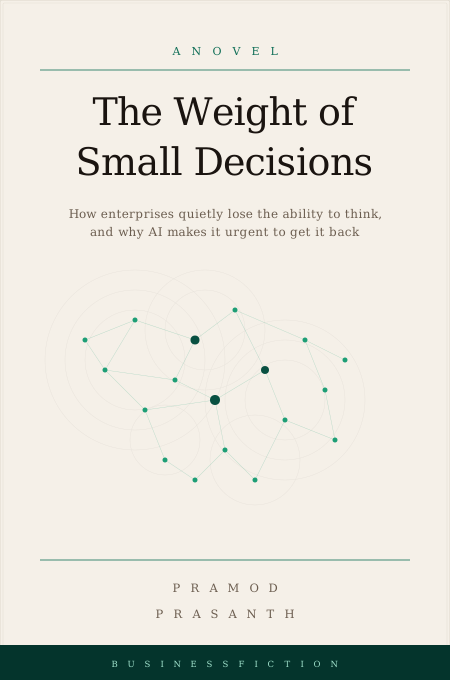
The Weight of Small Decisions
How enterprises quietly lose the ability to think, and why AI makes it urgent to get it back.
By the end, you will be able to diagnose decision atrophy in your own organisation, name the judgement gap that's hiding in plain sight, and design a minimal architecture to start closing it.
A business novel in the tradition of Goldratt's The Goal, applied to enterprise decision architecture.
This page is a public chronicle of building the book. Partly so readers can follow the work. Partly to force myself to finish: shipping a public commitment is one form of accountability.
It tells you what the book is, who it's for, and how it's being built. It updates when major milestones land.
I am a first-time novelist. I have spent twenty years inside regulated enterprises, building the systems that underpin their most consequential decisions. I know the subject. I do not yet know how to write a novel.
The thesis
This is written for heads of operations, finance, and strategy who already feel the friction in how their enterprise decides. Practitioners who recognise the patterns inside their own organisations and want a story that holds up to what they see every day.
By the end of the book, the reader will be able to:
- diagnose decision atrophy in their own organisation
- map the hidden decision load that no dashboard surfaces
- design a minimal decision-architecture intervention they can run inside their function
Enterprises are built or eroded by the cumulative quality of thousands of small decisions, not by any single big one. When those decisions share a model of what matters, the accumulation compounds into structural strength. When they do not, the same accumulation produces a structural condition that no dashboard can detect and no reorganisation can fix.
The book does not argue this. It shows it. A protagonist inside a Basel specialty pharma watches it happen in real time, through characters the reader recognises, in situations that feel uncomfortably familiar. The argument arrives as a discovery, not a lecture.
The framing I keep coming back to: this is a book that aims to do for decision architecture what The Goal did for process bottlenecks.
AI is the diagnostic lens, not the hero of the story.
Five concepts carry the book.
- Decision atrophy.Organisations that stop making genuine decisions at the right level develop a muscle memory of avoidance.Quarterly reviews that keep asking the same questions and accepting the same answers, long after the questions stopped touching reality.
- The judgement gap.The space between data and action. Most enterprise investment goes into reducing uncertainty. Almost none goes into improving the quality of the judgement applied to that data.Twenty dashboards on the wall, none of them telling the planner whether to break a struggling supplier's contract.
- Compounding small decisions.Individual decisions that look reasonable in isolation create path dependencies that constrain future decisions. The constraint becomes invisible because it was built incrementally.The incremental custom exceptions a supply chain team adds to "get this quarter done" that eventually make the network unplannable.
- Organisational decision load.Every decision deferred or made by the wrong level adds to a structural backlog that does not appear on any balance sheet.Sign-offs piling up on the CFO's desk that the regional GMs were supposed to make six layers down.
- AI as lens.A diagnostic tool that makes the judgement gap visible at scale. Not automation. Not prediction.Not the agent that writes the report; the system that reads the last hundred decisions and surfaces the ones an experienced planner would have caught.
How the book is being built
The process is deliberately sequential. The structural architecture was locked before any prose was committed to the manuscript. The lattice came before the walls (the decision-architecture equivalent of mapping a process before touching any tooling).
- Step 1 · Jan to Apr 2026ConceptTwo iterations of a concept document. Premise, protagonist, narrative arc, decision-science backbone, comparative titles, publishing route. Version 2 locked the industry setting (Basel specialty pharma with a cell-and-gene-therapy pipeline), the operating context (a CGT manufacturing capex decision), and the protagonist's role. Head of Strategic Operations, at the seam between commercial, finance, supply chain, and CMC.
- Step 2 · Apr 2026Research architectureA source library of more than a hundred books, papers, and videos across six themed notebooks: decision science, AI and judgement, supply chain and regulated industry, narrative voice and craft, organisational dynamics, and a miscellaneous inbox for new arrivals. Sources indexed by notebook. This is structured capture of two decades of reading, finally organised for one purpose.
- Step 3 · Apr 2026CGT operations researchThe operational, economic, and human reality of making a medicine where the unit of production is a person. The build-vs-partner capex decision. What a cleanroom sounds like. What a batch failure means for the patient who was waiting. What the first phone call from the contract manufacturer sounds like when something goes wrong. Built from primary research, with practitioner conversations to come.
- Step 4 · Apr 2026Craft briefingsTwo craft briefings assembled from the research. One on novel-craft and first-time-author realities (business-novel hybrid structure, plot architecture, character work, what to plan before drafting). One on prose-craft principles (sentence-level habits, making abstractions physical, breaking generic-business-book voice, narrative-vs-interlude cadence). These are the writing rules I hold myself to.
- Step 5 · Apr 2026The latticeFour structural documents. The concept sequence: which of the five decision-science concepts gets dramatised in which chapter, across all 24 chapters. The cast: fifteen named characters with snowflake-lite profiles for the six load-bearing ones. The locations: ten primary and secondary settings with sensory-grounding detail, paired to the concepts each carries. The writing rules: a drafting checklist that pulls together voice rules, character voice constraints, structural beats to protect, and pacing decisions. This is the architecture the fat outline is built on.
- Step 6 · May 2026Fat outlinePer-chapter entries combining concept, characters present, location, emotional beat, and the unresolved question that closes each chapter. Every chapter specified before any is drafted. The cargo and the vehicle balanced on paper first.
- Step 7 · May 2026Sample chapters and proposalThe first narrative chapter and the first concept interlude are drafted and in early beta circulation with a small set of practitioner and writer readers. The proposal package follows: overview, reader transformation, market, audience, comparables, credibility, outline, sample material.
- Step 8 · upcomingDraftingThe manuscript. 60,000 to 75,000 words across twenty-four narrative chapters paired with concept interludes.
What the source library looks like
The book sits at the intersection of decision science, enterprise operations, AI, narrative craft, and organisational behaviour. The library reflects that. It is not a literature review. It is structured capture of two decades of reading, reorganised for a single project.
Decision science and judgement
Goldratt's The Goal. Munger's Poor Charlie's Almanack. Annie Duke on probabilistic decision-making. Meadows on systems thinking. Hofstadter on analogical reasoning. Dalio on decision principles at scale. Mokyr on useful knowledge and institutions. Porter, Helmer, and Deutsch on strategy and explanation.
AI, agents, and the labour-market question
Bishop's Deep Learning. Anthropic's enterprise patterns. Agent design and governance guides. Falk and Tsoukalas on the AI layoff trap (arXiv, March 2026). Anthropic's labour-market impact study (March 2026). My own essay on the math under the AI bet. The EU AI Act survival guide. These ground the book's AI-as-lens concept in what the technology actually does and what it actually costs.
Supply chain and regulated industry
Chopra, Christopher, Simchi-Levi: the foundational supply chain texts. Sheffi on resilience. Pharma-specific supply chain resilience studies. Sorkin's Too Big to Fail for regulated-industry crisis narrative voice. CGT manufacturing operational studies built from primary research, so the physical, economic, and human reality of making a medicine where each batch belongs to one patient is on the page when the book needs it.
Narrative voice and writing craft
Orwell on political language. Klinkenborg on sentences. Connell's short guide. Feynman as a voice exemplar for a practitioner explaining. Labatut for narrative non-fiction register. Lencioni's Five Dysfunctions as the direct structural format ancestor. Biographies and memoirs studied for how they sound.
Influence and organisational dynamics
Voss on negotiation. Greene on power. Robbins and Judge on organisational behaviour. The Leadership Pipeline for mid-management transitions, directly relevant to the protagonist's arc. Drucker, Zhuo, and Guidara for different registers of what leadership sounds like in practice.
Why I am writing this
I have spent twenty years inside regulated enterprises (Syngenta, Pfizer, Gilead, AstraZeneca, BASF) building the systems that underpin their most consequential decisions. I designed the Tatmeen system for the UAE Ministry of Health, the national-scale serialisation and track-and-trace platform regulating pharmaceutical movements across the country. I am now the founder of ChainAlign, a decision intelligence platform.
The book and ChainAlign share the same thesis: decision quality is a systemic property, not an individual one. The book makes the thesis legible to a wide enterprise audience. The company is where the thesis becomes software. The two reinforce each other rather than competing for attention. Enterprises that do not treat decision quality as a strategic asset will be outcompeted by those that do.
I am writing from inside the problem. That is the credential that matters for this kind of book.
What comes next
The first sample chapter and accompanying interlude are out for early beta read. The proposal package is the next deliverable. The full manuscript follows.
The plan above is the plan. The deviations are what will make this page worth reading.
Follow the build
Get an email when a milestone lands. Low frequency, only major progress (fat outline, sample chapters, proposal, draft milestones).
Read the essays behind the book
The essays at pramod.ch/essays work through decision architecture, enterprise judgement, and AI as lens. The conceptual material the book will turn into story.